Paper II — Q5
(a) Lateral Entry in Government of India has not moved in the intended direction. Explain the reasons. (10 marks) (b) Though…
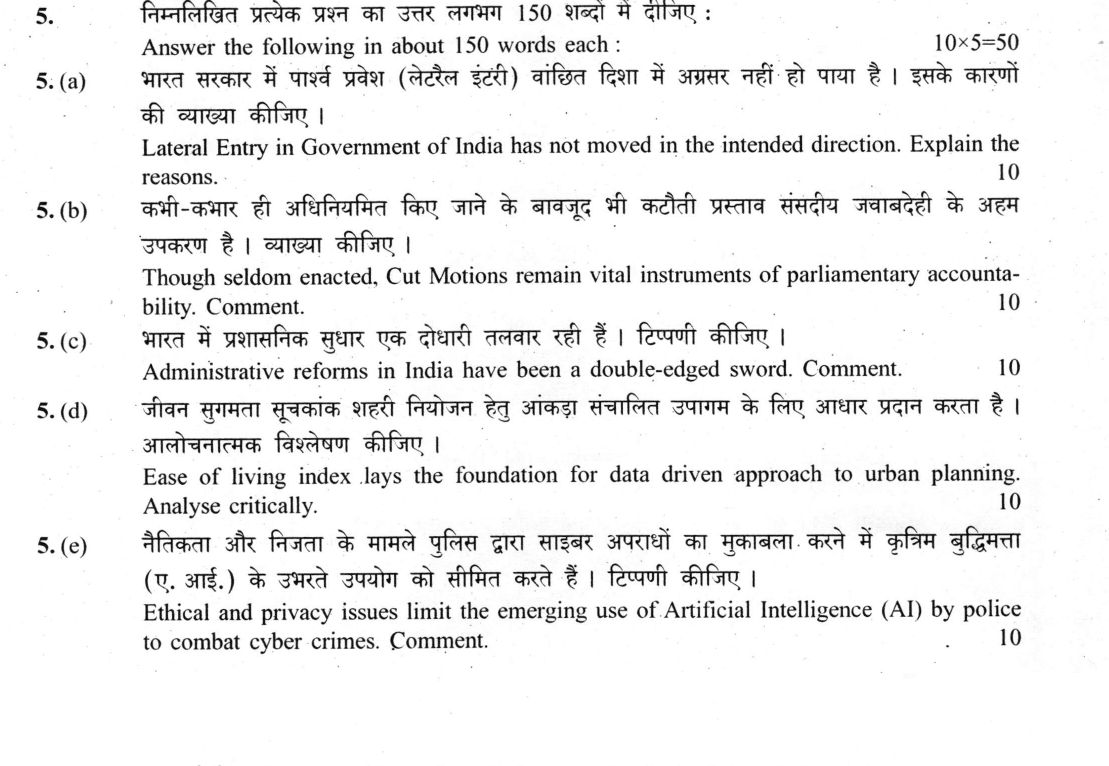
Answer the following in about 150 words each :
Lateral Entry in Government of India has not moved in the intended direction. Explain the reasons. 10 marks
Though seldom enacted, Cut Motions remain vital instruments of parliamentary accountability. Comment. 10 marks
Administrative reforms in India have been a double-edged sword. Comment. 10 marks
Ease of living index lays the foundation for data driven approach to urban planning. Analyse critically. 10 marks
Ethical and privacy issues limit the emerging use of Artificial Intelligence (AI) by police to combat cyber crimes. Comment. 10 marks
हिंदी में प्रश्न पढ़ें
निम्नलिखित प्रत्येक प्रश्न का उत्तर लगभग 150 शब्दों में दीजिए :
भारत सरकार में पार्श्व प्रवेश (लेटरल एन्ट्री) वांछित दिशा में अग्रसर नहीं हो पाया है । इसके कारणों की व्याख्या कीजिए । (10 अंक)
कभी-कभार ही अधिनियमित किए जाने के बावजूद भी कटौती प्रस्ताव संसदीय जवाबदेही के अहम उपकरण है । व्याख्या कीजिए । (10 अंक)
भारत में प्रशासनिक सुधार एक दोधारी तलवार रही है । टिप्पणी कीजिए । (10 अंक)
जीवन सुगमता सूचकांक शहरी नियोजन हेतु आंकड़ा संचालित उपागम के लिए आधार प्रदान करता है । आलोचनात्मक विश्लेषण कीजिए । (10 अंक)
नैतिकता और निजता के मामले पुलिस द्वारा साइबर अपराधों का मुकाबला करने में कृत्रिम बुद्धिमत्ता (ए. आई.) के उभरते उपयोग को सीमित करते हैं । टिप्पणी कीजिए । (10 अंक)
Model answer
Drafted with AI by UPSC Answer Check against this question's marking rubric, to the 150-word length. UPSC does not publish answers for Mains — this is one way to score well, not an official key. How we build rubrics and answers.
(a) Why Lateral Entry Has Not Moved as Intended Lateral entry was meant to bring domain experts into government at Joint Secretary, Director and Deputy Secretary levels. Recommended by NITI Aayog's Three Year Action Agenda (2017), it began with a June 2018 advertisement for ten Joint Secretary posts; nine entrants joined in 2019, and about 63 had been appointed by 2024 - a tiny share of senior posts. In August 2024 a 45-post advertisement was withdrawn after objections over reservation.
The reasons are several. Legally and socially, each contractual post was treated as a single-post cadre, so SC/ST/OBC reservation did not apply. In design, three-to-five-year contracts deter strong candidates and leave little institutional memory. Institutionally, career services resist the loss of Central Staffing Scheme posts, and entrants are often placed without real authority or peer acceptance. There is no published evaluation of their performance, and the systemic alternative - domain specialisation within the services, urged by the Surinder Nath (2003) and Hota (2004) Committees and the 2nd ARC's 10th Report (2008) - was never built.
(b) Cut Motions and Parliamentary Accountability A cut motion is moved in the Lok Sabha at the Demands for Grants stage (Articles 113-114) to reduce a demand. The disapproval-of-policy cut reduces it to Re 1, the economy cut by a specified amount, and the token cut by Rs 100 to voice a specific grievance.
Cut motions are seldom carried because the government commands a majority and defeat would signal loss of confidence; most demands are in any case passed by the guillotine.
Their value survives defeat. A cut motion forces the minister to defend the demand, lets the opposition set the agenda and puts grievances on record. In April 2010, cut motions on price rise obliged the government to marshal its majority and allies. Department-Related Standing Committees (1993) examine demands in detail and inform the debate. The worry is shrinking time: in March 2023 all Demands for Grants were guillotined without discussion. Cut motions remain vital, but only if Parliament allows time to move them.
(c) Administrative Reforms as a Double-Edged Sword From the 1st ARC (1966-70) to the 2nd ARC (2005-09, 15 reports), Indian reforms have often produced intended gains and unintended costs from the same measure.
The RTI Act, 2005 transformed transparency, yet the RTI (Amendment) Act, 2019 let the Centre fix commissioners' tenure and pay, and Section 44(3) of the DPDP Act, 2023 widened the personal-information exemption. DBT with Aadhaar cut leakages, but authentication failures caused exclusion - a tension the Supreme Court weighed in its 2018 Puttaswamy Aadhaar judgment. Section 17A of the Prevention of Corruption Act (inserted in 2018) shields honest officers from frivolous probes, but its prior-approval requirement can delay investigation. Mission Karmayogi (2020) promises competency-based training but risks becoming a box-ticking e-learning exercise.
The common mechanism is that reforms change incentives. Without sequencing, complementary capacity and honest evaluation, a reform that strengthens one dimension of governance can weaken another; the sword cuts both ways because reforms are designed in isolation.
(d) Ease of Living Index and Data-driven Urban Planning The Ease of Living Index, published by the Ministry of Housing and Urban Affairs since 2018 with a companion Municipal Performance Index, ranks cities in million-plus and below-million categories. The 2020 edition (released March 2021) covered 111 cities, weighting quality of life (35 per cent), economic ability (15 per cent), sustainability (20 per cent) and a Citizen Perception Survey (30 per cent); Bengaluru and Shimla topped the two categories. It gives planners comparable data, rewards improvement through competition, adds citizen voice, and was meant to feed the Smart Cities Mission (concluded March 2025) and the Data Smart Cities Strategy.
Its limits are real. City averages hide ward-level and slum deprivation and under-count informal settlements and migrants. Rankings carry no link to devolution or statutory duties under the 74th Amendment, and later editions have been irregular. Capacity is thin: NITI Aayog's 2021 report found about 65 per cent of India's 7,933 urban settlements without a master plan. The Index is a useful diagnostic, not yet a foundation for planning.
(e) Ethics, Privacy and Police Use of AI against Cyber Crime Indian police use AI for facial recognition, fraud-pattern analysis by the Indian Cyber Crime Coordination Centre (I4C, 2020) and its 1930 helpline, and data integration through CCTNS, the Inter-operable Criminal Justice System and NAFIS.
Privacy limits this. K.S. Puttaswamy (2017) requires any intrusion to be lawful, necessary and proportionate. The DPDP Act, 2023 governs personal data, but Section 17 lets the government exempt state agencies on grounds such as security and public order, and the Criminal Procedure (Identification) Act, 2022 allows wide collection of measurements, retained for 75 years, even from arrested persons. Ethical risks add to this: biased training data, opaque and unexplainable outputs, and function creep from cyber-crime tools into mass surveillance that can chill free speech and assembly.
These limits are better seen as necessary discipline than as a bar. Purpose limitation, human review of AI outputs, audit trails and independent oversight, in line with NITI Aayog's Responsible AI principles (2021), would let AI serve policing. As police is a State subject, common national standards are needed.
How this answer will be evaluated
Evaluation rubric
Each sub-part is marked on its own, against the marks and word limit printed on the paper.
- (a) The question presumes the shortfall and asks only for reasons. The answer must first state, briefly and accurately, what lateral entry was intended to achieve and what has actually happened, then supply distinct categories of reasons - design, legal-social, institutional and incentive-related - rather than a single grievance repeated. 10 marks · 150 words
Must cover
- State the intent and record briefly: domain expertise at Joint Secretary, Director and Deputy Secretary levels; NITI Aayog's recommendation (2017); June 2018 advertisement, nine joined in 2019; about 63 appointments by 2024; 45-post advertisement withdrawn in August 2024
- Legal-social reason: no SC/ST/OBC reservation because each contractual post was treated as a single-post cadre
- Design and incentive reasons: short three-to-five-year contracts and placement without real authority
- Institutional reasons: career-service resistance over Central Staffing Scheme posts, low peer acceptance, no published evaluation, no parallel domain specialisation within the services
Loses marks
- Claiming lateral entry is a post-2018 invention; specialists have long entered government through deputation, and economists and technocrats have held senior posts for decades.
- Asserting precise cumulative appointment figures without qualification; the parliamentary replies give varying totals and should be cited as approximate.
- Confusing the UPSC-conducted lateral entry for Central Staffing Scheme posts with appointments to regulatory bodies or with NITI Aayog's own hiring.
- Writing a general critique of the bureaucracy rather than reasons specific to lateral entry, which is what the question asks.
- Omitting the reservation issue, which is the single most important reason for the programme's stalling.
Earns more
- Notes institutional resistance from career services over Central Staffing Scheme posts, low peer acceptance and placement without real authority
- Points to the unimplemented systemic alternative - domain specialisation within the services, as recommended by the Surinder Nath Committee (2003), the Hota Committee (2004) and the 2nd ARC's 10th Report (2008) - and to the absence of published evaluation of lateral entrants
Extra mark
- Surinder Nath Committee (2003), Hota Committee (2004) and 2nd ARC 10th Report (2008) on domain specialisation
- A concrete way forward (roster-compliant pooled recruitment, longer tenure, performance evaluation)
- (b) 'Comment' on a paradox: cut motions are almost never carried, yet remain vital instruments of accountability. The answer must state what a cut motion is, name and define its three types with their exact wording, explain why passage is rare, and then explain the accountability value that survives non-passage. 10 marks · 150 words
Must cover
- Define a cut motion (Lok Sabha only, Demands for Grants stage, Articles 113-114) and its three types: policy cut (to Re 1), economy cut (by a specified amount), token cut (by Rs 100)
- Explain why passage is rare (government majority; defeat implies loss of confidence) and the guillotine
- Explain the accountability value despite non-passage (ministers must defend demands, opposition sets the agenda, grievances go on record)
- Note the complementary role and limits (DRSC scrutiny since 1993; shrinking discussion time) and conclude
Loses marks
- Getting the token cut amount wrong; it is a reduction of Rs. 100, while the policy cut reduces the demand to Re. 1.
- Saying cut motions can be moved in the Rajya Sabha; they cannot - the Rajya Sabha has no power over Demands for Grants.
- Confusing a cut motion with an adjournment motion, a no-confidence motion or a censure motion.
- Claiming cut motions apply to charged expenditure; expenditure charged on the Consolidated Fund of India is non-votable.
- Asserting a specific historical instance of a cut motion being carried without being sure of it; the safer statement is that passage is extremely rare.
Earns more
- Notes the limiting practice of the guillotine, under which most demands are voted without discussion, and the recommendatory role of Department-Related Standing Committees (1993) in examining Demands for Grants
Extra mark
- April 2010 price-rise cut motions as pressure without passage
- All Demands for Grants guillotined without discussion in March 2023
- (c) 'Comment' on the metaphor: administrative reforms cut both ways. A strong answer names specific reforms, shows the intended gain and the unintended cost of the same reform, and does not simply list benefits in one paragraph and drawbacks in another without linking them. 10 marks · 150 words
Must cover
- Name specific reforms with correct attribution (1st ARC 1966-70; 2nd ARC 2005-09 with 15 reports; RTI 2005; DBT and Aadhaar; Section 17A of the PC Act, 2018; Mission Karmayogi 2020)
- Show the intended gain and the unintended cost of the same reform (RTI narrowed by the 2019 Amendment and DPDP Section 44(3); DBT leakage versus exclusion; 17A protection versus delay)
- Explain why reforms cut both ways (incentives, sequencing, capacity, evaluation)
- Reach a balanced conclusion
Loses marks
- Producing an unstructured advantages-and-disadvantages list without showing that the same reform generates both.
- Dating the 2nd ARC to 2004 or its chairmanship wrongly; it was constituted on 31 August 2005 under Veerappa Moily, with V. Ramachandran chairing later.
- Saying the RTI Act was repealed or replaced; it was amended in 2019 and further narrowed on personal information by the DPDP Act, 2023.
- Treating Aadhaar-based delivery as wholly beneficial or wholly harmful, instead of recognising the leakage-versus-exclusion trade-off the question invites.
- Citing only pre-2010 reforms, which makes the answer look dated to an examiner testing contemporary awareness.
Earns more
- Anchors the answer in the reform architecture: 1st ARC (1966-70) and 2nd ARC (2005 onwards, 15 reports), naming at least one report correctly
- Concludes with the general mechanism - reforms change incentives, so they need sequencing, complementary capacity and evaluation - rather than listing pros and cons
Extra mark
- The 2018 Puttaswamy Aadhaar judgment on exclusion and proportionality
- Results-Framework Documents (2009-10) or CPGRAMS as further two-edged examples
- (d) 'Analyse critically' requires both sides: what the Ease of Living Index contributes to data-driven urban planning, and what its methodological and institutional limits are. The answer must show knowledge of the Index itself - who runs it, its pillars, its editions - not merely discuss data in governance generally. 10 marks · 150 words
Must cover
- Describe the Index: Ministry of Housing and Urban Affairs; 2018 and 2020 editions (111 cities); million-plus and below-million categories; pillars and Citizen Perception Survey; companion Municipal Performance Index
- State what it contributes to data-driven planning (benchmarking, competition, citizen voice, link to Smart Cities and the Data Smart Cities Strategy)
- Methodological limits (city averages masking ward and slum deprivation, informal settlements, irregular editions)
- Institutional limits and a verdict (no link to devolution or statutory duties; planning-capacity shortfall per NITI Aayog 2021)
Loses marks
- Attributing the Index to NITI Aayog or to the Ministry of Urban Development's predecessor structure; it is published by the Ministry of Housing and Urban Affairs.
- Confusing the Ease of Living Index with the Ease of Doing Business ranking of states, which is a DPIIT exercise, or with the SDG Urban Index.
- Asserting specific city ranks without certainty; if ranks are cited they must be accurate and attributed to the correct edition.
- Writing generally about data-driven governance with no description of the Index's own pillars or methodology.
- Giving only criticism, or only praise, when the directive is 'analyse critically', which requires both.
Earns more
- Critiques the unit of analysis and equity dimension: city averages masking ward-level and slum deprivation, under-representation of informal settlements and migrants
- Notes the missing consequence and capacity link: rankings are not tied to devolution or statutory duties, and planning capacity is short - NITI Aayog's 2021 report found most urban settlements lack a master plan and that there is an acute shortage of town planners
Extra mark
- 2020 weights: Quality of Life 35%, Economic-ability 15%, Sustainability 20%, Citizen Perception 30%
- Smart Cities Mission concluded in March 2025
- (e) 'Comment' on the claim that ethical and privacy concerns are limiting police adoption of AI against cyber crime. The answer must show what AI policing actually involves in India, then specify the ethical and privacy constraints with constitutional and statutory anchors, and take a position on whether these constraints are a limitation or a necessary discipline. 10 marks · 150 words
Must cover
- Describe AI use in Indian cyber policing (facial recognition, pattern analysis by I4C, CCTNS/ICJS, NAFIS)
- Privacy constraints with anchors: Puttaswamy (2017) proportionality; DPDP Act 2023 and its State exemptions; Criminal Procedure (Identification) Act 2022
- Ethical constraints: algorithmic bias, opacity and explainability, function creep, chilling effects
- Take a position with safeguards (purpose limitation, human-in-the-loop, audits, independent oversight, NITI Aayog's Responsible AI)
Loses marks
- Writing a general essay on AI's promise and peril with no Indian policing instance and no constitutional anchor.
- Stating that India has a law specifically regulating facial recognition or predictive policing; it does not.
- Confusing the Criminal Procedure (Identification) Act, 2022 with the Digital Personal Data Protection Act, 2023, or overlooking that the 2022 Act replaced the Identification of Prisoners Act, 1920.
- Treating privacy as an absolute bar; Puttaswamy permits restriction that satisfies the proportionality test.
- Forgetting that police and public order are State subjects under List II, so deployment decisions and safeguards vary across states.
Earns more
- Sets out the ethical objections: algorithmic bias from skewed historical data, opacity and lack of explainability, function creep into mass surveillance, and chilling effects on Articles 19(1)(a) and 19(1)(b)
- Offers the constructive counterpoint - NITI Aayog's National Strategy for AI (2018) and Responsible AI approach documents (2021), purpose limitation, human-in-the-loop review, audit trails and independent oversight - and takes a position
Extra mark
- The EU AI Act (2024) limits on real-time remote biometric identification
- Police as a State subject (List II), so safeguards vary across states
What "Explain" is asking you to do
Make the working of something clear — what sets it off, what follows from what, and what it produces. Explain is the Commission's mechanism word: it dominates the technical papers and the “explain why” stems, where the marks sit in the causal chain and not in the label.
Structure that answers it
State what it is → the initiating condition → the chain of cause, step by step → an instance where it plays out → what the chain produces
Where marks are lost
Describing what something looks like instead of why it works that way. Naming the stages without linking them reads as description too.
Practice this exact question
Write your answer and it is marked point by point against the model answer above — what you covered, what you missed, what you got wrong.
Evaluate my answer →More from Public Administration 2026 Paper II
- Q2 (a) An important characteristic of the British Civil Service was its open refusal to be i…
- Q3 (a) Planning Commission planned for economic development and social justice, but NITI Aay…
- Q4 (a) Doctrine of Pith and Substance, and the Doctrine of severability in the legislative r…
- Q5 Answer the following in about 150 words each : (a) Lateral Entry in Government of India h…
- Q6 (a) Civil services is grappling with severe capacity issues and which is a major bottlene…
- Q7 (a) Supreme Court of India in Prakash Singh case laid the foundation for effective police…
- Q8 (a) Discuss the major management challenges faced by Indian Mega Cities and explore susta…