Paper II — Q6
(a) Civil services is grappling with severe capacity issues and which is a major bottleneck in implementing ambitious programmes…
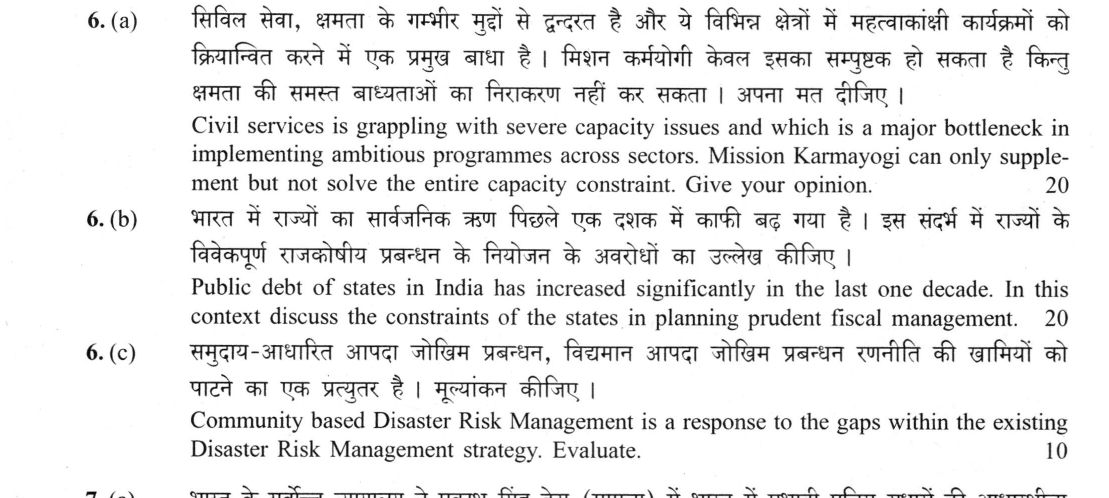
Civil services is grappling with severe capacity issues and which is a major bottleneck in implementing ambitious programmes across sectors. Mission Karmayogi can only supple-ment but not solve the entire capacity constraint. Give your opinion. 20 marks
Public debt of states in India has increased significantly in the last one decade. In this context discuss the constraints of the states in planning prudent fiscal management. 20 marks
Community based Disaster Risk Management is a response to the gaps within the existing Disaster Risk Management strategy. Evaluate. 10 marks
हिंदी में प्रश्न पढ़ें
सिविल सेवा, क्षमता के गम्भीर मुद्दों से द्वन्द्वरत है और ये विभिन्न क्षेत्रों में महत्वाकांक्षी कार्यक्रमों को क्रियान्वित करने में एक प्रमुख बाधा है। मिशन कर्मयोगी केवल इसका सम्पूरक हो सकता है किन्तु क्षमता की समस्त बाध्यताओं का निराकरण नहीं कर सकता। अपना मत दीजिए। (20 अंक)
भारत में राज्यों का सार्वजनिक ऋण पिछले एक दशक में काफी बढ़ गया है। इस संदर्भ में राज्यों के विवेकपूर्ण राजकोषीय प्रबन्धन के नियोजन के अवरोधों का उल्लेख कीजिए। (20 अंक)
समुदाय-आधारित आपदा जोखिम प्रबन्धन, विद्यमान आपदा जोखिम प्रबन्धन रणनीति की खामियों को पाटने का एक प्रत्युत्तर है। मूल्यांकन कीजिए। (10 अंक)
Model answer
Drafted with AI by UPSC Answer Check against this question's marking rubric, to the expected length. UPSC does not publish answers for Mains — this is one way to score well, not an official key. How we build rubrics and answers.
(a) Civil Service Capacity and the Limits of Mission Karmayogi The civil services is grappling with severe capacity issues that act as a major bottleneck in implementing ambitious programmes across sectors. Capacity is a multi-dimensional construct comprising not just the number of personnel, but also their skills, assured tenure, and the efficiency of state and local systems. It is not merely a matter of conducting training courses.
Mission Karmayogi (the National Programme for Civil Services Capacity Building), approved on 2 September 2020, is the government's flagship initiative to address these deficits. Its institutional architecture includes the Capacity Building Commission (2021) as the apex advisory body and Karmayogi Bharat, a special purpose vehicle, which operates the iGOT-Karmayogi platform. The mission is underpinned by the Prime Minister's Human Resource Council and the Framework of Roles, Activities and Competencies (FRAC), which aims to shift the administrative culture from "rules-based" to "roles-based." This aligns with the recommendations of the 2nd ARC 10th Report (2008) on the refurbishing of personnel administration and with the National Training Policy (2012). States have begun adapting the model for their own cadres through their Administrative Training Institutes.
However, my opinion is that while Mission Karmayogi is a necessary intervention, it is insufficient to solve the entire capacity constraint. It can only supplement the system. Structural deficits remain:
- Recruitment and Tenure: Vacancy levels remain a concern - the IAS alone had well over a thousand unfilled posts in 2024 - and the lack of assured tenure and weak implementation of the Civil Services Boards mandated by the Supreme Court in T.S.R. Subramanian v. Union of India (2013) continue to affect officer morale and retention.
- Specialist Induction: The mission focuses on generalist upskilling, but the need for specialist induction in technical roles remains unaddressed.
- State and Local Capacity: Most implementation capacity sits in state and local administration, which is not the primary focus of this central initiative.
In conclusion, Mission Karmayogi is a vital tool for modernizing the workforce, but it must be complemented by cadre reviews, credible appraisal systems, and structural reforms in state administration to truly resolve the capacity bottleneck.
(b) Constraints on Prudent Fiscal Management by States The constraints on states in planning prudent fiscal management are structural, constitutional, and political.
Constitutional and Institutional Constraints: Under Article 293(3), states require Union consent to borrow while they are indebted to the Union. This is not a blanket prohibition but a check on the Net borrowing ceiling. States are further bound by their own Fiscal Responsibility Legislations, distinct from the Union's FRBM Act, 2003. The N.K. Singh FRBM Review Committee (2017) recommended 60/40/20 debt targets (general government, Centre and states) to ensure sustainability. States' outstanding liabilities are around 28-29 per cent of GDP in aggregate, but some, such as Punjab, Himachal Pradesh and Kerala, carry far heavier burdens. Kerala's suit against the Union over borrowing limits, referred to a Constitution Bench in 2024, shows how contested these controls have become.
Revenue-side Constraints: The fiscal autonomy of states has been eroded. The GST (Compensation to States) Act, 2017, provided a safety net that ended on 30 June 2022. Furthermore, the 15th Finance Commission (2021-26) set the devolution share at 41 per cent (one point below the 14th FC's 42 per cent, to account for the new Union Territories), a share the Sixteenth Finance Commission (2026-31) has retained, and the growing share of cesses and surcharges, which are not shared with states, shrinks the divisible pool; devolution thus does not equate to full revenue autonomy. States have limited control over tax rates and face a structural mismatch between their expenditure responsibilities and their revenue sources.
Expenditure-side and Contingent Liabilities: States face rigid expenditure obligations, including salaries, interest and pensions, and the revival of the Old Pension Scheme (OPS) by several states since 2022, which the RBI warned would burden future budgets; the Centre's Unified Pension Scheme (in force from April 2025) is an attempt at a middle path. A major constraint is the management of DISCOM losses. Despite the UDAY scheme (2015) and the Revamped Distribution Sector Scheme (2021), states continue to carry contingent liabilities through guarantees and off-budget borrowing via Special Purpose Vehicles (SPVs); the Centre's 50-year interest-free loans for capital investment (since 2020-21) and extra borrowing space linked to power-sector reforms try to reward prudence.
Political Economy: Political cycles drive "competitive subsidies" and loan waivers, which inflate debt. As noted in the RBI's State Finances: A Study of Budgets, the interest-rate-growth differential and State Development Loan (SDL) spreads further constrain the ability of states to manage debt prudently.
(c) Community-based Disaster Risk Management Community Based Disaster Risk Management (CBDRM) is a response to the gaps within the existing top-down statutory framework. The Disaster Management Act, 2005, established a hierarchical system (NDMA, SDMA, DDMA) and the NDRF; the Disaster Management (Amendment) Act, 2025 added urban disaster management authorities and statutory backing for national and state disaster databases. However, this system often struggles with "last-mile" connectivity and lacks local knowledge.
CBDRM, rooted in the Hyogo Framework (2005) and aligned with the Sendai Framework for Disaster Risk Reduction 2015-2030 and the Prime Minister's Ten-Point Agenda on DRR (2016), addresses these gaps through participatory hazard, vulnerability, and capacity assessment. Indian evidence of its success includes the Odisha cyclone shelters managed by village committees and the evacuation of nearly a million people before Cyclone Phailin (2013) and over a million before Cyclone Fani (2019), fishermen's rescue work during the 2018 Kerala floods, and the NDMA's Aapda Mitra volunteer scheme (piloted in 2016 and scaled up in 2021).
However, the evaluation must note its limits. CBDRM is a complement, not a substitute, for the statutory system. It faces challenges such as project-dependent funding, volunteer attrition, and elite capture. Additionally, its fit for urban informal settlements is often poor, and there is a risk of the state offloading its primary responsibility for disaster management onto the community.
How this answer will be evaluated
Evaluation rubric
Each sub-part is marked on its own, against the marks and word limit printed on the paper.
- (a) 'Give your opinion' on a stated thesis with two parts: that capacity deficits in the civil services are a major implementation bottleneck, and that Mission Karmayogi can only supplement rather than solve them. The answer must define capacity beyond training, describe Mission Karmayogi's design accurately, and then take and defend a position. 20 marks
Must cover
- Define capacity beyond training (numbers, skills, tenure, systems, state and local capacity) and show it as an implementation bottleneck
- Describe Mission Karmayogi accurately: NPCSCB approved 2 September 2020; rules-to-roles shift through FRAC; iGOT-Karmayogi; Capacity Building Commission (2021); Karmayogi Bharat SPV; PM's Human Resource Council
- Identify what training cannot fix (vacancies and recruitment, tenure and transfers, specialist induction, appraisal, state and local capacity)
- Take and defend an explicit opinion with complementary reforms (e.g., minimum tenure and Civil Services Boards under T.S.R. Subramanian 2013; 2nd ARC 10th Report 2008)
Loses marks
- Describing Mission Karmayogi only as an online training portal, missing the roles-based HR reform and the institutional architecture behind it.
- Confusing the Capacity Building Commission with Karmayogi Bharat; the former is the apex advisory and standard-setting body, the latter the not-for-profit company operating the platform.
- Quoting precise vacancy numbers without qualification; parliamentary replies vary by year and cadre, so figures should be presented as approximate and dated.
- Failing to take a position although the question expressly asks for an opinion.
- Treating capacity as a purely central-government problem when most implementation capacity sits in state and local administration.
Earns more
- Prescribes the complements and states an explicit opinion: cadre review and recruitment, assured tenure with Civil Services Boards per T.S.R. Subramanian (2013), credible appraisal, specialist induction, and state and local capacity building
Extra mark
- National Training Policy (2012) or state ATIs adapting the Karmayogi model
- Approximate, dated vacancy evidence (e.g., well over a thousand IAS vacancies in 2024)
- (b) The question stipulates the fact of rising state public debt over the last decade and asks specifically for the constraints on states in planning prudent fiscal management. The answer must classify constraints - constitutional/institutional, revenue-side, expenditure-side, contingent and political-economy - and must engage the constitutional and Finance Commission framework, not merely list problems. 20 marks
Must cover
- Constitutional and institutional constraints: Article 293(3) consent and the net borrowing ceiling; state Fiscal Responsibility Acts (not the Union's FRBM Act 2003); N.K. Singh Committee (2017) 60/40/20 targets
- Revenue-side constraints: limited rate autonomy under GST, end of GST compensation (30 June 2022), cesses and surcharges outside the divisible pool, Finance Commission devolution (41 per cent under the 15th and 16th)
- Expenditure-side and contingent constraints: committed salaries, pensions and interest; OPS reversal; DISCOM losses despite UDAY 2015 and RDSS 2021; guarantees and off-budget SPV borrowing
- Political-economy and debt-dynamics constraints (competitive subsidies, loan waivers, electoral cycles, interest-growth differential), with RBI's State Finances as a source
Loses marks
- Misstating Article 293: clause (1) permits state borrowing within India on the security of the Consolidated Fund of the State; clause (3) requires Union consent only while the state is indebted to the Union - it is not a blanket prohibition.
- Claiming the FRBM Act, 2003 binds the states; it binds the Union, and states legislate their own Fiscal Responsibility Acts.
- Confusing the Finance Commission's devolution share with NITI Aayog transfers; NITI Aayog has no allocative role.
- Quoting precise debt-to-GSDP figures without attribution or year; such numbers must be attributed to a source and period or given as approximations.
- Blaming only 'freebies' and ignoring the structural mismatch between states' expenditure responsibilities and their revenue autonomy after GST.
Earns more
- Identifies contingent and off-budget liabilities: state guarantees, DISCOM losses despite UDAY (2015) and RDSS (2021), and SPV borrowings
- Adds political economy and debt dynamics: competitive subsidies and loan waivers, electoral cycles, the interest-rate-growth differential and State Development Loan spreads, with RBI's State Finances study as the standard source
Extra mark
- Kerala's suit over borrowing limits referred to a Constitution Bench (2024)
- The Centre's 50-year interest-free capex loans and reform-linked extra borrowing space as incentives
- (c) 'Evaluate' the claim that Community Based Disaster Risk Management is a response to gaps in the existing Disaster Risk Management strategy. The answer must name the gaps in the statutory top-down system, show how CBDRM addresses each, and then judge how far it actually closes them. 10 marks
Must cover
- Identify the gaps in the statutory top-down system (DM Act 2005: NDMA, SDMA, DDMA, NDRF; last-mile reach, local knowledge, response-centred approach)
- Explain CBDRM and how it addresses each gap (participatory hazard, vulnerability and capacity assessment; local preparedness and first response), aligned with the Sendai Framework 2015-2030 and the PM's Ten-Point Agenda (2016)
- Give Indian evidence (Aapda Mitra; Odisha cyclone shelters and the Phailin 2013 evacuation)
- Evaluate its limits and conclude that CBDRM complements rather than substitutes for the statutory system
Loses marks
- Confusing the NDRF as a force under section 44 of the Act with the National Disaster Response Fund, the financing instrument - the abbreviation covers both.
- Saying the DDMA is chaired by the Zila Parishad chairperson alone; the Collector/District Magistrate chairs it, with the elected district head as co-chairperson in most states.
- Placing the Sendai Framework in 2005; that was the Hyogo Framework for Action 2005-2015, with Sendai adopted in 2015 for 2015-2030.
- Presenting CBDRM as a substitute for the statutory system rather than as a complement, which the word 'evaluate' requires the candidate to weigh.
- Offering no Indian example, leaving the evaluation unevidenced.
Earns more
- Supplies Indian evidence: NDMA's Aapda Mitra volunteer scheme, Odisha's cyclone shelter management committees and the Phailin (2013) evacuation, the GoI-UNDP Disaster Risk Management Programme, or community response in the Kerala floods of 2018
- Evaluates the limits: project-dependent funding, volunteer attrition, elite capture, weak statutory standing and budget at panchayat level, poor fit for urban informal settlements, and the risk of offloading state responsibility
Extra mark
- The Disaster Management (Amendment) Act, 2025 (urban disaster management authorities, disaster databases)
- The Cyclone Fani (2019) evacuation or community rescue in the 2018 Kerala floods
What "Solve" is asking you to do
Choose the method, then carry it through to a final answer. Identifying what kind of problem this is and why that method applies is the first thing marked; a correct figure arrived at invisibly earns almost nothing.
Structure that answers it
Given data and what is required → method chosen, with the reason it applies → set-up (equation, circuit, free body, trial balance) → working, step by step → answer with units and any condition of validity
Where marks are lost
Doing the middle steps mentally and writing only the result. In mathematics papers, a further loss comes from giving a decimal where the exact value in surds or fractions was wanted, or from skipping the justification a part explicitly asks for.
Practice this exact question
Write your answer and it is marked point by point against the model answer above — what you covered, what you missed, what you got wrong.
Evaluate my answer →More from Public Administration 2026 Paper II
- Q3 (a) Planning Commission planned for economic development and social justice, but NITI Aay…
- Q4 (a) Doctrine of Pith and Substance, and the Doctrine of severability in the legislative r…
- Q5 Answer the following in about 150 words each : (a) Lateral Entry in Government of India h…
- Q6 (a) Civil services is grappling with severe capacity issues and which is a major bottlene…
- Q7 (a) Supreme Court of India in Prakash Singh case laid the foundation for effective police…
- Q8 (a) Discuss the major management challenges faced by Indian Mega Cities and explore susta…