Paper II — Q7
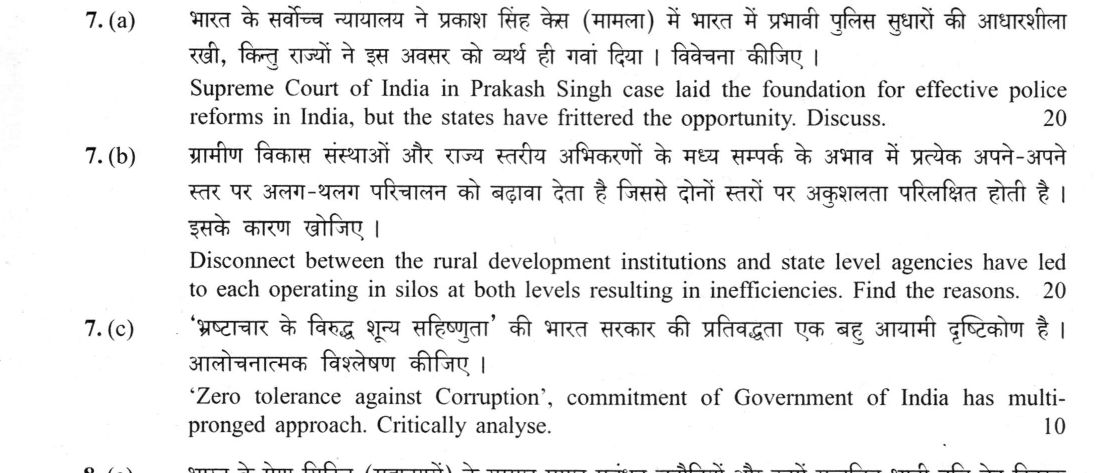
(a) Supreme Court of India in Prakash Singh case laid the foundation for effective police reforms in India, but the states have…
Supreme Court of India in Prakash Singh case laid the foundation for effective police reforms in India, but the states have frittered the opportunity. Discuss. 20 marks
Disconnect between the rural development institutions and state level agencies have led to each operating in silos at both levels resulting in inefficiencies. Find the reasons. 20 marks
‘Zero tolerance against Corruption’, commitment of Government of India has multi-pronged approach. Critically analyse. 10 marks
हिंदी में प्रश्न पढ़ें
भारत के सर्वोच्च न्यायालय ने प्रकाश सिंह केस (मामला) में भारत में प्रभावी पुलिस सुधारों की आधारशिला रखी, किन्तु राज्यों ने इस अवसर को व्यर्थ ही गवां दिया। विवेचना कीजिए। (20 अंक)
ग्रामीण विकास संस्थाओं और राज्य स्तरीय अभिकरणों के मध्य सम्पर्क के अभाव में प्रत्येक अपने-अपने स्तर पर अलग-थलग परिचालन को बढ़ावा देता है जिससे दोनों स्तरों पर अकुशलता परिलक्षित होती है। इसके कारण खोजिए। (20 अंक)
‘भ्रष्टाचार के विरुद्ध शून्य सहिष्णुता’ की भारत सरकार की प्रतिबद्धता एक बहु आयामी दृष्टिकोण है। आलोचनात्मक विश्लेषण कीजिए। (10 अंक)
Model answer
Drafted with AI by UPSC Answer Check against this question's marking rubric, to the expected length. UPSC does not publish answers for Mains — this is one way to score well, not an official key. How we build rubrics and answers.
(a) Prakash Singh and the Unfinished Police Reform The Supreme Court of India in Prakash Singh v. Union of India (2006) laid the constitutional foundation for effective police reform, yet the states have largely squandered the opportunity. In its judgment of 22 September 2006, the Court issued seven directives: (1) State Security Commission (SSC) to insulate policy; (2) DGP selection via UPSC empanelment; (3) two-year minimum tenure for DGP and senior officers; (4) separation of investigation from law and order, starting with towns of ten lakh or more; (5) Police Establishment Board (PEB) for service matters; (6) Police Complaints Authority (PCA) at state and district levels; and (7) National Security Commission (NSC). These directives built upon the National Police Commission (1977-81), the Ribeiro (1998), Padmanabhaiah (2000) and Malimath (2003) Committees, and were followed by the Model Police Act, 2006 drafted by the Soli Sorabjee Committee.
However, compliance has been dilutive. Because police is a State subject (Entries 1 and 2, State List), states enacted "compliant" Acts that retained executive control over transfers and postings as political currency. Structural weaknesses, including an actual strength of only about 155 police per lakh population against the commonly cited UN benchmark of 222, vacancies of about a fifth of sanctioned strength, and low spending on forensics and training, further eroded the reforms. Watchdog assessments such as those by the Commonwealth Human Rights Initiative have found that no state fully complies with all the directives, and Police Complaints Authorities in many states are either not set up or lack independent members. The Justice K.T. Thomas Committee (2010) and the 2018 order on acting DGPs highlight the persistent gap between the Court's vision and state-level implementation.
(b) Reasons for Silos between Rural Development Institutions and State Agencies The disconnect between rural development institutions and state-level agencies stems from structural and planning failures. First, Article 243G empowers but does not compel state legislatures to devolve the 29 subjects of the Eleventh Schedule, leading to incomplete "3Fs" (funds, functions, functionaries). Second, District Planning Committees (DPCs) under Article 243ZD are often non-functional, leaving Gram Panchayat Development Plans unlinked to departmental budgets.
Third, institutional silos exist because District Rural Development Agencies (DRDAs) functioned for decades as registered societies under executive control rather than elected bodies (they were merged with Zila Parishads only in April 2022), while missions like DAY-NRLM (2011) operate through parallel State Rural Livelihoods Missions and self-help group federations that often have no formal link with Gram Panchayats. Fourth, scheme-wise management information systems are non-interoperable, preventing integrated monitoring, though platforms such as eGramSwaraj (2020) and the Panchayat Advancement Index have begun to integrate panchayat planning, accounts and performance data. The 2nd ARC’s 6th Report (2007) suggests remedies: merging parallel bodies with the Zila Parishad, completing activity mapping, and providing untied funds to enable DPC-led integrated district planning.
(c) 'Zero Tolerance against Corruption': A Critical Analysis The Government’s "zero tolerance" approach is multi-pronged, covering preventive, punitive, and technological domains. Punitive measures include the Prevention of Corruption Act (1988, amended in 2018 to make bribe-giving an offence), PMLA (2002), the Black Money (Undisclosed Foreign Income and Assets) Act (2015), the amended Benami Transactions Act (2016) and the Fugitive Economic Offenders Act (2018). Institutional bodies like the CVC (statutory since 2003) and the Lokpal (Act of 2013) provide oversight, and India ratified the UN Convention against Corruption in 2011. Transparency and technology prongs include RTI (2005), Direct Benefit Transfer (DBT), e-procurement through the Government e-Marketplace (GeM), and faceless income-tax assessment (2020), which reduce discretion and face-to-face contact.
However, implementation gaps weaken the approach. The 2018 amendment's Section 17A requires prior approval before investigating public servants for decisions taken in official functions, which critics say shields the powerful; PMLA cases have a very low conviction rate relative to the number registered, and opposition parties allege selective use of central agencies. The Whistle Blowers Protection Act (2014) remains unnotified, and the Supreme Court struck down the Electoral Bond Scheme in 2024, exposing a gap in political finance transparency. While the legal architecture is robust, the "zero tolerance" claim is undermined by the slow operationalisation of key statutes and India's middling Corruption Perceptions Index standing (91st of 182 with a score of 39 in the 2025 index, up from 96th in 2024).
How this answer will be evaluated
Evaluation rubric
Each sub-part is marked on its own, against the marks and word limit printed on the paper.
- (a) 'Discuss' a two-part claim: that Prakash Singh (2006) laid the foundation of police reform, and that states have squandered it. The answer must reproduce the Court's directives accurately, then evidence non-compliance and dilution, and close with an assessment of why compliance failed and what remains. 20 marks
Must cover
- State the case and its seven directives accurately (Prakash Singh v. Union of India, 22 September 2006): State Security Commission; DGP selection from UPSC-empanelled officers with two-year tenure; minimum tenure for field officers; separation of investigation from law and order; Police Establishment Board; Police Complaints Authorities; National Security Commission
- Place it in the reform lineage (National Police Commission 1977-81; Ribeiro 1998; Padmanabhaiah 2000; Model Police Act 2006 by the Soli Sorabjee Committee)
- Evidence non-compliance and dilution by states (police a State subject; diluting Acts that keep control of transfers; missing or toothless Police Complaints Authorities)
- Explain why compliance failed and what remains (transfers as political currency, vacancies, police-population ratio, forensic and training deficits) and assess
Loses marks
- Getting the number of directives wrong; there are seven, and inventing an eighth or omitting the National Security Commission is a common error.
- Confusing the Police Establishment Board (service matters) with the State Security Commission (policy and insulation) or with the Police Complaints Authority (misconduct).
- Saying the Supreme Court struck down state police laws; it did not - it issued directives to operate until states legislated, and several state laws diluted them.
- Attributing the Model Police Act, 2006 to the National Police Commission; the 2006 draft came from the committee headed by Soli Sorabjee.
- Ignoring the federal point that police is a State subject, which is central to explaining non-compliance.
Earns more
- Cites the antecedent reform record - National Police Commission (1977-81, Dharma Vira), Ribeiro (1998), Padmanabhaiah (2000), Model Police Act (2006) - and the follow-up Justice K.T. Thomas Committee (2010) and the 2018 order on acting DGPs
- Explains why compliance failed - control over transfers and postings as political currency - and links it to structural weaknesses such as vacancies of about a fifth of sanctioned strength and a low police-population ratio
Extra mark
- Justice K.T. Thomas Committee (2010) and the 2018 order on acting DGPs
- Approximate, dated capacity data (about 155 police per lakh population actual; vacancies near a fifth of sanctioned strength)
- (b) 'Find the reasons' - a diagnostic question. The candidate must identify why rural development institutions (panchayats, DRDAs, block agencies) and state-level agencies (line departments, missions, societies) operate in silos, organising the reasons structurally rather than listing complaints, and should indicate the remedies implied by each reason. 20 marks
Must cover
- Constitutional reason: Article 243G enables but does not compel devolution of the 29 Eleventh Schedule subjects, leaving activity mapping and the 3Fs incomplete
- Planning reason: non-functional District Planning Committees (Article 243ZD); GPDPs unlinked to departmental budgets; weak State Finance Commissions (Article 243I)
- Institutional reason: parallel bodies under executive control (DRDA as a registered society until its April 2022 merger; DAY-NRLM 2011 through SRLMs and SHG federations)
- Information and accountability reason (non-interoperable scheme MIS; vertical accountability of line departments), with the remedies each implies, citing the 2nd ARC 6th Report (2007)
Loses marks
- Blaming 'lack of coordination' without identifying the structural incentives that produce silos, which is precisely what 'find the reasons' asks for.
- Treating DRDAs and panchayats as the same institution; DRDAs are registered societies under executive control, not elected bodies.
- Claiming the 73rd Amendment made devolution of all 29 subjects mandatory; Article 243G empowers but does not compel state legislatures.
- Confusing the District Planning Committee (Article 243ZD) with the Metropolitan Planning Committee (Article 243ZE) or the District Development Coordination and Monitoring Committee.
- Offering no remedy, when the reasons identified naturally imply the corrective and examiners reward the link.
Earns more
- Identifies the planning and information reasons: non-functional District Planning Committees under Article 243ZD, Gram Panchayat Development Plans unlinked to departmental budgets, and non-interoperable scheme-wise management information systems
- Names the remedy set, citing the 2nd ARC's 6th Report, Local Governance (2007) - merging parallel bodies with the Zila Parishad, completing activity mapping, untied funds and DPC-led integrated district planning
Extra mark
- eGramSwaraj (2020) and the Panchayat Advancement Index as integrating platforms
- PESA Act, 1996 in Scheduled Areas as a further layer of institutional overlap
- (c) 'Critically analyse' the claim that the zero-tolerance commitment is being pursued through a multi-pronged approach. The answer must map the prongs - preventive, punitive, technological and institutional - with named statutes and bodies, and then test the claim against implementation evidence and identified gaps. 10 marks
Must cover
- Map the punitive prong with named statutes (PC Act 1988 and its 2018 amendment; PMLA 2002; Black Money Act 2015; Benami amendment 2016; Fugitive Economic Offenders Act 2018)
- Map the institutional and preventive prongs (CVC, executive 1964 and statutory 2003; Lokpal and Lokayuktas Act 2013, Lokpal functional from 2019; RTI 2005)
- Map the technological prong (DBT/JAM, GeM e-procurement, faceless assessment) and show how it reduces discretion
- Critically test the claim (Section 17A prior approval, low PMLA conviction rate, Whistle Blowers Protection Act 2014 unnotified, political-finance gap) and give a balanced verdict
Loses marks
- Saying the Whistle Blowers Protection Act, 2014 is in force; it received assent in 2014 but has not been notified into operation.
- Dating the Lokpal Act to 2011 or 2014; the Lokpal and Lokayuktas Act is of 2013, with the first Lokpal chairperson appointed in March 2019.
- Treating the CVC as a statutory body from 1964; it was created by executive resolution in 1964 and given statutory status by the CVC Act, 2003.
- Listing laws without critical assessment, which fails the 'critically analyse' directive.
- Quoting a Corruption Perceptions Index rank without certainty; if cited, the score, rank and year must all be correct, otherwise the claim should be made qualitatively.
Earns more
- Notes the political-finance gap - the Supreme Court striking down the Electoral Bond Scheme in 2024 - and/or the limited movement in India's Corruption Perceptions Index standing, and reaches a balanced verdict
Extra mark
- India's ratification of UNCAC (2011)
- Corruption Perceptions Index 2025: 91st of 182 with a score of 39 (96th in 2024)
What "Discuss" is asking you to do
Lay the issue out from more than one side — how it arose, what is claimed for it, what is held against it, and where it now stands. UPSC attaches discuss to broad topics with several live dimensions, so coverage of the dimensions earns more than the strength of your opinion.
Structure that answers it
Set the issue up → the case as it is made → the case against → the dimension both sides leave out → where the balance now lies
Where marks are lost
Listing facts with no thread between them, or arguing one side throughout and calling it a discussion.
Practice this exact question
Write your answer and it is marked point by point against the model answer above — what you covered, what you missed, what you got wrong.
Evaluate my answer →More from Public Administration 2026 Paper II
- Q4 (a) Doctrine of Pith and Substance, and the Doctrine of severability in the legislative r…
- Q5 Answer the following in about 150 words each : (a) Lateral Entry in Government of India h…
- Q6 (a) Civil services is grappling with severe capacity issues and which is a major bottlene…
- Q7 (a) Supreme Court of India in Prakash Singh case laid the foundation for effective police…
- Q8 (a) Discuss the major management challenges faced by Indian Mega Cities and explore susta…