Paper II — Q4
(a) Doctrine of Pith and Substance, and the Doctrine of severability in the legislative relations between the Indian Union and…
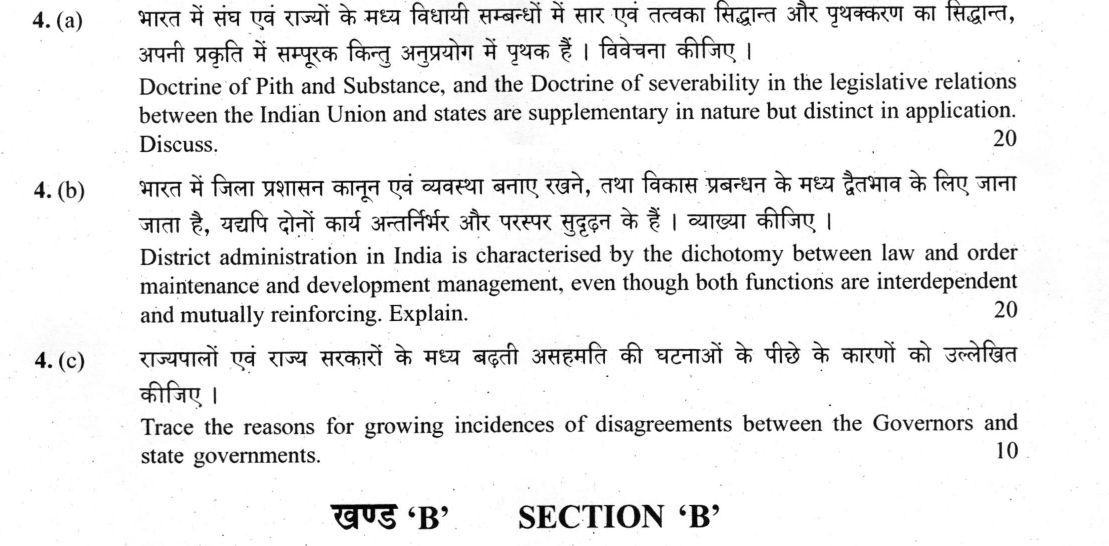
Doctrine of Pith and Substance, and the Doctrine of severability in the legislative relations between the Indian Union and states are supplementary in nature but distinct in application. Discuss. 20 marks
District administration in India is characterised by the dichotomy between law and order maintenance and development management, even though both functions are interdependent and mutually reinforcing. Explain. 20 marks
Trace the reasons for growing incidences of disagreements between the Governors and state governments. 10 marks
हिंदी में प्रश्न पढ़ें
भारत में संघ एवं राज्यों के मध्य विधायी सम्बन्धों में सार एवं तत्व का सिद्धान्त और पृथक्करणीयता का सिद्धान्त, अपनी प्रकृति में सम्पूरक किन्तु अनुप्रयोग में पृथक हैं । विवेचना कीजिए । (20 अंक)
भारत में जिला प्रशासन कानून एवं व्यवस्था बनाए रखने, तथा विकास प्रबन्धन के मध्य द्वैतभाव के लिए जाना जाता है, यद्यपि दोनों कार्य अन्तर्निर्भर और परस्पर सुदृढ़कारी हैं । व्याख्या कीजिए । (20 अंक)
राज्यपालों एवं राज्य सरकारों के मध्य बढ़ती असहमति की घटनाओं के पीछे के कारणों को उल्लेखित कीजिए । (10 अंक)
Model answer
Drafted with AI by UPSC Answer Check against this question's marking rubric, to the expected length. UPSC does not publish answers for Mains — this is one way to score well, not an official key. How we build rubrics and answers.
(a) Pith and Substance and Severability The legislative relations between the Union and States are governed by the distribution of powers in the Seventh Schedule. The Doctrine of Pith and Substance and the Doctrine of Severability are judicial tools that manage these relations. They are supplementary in nature because both serve the presumption of constitutionality (ut res magis valeat quam pereat), aiming to save legislation rather than strike it down. However, they are distinct in application: Pith and Substance addresses the competence of the legislature, while Severability addresses the consequence of a partial invalidity.
Pith and Substance determines the true nature of a law to decide which List it falls under. In Profulla Kumar Mukherjee v. Bank of Commerce, Khulna (1947), the Privy Council held that if the true nature of a law is within a legislature’s competence, incidental encroachment on another List is permissible; the Supreme Court adopted the doctrine in State of Bombay v. F. N. Balsara (1951), upholding prohibition as a State subject despite its incidental effect on imports. This is distinct from Colourable Legislation (K.C. Gajapati Narayan Deo v. State of Orissa, 1953), which strikes down indirect usurpation of a power the legislature does not possess.
Severability operates under Article 13(1) and 13(2), which declare laws void only "to the extent of such inconsistency." In R.M.D. Chamarbaugwalla v. Union of India (1957), the Court established that if an unconstitutional part is not so intertwined that the whole must fail, the rest of the law survives. Concrete illustrations include A.K. Gopalan v. State of Madras (1950), where Section 14 of the Preventive Detention Act was severed, and Kihoto Hollohan v. Zachillhu (1992), where Paragraph 7 of the Tenth Schedule was severed to save the anti-defection law.
The two therefore work in sequence: pith and substance first decides whether a law as a whole falls within the enacting legislature's List; where only some provisions exceed competence or violate Part III, severability saves the valid remainder. Balsara shows both at once - the Bombay Prohibition Act was upheld as a State law in pith and substance, while a few provisions were struck down and severed.
(b) Law and Order versus Development in District Administration District administration in India is the pivot of governance, characterized by a dichotomy between law and order maintenance (regulatory) and development management. This dichotomy has historical roots: the office of Collector was established by Warren Hastings in 1772; the Cornwallis Code (1793) separated revenue collection from judicial and magisterial functions, but Lord William Bentinck reunited magisterial powers with the Collector in 1831, creating the Collector-Magistrate whose regulatory role dominated colonial district administration. In contrast, the developmental function emerged post-independence with the Community Development Programme (2 October 1952) and the National Extension Service (1953).
Institutionally, this dichotomy is expressed through the District Magistrate (DM) under the Bharatiya Nagarik Suraksha Sanhita (BNSS), 2023 (replacing the CrPC, 1973), and the District Disaster Management Authority under Section 25 of the Disaster Management Act, 2005. Development is managed by the District Programme Coordinator (e.g., for MGNREGA, 2005, now succeeded by the VB-G RAM G Act, 2025), the Chief Executive Officer of the Zila Parishad, and district-level committees for flagship schemes, while the Aspirational Districts Programme (2018) has made the Collector the anchor for outcome-based development. The Balwantrai Mehta Committee (1957) and Ashok Mehta Committee (1978) addressed the integration of these functions through democratic decentralization. The G.V.K. Rao Committee (1985) proposed a District Development Commissioner, working as chief executive of the Zila Parishad, to separate development from the Collector’s regulatory duties. In big cities the commissionerate system of policing has similarly separated law and order from the Collector.
Despite this separation, the functions are interdependent and mutually reinforcing. The 2nd ARC’s 15th Report (2009) on State and District Administration emphasizes that law and order is a prerequisite for development; without security, infrastructure projects and welfare schemes cannot be delivered. Conversely, development management reduces the root causes of disorder—such as unemployment and poverty—thereby reinforcing law and order. The dual-hat system is a design feature, though the overload on the DM remains a challenge.
(c) Reasons for Governor-State Government Disagreements Disagreements between Governors and state governments stem from constitutional, political, and institutional sources.
Constitutional Reasons:
- Article 156: The Governor serves at the pleasure of the President, leading to concerns over arbitrary removal, as addressed in B.P. Singhal v. Union of India (2010).
- Article 200: The Constitution does not prescribe a time limit for the Governor to act on a bill, creating friction over delays. In State of Punjab v. Principal Secretary to the Governor (2023) the Supreme Court held that a Governor who withholds assent must return the bill to the House; in State of Tamil Nadu v. Governor (April 2025) a two-judge bench fixed timelines and deemed ten bills assented; but in its November 2025 advisory opinion on a presidential reference, a Constitution Bench held that courts cannot impose fixed timelines or deemed assent, while allowing limited judicial scrutiny of prolonged, unexplained inaction.
- Article 163: Preserves the Governor’s residual discretionary functions, whose scope is contested even though Shamsher Singh v. State of Punjab (1974) held that the Governor ordinarily acts on ministerial advice.
- Article 356 and government formation: The history of recommending President's Rule (curbed by S. R. Bommai, 1994) and of discretion in inviting parties to form governments, as in Maharashtra (2019) and Karnataka (2018), fuels distrust; in Nabam Rebia v. Deputy Speaker (2016) the Supreme Court held that the Arunachal Governor could not advance the Assembly session on his own, without ministerial advice.
Political and Institutional Reasons:
- Partisan Appointments: Governors are often appointed from the ruling party at the Centre, leading to a lack of neutrality.
- Chancellor Role: The Governor serves as the Chancellor of state universities, leading to disputes over Vice-Chancellor appointments; Kerala and West Bengal have passed bills to remove Governors as Chancellors and Tamil Nadu to transfer Vice-Chancellor appointments to the state government, and the UGC's draft regulations of 2025 on VC selection intensified the dispute.
- Other flashpoints: Governors departing from the text of the customary address to the Assembly, delays in sanctioning prosecutions, and public criticism of elected governments.
Commission Recommendations: The Sarkaria Commission (1988) recommended transparent selection criteria and a fixed tenure. The Punchhi Commission (2010) suggested a defined appointment process, a fixed five-year tenure with removal only through a resolution of the State Legislature, and that Governors should not be burdened with the role of Chancellor; the NCRWC (2002) likewise favoured consulting the Chief Minister on the appointment. Recent flashpoints include delays in ministerial appointments and the exercise of discretionary powers in states with weak governments.
How this answer will be evaluated
Evaluation rubric
Each sub-part is marked on its own, against the marks and word limit printed on the paper.
- (a) 'Discuss' requires both doctrines to be explained with their tests and leading cases, and then the express proposition to be tested: that they are supplementary in nature (both serve the presumption of constitutionality and save legislation) but distinct in application (competence versus consequence of invalidity). Both limbs must be argued. 20 marks
Must cover
- Explain pith and substance: Article 246 and the Seventh Schedule; the true-nature test; incidental encroachment permitted (Profulla Kumar Mukherjee, 1947; F. N. Balsara, 1951)
- Explain severability: Article 13 'to the extent of such inconsistency'; the R.M.D. Chamarbaugwalla (1957) test; examples of severance
- Argue the 'supplementary' limb: both serve the presumption of constitutionality and save legislation
- Argue the 'distinct' limb: competence versus the consequence of partial invalidity; distribution of powers versus Part III and other constitutional limits
Loses marks
- Treating the two doctrines as interchangeable and never separating competence (pith and substance) from consequence (severability).
- Confusing pith and substance with the doctrine of colourable legislation; the former permits incidental encroachment, the latter strikes down indirect usurpation of a power the legislature does not possess.
- Confusing severability with the doctrine of eclipse, which concerns pre-Constitution laws inconsistent with Part III under Article 13(1) and their revival.
- Citing the wrong leading case - Chamarbaugwalla (1957) is the severability authority; Profulla Kumar (1947) the pith-and-substance authority.
- Discussing only the federal Lists and ignoring that severability operates equally against Fundamental Rights violations and, as in Kihoto Hollohan, against constitutional amendments.
Earns more
- Gives concrete severance illustrations, at least two of: A.K. Gopalan (1950, section 14 of the Preventive Detention Act), F.N. Balsara (1951), Minerva Mills (1980, sections 4 and 55 of the 42nd Amendment), Kihoto Hollohan (1992, paragraph 7 of the Tenth Schedule)
Extra mark
- Distinguishing colourable legislation (K.C. Gajapati Narayan Deo, 1953) and the doctrine of eclipse
- Showing the two operating in sequence in one case (e.g., Balsara upholding the Act in pith and substance while severing invalid provisions)
- (b) 'Explain' the dichotomy between regulatory (law and order) and developmental functions in Indian district administration, while simultaneously demonstrating that the two are interdependent and mutually reinforcing. The answer must trace the historical origin of the dichotomy, describe its present institutional expression, and then show the interdependence with evidence. 20 marks
Must cover
- Trace the historical origin: the Collector (1772), Cornwallis's separation (1793), Bentinck's reunion of magisterial powers (1831); the developmental role from Community Development (1952) and NES (1953)
- Describe the present institutional expression: DM under the BNSS 2023 (formerly CrPC 1973) and DDMA (Section 25, Disaster Management Act 2005) versus development through the Zila Parishad CEO, scheme coordinators and district committees
- Show the interdependence with evidence (order enables delivery; development reduces the causes of disorder; disasters, elections and epidemics need both)
- Use committee diagnoses and a way forward (Balwantrai Mehta 1957, Ashok Mehta 1978, G.V.K. Rao 1985, 2nd ARC 15th Report 2009)
Loses marks
- Describing the Collector's duties as a list without ever explaining why the dichotomy arises or why the functions reinforce each other.
- Confusing the committees - Balwantrai Mehta (1957) proposed three-tier democratic decentralisation; Ashok Mehta (1978) proposed a two-tier system with the Zila Parishad as pivot; G.V.K. Rao (1985) proposed a District Development Commissioner.
- Asserting that the 73rd Amendment transferred the District Magistrate's law-and-order powers to panchayats; it did not.
- Overlooking the recodification of criminal law - the CrPC, 1973 was replaced by the Bharatiya Nagarik Suraksha Sanhita, 2023 with effect from 1 July 2024.
- Answering only the dichotomy half and ignoring the interdependence the question expressly asserts.
Earns more
- Cites committee diagnoses - G.V.K. Rao Committee (1985) District Development Commissioner, Ashok Mehta Committee (1978), and the 2nd ARC's 15th Report on State and District Administration (2009)
Extra mark
- Police commissionerate systems separating urban law and order from the Collector
- The Aspirational Districts Programme (2018) making the Collector the anchor of outcome-based development
- (c) 'Trace the reasons' - the demand is causal and diagnostic, not narrative. The answer must identify the constitutional, political and institutional sources of Governor-state friction, anchored in specific Articles, cases and commission recommendations, and should note the flashpoints where friction has recently concentrated. 10 marks
Must cover
- Constitutional sources: Articles 153-156 (tenure at pleasure), 163 (discretion), 174, 200-201 (assent with no time limit), 356
- Judicial landmarks: Shamsher Singh (1974), S.R. Bommai (1994), B.P. Singhal (2010), Nabam Rebia (2016)
- Political and institutional sources: partisan appointments, government formation, the Chancellor role in state universities
- Commission recommendations: Sarkaria (1983-88), Punchhi (2007-10), NCRWC (2002)
Loses marks
- Saying the Governor has a fixed five-year term that cannot be curtailed; Article 156(3) provides a five-year term but subject to the President's pleasure - B.P. Singhal (2010) only bars arbitrary or mala fide removal.
- Claiming Article 200 prescribes a time limit for assent; it does not, which is exactly why the litigation arose.
- Confusing the commissions - Sarkaria was appointed in 1983 and reported in 1988; Punchhi was constituted in 2007 and reported in 2010.
- Asserting that the Governor is a purely ceremonial head; Article 163 preserves genuine discretionary functions, and Article 371-series provisions add special responsibilities in some states.
- Narrating individual political controversies without extracting the constitutional reason, which is what 'trace the reasons' requires.
Earns more
- Names the commission prescriptions: Sarkaria Commission (1988) on selection criteria and tenure, and the Punchhi Commission (2010) on a defined appointment process, fixed tenure and removal of the Chancellor role
- Notes non-constitutional flashpoints - the Chancellor's role in state universities, delays in ministerial or Vice-Chancellor appointments, and political appointment of the Governor - and B.P. Singhal v. Union of India (2010) on arbitrary removal
Extra mark
- State of Punjab v. Principal Secretary to the Governor (2023) and State of Tamil Nadu v. Governor of Tamil Nadu (April 2025)
- The 20 November 2025 advisory opinion on the Presidential Reference (no judicially fixed timelines or deemed assent)
What "Discuss" is asking you to do
Lay the issue out from more than one side — how it arose, what is claimed for it, what is held against it, and where it now stands. UPSC attaches discuss to broad topics with several live dimensions, so coverage of the dimensions earns more than the strength of your opinion.
Structure that answers it
Set the issue up → the case as it is made → the case against → the dimension both sides leave out → where the balance now lies
Where marks are lost
Listing facts with no thread between them, or arguing one side throughout and calling it a discussion.
Practice this exact question
Write your answer and it is marked point by point against the model answer above — what you covered, what you missed, what you got wrong.
Evaluate my answer →More from Public Administration 2026 Paper II
- Q1 Answer the following in about 150 words each : (a) Learnings from Arthasastra could make…
- Q2 (a) An important characteristic of the British Civil Service was its open refusal to be i…
- Q3 (a) Planning Commission planned for economic development and social justice, but NITI Aay…
- Q4 (a) Doctrine of Pith and Substance, and the Doctrine of severability in the legislative r…
- Q5 Answer the following in about 150 words each : (a) Lateral Entry in Government of India h…
- Q6 (a) Civil services is grappling with severe capacity issues and which is a major bottlene…
- Q7 (a) Supreme Court of India in Prakash Singh case laid the foundation for effective police…