Paper II — Q3
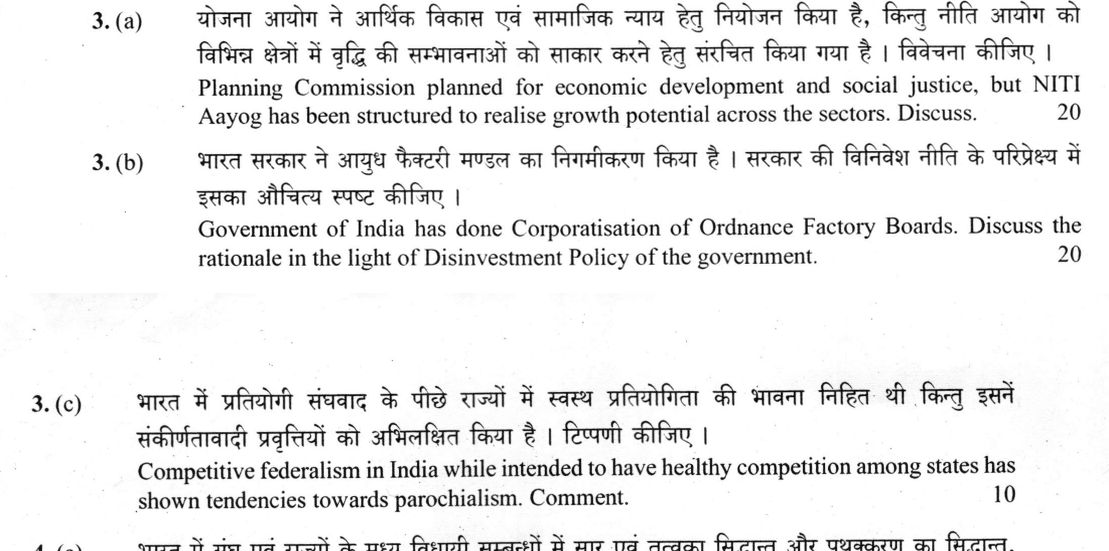
(a) Planning Commission planned for economic development and social justice, but NITI Aayog has been structured to realise growth…
Planning Commission planned for economic development and social justice, but NITI Aayog has been structured to realise growth potential across the sectors. Discuss. 20 marks
Government of India has done Corporatisation of Ordnance Factory Boards. Discuss the rationale in the light of Disinvestment Policy of the government. 20 marks
Competitive federalism in India while intended to have healthy competition among states has shown tendencies towards parochialism. Comment. 10 marks
हिंदी में प्रश्न पढ़ें
योजना आयोग ने आर्थिक विकास एवं सामाजिक न्याय हेतु नियोजन किया है, किन्तु नीति आयोग को विभिन्न क्षेत्रों में वृद्धि की सम्भावनाओं को साकार करने हेतु संरचित किया गया है । विवेचना कीजिए । (20 अंक)
भारत सरकार ने आयुध फैक्टरी मण्डल का निगमीकरण किया है । सरकार की विनिवेश नीति के परिप्रेक्ष्य में इसका औचित्य स्पष्ट कीजिए । (20 अंक)
भारत में प्रतियोगी संघवाद के पीछे राज्यों में स्वस्थ प्रतियोगिता की भावना निहित थी, किन्तु इसने संकीर्णतावादी प्रवृत्तियों को प्रदर्शित किया है । टिप्पणी कीजिए । (10 अंक)
Model answer
Drafted with AI by UPSC Answer Check against this question's marking rubric, to the expected length. UPSC does not publish answers for Mains — this is one way to score well, not an official key. How we build rubrics and answers.
(a) From Planning Commission to NITI Aayog The transition from the Planning Commission to NITI Aayog represents a fundamental shift in India’s development architecture, moving from a centralised, redistributive model to a decentralised, growth-oriented framework. The Planning Commission, established on 15 March 1950 as an executive creation, was mandated to plan for economic development and social justice. It operated through the National Development Council (NDC, 1952) and Five-Year Plans, using the Mahalanobis model (Second Plan, 1956-61) and the Gadgil formula (1969) to allocate resources, prioritising industrialisation and equity.
NITI Aayog, established on 1 January 2015, is structured to realise growth potential across sectors. It functions as a think-tank rather than an allocation body. Chaired by the Prime Minister, with a Vice-Chairperson, full-time members, a Governing Council of all Chief Ministers and Lieutenant Governors, and Regional Councils, its instruments include the Three Year Action Agenda, the Strategy for New India @75 (2018), the Aspirational Districts Programme (2018) and Aspirational Blocks Programme (2023), and support for State Institutions for Transformation that replicate its role in the states. It promotes "cooperative federalism" through the Governing Council, which has functionally superseded the NDC, and uses indices like the SDG India Index and the DMEO to drive performance.
This shift is linked to fiscal federalism: the 14th Finance Commission raised states' share to 42 per cent (2015-20), and the 15th kept it at 41 per cent (2021-26), after adjusting for the new Union Territories of Jammu and Kashmir and Ladakh; the Sixteenth Finance Commission (2026-31) has also kept it at 41 per cent. With the Plan/Non-Plan distinction ending in 2017-18, NITI Aayog has no financial allocation role; transfers flow through the Finance Commission and Ministry of Finance. While the contrast is real—NITI Aayog lacks the redistributive leverage and resource power of the Planning Commission—the shift is not absolute. Social justice remains a goal, but it is now pursued through ministries, centrally sponsored schemes and competitive federalism rather than centralised planning. Critics note that without funds NITI's advice can be ignored, while supporters argue that the Planning Commission had itself become a bureaucratic gatekeeper that reduced states to supplicants.
(b) Corporatisation of the Ordnance Factory Board and Disinvestment Policy The Government of India dissolved the Ordnance Factory Board (OFB) with effect from 1 October 2021, following Cabinet approval on 16 June 2021. The 41 ordnance factories were converted into seven Defence Public Sector Undertakings (DPSUs) under the Department of Defence Production, Ministry of Defence. The new DPSUs include Munitions India, Armoured Vehicles Nigam, Advanced Weapons and Equipment India, Troop Comforts, Yantra India, India Optel and Gliders India. This corporatisation is a strategic move within the government's broader public enterprise and disinvestment framework, specifically the New Public Sector Enterprise Policy of 2021, although corporatisation itself involves no sale of equity.
The rationale is to modernise defence manufacturing while maintaining state control. Under the 2021 PSE Policy, defence is a "strategic sector," where a bare minimum public presence is retained, and the government holds 100 per cent equity in the new DPSUs; corporatisation is not privatisation. The move aligns with the "Atmanirbhar Bharat" (self-reliant India) announcement of 16 May 2020, aiming to reduce import dependence. The Department of Public Enterprises' guidelines on board autonomy, rather than DIPAM (which handles disinvestment), govern how these companies are run; corporate status lets them raise funds, take export orders and be judged on performance rather than budgetary allocations.
This process follows recommendations from the T. K. S. Nair Committee (2000), the Kelkar Committee (2004-05), the Raman Puri Committee (2015) and the Shekatkar Committee (2016). However, it faced contestation from employee federations, leading to the Essential Defence Services Act, 2021 (first issued as an ordinance) to prevent strikes and ensure continuity. The move sits alongside positive indigenisation lists (from 2020) and record defence exports of about ₹23,600 crore in 2024-25, and several of the new DPSUs reported improved orders and profits in their early years. The rationale is thus to create a competitive, efficient defence industry through corporate governance structures, while keeping the sector under sovereign control to meet national security needs.
(c) Competitive Federalism and Parochialism Competitive federalism in India, intended to foster healthy inter-state competition, has often degenerated into parochialism. The intended mechanism involves policy postures like NITI Aayog indices (e.g., SDG India Index) and DPIIT’s Business Reform Action Plan, which rank states to incentivise reform.
However, this has led to parochial tendencies. For instance, the Haryana State Employment of Local Candidates Act, 2020, attempted to reserve 75 per cent of private jobs for locals; the Punjab and Haryana High Court struck it down in November 2023 as violating Articles 14, 16 and 19 (an appeal is pending), and similar laws or bills have appeared in Andhra Pradesh (2019), Jharkhand (2021, stayed by the High Court in December 2024) and Karnataka (2024, shelved after industry protests). States also engage in "subsidy races" and "investment beauty contests" to attract capital, competitive pre-election cash transfers (the "freebies" debate the Supreme Court has examined since 2022), and disputes over river waters and relocation of projects, often at the expense of fiscal discipline.
While competition can drive efficiency, the parochial turn—seen in domicile-based restrictions and aggressive subsidy policies—undermines the national market. Counterweights like the GST Council (Article 279A) and Inter-State Council (Article 263) are essential to balance this, ensuring that competition remains cooperative rather than exclusionary.
How this answer will be evaluated
Evaluation rubric
Each sub-part is marked on its own, against the marks and word limit printed on the paper.
- (a) 'Discuss' a contrast in stated purposes: the Planning Commission as an instrument of economic development with social justice, versus NITI Aayog as an instrument structured to realise sectoral growth potential. The answer must compare mandates, structures, instruments and federal roles, and must reach a judgement on whether the contrast is as sharp as the statement claims. 20 marks
Must cover
- Planning Commission: executive resolution of 15 March 1950, mandate of development with social justice, National Development Council (1952), five-year plans, allocative role (Gadgil formula 1969)
- NITI Aayog (1 January 2015): think-tank structure, Governing Council, no allocative power; instruments (Three Year Action Agenda, Strategy for New India @75, Aspirational Districts 2018, indices, DMEO)
- Compare mandates, structures, instruments and federal roles
- Link to fiscal federalism (14th FC 42 per cent, 15th FC 41 per cent, 16th FC 41 per cent for 2026-31; end of Plan/Non-Plan from 2017-18)
- Judge whether the contrast is as sharp as claimed (social justice now pursued through ministries and CSS; loss of redistributive leverage)
Loses marks
- Claiming the Planning Commission was a constitutional body or that it was created by the Constitution; it was an executive creation.
- Saying NITI Aayog allocates funds to states; it has no financial allocation role - transfers flow through the Finance Commission and the Ministry of Finance.
- Confusing the National Development Council with NITI Aayog's Governing Council, or stating that the NDC was abolished by the 2015 resolution.
- Getting the Finance Commission numbers wrong - 14th FC raised the share to 42 per cent for 2015-20; the 15th FC recommended 41 per cent for 2021-26.
- Producing two unconnected descriptions instead of the comparison on mandate, structure and instruments that 'discuss' demands.
Earns more
- Links the change to fiscal federalism: the 14th Finance Commission raised states' share from 32 to 42 per cent, the 15th kept 41 per cent and the 16th (2026-31) also 41 per cent; the Plan/Non-Plan distinction was abolished from 2017-18; the National Development Council was displaced in practice by the Governing Council
- Delivers a judgement - competitive and cooperative federalism and evidence-based sectoral focus versus loss of redistributive leverage, no resource power, and dependence on ministries
Extra mark
- Aspirational Blocks Programme (2023) and State Institutions for Transformation
- Gadgil-Mukherjee formula (1991) as the last plan-transfer formula
- (b) 'Discuss the rationale' of OFB corporatisation specifically 'in the light of the Disinvestment Policy'. Two things must be done: state the facts of the corporatisation accurately (what was dissolved, when, into what), and locate it within the government's disinvestment/PSE policy framework - while noting that corporatisation is not itself privatisation. 20 marks
Must cover
- State the facts accurately: OFB dissolved with effect from 1 October 2021 (Cabinet approval 16 June 2021); 41 factories reorganised into seven wholly government-owned DPSUs under the Department of Defence Production
- Explain the rationale: autonomy, accountability, efficiency, competitiveness, exports and self-reliance (Atmanirbhar Bharat announcement, 16 May 2020)
- Locate it within disinvestment and PSE policy: New PSE Policy 2021 with defence as a strategic sector; corporatisation is neither privatisation nor disinvestment; DIPAM's role
- Note prior committee recommendations, contestation and early outcomes, and reach a balanced conclusion
Loses marks
- Saying the OFB has been privatised or sold; the seven successor companies are wholly government-owned.
- Getting the number wrong - seven DPSUs, formed from 41 ordnance factories - or inventing company names.
- Dating the change to 2020; the announcement was in May 2020 but the effective date was 1 October 2021.
- Ignoring the express instruction to discuss it 'in the light of Disinvestment Policy', and writing only about defence production.
- Claiming defence is a non-strategic sector under the 2021 PSE Policy; it is listed among the strategic sectors.
Earns more
- Notes the contestation: employee federation opposition and the Essential Defence Services Act, 2021; and/or the prior committee recommendations (Kelkar 2004-05, Raman Puri 2015, Shekatkar 2016)
Extra mark
- Committee lineage: T. K. S. Nair (2000), Kelkar (2004-05), Raman Puri (2015), Shekatkar (2016)
- Early outcomes: positive indigenisation lists and record defence exports of about Rs 23,600 crore in 2024-25
- (c) 'Comment' on a two-step claim: competitive federalism was designed to produce healthy inter-state competition, but has produced parochial tendencies. The answer must show the intended mechanism with named instruments, then evidence the parochial turn with concrete instances, and end with a balanced position. 10 marks
Must cover
- Explain competitive federalism (a policy posture, not a constitutional term) and its intended mechanism with named instruments (NITI Aayog indices, DPIIT Business Reform Action Plan rankings)
- Evidence the parochial turn with concrete instances (domicile job quotas such as Haryana's 2020 Act struck down in 2023; subsidy and incentive races)
- Link to constitutional limits (Articles 16(2), 16(3), 19, 301-307)
- Balance with cooperative counterweights (GST Council, Article 279A; Inter-State Council, Article 263) and reach a reasoned verdict
Loses marks
- Treating competitive federalism as a constitutional concept; it is a policy posture, not a constitutional term.
- Offering no concrete example of parochialism, leaving the second half of the proposition unsupported.
- Confusing Article 263 (Inter-State Council) with Article 262 (adjudication of inter-state water disputes) or with Article 279A (GST Council).
- Asserting that domicile-based private-job quotas are settled law; the Haryana law was struck down by the High Court and the area remains contested.
- Writing a general federalism essay without engaging the 'healthy competition turning parochial' argument.
Earns more
- Identifies fiscal and resource parochialism: incentive races to the bottom, competitive subsidy announcements, and inter-state river water disputes or Finance Commission criteria contestation
- Balances with the cooperative-federalism counterweights - GST Council (Article 279A), Inter-State Council (Article 263), Zonal Councils - and reaches a reasoned verdict
Extra mark
- Similar local-job laws or bills in Andhra Pradesh (2019), Jharkhand (2021, stayed in 2024) and Karnataka (2024, shelved)
- The 'freebies' debate before the Supreme Court since 2022
What "Discuss" is asking you to do
Lay the issue out from more than one side — how it arose, what is claimed for it, what is held against it, and where it now stands. UPSC attaches discuss to broad topics with several live dimensions, so coverage of the dimensions earns more than the strength of your opinion.
Structure that answers it
Set the issue up → the case as it is made → the case against → the dimension both sides leave out → where the balance now lies
Where marks are lost
Listing facts with no thread between them, or arguing one side throughout and calling it a discussion.
Practice this exact question
Write your answer and it is marked point by point against the model answer above — what you covered, what you missed, what you got wrong.
Evaluate my answer →More from Public Administration 2026 Paper II
- Q1 Answer the following in about 150 words each : (a) Learnings from Arthasastra could make…
- Q2 (a) An important characteristic of the British Civil Service was its open refusal to be i…
- Q3 (a) Planning Commission planned for economic development and social justice, but NITI Aay…
- Q4 (a) Doctrine of Pith and Substance, and the Doctrine of severability in the legislative r…
- Q5 Answer the following in about 150 words each : (a) Lateral Entry in Government of India h…
- Q6 (a) Civil services is grappling with severe capacity issues and which is a major bottlene…