Paper II — Q8
(a) Discuss the major management challenges faced by Indian Mega Cities and explore sustainable, inclusive urban development…
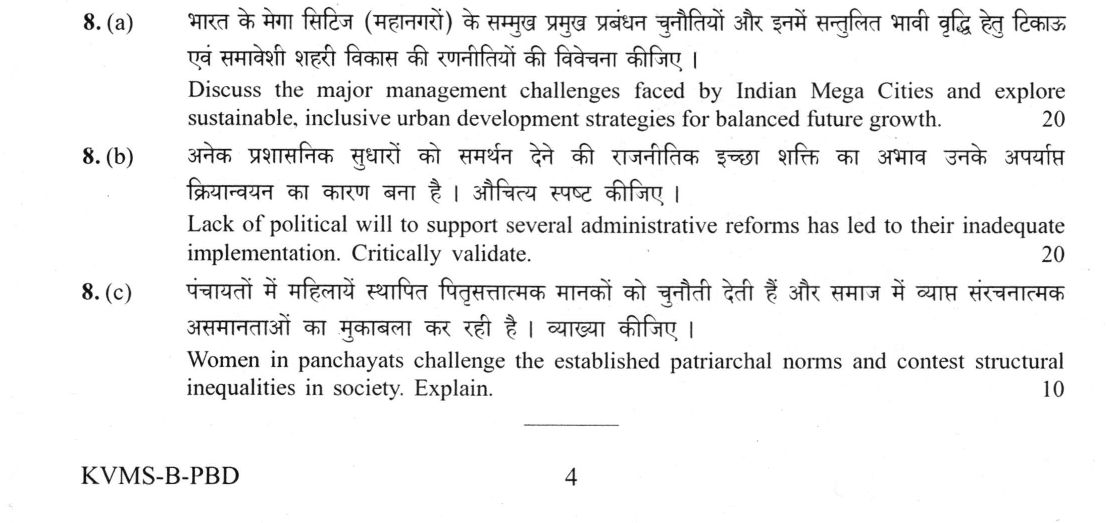
Discuss the major management challenges faced by Indian Mega Cities and explore sustainable, inclusive urban development strategies for balanced future growth. 20 marks
Lack of political will to support several administrative reforms has led to their inadequate implementation. Critically validate. 20 marks
Women in panchayats challenge the established patriarchal norms and contest structural inequalities in society. Explain. 10 marks
हिंदी में प्रश्न पढ़ें
भारत के मेगा सिटीज (महानगरों) के सम्मुख प्रमुख प्रबंधन चुनौतियों और इनमें सन्निहित भावी वृद्धि हेतु टिकाऊ एवं समावेशी शहरी विकास की रणनीतियों की विवेचना कीजिए। (20 अंक)
अनेक प्रशासनिक सुधारों को समर्थन देने की राजनीतिक इच्छा शक्ति का अभाव उनके अपर्याप्त क्रियान्वयन का कारण बना है। आलोचनात्मक पुष्टि कीजिए। (20 अंक)
पंचायतों में महिलायें स्थापित पितृसत्तात्मक मानकों को चुनौती देती हैं और समाज में व्याप्त संरचनात्मक असमानताओं का मुकाबला कर रही है। व्याख्या कीजिए। (10 अंक)
Model answer
Drafted with AI by UPSC Answer Check against this question's marking rubric, to the expected length. UPSC does not publish answers for Mains — this is one way to score well, not an official key. How we build rubrics and answers.
(a) Mega-city Management Challenges and Strategies for Balanced Growth Indian mega cities face a management crisis rooted in the mismatch between rapid urbanization and institutional capacity. According to Census 2011, India’s urban population reached 377 million (31 per cent), with 53 million-plus agglomerations, including Greater Mumbai, Delhi, and Kolkata; the next Census (reference date 1 March 2027) is expected to show a far larger urban share, much of it in "census towns" still governed as villages. The core management challenges include:
- Institutional Fragmentation: The 18 functions listed in the Twelfth Schedule under Article 243W are unevenly devolved and poorly coordinated among municipalities and state parastatals. Article 243ZE (Metropolitan Planning Committees) remains largely underutilized, leading to disjointed urban planning.
- Financial and Human Resource Deficits: The RBI Report on Municipal Finances (2022) highlights a heavy dependence on central transfers. Furthermore, the NITI Aayog report (2021) points to a critical shortage of urban planners and engineers.
- Environmental and Social Pressures: Recurring urban floods in Mumbai, Chennai and Bengaluru expose encroached drainage and wetlands, and the National Clean Air Programme (2019) addresses the crisis of air quality, while the informal sector—governed by the Street Vendors Act (2014) and PM SVANidhi (2020)—struggles for formal recognition.
To achieve balanced future growth aligned with SDG 11, sustainable strategies must focus on:
- Institutional Reform: As per the 2nd ARC 6th Report, city governments must be reformed to ensure integrated governance.
- Infrastructure and Livability: Programs like AMRUT 2.0 (2021), PMAY-Urban 2.0 (2024) and the Urban Challenge Fund announced in the 2025-26 Budget must be integrated with transit-oriented development (Metro Rail Policy, 2017) to reduce congestion.
- Inclusive Growth: The Smart Cities Mission (2015-2025), though an area-based intervention whose special purpose vehicles often bypassed elected councils, must give way to pan-city, mayor-led sustainability planning with municipal bonds and property-tax reform to strengthen own revenues. Ultimately, project-level solutions like flyovers are insufficient without a fundamental reform of urban governance and municipal finance.
(b) Political Will and the Implementation of Administrative Reforms Political will is defined as the political leadership's commitment to prioritize a reform on the agenda and bear the associated political costs. The proposition that its absence leads to inadequate implementation is largely valid, though not the sole factor.
Validation of the Claim:
- Stalled Legislation: The Whistle Blowers Protection Act (2014) was passed but never notified, and the Public Procurement Bill (2012) lapsed, reflecting a reluctance to disrupt existing procurement networks.
- Political Dilution of Judicial Directives: In Prakash Singh v. Union of India (2006), the Supreme Court mandated insulating police appointments and transfers from political control through bodies like the Police Establishment Board. However, many states have diluted these directives due to a lack of political will to curb the influence of the political class over the police.
- Constitutional Inertia: The All India Judicial Service (Article 312) remains unimplemented, and the 2nd ARC’s recommendation that Article 311 be repealed and replaced by a law under Article 309 (to allow for performance-based removal of civil servants with safeguards) has not been acted upon. The Lokpal, first recommended by the First ARC in 1966, took until 2013 to be enacted and 2019 to become functional.
Critical Qualification: However, political will is not the only determinant. The RTI Act (2005), GST (101st Amendment, 2016) and the Insolvency and Bankruptcy Code (2016) show that reforms move when political will aligns with pressure from civil society or markets, and even these have faced implementation problems. These successes suggest that "policy windows" (Kingdon) and "incrementalism" (Lindblom) also drive reform. Furthermore, bureaucratic resistance and federal division of powers often hinder implementation regardless of political intent.
Verdict: While political will is a necessary condition for administrative reform, it is not sufficient. It must be coupled with institutional capacity and a "good enough governance" approach (Grindle) to ensure reforms are not merely symbolic.
(c) Women in Panchayats and Patriarchal Norms The 73rd Constitutional Amendment Act (1992) mandated in Article 243D that not less than one-third of panchayat seats be reserved for women. Many states have since raised this to 50 per cent. This mandate has begun to move local governance from descriptive towards substantive representation (Pitkin).
Women in panchayats challenge patriarchal norms by:
- Shifting Public Goods: Research by Chattopadhyay and Duflo (2004) in West Bengal and Rajasthan shows that women pradhans invest more in the public goods women themselves demand - drinking water in both states, and roads in West Bengal where women raised them - contesting the male-dominated agenda. Beaman and others found that exposure to women leaders reduced voters' bias (2009) and raised girls' aspirations (2012).
- Contesting the Gram Sabha: The Gram Sabha has become a site of contestation where women address issues of domestic violence and social exclusion.
- Economic Empowerment: Through Self Help Groups under DAY-NRLM, women have gained financial independence, further weakening patriarchal control over household resources.
However, this challenge faces counter-pressures such as the sarpanch pati (proxy husband) phenomenon, where women leaders defer to their husbands - an advisory committee of the Ministry of Panchayati Raj reported in 2025 with measures to curb it - and "two-child norm" disqualifications, upheld in Javed v. State of Haryana (2003), which fall hardest on poor women. Despite these obstacles, the presence of women in local governance has fundamentally altered the social fabric, and the Constitution (106th Amendment) Act, 2023, extends this reservation logic to the Lok Sabha and State Assemblies - to take effect after the delimitation following the next Census - signaling a broader structural shift.
How this answer will be evaluated
Evaluation rubric
Each sub-part is marked on its own, against the marks and word limit printed on the paper.
- (a) Two express tasks: discuss the major management challenges of Indian mega cities, and explore sustainable and inclusive urban development strategies for balanced future growth. Roughly equal treatment is expected; an answer that only lists problems forfeits half the marks. 20 marks
Must cover
- Establish scale with dated data (Census 2011: about 377 million urban, 31 per cent, 53 million-plus agglomerations)
- Discuss institutional challenges: weak devolution of the Twelfth Schedule's 18 functions (Article 243W), dormant Metropolitan Planning Committees (Article 243ZE), fragmented parastatals
- Discuss financial, capacity, environmental and social challenges (municipal finance per RBI 2022; planner shortage per NITI Aayog 2021; floods; air quality under NCAP 2019; informality and housing)
- Explore sustainable and inclusive strategies in roughly equal measure: empowered city governments, own-revenue reform and municipal bonds, transit-oriented development (Metro Rail Policy 2017), AMRUT 2.0, PMAY-Urban, street vendors' rights
- Link the strategies to balanced growth and SDG 11, and conclude
Loses marks
- Answering only the challenges half and giving strategies two lines, when the question gives both tasks equal weight.
- Confusing the Eleventh Schedule (29 subjects, panchayats) with the Twelfth Schedule (18 subjects, municipalities).
- Quoting urban population or slum figures without stating the source year; Census 2011 is the last full enumeration and figures should be labelled as such.
- Treating the Smart Cities Mission as a general urban development programme; it was an area-based and pan-city intervention in 100 selected cities and has concluded.
- Offering only project-level solutions (more metros, more flyovers) with no institutional reform of city government, which is the core of the problem.
Earns more
- Establishes scale and context with Census 2011 data: about 377 million urban residents (31 per cent), 53 million-plus agglomerations, and Greater Mumbai, Delhi and Kolkata above ten million
Extra mark
- Urban Challenge Fund (Budget 2025-26) or PMAY-Urban 2.0 (2024)
- Census 2027 (reference date 1 March 2027) and census towns still governed as villages
- (b) 'Critically validate' means test the proposition rather than assume it: does lack of political will explain inadequate implementation of administrative reforms? The answer must define political will, validate the claim with cases of stalled reform, then qualify it with reforms that did succeed and with non-political causes of failure, and reach a defensible verdict. 20 marks
Must cover
- Define political will and the mechanism by which its absence stalls implementation
- Validate with stalled cases (Whistle Blowers Act 2014 unnotified; Public Procurement Bill 2012 lapsed; dilution of Prakash Singh 2006; All India Judicial Service under Article 312; Lokpal delayed from 1966 to 2019)
- Qualify with successes and non-political causes (RTI 2005, GST 2016, IBC 2016; bureaucratic resistance, capacity, federal division of powers)
- Deliver an explicit verdict (e.g., necessary but not sufficient)
Loses marks
- Asserting political will as a self-evident explanation without defining it or specifying a mechanism.
- Giving only failures and no counter-examples, which makes the answer an assertion rather than a validation.
- Getting the reform record wrong - for example, saying the Lokpal Act was never passed (it was, in 2013) or that the Whistle Blowers Act was repealed (it was never notified).
- Blaming only politicians while ignoring bureaucratic resistance, capacity limits and the federal division of powers.
- Failing to deliver a verdict, which 'critically validate' expressly requires.
Earns more
- Frames the analysis theoretically - Lindblom's incrementalism, Kingdon's policy windows, Jenkins on reform by stealth, Grindle's good enough governance - and delivers an explicit verdict
Extra mark
- The 2nd ARC recommendation to replace Article 311 protections with a law under Article 309
- Theoretical framing: Kingdon's policy windows, Lindblom's incrementalism, Jenkins's reform by stealth, Grindle's good enough governance
- (c) 'Explain' how women in panchayats challenge patriarchal norms and contest structural inequality. The answer must combine the constitutional basis of their presence, evidence of substantive (not merely descriptive) impact, and the counter-pressures such as proxy leadership - while remaining an explanation of challenge, not a catalogue of obstacles. 10 marks
Must cover
- Constitutional basis: 73rd Amendment 1992, Article 243D - not less than one-third, raised to 50 per cent in many states
- Explain how women challenge norms: substantive rather than merely descriptive representation (Pitkin), changed public-goods priorities (Chattopadhyay and Duflo, 2004), the gram sabha as a site of contestation
- Link to wider structural change (SHG federations under DAY-NRLM, reduced bias, changed aspirations)
- Acknowledge counter-pressures (proxy sarpanch pati, two-child norms, caste disadvantage) while keeping the focus on challenge
Loses marks
- Misquoting Article 243D as reserving exactly one-third; it prescribes not less than one-third, which is why states could legislate 50 per cent.
- Reducing the answer entirely to the proxy-husband problem, when the question asks how women challenge patriarchal norms.
- Asserting precise national percentages of elected women representatives without sourcing; 'close to half' or 'about 46 per cent according to Ministry of Panchayati Raj data' is the safe register.
- Attributing the 106th Amendment's reservation to panchayats; it concerns the Lok Sabha, state legislative assemblies and the Delhi assembly, and takes effect after a census and delimitation.
- Providing no empirical evidence, leaving the claim of substantive change unsupported.
Earns more
- Addresses the counter-pressure of proxy leadership (sarpanch pati/pradhan pati), no-confidence motions, mobility and literacy constraints, caste-based double disadvantage, and two-child-norm disqualifications in some states
- Names enablers and wider significance: capacity building under Rashtriya Gram Swaraj Abhiyan, Self Help Group federations under DAY-NRLM, and the Constitution (106th Amendment) Act, 2023 extending reservation to legislatures
Extra mark
- Beaman and others on reduced voter bias (2009) and girls' aspirations (2012)
- Constitution (106th Amendment) Act, 2023 for the Lok Sabha and state assemblies, effective after census and delimitation
What "Discuss" is asking you to do
Lay the issue out from more than one side — how it arose, what is claimed for it, what is held against it, and where it now stands. UPSC attaches discuss to broad topics with several live dimensions, so coverage of the dimensions earns more than the strength of your opinion.
Structure that answers it
Set the issue up → the case as it is made → the case against → the dimension both sides leave out → where the balance now lies
Where marks are lost
Listing facts with no thread between them, or arguing one side throughout and calling it a discussion.
Practice this exact question
Write your answer and it is marked point by point against the model answer above — what you covered, what you missed, what you got wrong.
Evaluate my answer →More from Public Administration 2026 Paper II
- Q5 Answer the following in about 150 words each : (a) Lateral Entry in Government of India h…
- Q6 (a) Civil services is grappling with severe capacity issues and which is a major bottlene…
- Q7 (a) Supreme Court of India in Prakash Singh case laid the foundation for effective police…
- Q8 (a) Discuss the major management challenges faced by Indian Mega Cities and explore susta…