Paper I — Q1
Answer the following questions in about 150 words each: (a) Discuss the nature of Sociology. Highlight its relationship with…
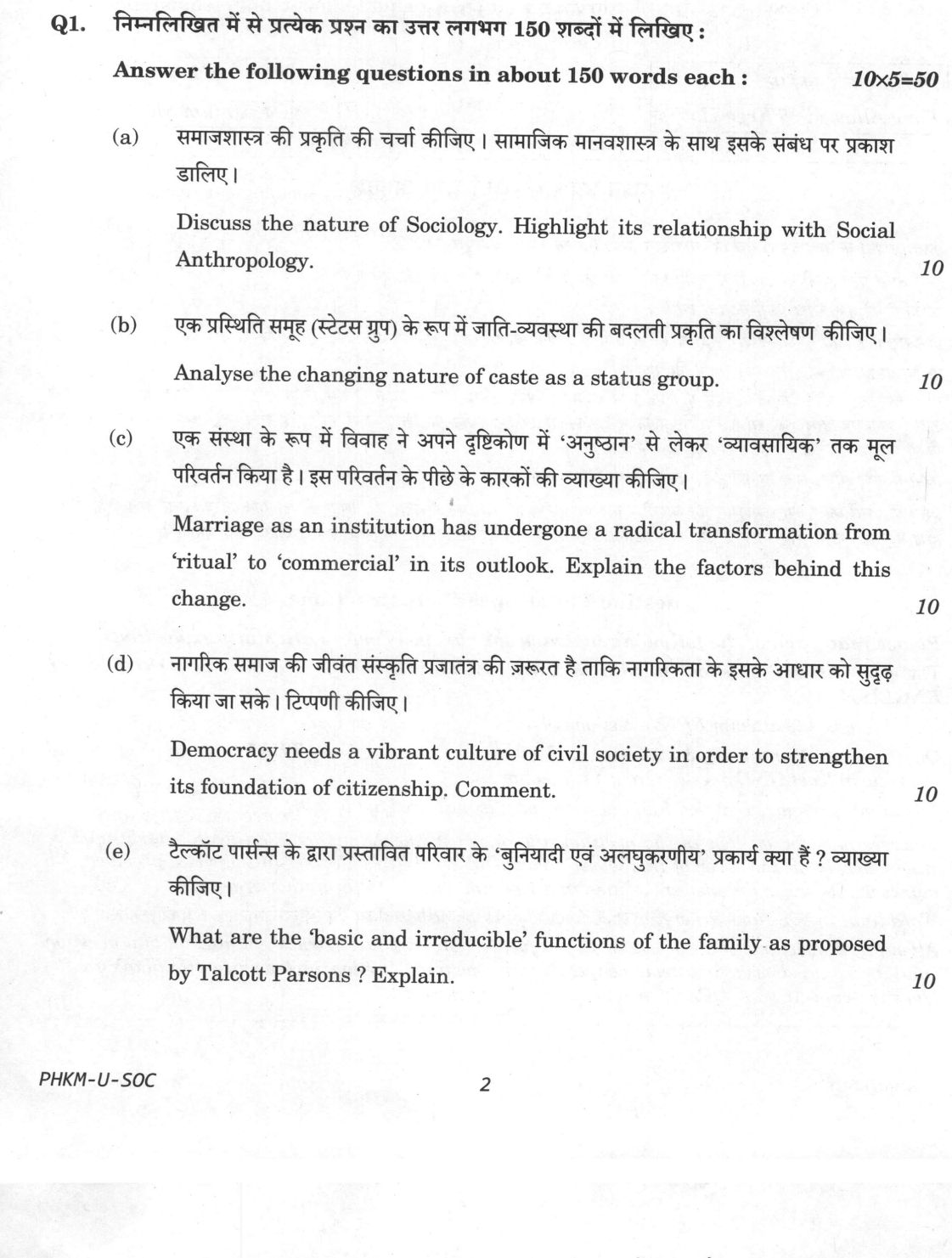
Answer the following questions in about 150 words each:
Discuss the nature of Sociology. Highlight its relationship with Social Anthropology. 10 marks
Analyse the changing nature of caste as a status group. 10 marks
Marriage as an institution has undergone a radical transformation from 'ritual' to 'commercial' in its outlook. Explain the factors behind this change. 10 marks
Democracy needs a vibrant culture of civil society in order to strengthen its foundation of citizenship. Comment. 10 marks
What are the 'basic and irreducible' functions of the family as proposed by Talcott Parsons? Explain. 10 marks
हिंदी में प्रश्न पढ़ें
निम्नलिखित में से प्रत्येक प्रश्न का उत्तर लगभग 150 शब्दों में लिखिए:
समाजशास्त्र की प्रकृति की चर्चा कीजिए। सामाजिक मानवशास्त्र के साथ इसके संबंध पर प्रकाश डालिए। (10 अंक)
एक प्रतिष्ठित समूह (स्टेटस ग्रुप) के रूप में जाति-व्यवस्था की बदलती प्रकृति का विश्लेषण कीजिए। (10 अंक)
एक संस्था के रूप में विवाह ने अपने दृष्टिकोण में 'अनुष्ठान' से लेकर 'व्यावसायिक' तक मूल परिवर्तन किया है। इस परिवर्तन के पीछे के कारकों की व्याख्या कीजिए। (10 अंक)
नागरिक समाज की जीवंत संस्कृति प्रजातंत्र की जरूरत है ताकि नागरिकता के इसके आधार को सुदृढ़ किया जा सके। टिप्पणी कीजिए। (10 अंक)
टैलकॉट पार्संस के द्वारा प्रस्तावित परिवार के 'बुनियादी एवं अल्प्यूकरणीय' प्रकार्य क्या हैं? व्याख्या कीजिए। (10 अंक)
Model answer
Written by UPSC Answer Check against this question's marking rubric, to the 150-word length. UPSC does not publish answers for Mains — this is one way to score well, not an official key.
(a) Nature of Sociology and its Relationship with Social Anthropology
Sociology possesses a dual ontological and epistemological nature. While positivist scholars like Emile Durkheim conceptualised it as an objective, empirical natural science studying observable social facts, interpretive sociologists like Max Weber emphasised Verstehen to understand subjective social action. It combines macro-structural analysis with micro-interactionist perspectives to examine both social order and social change.
The discipline shares an intimate, historically evolving relationship with Social Anthropology. Traditionally, they diverged in scope and methodology: anthropology focused on holistic, qualitative participant observation within simple, pre-literate, and non-Western societies, whereas sociology deployed quantitative surveys, statistical methods, and historical comparisons within complex, modern, industrial societies.
However, since the mid-20th century, this binary has dissolved into substantial convergence. Sociologists increasingly adopt ethnographic fieldwork, while anthropologists study modern state institutions, migration, and urban settings. In the Indian context, scholars like M.N. Srinivas and André Béteille demonstrated this fusion by studying caste, village structures, and agrarian stratification without artificial disciplinary boundaries.
(b) Changing Nature of Caste as a Status Group
Max Weber defined caste as the closed status group par excellence, wherein social stratification is anchored in differential social honour, ritual purity and pollution, lifestyle restrictions, and endogamy rather than economic power. Historically, this status hierarchy was maintained through non-competitive jajmani relations and religious legitimacy.
In contemporary times, caste has transitioned from an ascribed ritual hierarchy to a secularised, politicised, and competing interest group. Early structural mobility occurred through Sanskritisation, where lower castes emulated dominant ritual practices to claim higher status. Post-independence democratisation and the Mandal-Mandir era transformed caste into an instrument of political mobilisation and electoral bargaining. As Kancha Ilaiah highlights, subaltern assertions have challenged Brahminical hegemony, fostering autonomous Dalit identity politics.
Furthermore, economic liberalisation, urbanisation, and occupational diversification have detached status from traditional caste occupations. While endogamy persists, caste operates increasingly as an identity-based civil society association and a vehicle for resource competition rather than an immutable ritual hierarchy.
(c) Transformation of Marriage from Ritual to Commercial Outlook
Traditionally conceptualised in Hindu jurisprudence and customary practices as an indissoluble spiritual samskara (sacrament) aimed at fulfilling religious duties (dharma) and lineage continuation, marriage has increasingly acquired a contractual, commodified, and commercial outlook.
Several structural factors drive this transformation. Rapid urbanisation and the shift to nuclear households have eroded patriarchal community controls. Expansion of female higher education and workforce participation has fostered individual agency, leading to companionate expectations. Legal modernisations—notably the Hindu Marriage Act, 1955, which secularised divorce, and the Special Marriage Act, 1954—formally reframed marriage as a dissoluble civil contract.
Simultaneously, the rise of a consumerist market economy has intensified conspicuous consumption, transforming weddings into high-cost commercial spectacles evaluated by material expenditure and dowry exchanges. Furthermore, digital matrimonial platforms and dating applications have rationalised partner selection into a market-driven process where personal attributes, caste capital, and economic assets are quantified, commodified, and negotiated.
(d) Civil Society and Democracy
Civil society constitutes the non-state, non-market associational sphere that acts as an essential mediator between the individual and the state. Alexis de Tocqueville argued that vibrant associational life protects democracy by checking state authoritarianism and cultivating democratic habits. Robert Putnam similarly demonstrated that civic networks generate social capital, norms of reciprocity, and institutional trust, thereby deepening democratic citizenship from formal voting rights into active political participation.
In India, civil society has historically vitalised democracy by mobilising marginalized groups. Grassroots movements—such as the Chipko movement for environmental rights, the Mazdoor Kisan Shakti Sangathan (MKSS) which led to the Right to Information Act, 2005, and contemporary constitutional protests—have expanded citizenship rights and enforced state accountability.
However, civil society is not inherently democratic. It is frequently constrained by elite capture, donor-driven NGO-isation that depoliticises structural inequalities, and the proliferation of sectarian or communal associations that polarise society and undermine universal citizenship.
(e) Basic and Irreducible Functions of the Family
In his structural-functionalist framework, Talcott Parsons argued that while the modern nuclear family has shed many traditional economic, educational, and political functions due to structural differentiation, it retains two "basic and irreducible" functions essential for societal equilibrium.
The first is the Primary Socialisation of children, wherein the family internalises society's core value consensus, culture, and social norms into the unformed personality of the child, integrating them into the social system. The second is the Stabilisation of Adult Personalities, commonly termed the "warm bath" function. In competitive, emotionally demanding industrial societies, the family provides an affective refuge where adults relieve psychological stress, thereby preventing social anomie and maintaining emotional stability through segregated gender roles (instrumental male, expressive female).
This functionalist view has faced significant critique. Marxist scholars like Eli Zaretsky argue that this idealised domestic haven simply reproduces docile labour power to cushion the alienating contradictions of capitalism. Feminist sociologists, notably Ann Oakley and Christine Delphy, criticise Parsons for naturalising the exploitative sexual division of labour and obscuring patriarchal domestic oppression.
What "Discuss" is asking you to do
Lay the issue out from more than one side — how it arose, what is claimed for it, what is held against it, and where it now stands. UPSC attaches discuss to broad topics with several live dimensions, so coverage of the dimensions earns more than the strength of your opinion.
Structure that answers it
Set the issue up → the case as it is made → the case against → the dimension both sides leave out → where the balance now lies
Where marks are lost
Listing facts with no thread between them, or arguing one side throughout and calling it a discussion.
How this answer will be evaluated
Approach
Framework: Sociology Paper 1 (UPSC). (a) discuss: intro > 3-4 dimensions > example > balanced close | (b) analyse: intro > causes > effects > stakeholders/linkages > way forward | (c) explain: definition/context > points in order > small example > short close | (d) comment: context > arguments both sides > judgment > close | (e) explain: definition/context > points in order > small example > short close Full marks: Precise definitions, named thinkers, clear analytical structure, specific examples.
Key points expected
- Define sociology as empirical study of social life
- Distinguish sociology (modern/complex) from anthropology (primitive/simple)
- Mention Durkheim or Comte for sociological nature
- Highlight methodological differences (survey vs fieldwork)
- Define caste as a status group (ascribed status)
- Identify political mobilization as a key factor of change
- Mention economic mobility or education as drivers
- Reference to M.N. Srinivas (Sanskritization) or political mobilization
Evaluation rubric
Each sub-part is marked on its own, against the marks and word limit printed on the paper.
- (a) Define sociology's nature and contrast it with social anthropology. 10 marks · 150 words
discuss— intro → 3-4 dimensions → example → balanced close
Must cover
- Define sociology as empirical study of social life
- Distinguish sociology (modern/complex) from anthropology (primitive/simple)
- Mention Durkheim or Comte for sociological nature
- Highlight methodological differences (survey vs fieldwork)
Loses marks
- Treating anthropology as a sub-branch of sociology
- Vague definitions without methodological distinction
Earns more
- Reference to Radcliffe-Brown or Malinowski
- Mention of 'holistic' approach in anthropology
- Reference to 'social facts' (Durkheim)
Extra mark
- Reference to specific Indian context (e.g., caste study)
- (b) Explain the shift of caste from a rigid status group to a political status group. 10 marks · 150 words
analyse— intro → causes → effects → stakeholders/linkages → way forward
Must cover
- Define caste as a status group (ascribed status)
- Identify political mobilization as a key factor of change
- Mention economic mobility or education as drivers
- Reference to M.N. Srinivas (Sanskritization) or political mobilization
Loses marks
- Ignoring the political dimension of caste change
- Treating caste as static and unchanging
Earns more
- Reference to 'Caste in Modern India' (Srinivas)
- Mention of reservation policies
- Reference to 'status competition'
Extra mark
- Reference to specific contemporary political movement
- (c) Explain the factors driving the transformation of marriage from ritual to commercial. 10 marks · 150 words
explain— definition/context → points in order → small example → short close
Must cover
- Define the 'ritual' aspect of traditional marriage
- Define the 'commercial' aspect (matrimonial market)
- Identify urbanization and nuclear family as factors
- Mention the role of media or matrimonial websites
Loses marks
- Ignoring the 'commercial' aspect of the question
- Vague generalizations without specific factors
Earns more
- Reference to 'companionate marriage'
- Mention of 'arranged marriage' vs 'love marriage'
- Reference to economic independence of women
Extra mark
- Reference to specific data on marriage trends
- (d) Comment on the role of civil society in strengthening democratic citizenship. 10 marks · 150 words
comment— context → arguments both sides → judgment → close
Must cover
- Define civil society (space between state and market)
- Explain how civil society fosters citizenship (participation, rights)
- Mention role of NGOs, media, or social movements
- Reference to 'active citizenship' or 'social capital'
Loses marks
- Confusing civil society with political society
- Ignoring the 'vibrant culture' aspect of the question
Earns more
- Reference to 'public sphere' (Habermas)
- Mention of 'social capital' (Putnam)
- Reference to specific Indian social movements
Extra mark
- Reference to specific contemporary issue (e.g., RTI, environmental movements)
- (e) Explain Talcott Parsons' 'basic and irreducible' functions of the family. 10 marks · 150 words
explain— definition/context → points in order → small example → short close
Must cover
- Name Talcott Parsons as the theorist
- Identify 'stabilization of adult personalities' as a function
- Identify 'socialization of children' as a function
- Explain why these are 'irreducible' (cannot be performed by other institutions)
Loses marks
- Listing functions without explaining 'irreducibility'
- Confusing Parsons' view with other functionalist views
Earns more
- Reference to 'nuclear family' (Parsons)
- Mention of 'pattern maintenance' (AGIL scheme)
- Reference to 'primary socialization'
Extra mark
- Reference to specific critique of Parsons' view
Practice this exact question
Write your answer and it is marked point by point against the model answer above — what you covered, what you missed, what you got wrong.
Evaluate my answer →More from Sociology 2024 Paper I
- Q1 Answer the following questions in about 150 words each: (a) Discuss the nature of Sociolo…
- Q2 (a) Sociology is the product of European enlightenment and renaissance. Critically examin…
- Q3 (a) How do you view and assess the increasing trend of digital ethnography and use of vis…
- Q4 (a) What do you understand by 'mixed method'? Discuss its strengths and limitations in so…