Paper I — Q7
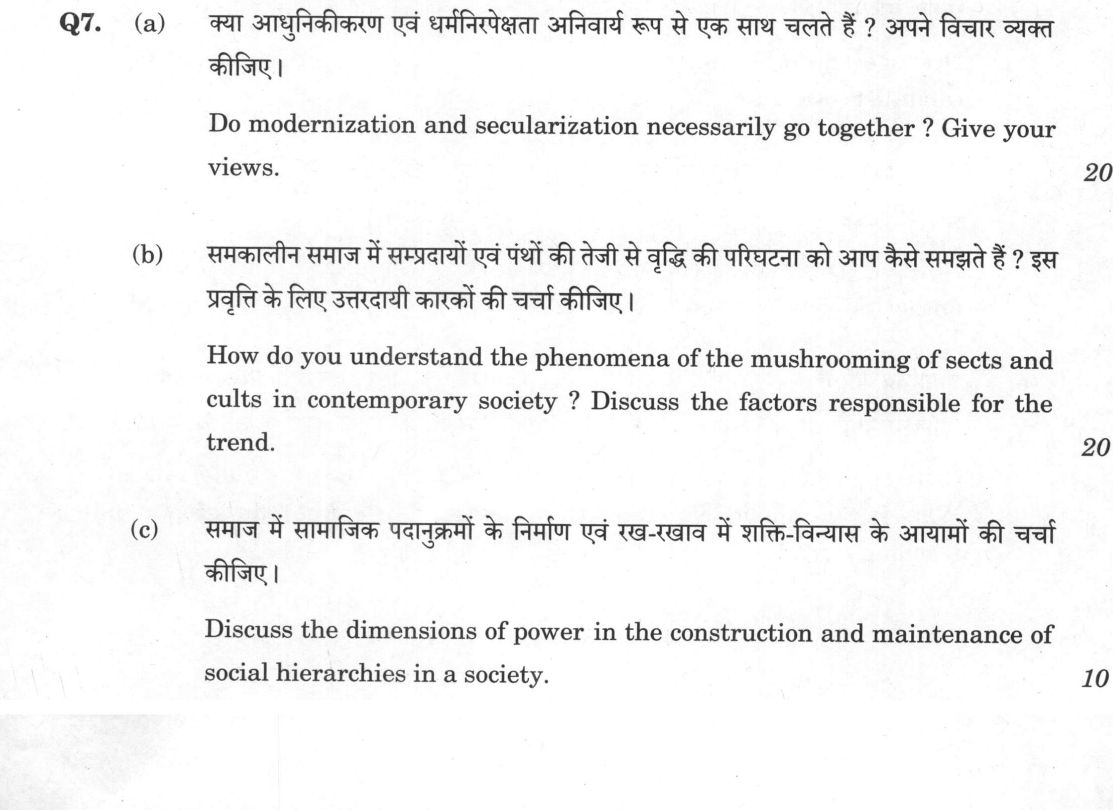
(a) Do modernization and secularization necessarily go together? Give your views. (20 marks) (b) How do you understand the…
Do modernization and secularization necessarily go together? Give your views. 20 marks
How do you understand the phenomena of the mushrooming of sects and cults in contemporary society? Discuss the factors responsible for the trend. 20 marks
Discuss the dimensions of power in the construction and maintenance of social hierarchies in a society. 10 marks
हिंदी में प्रश्न पढ़ें
क्या आधुनिकीकरण एवं धर्मनिरपेक्षता अनिवार्य रूप से एक साथ चलते हैं? अपने विचार व्यक्त कीजिए। (20 अंक)
समकालीन समाज में सम्प्रदायों एवं पंथों की तेजी से वृद्धि की परिघटना को आप कैसे समझते हैं? इस प्रवृत्ति के लिए उत्तरदायी कारकों की चर्चा कीजिए। (20 अंक)
समाज में सामाजिक पदानुक्रमों के निर्माण एवं रख-रखाव में शक्ति-विन्यास के आयामों की चर्चा कीजिए। (10 अंक)
Model answer
Written by UPSC Answer Check against this question's marking rubric, to the expected length. UPSC does not publish answers for Mains — this is one way to score well, not an official key.
Modernization and Secularization
Classical sociological paradigms posited an intrinsic link between modernization and secularization. Max Weber argued that rationalization and bureaucratization lead to the disenchantment of the world, while Peter Berger initially theorized the collapse of the sacred canopy under modern pluralism. However, contemporary debates on desecularization and resacralization, articulated by David Martin and José Casanova, demonstrate that modernization does not inevitably shrink religion. Casanova highlights the deprivatization of religion, wherein religious traditions re-enter the public sphere to contest moral and political questions.
In non-Western contexts, S.N. Eisenstadt and Charles Taylor advanced the multiple modernities framework, showing that modernization proceeds without unilinear secularization. India exemplifies this divergence. Rajni Kothari viewed communalism and competitive religious identity not as feudal remnants, but as products of modern democratic mobilization and state processes. Conversely, Ashis Nandy argued that authentic religious tolerance represents an alternative modernity superior to imported, state-enforced secularism. Furthermore, empirical realities, such as the socio-economic disparities mapped by the Sachar Committee (2006) and the enduring salience of community identities in electoral politics, confirm that modernization in India reshapes and re-energizes religious identity rather than extinguishing it.
Mushrooming of Sects and Cults
Sociologically, Ernst Troeltsch differentiated sects as schismatic breakaways seeking doctrinal purity from established churches, while Rodney Stark and William Bainbridge defined cults as novel, loosely organized movements introducing new spiritual beliefs. In contemporary sociology, these are analyzed as New Religious Movements (NRMs) thriving within a spiritual marketplace. In India, movements like ISKCON, the Art of Living, Radha Soami Satsang Beas, and the Sant Nirankari Mission have witnessed exponential expansion.
This mushrooming is driven by structural and psychological transitions. Rapid capitalist modernization and urbanization induce Durkheimian anomie, breaking traditional community networks and leaving individuals alienated. The emerging middle class experiences existential and status anxieties, turning to modern sects for therapeutic solace, stress alleviation, and caste-agnostic fellowship. Meera Nanda’s critique in The God Market illustrates how post-liberalization consumerism, telegenic media-savvy gurus, and a symbiotic state-temple economy nexus have commercialized spirituality. These movements package faith as an individualized lifestyle product, bridging tradition with modern consumer culture.
Dimensions of Power and Social Hierarchies
Social hierarchies are constructed and reproduced through multifaceted mechanisms of power. Steven Lukes conceptualizes power across three dimensions: the overt decision-making power involving direct conflict; the agenda-setting power that suppresses grievances; and the ideological, preference-shaping power that leads actors to accept their subordination. This aligns with Antonio Gramsci’s concept of hegemony, where ruling groups manufacture consent, and Pierre Bourdieu’s notion of symbolic power, wherein cultural capital disguises arbitrary domination as legitimate order.
In India, while Louis Dumont posited caste as an ideational hierarchy of purity and pollution, sociologists like Surinder Jodhka emphasize caste as an entrenched system of material dominance, labor control, and power relations. B.R. Ambedkar’s critique in The Annihilation of Caste exposed hierarchy as graded inequality sustained through ideological hegemony and institutionalized socio-political exclusion, intersecting across caste, class, and gender. While institutional dominance sustains these structures, subordinate groups negotiate and subvert power through what James C. Scott terms everyday forms of resistance and counter-hegemonic assertion.
Conclusion
Contemporary modernity does not follow a linear path toward secular disenchantment; rather, it reconstitutes faith through dynamic spiritual markets and sect movements. Addressing these evolving socio-religious landscapes requires unpacking the structural, ideological, and institutional dimensions of power that continuously reshape social hierarchies in democratic societies.
What "Discuss" is asking you to do
Lay the issue out from more than one side — how it arose, what is claimed for it, what is held against it, and where it now stands. UPSC attaches discuss to broad topics with several live dimensions, so coverage of the dimensions earns more than the strength of your opinion.
Structure that answers it
Set the issue up → the case as it is made → the case against → the dimension both sides leave out → where the balance now lies
Where marks are lost
Listing facts with no thread between them, or arguing one side throughout and calling it a discussion.
How this answer will be evaluated
Approach
(a) comment: context > arguments both sides > judgment > close | (b) discuss: intro > 3-4 dimensions > example > balanced close | (c) discuss: intro > 3-4 dimensions > example > balanced close Full marks: Precise definitions, named thinkers, clear arguments, Indian examples, and balanced judgment.
Key points expected
- Define modernization and secularization sociologically
- Name thinkers like Weber, Durkheim, or Berger
- Contrast secularization thesis with religious resurgence
- Take a clear position on the relationship
- Define sects and cults sociologically
- Identify 3-4 factors for their rise
- Link factors to contemporary social conditions
- Provide Indian examples of sects/cults
Evaluation rubric
Each sub-part is marked on its own, against the marks and word limit printed on the paper.
- (a) Contextualize modernization/secularization, present arguments for/against their linkage, and offer a judgment. 20 marks
comment— context → arguments both sides → judgment → close
Must cover
- Define modernization and secularization sociologically
- Name thinkers like Weber, Durkheim, or Berger
- Contrast secularization thesis with religious resurgence
- Take a clear position on the relationship
Loses marks
- Equating secularization with anti-religious sentiment
- Name-dropping thinkers without explaining their arguments
- Common-sense opinion without sociological grounding
Earns more
- Reference to 'disenchantment of the world'
- Mention of 'privatization of religion'
- Discussion of 'secularization vs. secularism'
- Reference to 'second modernity' or 'reflexive modernity'
Extra mark
- Cite FLFPR or NFHS data on religious trends
- Reference to 'secularization of the state' vs 'society'
- (b) Explain the phenomenon of sects/cults and discuss the factors responsible for this trend. 20 marks
discuss— intro → 3-4 dimensions → example → balanced close
Must cover
- Define sects and cults sociologically
- Identify 3-4 factors for their rise
- Link factors to contemporary social conditions
- Provide Indian examples of sects/cults
Loses marks
- Moralizing about cults without sociological analysis
- Confusing sects with mainstream religious groups
- Listing factors without explaining their mechanism
Earns more
- Reference to 'anomie' or 'social disintegration'
- Mention of 'spiritual vacuum' or 'meaning crisis'
- Discussion of 'consumerism in religion'
- Reference to 'new religious movements' (NRM)
Extra mark
- Cite specific data on growth of sects
- Reference to 'cult of personality' in politics
- (c) Discuss the dimensions of power in constructing and maintaining social hierarchies. 10 marks
discuss— intro → 3-4 dimensions → example → balanced close
Must cover
- Define power in sociological terms
- Identify 3-4 dimensions of power
- Link power to social hierarchy construction
- Provide examples of power dimensions
Loses marks
- Limiting power to political authority only
- Ignoring the maintenance aspect of hierarchies
- Vague generalizations without specific dimensions
Earns more
- Reference to 'economic, political, social power'
- Mention of 'cultural power' or 'symbolic power'
- Discussion of 'hegemony' or 'domination'
- Reference to 'power elite' or 'ruling class'
Extra mark
- Cite specific data on power distribution
- Reference to 'power distance' in culture
Practice this exact question
Write your answer and it is marked point by point against the model answer above — what you covered, what you missed, what you got wrong.
Evaluate my answer →More from Sociology 2024 Paper I
- Q4 (a) What do you understand by 'mixed method'? Discuss its strengths and limitations in so…
- Q5 Answer the following questions in about 150 words each: (a) Describe various characterist…
- Q6 (a) Underline the role of social media in contemporary social movements and describe its…
- Q7 (a) Do modernization and secularization necessarily go together? Give your views. (20 mar…
- Q8 (a) Modern families have not just become nuclear and neo-local, but also filiocentric. Ho…