Paper I — Q4
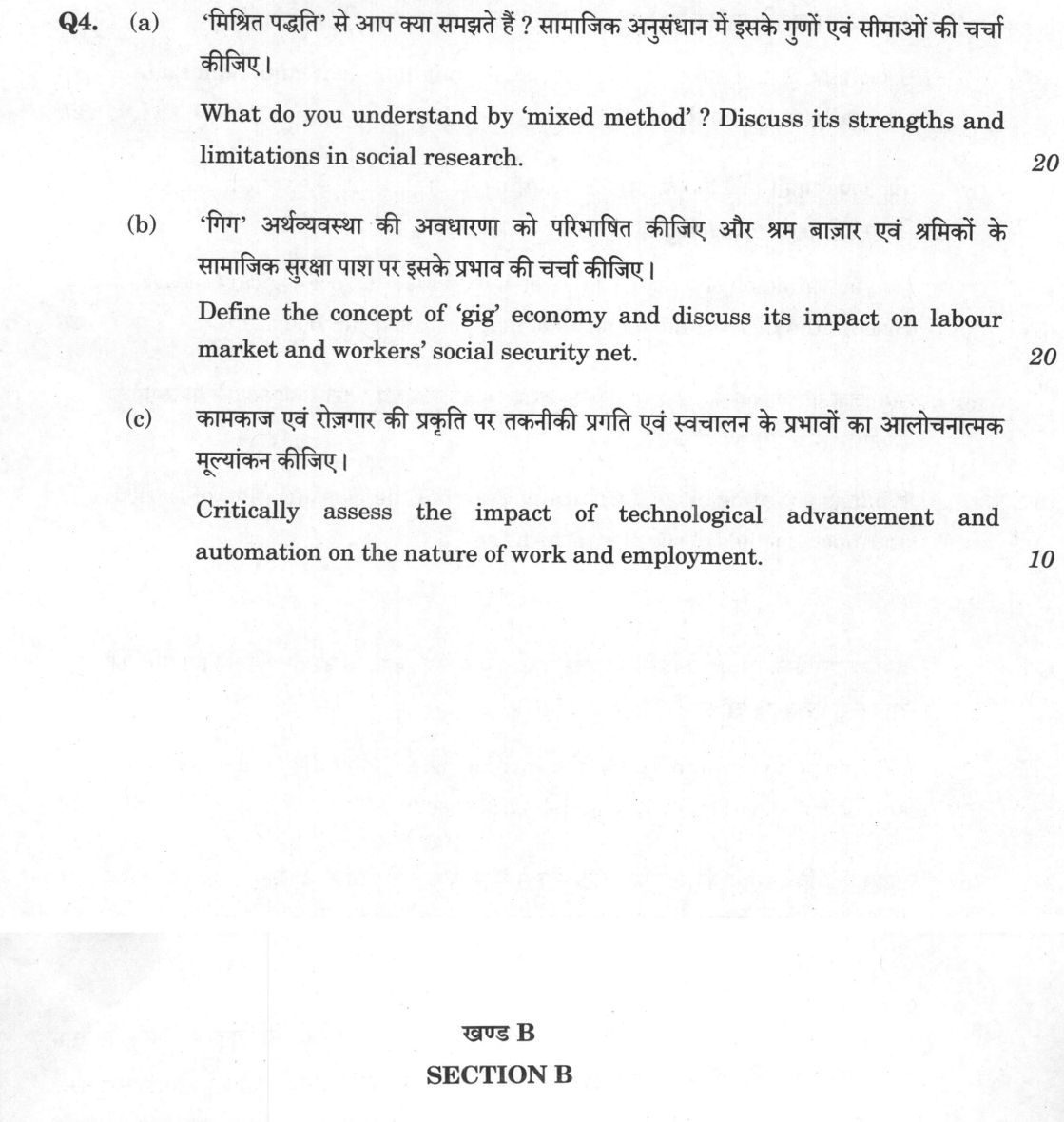
(a) What do you understand by 'mixed method'? Discuss its strengths and limitations in social research. (20 marks) (b) Define…
What do you understand by 'mixed method'? Discuss its strengths and limitations in social research. 20 marks
Define the concept of 'gig' economy and discuss its impact on labour market and workers' social security net. 20 marks
Critically assess the impact of technological advancement and automation on the nature of work and employment. 10 marks
हिंदी में प्रश्न पढ़ें
'मिश्रित पद्धति' से आप क्या समझते हैं? सामाजिक अनुसंधान में इसके गुणों एवं सीमाओं की चर्चा कीजिए। (20 अंक)
'गिग' अर्थव्यवस्था की अवधारणा को परिभाषित कीजिए और श्रम बाजार एवं श्रमिकों के सामाजिक सुरक्षा पाश पर इसके प्रभाव की चर्चा कीजिए। (20 अंक)
कामकाज एवं रोजगार की प्रकृति पर तकनीकी प्रगति एवं स्वचालन के प्रभावों का आलोचनात्मक मूल्यांकन कीजिए। (10 अंक)
Model answer
Written by UPSC Answer Check against this question's marking rubric, to the expected length. UPSC does not publish answers for Mains — this is one way to score well, not an official key.
Mixed Methods in Social Research
Mixed method research refers to the systematic integration of quantitative and qualitative paradigms, data collection, and analytical techniques within a single empirical investigation. As conceptualized by John Creswell and Vicki Plano Clark, mixed methods can be structured through distinct designs, including convergent parallel, explanatory sequential, and exploratory sequential designs. The approach serves three primary epistemological purposes: triangulation (cross-validating findings across different data sources), complementarity (using qualitative insights to clarify or illustrate quantitative trends), and expansion (extending the breadth and range of inquiry across macro-structures and micro-realities).
The principal strength of mixed methods lies in enhancing construct validity and providing a holistic understanding of complex phenomena by bridging positivist generalizability with interpretivist depth and contextualization. However, it faces significant limitations. Pragmatically, it is resource-, time-, and skill-intensive. Epistemologically, it encounters the paradigm incommensurability debate, wherein critics argue that the ontological assumptions of quantitative research (objective, measurable social facts) and qualitative research (socially constructed, subjective meanings) cannot be unproblematically fused.
The Gig Economy, Labour Markets, and Social Security
The gig economy represents a system of short-term, task-based, platform-mediated work coordinated through digital algorithms. While sharing vulnerabilities with the traditional informal sector, the gig economy is distinct: it is characterized by algorithmic management, proprietary rating systems, digital surveillance, and intermediary corporate platforms that discursively frame workers as independent partners rather than employees.
This restructuring has transformed labour markets through hyper-flexibilization, systemic casualization, and the erosion of the standard employment relationship (SER). By misclassifying labour as self-employed contractors, platforms shift operational risks and capital costs (such as vehicles and fuel) entirely onto workers. Consequently, it creates severe gaps in the social security net. Platform workers are excluded from traditional statutory entitlements such as the Employees' Provident Fund (EPF), Employees' State Insurance (ESI), gratuity, regulated working hours, and paid maternity benefits. Although the Code on Social Security, 2020 in India formally recognized gig and platform workers for targeted welfare board schemes, operationalization and universal coverage remain largely unrealized.
Technological Advancement, Automation, and the Nature of Work
Technological advancement and automation have polarized the sociology of work, reviving the debate between degradation and upgrading. Harry Braverman's deskilling thesis demonstrated how management uses technology to separate conception from execution, cheapening labour and intensifying managerial control. Conversely, post-Fordist theorists argue that technological modernization enables flexible specialization, upskilling, and worker autonomy in knowledge-intensive sectors.
In the contemporary platform and AI era, both processes occur simultaneously: high-end technical design is upskilled, while front-line work is subjected to algorithmic deskilling and intensification. In India, this tension is visible in recurrent strikes and collective protests by Ola and Uber drivers and Swiggy and Zomato delivery executives, organized against arbitrary algorithmic wage cuts, automated deactivations, and escalating surveillance.
Methodological Implications and Way Forward
Capturing these structural and experiential shifts in contemporary labour requires robust methodological innovation. A mixed-method approach—combining large-scale quantitative surveys (measuring wage fluctuations, working hours, and debt burdens) with digital and multi-sited ethnography (capturing algorithmic alienation, lived precarity, and informal worker solidarities)—provides the necessary analytical depth. Moving forward, addressing the dual pressures of technological disruption and labour casualization requires harmonizing innovation with enforceable statutory protections, algorithmic transparency, and institutionalized social dialogue.
What "Discuss" is asking you to do
Lay the issue out from more than one side — how it arose, what is claimed for it, what is held against it, and where it now stands. UPSC attaches discuss to broad topics with several live dimensions, so coverage of the dimensions earns more than the strength of your opinion.
Structure that answers it
Set the issue up → the case as it is made → the case against → the dimension both sides leave out → where the balance now lies
Where marks are lost
Listing facts with no thread between them, or arguing one side throughout and calling it a discussion.
How this answer will be evaluated
Approach
Framework: Sociology Paper 1 (Methodology & Contemporary Issues). (a) discuss: intro > 3-4 dimensions > example > balanced close | (b) discuss: intro > 3-4 dimensions > example > balanced close | (c) critique: the claim > its strengths > its weaknesses > your judgment Full marks: Precise definitions, named thinkers, specific Indian examples, balanced critical analysis, clear structure.
Key points expected
- Define mixed method (quant + qual integration)
- Name key proponent (e.g., Creswell, Tashakkori)
- List 3-4 specific strengths (triangulation, depth)
- List 3-4 specific limitations (complexity, cost)
- Define gig economy (platform-based, short-term)
- Analyze impact on labor market (flexibility vs precarity)
- Analyze impact on social security (exclusion from benefits)
- Mention specific Indian platforms (Uber, Zomato, Swiggy)
Evaluation rubric
Each sub-part is marked on its own, against the marks and word limit printed on the paper.
- (a) Define mixed method and evaluate its utility in social research. 20 marks
discuss— intro → 3-4 dimensions → example → balanced close
Must cover
- Define mixed method (quant + qual integration)
- Name key proponent (e.g., Creswell, Tashakkori)
- List 3-4 specific strengths (triangulation, depth)
- List 3-4 specific limitations (complexity, cost)
Loses marks
- Treating it as just 'using both methods' without integration
- Ignoring the limitations entirely
- Vague generalities without methodological specifics
Earns more
- Distinguish between concurrent and sequential designs
- Mention 'triangulation' as a core strength
- Reference specific Indian research context
- Balanced conclusion on when to use it
Extra mark
- Cite a specific Indian study using mixed methods
- Reference a specific methodological framework (e.g., PRISMA)
- (b) Define gig economy and analyze its dual impact on labor and security. 20 marks
discuss— intro → 3-4 dimensions → example → balanced close
Must cover
- Define gig economy (platform-based, short-term)
- Analyze impact on labor market (flexibility vs precarity)
- Analyze impact on social security (exclusion from benefits)
- Mention specific Indian platforms (Uber, Zomato, Swiggy)
Loses marks
- Focusing only on the benefits (flexibility) without the downsides
- Ignoring the social security aspect entirely
- Using outdated examples (pre-2015 platforms)
Earns more
- Reference the Code on Social Security, 2020
- Discuss the 'worker vs contractor' legal ambiguity
- Mention the Gig Workers Welfare Fund
- Contrast with traditional employment models
Extra mark
- Cite specific data on gig worker numbers in India
- Reference a specific court judgment on gig worker status
- (c) Critically assess how technology and automation change work and employment. 10 marks
critique— the claim → its strengths → its weaknesses → your judgment
Must cover
- Identify the shift in nature of work (skill polarization)
- Assess impact on employment (job displacement vs creation)
- Provide a critical judgment (not just description)
- Mention specific technologies (AI, robotics, automation)
Loses marks
- Purely descriptive answer without critical assessment
- Ignoring the 'nature of work' aspect (only focusing on quantity)
- Overly optimistic or pessimistic without nuance
Earns more
- Reference the 'Luddite' fallacy or technological unemployment
- Mention the 'Great Decoupling' of productivity and wages
- Discuss the rise of the 'precariat' class
- Reference specific Indian manufacturing or service sector examples
Extra mark
- Cite a specific report (e.g., World Bank, ILO) on automation
- Reference a specific Indian policy response to automation
Practice this exact question
Write your answer and it is marked point by point against the model answer above — what you covered, what you missed, what you got wrong.
Evaluate my answer →More from Sociology 2024 Paper I
- Q1 Answer the following questions in about 150 words each: (a) Discuss the nature of Sociolo…
- Q2 (a) Sociology is the product of European enlightenment and renaissance. Critically examin…
- Q3 (a) How do you view and assess the increasing trend of digital ethnography and use of vis…
- Q4 (a) What do you understand by 'mixed method'? Discuss its strengths and limitations in so…
- Q5 Answer the following questions in about 150 words each: (a) Describe various characterist…
- Q6 (a) Underline the role of social media in contemporary social movements and describe its…
- Q7 (a) Do modernization and secularization necessarily go together? Give your views. (20 mar…