Paper I — Q3
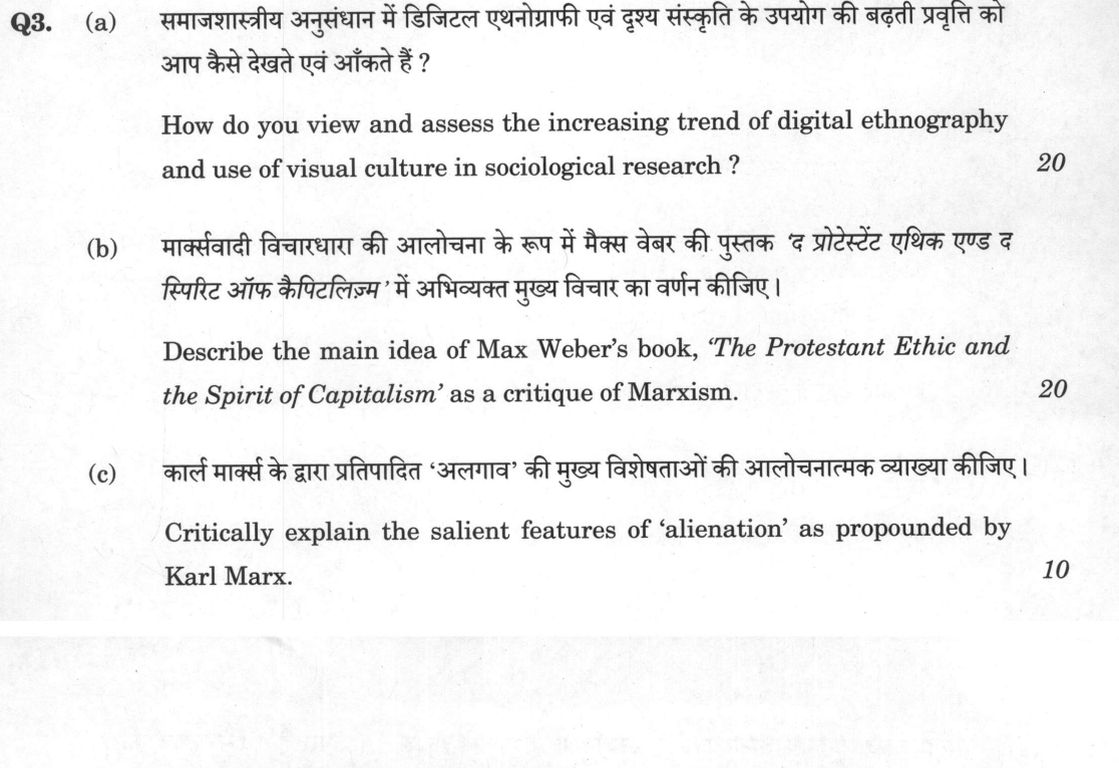
(a) How do you view and assess the increasing trend of digital ethnography and use of visual culture in sociological research?…
How do you view and assess the increasing trend of digital ethnography and use of visual culture in sociological research? 20 marks
Describe the main idea of Max Weber's book, 'The Protestant Ethic and the Spirit of Capitalism' as a critique of Marxism. 20 marks
Critically explain the salient features of 'alienation' as propounded by Karl Marx. 10 marks
हिंदी में प्रश्न पढ़ें
समाजशास्त्रीय अनुसंधान में डिजिटल एथनोग्राफी एवं दृश्य संस्कृति के उपयोग की बढ़ती प्रवृत्ति को आप कैसे देखते एवं आंकते हैं? (20 अंक)
मार्क्सवादी विचारधारा की आलोचना के रूप में मैक्स वेबर की पुस्तक द प्रोटेस्टेंट एथिक एंड द स्पिरिट ऑफ कैपिटलिज्म में अभिव्यक्त मुख्य विचार का वर्णन कीजिए। (20 अंक)
कार्ल मार्क्स के द्वारा प्रतिपादित 'अलगाव' की मुख्य विशेषताओं की आलोचनात्मक व्याख्या कीजिए। (10 अंक)
Model answer
Written by UPSC Answer Check against this question's marking rubric, to the expected length. UPSC does not publish answers for Mains — this is one way to score well, not an official key.
Contemporary sociological inquiry has witnessed a methodological and ontological transition through the rise of digital spaces and visual artefacts, while foundational debates on rationalisation, culture, and labour continue to anchor the discipline.
Digital Ethnography and Visual Culture in Sociological Research
Digital ethnography—incorporating Robert Kozinets’ ‘netnography’, virtual fieldwork, and multi-sited ethnography across online-offline continuums—democratises research by accessing previously inaccessible micro-interactions. Complementing this, visual sociology employs methods like photo-elicitation and participatory video to capture sensory, embodied realities.
In India, digital ethnography has unmasked algorithmic politics and vernacular counter-publics, such as the social media mobilisation during the 2020–21 Farmer Protests, TikTok creator economies among subaltern youth, and the epistemological echo chambers of ‘WhatsApp University’. Similarly, visual culture methodologies deconstruct power relations in Dharavi slum tourism photography and Srinagar street photojournalism, revealing how visuality constructs marginality.
However, critical evaluation reveals profound methodological and ethical limitations. The ‘digital divide’ skews digital ethnography toward urban, tech-literate cohorts, masking structural exclusions. Epistemologically, online self-presentation often conflates performativity with lived social reality. Ethically, algorithmic environments render traditional informed consent and genuine anonymity virtually impossible, turning sociologists into unwitting data miners. Thus, while visual and digital tools enrich thick description, they cannot substitute grounded structural immersion; they must be deployed alongside conventional fieldwork.
Weber’s Protestant Ethic as a Critique of Marxism
In The Protestant Ethic and the Spirit of Capitalism, Max Weber provides a methodological and substantive critique of Karl Marx’s historical materialism. Using the heuristic tool of the ‘ideal type’, Weber rejects Marx’s monocausal economic determinism—which reduces religion to a mere superstructural reflection of the material base—and instead advances the concept of elective affinity (Wahlverwandtschaft).
Weber demonstrates that Calvinist doctrines of predestination and the ‘calling’ (Beruf) generated an inner-worldly asceticism that compelled believers to pursue rational, methodical economic accumulation without hedonistic consumption. This religious ethos acted as an autonomous catalyst for modern rational capitalism. Substantively, Weber does not invert Marx into vulgar idealism; rather, he posits a pluralistic causality where cultural and religious values possess independent efficacy.
While Weber agrees with Marx on the dehumanising rationalisation of modern capitalism (the ‘iron cage’ of rational-bureaucratic bondage), he disputes that economic relations solely determine history. In the Indian context, parallel elective affinities appear in the ascetic business ethics of Jain and Marwari trading networks or the entrepreneurial rationalisation within ISKCON, validating Weber's thesis that cultural ethics actively structure economic behaviour rather than passively mirroring it.
Salient Features and Contemporary Relevance of Marxian Alienation
Karl Marx formulated alienation (Entfremdung) in his Economic and Philosophic Manuscripts of 1844 as the systemic estrangement of human beings under capitalism. Marx identified four interconnected dimensions: alienation from the product of labour (which confronts the worker as an alien, dominating power), from the act of production (labour as forced, unfulfilling misery), from species-being (Gattungswesen, the loss of creative self-realisation), and from fellow workers (reduced to hostile market competitors). Bertell Ollman extends this to a fifth dimension: alienation from nature.
Critically, early Marxian alienation has been extended by Herbert Marcuse and the Frankfurt School into the creation of the ‘one-dimensional man’ through false consumer needs, though post-Marxists critique Marx for ignoring how gender, caste, and race intersect with workplace alienation.
Today, alienation manifests acutely in platform capitalism, algorithmic management, and the attention economy. In India, this is visible in the physical exhaustion and surveillance of Amazon warehouse workers, the atomised precariousness of gig delivery workers, the exploitative alienation in Special Economic Zones (SEZs), and the chronic burnout of IT sector professionals stripped of creative agency.
Ultimately, while digital and visual ethnography provide indispensable methods to map contemporary socio-technical life, the complementary theoretical frameworks of Weber and Marx remain essential to decode modern rationalisation, digital labour extraction, and systemic alienation.
What "Critically evaluate" is asking you to do
Judge how well something has performed against the standard it set for itself — its stated aim, mandate or promise — and commit to a verdict. Name the yardstick before you judge; an unanchored judgement reads as opinion. “Critically” is not a section added at the end: name the yardstick you are judging by — the evidence, the stated objective, a constitutional principle, a rival explanation — and let a verdict close each part of the body. Where the question quotes a claim, that verdict must land on the claim itself, accepted, qualified or rejected, and not on the theme in general.
Structure that answers it
Name the yardstick — stated aim, mandate or benchmark → performance against it → shortfall against it → why the gap exists → verdict
Where marks are lost
Merits in one paragraph, demerits in the next, and a conclusion calling for a balanced and holistic approach. That is a survey with the judgement left out and it holds the answer in the middle band. The opposite error is reading “critically” as permission to attack — and with the odd pairings, critically describe or critically explain, the exposition still carries most of the marks, the judgement being a layer on it rather than a substitute for it.
How this answer will be evaluated
Approach
Framework: Sociology Paper 1 (UPSC). (a) discuss: intro > 3-4 dimensions > example > balanced close | (b) describe: define > structure or process in order > labelled diagram > significance | (c) explain: definition/context > points in order > small example > short close Full marks: Precise definitions, clear contrast of thinkers, and specific examples.
Key points expected
- Define digital ethnography and visual culture
- Explain methodological shift from traditional to digital
- Assess validity and reliability of digital data
- Provide a contemporary research example
- Define the 'Protestant Ethic' and 'Spirit of Capitalism'
- Explain the link between Calvinism and work ethic
- Contrast Weber's idealism with Marx's materialism
- Identify the specific critique of Marx's base-superstructure
Evaluation rubric
Each sub-part is marked on its own, against the marks and word limit printed on the paper.
- (a) Assess the shift to digital methods and visual data in sociological research. 20 marks
discuss— intro → 3-4 dimensions → example → balanced close
Must cover
- Define digital ethnography and visual culture
- Explain methodological shift from traditional to digital
- Assess validity and reliability of digital data
- Provide a contemporary research example
Loses marks
- Treating digital ethnography as just 'online surveys'
- Ignoring the role of visual data (images/video)
Earns more
- Mention specific digital tools (e.g., social media scraping)
- Discuss ethical issues of digital surveillance
- Reference specific sociologists (e.g., Hine, Pink)
Extra mark
- Cite a specific Indian digital study
- Mention a specific visual culture project
- (b) Explain Weber's thesis on religion and capitalism as a critique of Marx. 20 marks
describe— define → structure or process in order → labelled diagram → significance
Must cover
- Define the 'Protestant Ethic' and 'Spirit of Capitalism'
- Explain the link between Calvinism and work ethic
- Contrast Weber's idealism with Marx's materialism
- Identify the specific critique of Marx's base-superstructure
Loses marks
- Confusing Weber's view with Marx's view
- Failing to explicitly state the critique of Marxism
Earns more
- Mention 'inner-worldly asceticism'
- Reference the 'iron cage' of rationality
- Discuss the role of 'rationalization'
Extra mark
- Mention the 'elect' or 'predestination' concept
- Reference a specific Weberian concept like 'Verstehen'
- (c) Critically explain the four dimensions of Marx's concept of alienation. 10 marks
explain— definition/context → points in order → small example → short close
Must cover
- Define alienation in the context of capitalism
- Explain alienation from the product of labor
- Explain alienation from the process of labor
- Explain alienation from species-being and others
Loses marks
- Confusing alienation with general 'unhappiness'
- Missing the 'species-being' dimension
Earns more
- Link alienation to 'commodity fetishism'
- Mention the role of private property
- Provide a modern example of alienation
Extra mark
- Reference a specific Marxist text (e.g., 1844 Manuscripts)
- Mention 'estrangement' as a synonym
Practice this exact question
Write your answer and it is marked point by point against the model answer above — what you covered, what you missed, what you got wrong.
Evaluate my answer →More from Sociology 2024 Paper I
- Q1 Answer the following questions in about 150 words each: (a) Discuss the nature of Sociolo…
- Q2 (a) Sociology is the product of European enlightenment and renaissance. Critically examin…
- Q3 (a) How do you view and assess the increasing trend of digital ethnography and use of vis…
- Q4 (a) What do you understand by 'mixed method'? Discuss its strengths and limitations in so…
- Q5 Answer the following questions in about 150 words each: (a) Describe various characterist…
- Q6 (a) Underline the role of social media in contemporary social movements and describe its…