Paper I — Q2
(a) Sociology is the product of European enlightenment and renaissance. Critically examine this statement. (20 marks) (b) Do you…
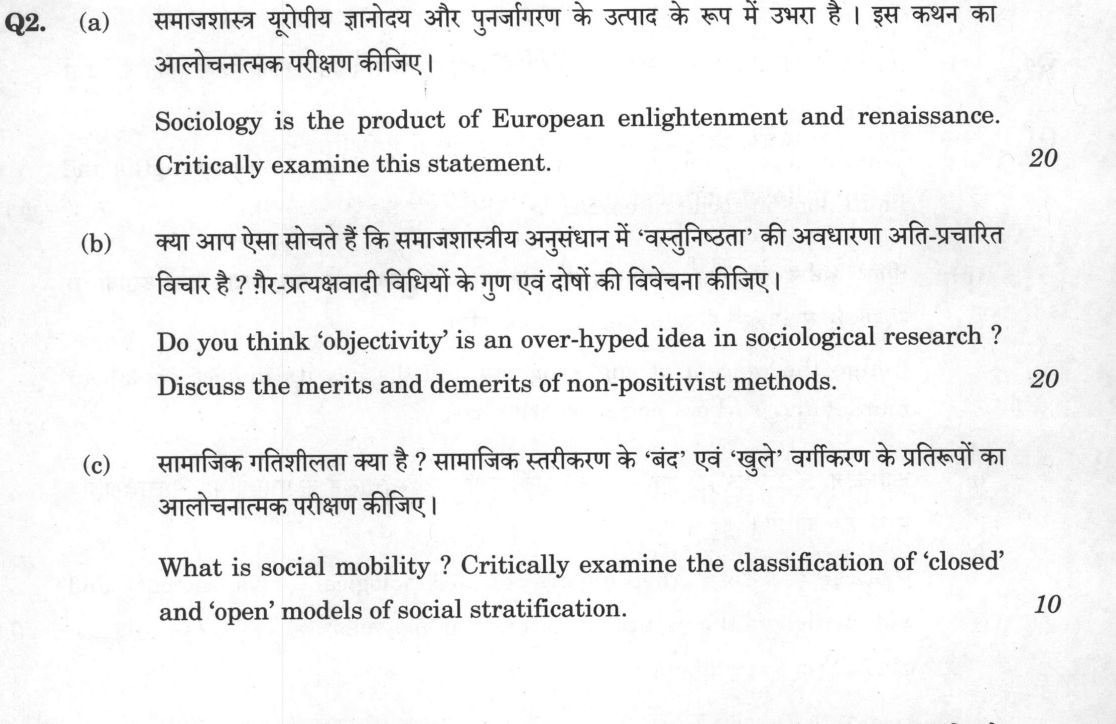
Sociology is the product of European enlightenment and renaissance. Critically examine this statement. 20 marks
Do you think 'objectivity' is an over-hyped idea in sociological research? Discuss the merits and demerits of non-positivist methods. 20 marks
What is social mobility? Critically examine the classification of 'closed' and 'open' models of social stratification. 10 marks
हिंदी में प्रश्न पढ़ें
समाजशास्त्र यूरोपीय ज्ञानोदय और पुनर्जागरण के उत्पाद के रूप में उभरा है। इस कथन का आलोचनात्मक परीक्षण कीजिए। (20 अंक)
क्या आप ऐसा सोचते हैं कि समाजशास्त्रीय अनुसंधान में 'वस्तुनिष्ठता' की अवधारणा अति-प्रचारित विचार है? गैर-प्रत्यक्षवादी विधियों के गुण एवं दोषों की विवेचना कीजिए। (20 अंक)
सामाजिक गतिशीलता क्या है? सामाजिक स्तरीकरण के 'बंद' एवं 'खुले' वर्गीकरण के प्रतिरूपों का आलोचनात्मक परीक्षण कीजिए। (10 अंक)
Model answer
Written by UPSC Answer Check against this question's marking rubric, to the expected length. UPSC does not publish answers for Mains — this is one way to score well, not an official key.
Sociology’s birth in Europe makes the statement plausible, but it is incomplete. The discipline was shaped by Enlightenment reason, secularism and Comte’s positivism, yet it also responded to industrialisation, colonial administration and non-European intellectual traditions. A critical reading therefore accepts its European matrix while resisting a purely Eurocentric account.
Enlightenment, Renaissance and colonial critique Renaissance humanism and individualism helped create the subject-object distinction, the study of human agency and confidence in rational inquiry. The Renaissance also revived classical ideas of citizenship and political community, which later fed into social contract thinking. Enlightenment ideas of progress, rights, secular public life and universal reason gave sociology its central problematics: society as an ordered system amenable to law-like explanation. Comte’s positivism, Durkheim’s social facts and Marx’s historical materialism all drew on this rationalist tradition. Yet sociology emerged not only from philosophy but also from the Industrial Revolution, urbanisation, class conflict and colonial governance and state formation. British census operations in India, for example, produced categories of caste, religion and tribe that shaped later sociological analysis and administrative control. Postcolonial critiques, especially Said’s Orientalism, show that European sociology often constructed the non-West as static, irrational or in need of European reason. The Indological school’s Eurocentrism and the recovery of alternative knowledge systems, such as Ibn Khaldun’s civilisational analysis, challenge the claim that sociology is simply a European product. Dipesh Chakrabarty’s call to provincialise Europe reinforces this: European categories are useful but must be historicised and translated into local contexts.
Objectivity and non-positivist methods Objectivity is not over-hyped, but it is over-simplified when treated as detached neutrality. Weber’s value-neutrality insisted that researchers distinguish facts from values, make assumptions explicit and avoid letting normative commitments distort evidence. Gouldner’s critique of the myth of value-free sociology argues that selection of topics, methods, categories and interpretations is always socially situated. Feminist standpoint theory, in Harding and Smith, and subaltern studies show that marginalised positions can reveal power relations invisible to dominant perspectives. In Indian research, this matters when studying caste, gender and subalternity, where outsider categories can misread local moral economies. Non-positivist methods, such as ethnography, verstehen and participatory action research, offer interpretive depth, contextual validity and the ability to study meaning, identity, resistance and lived experience. Their demerits are real: limited replicability, researcher subjectivity, small samples, interpretive bias and weak generalisability. The verdict is that objectivity should be understood as reflexive accountability, transparency and peer scrutiny rather than impossible detachment.
Social mobility and stratification models Social mobility, in Sorokin and Lipset-Zetterberg, is movement of individuals or groups between positions in a stratified system. It is measured intergenerationally or intragenerationally, and as structural mobility caused by economic change or exchange mobility through individual achievement. In India, mobility is often cultural and political before it is purely economic. Closed models, such as caste as an ideal-type and Dumont’s homo hierarchicus, emphasise birth, ritual status, endogamy and restricted mobility. Open models, such as class and the Davis-Moore thesis, stress merit, function, competition and achievement. India shows a mixed system: Sanskritisation, as analysed by Srinivas, indicates cultural mobility within caste boundaries; Mandal Commission data documented OBC backwardness and recommended reservations, while later OBC mobility patterns show partial, uneven movement. Thus neither closed nor open model fully captures Indian reality.
In conclusion, sociology is historically European but not exclusively so. Its Enlightenment roots remain important, but postcolonial and feminist critiques require epistemological pluralism. Objectivity is best retained as reflexive rigor, and stratification must be studied as a hybrid of caste, class and mobility. For Indian society, this means using multiple methods and historicised categories to explain both continuity and change.
What "Critically examine" is asking you to do
Test the proposition the question puts to you and return a finding on how far it holds. Examine stems carry a claim, or ask whether something has happened, and expect evidence weighed both ways before the extent is stated — often with remedial measures attached. “Critically” is not a section added at the end: name the yardstick you are judging by — the evidence, the stated objective, a constitutional principle, a rival explanation — and let a verdict close each part of the body. Where the question quotes a claim, that verdict must land on the claim itself, accepted, qualified or rejected, and not on the theme in general.
Structure that answers it
Restate the claim as the question frames it → evidence that supports it → evidence that undercuts it → the conditions under which it holds → verdict on how far it stands
Where marks are lost
Merits in one paragraph, demerits in the next, and a conclusion calling for a balanced and holistic approach. That is a survey with the judgement left out and it holds the answer in the middle band. The opposite error is reading “critically” as permission to attack — and with the odd pairings, critically describe or critically explain, the exposition still carries most of the marks, the judgement being a layer on it rather than a substitute for it.
How this answer will be evaluated
Approach
(a) critique: the claim > its strengths > its weaknesses > your judgment | (b) discuss: intro > 3-4 dimensions > example > balanced close | (c) critique: the claim > its strengths > its weaknesses > your judgment Full marks: Precise definitions, named thinkers, balanced critical analysis, specific examples.
Key points expected
- Link sociology to specific Enlightenment thinkers (e.g., Comte, Durkheim)
- Identify Renaissance contributions (e.g., humanism, secularism)
- Critique the Eurocentric bias of the statement
- Mention non-European or pre-modern antecedents
- Define 'objectivity' in the positivist context
- Argue for/against objectivity being 'over-hyped'
- List merits of non-positivist methods (e.g., depth, context)
- List demerits of non-positivist methods (e.g., subjectivity, generalizability)
Evaluation rubric
Each sub-part is marked on its own, against the marks and word limit printed on the paper.
- (a) Assess the validity of sociology's origin in European Enlightenment and Renaissance. 20 marks
critique— the claim → its strengths → its weaknesses → your judgment
Must cover
- Link sociology to specific Enlightenment thinkers (e.g., Comte, Durkheim)
- Identify Renaissance contributions (e.g., humanism, secularism)
- Critique the Eurocentric bias of the statement
- Mention non-European or pre-modern antecedents
Loses marks
- Treating the statement as an absolute fact
- Name-dropping thinkers without explaining their contribution
- Ignoring the 'critical' aspect of the command
Earns more
- Reference to specific works (e.g., Comte's 'Positive Philosophy')
- Discussion of the 'sociological imagination' (Mills)
- Mention of Indian sociological antecedents (e.g., Kautilya, Manu)
Extra mark
- Cite a specific statistic on global sociology
- Reference a specific non-Western sociologist
- (b) Evaluate the status of objectivity and the merits/demerits of non-positivist methods. 20 marks
discuss— intro → 3-4 dimensions → example → balanced close
Must cover
- Define 'objectivity' in the positivist context
- Argue for/against objectivity being 'over-hyped'
- List merits of non-positivist methods (e.g., depth, context)
- List demerits of non-positivist methods (e.g., subjectivity, generalizability)
Loses marks
- Confusing 'objectivity' with 'neutrality'
- Failing to distinguish positivist and non-positivist methods
- Providing only merits without demerits
Earns more
- Reference to interpretive sociology (Weber, Schutz)
- Mention of specific non-positivist methods (e.g., ethnography, phenomenology)
- Discussion of 'value-freedom' vs 'value-commitment'
Extra mark
- Cite a specific study using non-positivist methods
- Reference a specific debate on research ethics
- (c) Define social mobility and critically examine closed vs open stratification models. 10 marks
critique— the claim → its strengths → its weaknesses → your judgment
Must cover
- Define social mobility (vertical/horizontal)
- Define 'closed' stratification (e.g., caste, class)
- Define 'open' stratification (e.g., class, meritocracy)
- Critically compare the two models
Loses marks
- Confusing 'stratification' with 'mobility'
- Failing to provide a critical examination
- Using vague definitions without examples
Earns more
- Reference to specific theories (e.g., Marx, Weber)
- Mention of 'social fluidity' or 'social viscosity'
- Use of Indian examples (e.g., caste mobility)
Extra mark
- Cite a specific statistic on Indian mobility
- Reference a specific government report (e.g., NFHS)
Practice this exact question
Write your answer and it is marked point by point against the model answer above — what you covered, what you missed, what you got wrong.
Evaluate my answer →More from Sociology 2024 Paper I
- Q1 Answer the following questions in about 150 words each: (a) Discuss the nature of Sociolo…
- Q2 (a) Sociology is the product of European enlightenment and renaissance. Critically examin…
- Q3 (a) How do you view and assess the increasing trend of digital ethnography and use of vis…
- Q4 (a) What do you understand by 'mixed method'? Discuss its strengths and limitations in so…
- Q5 Answer the following questions in about 150 words each: (a) Describe various characterist…