Paper I — Q6
(a) Underline the role of social media in contemporary social movements and describe its challenges. (20 marks) (b) How does a…
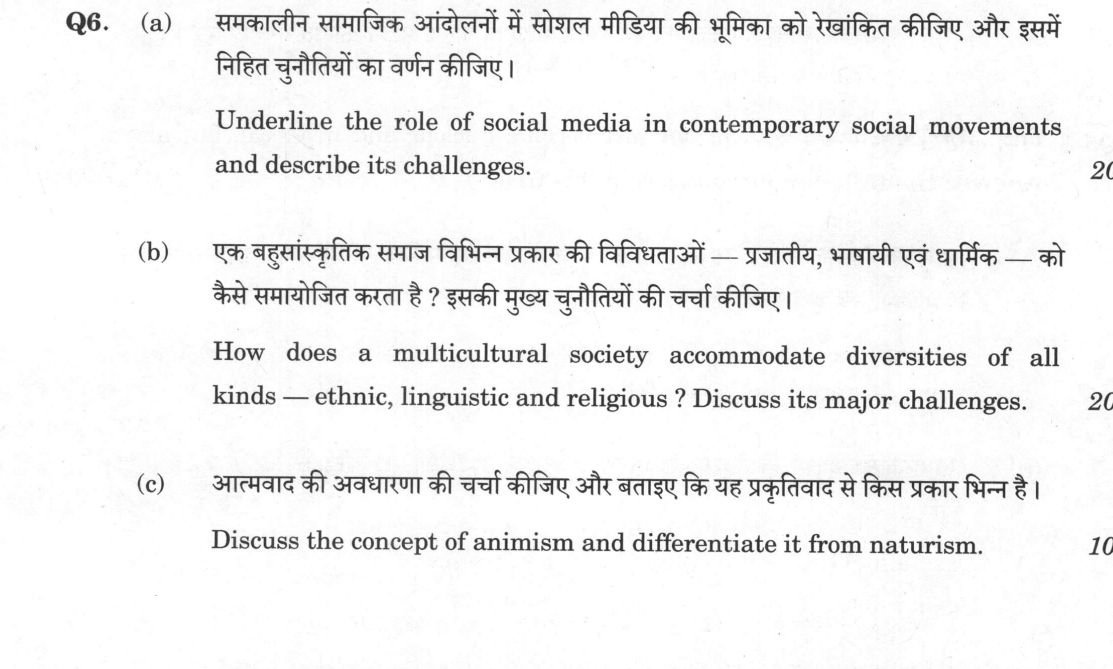
Underline the role of social media in contemporary social movements and describe its challenges. 20 marks
How does a multicultural society accommodate diversities of all kinds — ethnic, linguistic and religious? Discuss its major challenges. 20 marks
Discuss the concept of animism and differentiate it from naturism. 10 marks
हिंदी में प्रश्न पढ़ें
समकालीन सामाजिक आंदोलनों में सोशल मीडिया की भूमिका को रेखांकित कीजिए और इसमें निहित चुनौतियों का वर्णन कीजिए। (20 अंक)
एक बहुसांस्कृतिक समाज विभिन्न प्रकार की विविधताओं — प्रजातीय, भाषायी एवं धार्मिक — को कैसे समायोजित करता है? इसकी मुख्य चुनौतियों की चर्चा कीजिए। (20 अंक)
आत्मवाद की अवधारणा की चर्चा कीजिए और बताइए कि यह प्रकृतिवाद से किस प्रकार भिन्न है। (10 अंक)
Model answer
Written by UPSC Answer Check against this question's marking rubric, to the expected length. UPSC does not publish answers for Mains — this is one way to score well, not an official key.
Part (a) Social media has become the mobilisation infrastructure of contemporary social movements. It reduces the cost of organising, enables horizontal coordination, and allows movements to bypass gatekeepers by creating hashtags, livestreams and viral narratives. In Castells’ network society, power shifts from mass media to networked publics, where information flows shape collective action. Tufekci’s Twitter and Tear Gas shows that speed can accelerate mobilisation but also weaken deliberation, making coalitions fragile. In India, CAA-NRC protests used WhatsApp, Twitter and Instagram to counter misinformation, organise sit-ins such as Shaheen Bagh, and mobilise legal and material support. The farmers’ protest sustained long-term visibility through Twitter/X, YouTube and live streams, coordinating rallies and sharing updates. MeToo India used social media to break silence, create public accountability and sustain solidarity, though it also exposed victims to privacy violations and gendered harassment.
The challenges are equally significant. Slacktivism reduces participation to likes, shares and performative outrage without sustained commitment. Algorithmic bias amplifies polarising content and marginalises nuanced voices. Surveillance, data misuse and platform repression can expose activists to state or corporate control. Misinformation and disinformation distort facts and inflame tensions. The digital divide excludes rural, poor, elderly and many women users, making movements appear urban and elite.
Part (b) A multicultural society accommodates diversity through constitutional safeguards, federalism, minority rights and plural citizenship. In India, Articles 29-30 protect language, culture and minority educational institutions; Articles 350A-B promote mother-tongue instruction and regional languages. Federalism allows states to manage linguistic and ethnic identities, while minority rights and cultural pluralism recognise that citizenship need not require cultural homogeneity. Kymlicka’s multicultural citizenship argues for group-differentiated rights, balancing individual equality with collective identity. This differs from Indian syncretism, where shared festivals, Sufi-Bhakti traditions and composite cultural practices create overlapping identities.
The major challenges are majoritarianism, religious polarisation and competitive communalism, which can turn cultural difference into political threat. Linguistic state reorganisation has limits: it can settle some disputes but also harden boundaries, as seen in Hindi-Tamil tensions and Northeast insurgencies over ethnic identity. Anti-conversion laws and the abrogation of Article 370, eroding Kashmir’s autonomy, raise concerns about religious freedom and federal balance. Accommodation therefore requires not merely tolerance but institutional recognition, redistribution, representation and protection of vulnerable communities.
Part (c) Animism, in Tylor’s “minimum definition of religion”, is belief in spiritual beings, including souls, spirits and ancestors. Marett’s pre-animism critique questioned whether such beliefs are necessarily intellectual constructions, suggesting that simpler magical or animistic practices may precede elaborate religion. Naturism, or nature worship, associated with Max Müller, locates religion in awe of natural phenomena, especially solar mythology and the personification of natural forces. Frazer’s contribution was to argue that magic preceded religion, including animism and naturism, rather than to reject intellectualist assumptions.
The two differ in object, emotion and evolutionary interpretation. Animism focuses on spirits or beings, often involving fear, awe and negotiation with unseen agents; naturism focuses on natural phenomena, often involving dependence on, or reverence for, nature. The evolutionary stage debate shows that these categories are analytical, not fixed. Today, animism has relevance for indigenous rights, sacred sites and environmental sociology, while naturism informs ecological ethics and conservation.
In conclusion, contemporary Indian society must combine digital accountability, constitutional multiculturalism and respectful engagement with religious diversity. Social media can empower movements but needs literacy, platform responsibility and protection from surveillance. Multicultural governance must balance unity with recognition of linguistic, ethnic and religious difference. Religious sociology reminds us that beliefs in spirits and nature continue to shape identity, rights and environmental politics. This integrated approach is essential for a secular, plural and digitally connected India.
What "Discuss" is asking you to do
Lay the issue out from more than one side — how it arose, what is claimed for it, what is held against it, and where it now stands. UPSC attaches discuss to broad topics with several live dimensions, so coverage of the dimensions earns more than the strength of your opinion.
Structure that answers it
Set the issue up → the case as it is made → the case against → the dimension both sides leave out → where the balance now lies
Where marks are lost
Listing facts with no thread between them, or arguing one side throughout and calling it a discussion.
How this answer will be evaluated
Approach
Framework: Sociology Paper 1 (UPSC). (a) describe: define > structure or process in order > labelled diagram > significance | (b) discuss: intro > 3-4 dimensions > example > balanced close | (c) discuss: intro > 3-4 dimensions > example > balanced close Full marks: Comprehensive, well-structured, with specific examples and clear differentiation.
Key points expected
- Define role of social media in mobilization
- Explain role in agenda setting and visibility
- Describe 3-4 specific challenges (e.g., misinformation)
- Provide Indian illustration (e.g., #MeToo, CAA protests)
- Define multiculturalism and accommodation mechanisms
- Address ethnic, linguistic, and religious dimensions
- Discuss 3-4 major challenges (e.g., assimilation pressure)
- Provide Indian context (e.g., linguistic states, secularism)
Evaluation rubric
Each sub-part is marked on its own, against the marks and word limit printed on the paper.
- (a) Role of social media in contemporary social movements and its challenges. 20 marks
describe— define → structure or process in order → labelled diagram → significance
Must cover
- Define role of social media in mobilization
- Explain role in agenda setting and visibility
- Describe 3-4 specific challenges (e.g., misinformation)
- Provide Indian illustration (e.g., #MeToo, CAA protests)
Loses marks
- Generalizing without specific movement examples
- Ignoring the 'challenges' aspect of the prompt
Earns more
- Mention specific platform (Twitter, WhatsApp)
- Reference to 'slacktivism' or 'digital divide'
- Contrast traditional vs digital mobilization
Extra mark
- Cite specific data on digital literacy
- Reference to specific Supreme Court ruling on IT rules
- (b) Mechanisms of accommodation in multicultural society and major challenges. 20 marks
discuss— intro → 3-4 dimensions → example → balanced close
Must cover
- Define multiculturalism and accommodation mechanisms
- Address ethnic, linguistic, and religious dimensions
- Discuss 3-4 major challenges (e.g., assimilation pressure)
- Provide Indian context (e.g., linguistic states, secularism)
Loses marks
- Treating diversity as a problem rather than a feature
- Lack of specific Indian examples
Earns more
- Reference to 'cultural pluralism' vs 'assimilation'
- Mention specific policies (e.g., 8th Schedule)
- Discuss 'communalism' as a challenge
Extra mark
- Cite specific census data on linguistic diversity
- Reference to specific Supreme Court case on secularism
- (c) Concept of animism and differentiation from naturism. 10 marks
discuss— intro → 3-4 dimensions → example → balanced close
Must cover
- Define animism (belief in spirits in nature)
- Define naturism (nature as the ultimate reality)
- Differentiate the two concepts clearly
- Provide examples of animistic practices
Loses marks
- Confusing animism with animatism
- Failing to clearly differentiate from naturism
Earns more
- Reference to specific anthropological thinkers (e.g., Tylor)
- Mention specific tribal practices in India
Extra mark
- Reference to specific ethnographic study
- Mention specific ritual or ceremony
Practice this exact question
Write your answer and it is marked point by point against the model answer above — what you covered, what you missed, what you got wrong.
Evaluate my answer →More from Sociology 2024 Paper I
- Q3 (a) How do you view and assess the increasing trend of digital ethnography and use of vis…
- Q4 (a) What do you understand by 'mixed method'? Discuss its strengths and limitations in so…
- Q5 Answer the following questions in about 150 words each: (a) Describe various characterist…
- Q6 (a) Underline the role of social media in contemporary social movements and describe its…
- Q7 (a) Do modernization and secularization necessarily go together? Give your views. (20 mar…
- Q8 (a) Modern families have not just become nuclear and neo-local, but also filiocentric. Ho…