Paper I — Q5
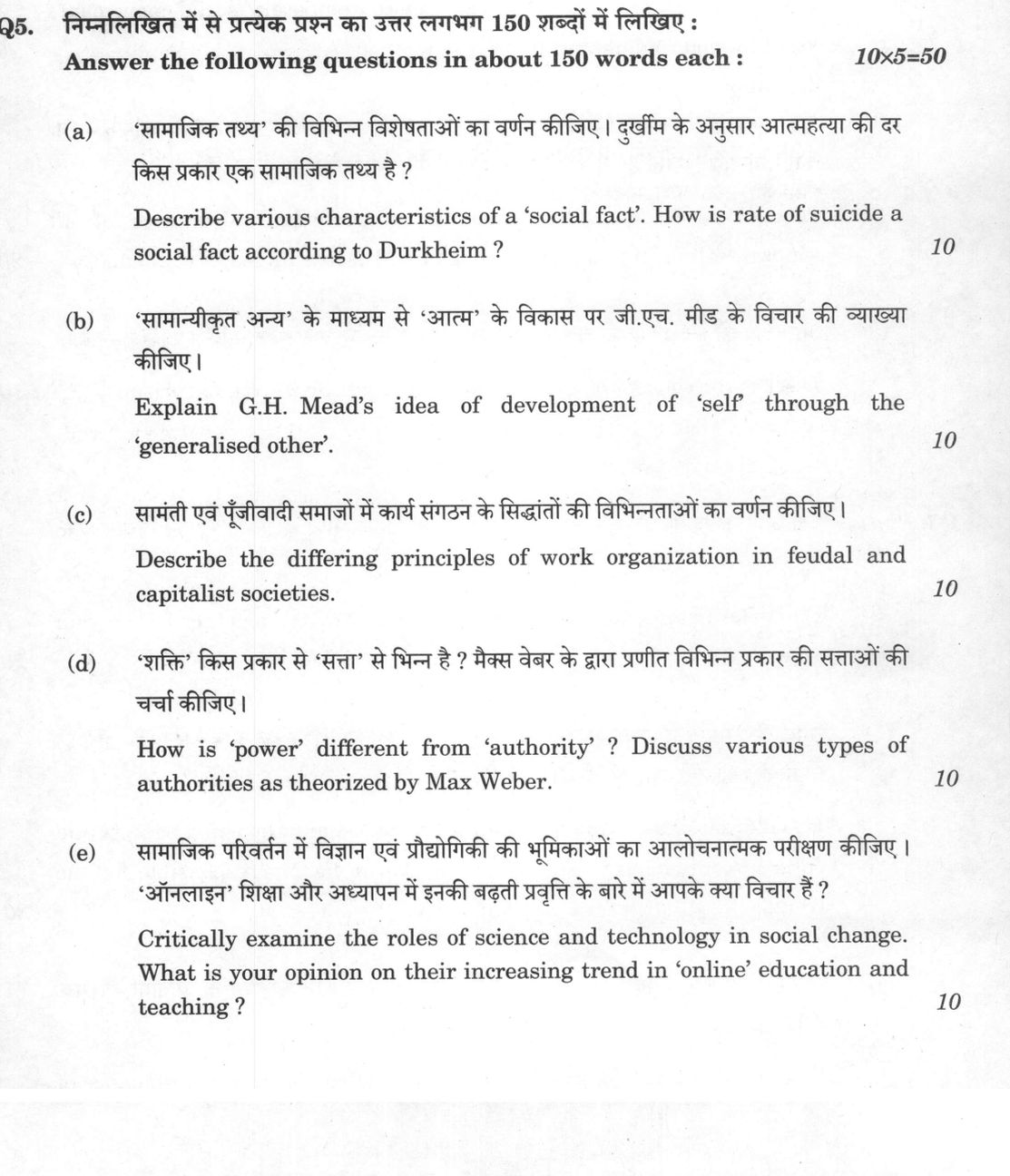
Answer the following questions in about 150 words each: (a) Describe various characteristics of a 'social fact'. How is rate of…
Answer the following questions in about 150 words each:
Describe various characteristics of a 'social fact'. How is rate of suicide a social fact according to Durkheim? 10 marks
Explain G.H. Mead's idea of development of 'self' through the 'generalised other'. 10 marks
Describe the differing principles of work organization in feudal and capitalist societies. 10 marks
How is 'power' different from 'authority'? Discuss various types of authorities as theorized by Max Weber. 10 marks
Critically examine the roles of science and technology in social change. What is your opinion on their increasing trend in 'online' education and teaching? 10 marks
हिंदी में प्रश्न पढ़ें
निम्नलिखित में से प्रत्येक प्रश्न का उत्तर लगभग 150 शब्दों में लिखिए:
'सामाजिक तथ्य' की विभिन्न विशेषताओं का वर्णन कीजिए। दुर्खीम के अनुसार आत्महत्या की दर किस प्रकार एक सामाजिक तथ्य है? (10 अंक)
'सामान्यीकृत अन्य' के माध्यम से 'आत्म' के विकास पर जी.एच. मीड के विचार की व्याख्या कीजिए। (10 अंक)
सामंती एवं पूंजीवादी समाजों में कार्य संगठन के सिद्धांतों की विभिन्नताओं का वर्णन कीजिए। (10 अंक)
'शक्ति' किस प्रकार से 'सत्ता' से भिन्न है? मैक्स वेबर के द्वारा प्रणीत विभिन्न प्रकार की सत्ताओं की चर्चा कीजिए। (10 अंक)
सामाजिक परिवर्तन में विज्ञान एवं प्रौद्योगिकी की भूमिकाओं का आलोचनात्मक परीक्षण कीजिए। 'ऑनलाइन' शिक्षा और अध्यापन में इनकी बढ़ती प्रवृत्ति के बारे में आपके क्या विचार हैं? (10 अंक)
Model answer
Written by UPSC Answer Check against this question's marking rubric, to the 150-word length. UPSC does not publish answers for Mains — this is one way to score well, not an official key.
(a) Émile Durkheim, in The Rules of Sociological Method (1895), defines a 'social fact' as every way of acting, thinking, and feeling that presents the notable property of existing outside the individual consciousness. Its primary characteristics are externality (it exists independent of individual will), constraint (it exercises coercive power over individual conduct), and generality (it is widespread throughout a given society). In Suicide (1897), Durkheim establishes that while individual suicides appear psychological, the suicide rate is a distinct sui generis social fact. The suicide rate exhibits structural stability across time and distinct variations across social groups. Durkheim demonstrates that suicide rates correlate inversely or excessively with two core social currents: integration and regulation. This yields four ideal types: egoistic (inadequate social integration), altruistic (excessive integration), anomic (insufficient normative regulation during rapid economic change), and fatalistic (oppressive over-regulation). Thus, suicide rates reflect the macro-level health of collective conscience.
(b) George Herbert Mead rejected biological reductionism, conceptualizing the 'self' not as a static, innate structure, but as an emergent social process developed through symbolic interaction. The self comprises two dialectical phases: the 'I' (the impulsive, spontaneous, and unorganized subjective response) and the 'me' (the organized set of attitudes of others that the individual assumes). The ontogenetic evolution of the self proceeds through developmental stages. In the preparatory stage, infants engage in simple imitation. In the play stage, the child assumes the role of a particular significant other (such as a parent). In the game stage, the child must internalize the simultaneous, interconnected roles and rules of all participants. Through this, the child develops the 'generalised other'—the internalized collective norms, values, and expectations of the wider community. The generalized other allows the individual to achieve self-consciousness and engage in self-regulation, ensuring the internalization of social control.
(c) Feudal and capitalist societies structure work around opposing socio-economic principles. Feudal work organization was status-based, ascriptive, and localized. Production was organized around unfree serfdom, where peasants were tied to the land and surrendered agricultural surplus through extra-economic, customary coercion. Work relations operated within an ethos of paternalism and mutual, though unequal, reciprocal obligations. Production prioritized use-values for localized subsistence and the conspicuous consumption of the nobility. Conversely, capitalist work organization is contractual, achievement-oriented, and anchored in market rationalism. It is built on formally 'free' wage labor separated from the means of production, as theorized by Karl Marx. Work is geared entirely toward exchange-value and capital accumulation through the extraction of surplus value. Labor is rationalized via extreme division of labor, scientific management (Taylorism), and assembly-line standardization (Fordism), reducing human labor into a quantifiable commodity while generating structural alienation.
(d) Max Weber distinguishes 'power' (Macht) from 'authority' (Herrschaft). Power is the probability that one actor within a social relationship will carry out their will even against resistance, regardless of the basis on which this probability rests. It is often coercive and unstable. Authority, or legitimate domination, arises when power is accepted as legitimate and binding by those subject to it, transforming obedience into a recognized duty. Weber delineates three ideal types of authority based on the grounds of their legitimacy claims: Traditional authority rests on an established belief in the sanctity of immemorial traditions and the legitimacy of those exercising rule under customary norms, such as feudal lords or patriarchal village heads. Charismatic authority rests on devotion to the exceptional sanctity, heroism, or exemplary character of an individual leader, seen in figures like Mahatma Gandhi. Legal-rational authority is grounded in the legality of enacted rules and the right of those elevated to authority under such rules to issue commands, exemplified by modern state bureaucracies and constitutional legal systems.
(e) Science and technology function as profound drivers of social change, replacing traditional worldviews with instrumental rationality and disenchantment, as noted by Max Weber. However, as Ulrich Beck argues in his Risk Society thesis, technological advancement is not unilinearly emancipatory; it systematically manufactures new ecological and technological hazards.
This duality is evident in the increasing trend of online education. On one hand, digital platforms provide educational democratization, temporal flexibility, and scalable access to pedagogical resources, supported in India through initiatives like SWAYAM and DIKSHA. On the other hand, critical evaluation reveals that unbridled online education deepens structural inequalities. It entrenches the digital divide along class, caste, and gender lines, degrades the pedagogical role of educators through deskilling into standardized content managers, and facilitates corporate data surveillance. Crucially, virtual instruction fails to replicate the physical classroom's function in democratic socialisation, peer learning, and civic dialogue. Therefore, online tools must serve strictly as an auxiliary aid to strengthen, rather than a market-driven replacement for, universal public educational institutions.
What "Critically examine" is asking you to do
Test the proposition the question puts to you and return a finding on how far it holds. Examine stems carry a claim, or ask whether something has happened, and expect evidence weighed both ways before the extent is stated — often with remedial measures attached. “Critically” is not a section added at the end: name the yardstick you are judging by — the evidence, the stated objective, a constitutional principle, a rival explanation — and let a verdict close each part of the body. Where the question quotes a claim, that verdict must land on the claim itself, accepted, qualified or rejected, and not on the theme in general.
Structure that answers it
Restate the claim as the question frames it → evidence that supports it → evidence that undercuts it → the conditions under which it holds → verdict on how far it stands
Where marks are lost
Merits in one paragraph, demerits in the next, and a conclusion calling for a balanced and holistic approach. That is a survey with the judgement left out and it holds the answer in the middle band. The opposite error is reading “critically” as permission to attack — and with the odd pairings, critically describe or critically explain, the exposition still carries most of the marks, the judgement being a layer on it rather than a substitute for it.
How this answer will be evaluated
Approach
Framework: Sociology Paper 1 (UPSC). (a) describe: define > structure or process in order > labelled diagram > significance | (b) explain: definition/context > points in order > small example > short close | (c) describe: define > structure or process in order > labelled diagram > significance | (d) discuss: intro > 3-4 dimensions > example > balanced close | (e) examine: intro > how/why with reasoning > evidence > conclusion Full marks: Precise definitions, clear thinker attribution, balanced critique, and specific examples.
Key points expected
- Define social fact as external and coercive
- Mention Durkheim's 'Suicide' study
- Explain suicide rate as a social fact
- Distinguish individual act from social fact
- Define 'self' as social product
- Explain 'generalized other' concept
- Link 'self' to social interaction
- Mention 'I' and 'Me' distinction
Evaluation rubric
Each sub-part is marked on its own, against the marks and word limit printed on the paper.
- (a) Define social fact and apply it to suicide rates. 10 marks · 150 words
describe— define → structure or process in order → labelled diagram → significance
Must cover
- Define social fact as external and coercive
- Mention Durkheim's 'Suicide' study
- Explain suicide rate as a social fact
- Distinguish individual act from social fact
Loses marks
- Treating suicide as purely individual/psychological
- Failing to define 'social fact' explicitly
Earns more
- Mention 'anomie' or 'integration' as causes
- Reference 'The Rules of Sociological Method'
Extra mark
- Cite specific suicide rates from Durkheim's data
- (b) Explain Mead's 'self' development via 'generalized other'. 10 marks · 150 words
explain— definition/context → points in order → small example → short close
Must cover
- Define 'self' as social product
- Explain 'generalized other' concept
- Link 'self' to social interaction
- Mention 'I' and 'Me' distinction
Loses marks
- Ignoring the social origin of the self
- Confusing 'generalized other' with 'significant other'
Earns more
- Reference 'Mind, Self and Society'
- Mention 'play stage' or 'game stage'
Extra mark
- Contrast with Freud's 'id/ego/superego'
- (c) Compare work organization in feudal vs capitalist societies. 10 marks · 150 words
describe— define → structure or process in order → labelled diagram → significance
Must cover
- Define feudal work organization
- Define capitalist work organization
- Contrast labor relations (serf vs wage)
- Contrast production goals (subsistence vs profit)
Loses marks
- Failing to contrast the two systems
- Ignoring the role of property relations
Earns more
- Mention 'division of labor' in capitalism
- Reference 'commodity production'
Extra mark
- Cite specific historical examples (e.g., British Industrial Revolution)
- (d) Differentiate power/authority and list Weber's types. 10 marks · 150 words
discuss— intro → 3-4 dimensions → example → balanced close
Must cover
- Define 'power' (Macht)
- Define 'authority' (Herrschaft)
- List Weber's three types of authority
- Explain 'legitimacy' as key to authority
Loses marks
- Confusing power with authority
- Failing to explain 'legitimacy'
Earns more
- Mention 'traditional', 'charismatic', 'legal-rational'
- Reference 'Economy and Society'
Extra mark
- Give contemporary examples of each authority type
- (e) Critique science/tech in social change and online education. 10 marks · 150 words
examine— intro → how/why with reasoning → evidence → conclusion
Must cover
- Examine science/tech as agents of change
- Critique 'online education' trend
- Mention 'digital divide' or 'accessibility'
- Provide a balanced judgment
Loses marks
- Ignoring the critical aspect (only positive view)
- Failing to link tech to social change
Earns more
- Reference 'technological determinism' vs 'social construction'
- Mention 'ed-tech' or 'MOOCs'
Extra mark
- Cite specific online education platforms (e.g., Coursera, SWAYAM)
Practice this exact question
Write your answer and it is marked point by point against the model answer above — what you covered, what you missed, what you got wrong.
Evaluate my answer →More from Sociology 2024 Paper I
- Q2 (a) Sociology is the product of European enlightenment and renaissance. Critically examin…
- Q3 (a) How do you view and assess the increasing trend of digital ethnography and use of vis…
- Q4 (a) What do you understand by 'mixed method'? Discuss its strengths and limitations in so…
- Q5 Answer the following questions in about 150 words each: (a) Describe various characterist…
- Q6 (a) Underline the role of social media in contemporary social movements and describe its…
- Q7 (a) Do modernization and secularization necessarily go together? Give your views. (20 mar…
- Q8 (a) Modern families have not just become nuclear and neo-local, but also filiocentric. Ho…