Paper II — Q1
(a) In what respect is M. N. Srinivas' study of Indian village society based on structural and functional perspective? Analyse…
Answer the following questions in about 150 words each :
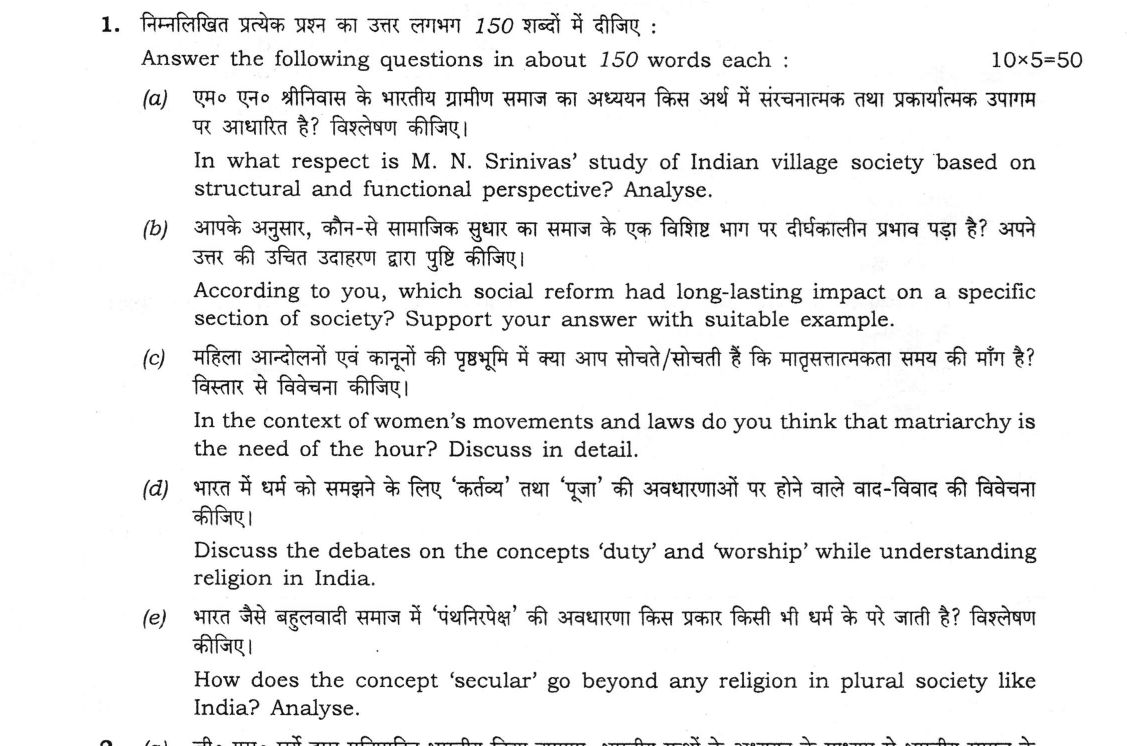
In what respect is M. N. Srinivas' study of Indian village society based on structural and functional perspective? Analyse. 10 marks
According to you, which social reform had long-lasting impact on a specific section of society? Support your answer with suitable example. 10 marks
In the context of women's movements and laws do you think that matriarchy is the need of the hour? Discuss in detail. 10 marks
Discuss the debates on the concepts 'duty' and 'worship' while understanding religion in India. 10 marks
How does the concept 'secular' go beyond any religion in plural society like India? Analyse. 10 marks
हिंदी में प्रश्न पढ़ें
निम्नलिखित प्रत्येक प्रश्न का उत्तर लगभग 150 शब्दों में दीजिए :
एम० एन० श्रीनिवास के भारतीय ग्रामीण समाज का अध्ययन किस अर्थ में संरचनात्मक तथा प्रकार्यात्मक उपागम पर आधारित है? विश्लेषण कीजिए। (10 अंक)
आपके अनुसार, कौन-से सामाजिक सुधार का समाज के एक विशिष्ट भाग पर दीर्घकालीन प्रभाव पड़ा है? अपने उत्तर की उचित उदाहरण द्वारा पुष्टि कीजिए। (10 अंक)
महिला आन्दोलनों एवं कानूनों की पृष्ठभूमि में क्या आप सोचते/सोचती हैं कि मातृसत्तात्मकता समय की माँग है? विस्तार से विवेचना कीजिए। (10 अंक)
भारत में धर्म को समझने के लिए 'कर्त्तव्य' तथा 'पूजा' की अवधारणाओं पर होने वाले वाद-विवाद की विवेचना कीजिए। (10 अंक)
भारत जैसे बहुलवादी समाज में 'पंथनिरपेक्ष' की अवधारणा किस प्रकार किसी भी धर्म के परे जाती है? विश्लेषण कीजिए। (10 अंक)
Model answer
Drafted with AI by UPSC Answer Check against this question's marking rubric, to the 150-word length. UPSC does not publish answers for Mains — this is one way to score well, not an official key. How we build rubrics and answers.
(a) Srinivas's village study as structural-functional
Frame: Srinivas trained at Oxford under Radcliffe-Brown and Evans-Pritchard; Religion and Society among the Coorgs of South India (1952) analysed ritual in structural-functional terms. His Rampura fieldwork (Mysore, 1948) appears in "The Social System of a Mysore Village" (1955, in Marriott's Village India) and The Remembered Village (1976).
Structural aspect: the village is a system of interdependent statuses: caste hierarchy, landownership and hereditary patron–client service ties. Its vertical (inter-caste) solidarity cuts across horizontal (intra-caste) solidarity.
Functional aspect: the dominant caste (the Okkaligas in Rampura), with numbers, land and power, keeps order and settles disputes; panchayats and shared festivals are explained by how they hold the village together.
Method and change: participant observation gave a "field view" against the Indological "book view"; Sanskritisation and Westernisation let an equilibrium frame explain mobility.
Critique: Dumont and Pocock (1957) denied that the village is a sociological unit; Kathleen Gough, Béteille and Berreman argued that functionalism underplayed conflict and Dalit exclusion.
Conclusion: the study is structural in mapping relationships and functional in explaining integration.
(b) A social reform with lasting impact
My choice: the anti-untouchability reform led by B.R. Ambedkar and consolidated in the Constitution. It has had the most lasting impact on Scheduled Castes (Dalits).
Context: untouchability denied Dalits access to wells, temples, schools and dignity, on the grounds of ritual pollution.
The reform:
- the Mahad Satyagraha (1927) for the right to use a public tank, and the Kalaram temple-entry satyagraha (1930);
- Article 17 abolished untouchability; the Protection of Civil Rights Act, 1955, the SC/ST (Prevention of Atrocities) Act, 1989, and reservation in education, jobs and legislatures followed.
Evidence of lasting impact:
- SC literacy rose from about 10% (1961) to 66% (2011);
- a Dalit middle class and political leadership emerged, from the BSP to Dalit representation in every legislature;
- Dalit literature and assertion grew, including the Dalit Panthers (1972).
Limits:
- the IHDS-II survey (2011–12) found about 27% of households admitting to practising untouchability in some form;
- atrocities and manual scavenging persist, and gains are uneven across SC sub-groups.
Conclusion: legal abolition changed rights and mobility durably, though social attitudes have changed more slowly.
(c) Is matriarchy the need of the hour?
Concepts: matriarchy is rule by women; matriliny is descent and inheritance through women; matrifocality is a mother-centred household. J.J. Bachofen's Das Mutterrecht (1861) proposed an original matriarchy, but none is securely attested.
Indian matrilineal societies: the Khasi and Garo of Meghalaya (the youngest Khasi daughter, khadduh, inherits); the Nayars of Kerala, whose marumakkathayam was abolished by law in 1975; Leela Dube on matrilineal Muslims of Lakshadweep and Irawati Karve on kinship zones. Yet authority stays with men (the mother's brother, the karanavan): these are matrilineal, not matriarchal.
Movements and law have sought equality, not reversal: Towards Equality (1974); the Protection of Women from Domestic Violence Act, 2005; the Hindu Succession (Amendment) Act, 2005, making daughters coparceners; the POSH Act, 2013; and the 106th Amendment (2023), reserving one-third of legislative seats for women after the next delimitation.
Counter-argument: matrilineal property raises women's bargaining power (Bina Agarwal), so its principles are worth borrowing.
Verdict: matriarchy is not the need of the hour; a mirror-image hierarchy conflicts with Articles 14–15. The need is substantive equality: property, safety, political voice and shared care.
(d) Duty and worship in Indian religion
The debate: is Indian religion best read as a duty-based social order or as faith and devotion?
The duty strand: dharma as svadharma and varnashrama-dharma is an ethical-social order more than a cult. Max Weber (The Religion of India) read karma and dharma as a theodicy legitimising caste; Louis Dumont (Homo Hierarchicus, 1966) placed purity and pollution at the core.
The worship strand: bhakti saints such as Kabir, Mirabai and Tukaram stressed personal devotion, often against hierarchy; puja, temple and pilgrimage make up lived religion (C.J. Fuller, The Camphor Flame, 1992).
Mediating frames: Redfield's great and little traditions, applied by McKim Marriott in Kishan Garhi (universalisation and parochialisation); Srinivas's Sanskritic and local Hinduism; T.N. Madan's Non-Renunciation (1987).
Beyond Hinduism: Islam distinguishes ibadat (worship) from muamalat (social dealings); Sikhism joins seva and kirat karo to devotion.
Today: the courts' "essential religious practice" test (Shirur Mutt, 1954; Sabarimala, 2018) separates worship from custom.
Conclusion: duty and worship are two readings of one field, which Indian religion combines.
(e) The secular beyond religion
The idea: Indian secularism is neither the American "wall of separation" nor French laïcité; it rests on sarva dharma sambhava and principled distance (Rajeev Bhargava).
Constitutional anchoring: "secular" entered the Preamble by the 42nd Amendment (1976), upheld by the Supreme Court in 2024; Articles 25–28 protect religious freedom subject to public order, morality, health and social reform; Articles 29–30 protect minorities; Article 44 directs a uniform civil code; S.R. Bommai (1994) made secularism part of the basic structure.
How it goes beyond any religion:
- citizenship, not faith, grounds rights, and no religion is the state's;
- claims in the public sphere must rest on public reason;
- the state may intervene within religions for equality (temple entry, abolition of untouchability, Shayara Bano, 2017);
- plural communities coexist under a neutral umpire.
Critique and defence: T.N. Madan ("Secularism in its Place", 1987) and Ashis Nandy call it an alien import; Bhargava and Amartya Sen (The Argumentative Indian, 2005) root it in the traditions of Ashoka and Akbar.
Indian secularism places equal citizenship above every religion.
How this answer will be evaluated
Evaluation rubric
Each sub-part is marked on its own, against the marks and word limit printed on the paper.
- (a) 'Analyse' requires the candidate to break Srinivas' village work into its structural component (the village as an interlocked system of caste, land and hereditary service statuses) and its functional component (institutions explained by the contribution they make to village integration), and to show 'in what respect' each perspective is visible in his actual studies. A purely descriptive account of Sanskritisation without linking it to structural-functionalism does not meet the demand. 10 marks · 150 words
Must cover
- M. N. Srinivas
- Rampura village, Mysore (fieldwork 1948)
- The Remembered Village (1976)
- The Social System of a Mysore Village (1955), in Marriott's Village India
- Religion and Society among the Coorgs of South India (1952)
- dominant caste
- vertical (inter-caste) solidarity
- Radcliffe-Brown / Evans-Pritchard
- field view vs book view
- Sanskritisation and Westernisation
- Dumont and Pocock critique (1957)
Loses marks
- Writing a general essay on Sanskritisation without ever showing how it relates to structure or function.
- Confusing Srinivas' village with someone else's field site (Rampura is Srinivas; Shamirpet is S. C. Dube; Sripuram is Beteille; Kishan Garhi is Marriott; Wangala and Dalena are Scarlett Epstein).
- Claiming Srinivas was a Marxist or an Indologist; he explicitly opposed the book-view.
- Omitting the functional half - listing castes and land but never saying what these arrangements do for village integration.
- No critical edge at all, so the directive 'analyse' is unmet.
Earns more
- Methodological lineage: Radcliffe-Brown and Evans-Pritchard at Oxford; participant observation; Srinivas' 'field view' against the indological 'book view'
- Sanskritisation and Westernisation as devices that let an essentially synchronic, equilibrium-oriented frame handle mobility and change
- Critique: Dumont and Pocock (Contributions to Indian Sociology, 1957) argue the village is not a sociological unit but caste and ideology are; Berreman and Beteille point to neglected conflict, power and Dalit subordination
Extra mark
- Contrasts Srinivas with a conflict-oriented village study, e.g., Kathleen Gough in Thanjavur or Béteille's Sripuram (Caste, Class and Power, 1965)
- (b) An opinion question with a compulsory evidential burden: the candidate must pick ONE named social reform, identify the specific section of society it affected, and support the claim of long-lasting impact with a concrete, verifiable example. Any defensible choice is acceptable; the marks lie in specificity and in demonstrating durability of the effect. 10 marks · 150 words
Must cover
- one named reform with leader and statute/year
- the specific social section affected
- at least one concrete illustrative example
- an acknowledgement of continuing limits
Loses marks
- Listing five reforms in a paragraph each instead of defending one choice - the question says 'which social reform', singular.
- Giving no example at all, when the question explicitly demands 'support your answer with suitable example'.
- Factual slips on statutes and dates: the Bengal Sati Regulation is 1829 (Bentinck), the Widows' Remarriage Act is 1856, the Sharda Act is 1929, the Age of Consent Act is 1891.
- Describing the colonial legislation only and ignoring the Indian reformer or movement behind it.
- Uncritical celebration with no mention of persistence or partial implementation.
Earns more
- Sociological framing rather than mere history: reform as cultural change preceding structural change (Yogendra Singh, 'Modernization of Indian Tradition', 1973), Sanskritisation/Westernisation (Srinivas), reform-from-above by an English-educated elite versus reform-from-below (Phule, Narayana Guru, Ambedkar)
- Balanced limitation: the practice or its residue persisting — e.g., untouchability still admitted by about 27% of households (IHDS-II, 2011–12) despite Article 17; the Roop Kanwar case and the Commission of Sati (Prevention) Act, 1987; child marriage despite the Prohibition of Child Marriage Act, 2006
Extra mark
- Explains durability with a concept or data, e.g., Marc Galanter's Competing Equalities (1984), or SC literacy rising from about 10% (1961) to 66% (2011)
- (c) 'Discuss in detail' a normative proposition: is matriarchy the need of the hour, read against women's movements and gender legislation? The candidate must first get the concepts right - matriarchy is not matriliny or matrifocality - then take and defend a position. The expected strong answer argues that the goal of movements and law has been substantive equality, not an inverted hierarchy. 10 marks · 150 words
Must cover
- matriarchy vs matriliny vs matrifocality
- Khasi / Garo / Nayar (marumakkathayam)
- Bachofen, Das Mutterrecht (1861)
- Leela Dube and/or Irawati Karve
- Towards Equality (1974)
- at least two of: PWDVA 2005, POSH Act 2013, Hindu Succession (Amendment) Act 2005, Criminal Law (Amendment) Act 2013
- a clear stated position
Loses marks
- Treating Khasi or Nayar society as 'matriarchal' - they are matrilineal; authority remains with men. This is the single commonest error in this question.
- Asserting that matriarchy existed as a universal early stage of humanity as established fact; it is a disputed nineteenth-century speculation.
- Writing a general essay on women's empowerment and never answering whether matriarchy is the need of the hour.
- Naming no law at all, when the question explicitly frames the issue 'in the context of women's movements and laws'.
- Taking a position without stating any counter-argument, which fails 'discuss in detail'.
Earns more
- Reasoned verdict: matriarchy is neither empirically available nor normatively attractive as a mirror-image hierarchy; what is needed is substantive gender equality - constitutional equality (Articles 14, 15, 15(3)), enforcement, and dismantling of what Uma Chakravarti calls Brahmanical patriarchy
- Counter-argument stated fairly: matrilineal and matrilocal arrangements demonstrably raise women's bargaining power through land and residence (Bina Agarwal, 'A Field of One's Own', 1994), so they carry a practical lesson even if matriarchy as a system is not the answer
- Notes that matriliny is itself under strain - partition of the Nayar tarwad by successive legislation, and the Khasi male counter-lobby Syngkhong Rympei Thymmai demanding patrilineal reform
Extra mark
- Notes that women's reservation under the Constitution (106th Amendment) Act, 2023 takes effect only after the delimitation following the next Census
- (d) 'Discuss the debates' means set out the rival positions, not describe Indian religion. The pivot is that the Western analytic category 'religion', built around belief and worship, fits Indian practice badly, where dharma is first of all duty; the answer must present the duty-centred readings, the worship/bhakti-centred readings, and what turns on the choice. 10 marks · 150 words
Must cover
- dharma as duty vs religion as worship
- Weber, The Religion of India
- Dumont, Homo Hierarchicus (purity and pollution)
- bhakti (at least one saint named)
- great tradition / little tradition - Redfield and Marriott
- Sanskritic vs local Hinduism (Srinivas)
- T. N. Madan or Ashis Nandy
Loses marks
- Writing a descriptive account of Hinduism's beliefs and festivals instead of presenting a debate.
- Treating 'duty' and 'worship' as two religions rather than two analytic readings of the same field.
- Attributing 'great tradition / little tradition' to Srinivas - it is Robert Redfield's, applied in India by McKim Marriott; Srinivas' parallel pair is Sanskritic and local Hinduism.
- Confining the answer to Hinduism when the question says 'religion in India' - Islam's ibadat and Sikhism's seva/kirat karo offer the same duty-worship tension.
- No Indian theorist named, so the answer reads as generic sociology of religion.
Earns more
- Great vs little tradition: Robert Redfield's formulation applied to India by McKim Marriott in Kishan Garhi ('Little Communities in an Indigenous Civilization', in Village India, 1955) through universalisation and parochialisation; Srinivas' Sanskritic vs local/village Hinduism and the book-view/field-view contrast
- Contemporary Indian interventions: T. N. Madan ('Non-Renunciation'; 'Modern Myths, Locked Minds') on the inadequacy of secular-Western categories for Indian religious life, and Ashis Nandy's distinction between religion-as-faith (tolerant, lived) and religion-as-ideology (politicised)
- Where the debate has practical force: the 'essential religious practices' doctrine from the Shirur Mutt case (1954), which forces courts under Article 25 to decide what is religion and what is secular activity - as in Sabarimala (2018)
Extra mark
- Weber's reading of karma-samsara as the most consistent theodicy, or C.J. Fuller's The Camphor Flame (1992) on puja as lived religion
- (e) 'Analyse' how the Indian idea of 'secular' transcends any single religion in a plural society. The answer must show that Indian secularism is neither anti-religious nor a strict separation of church and state, but a distinctive arrangement - equal respect with principled distance - anchored in the Constitution, and must engage the critics of that arrangement. 10 marks · 150 words
Must cover
- principled distance / sarva dharma sambhava
- 42nd Amendment, 1976 (Preamble)
- Articles 25-28; Article 44; Articles 29-30
- S. R. Bommai (1994) - secularism as basic structure
- citizenship as the ground of rights
- T. N. Madan and/or Ashis Nandy as critics; Rajeev Bhargava and/or Amartya Sen as defenders
Loses marks
- Equating Indian secularism with the Western separation of church and state and then calling India's practice a failure - it was never designed on that model.
- Saying 'secular' was in the Preamble from 1950; it was inserted by the 42nd Amendment in 1976 (though the Supreme Court has held the value was implicit earlier).
- Treating secular as anti-religious or as atheism.
- Listing constitutional articles with no sociological argument about plurality.
- Ignoring the critics entirely, so there is no analysis - only description.
Earns more
- Indian secularism allows intervention WITHIN religion for reform, which strict separation forbids - temple entry legislation, the Sabarimala judgment (Indian Young Lawyers Association v. State of Kerala, 2018), Shayara Bano v. Union of India (2017) on instant triple talaq
- The critics and the defence: T. N. Madan's 'Secularism in Its Place' (1987) and Ashis Nandy's argument that secularism is an alien import that disarms religious tolerance, against Rajeev Bhargava's and Amartya Sen's defence of Indian secularism as a genuine and workable achievement
- The plurality being managed is not only inter-religious but intra-religious (sects, denominations) and includes non-believers - so no single faith's norms can supply the public standard
Extra mark
- Cites the Supreme Court's 2024 ruling upholding 'secular' and 'socialist' in the Preamble (Dr Balram Singh v Union of India), or Bhargava's idea of contextual secularism
What "Analyse" is asking you to do
Break the subject into its working parts and show how they act on each other. The marks are in the interconnections — which factor drives which, and what the resulting structure explains — not in the inventory of factors.
Structure that answers it
Define the whole → separate it into its parts → show which part drives which → what that interaction produces → what the structure implies
Where marks are lost
A flat list of causes with no account of which drives which. An answer of neatly separated headings, each self-contained, scores as description.
Practice this exact question
Write your answer and it is marked point by point against the model answer above — what you covered, what you missed, what you got wrong.
Evaluate my answer →More from Sociology 2026 Paper II
- Q1 Answer the following questions in about 150 words each : (a) In what respect is M. N. Sri…
- Q2 (a) Indological approach, advocated by G. S. Ghurye, focuses on the study of Indian socie…
- Q3 (a) Examine the challenges of applying micro-level village studies to macro-level village…
- Q4 (a) How does the Constitution of India promote education? Do you think that education can…