Paper II — Q3
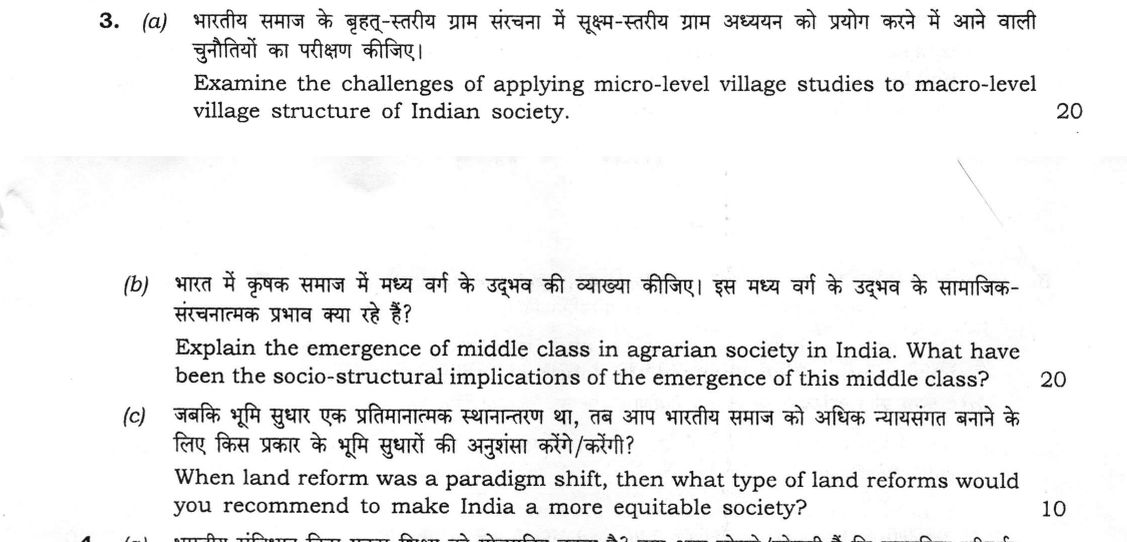
(a) Examine the challenges of applying micro-level village studies to macro-level village structure of Indian society. (20…
Examine the challenges of applying micro-level village studies to macro-level village structure of Indian society. 20 marks
Explain the emergence of middle class in agrarian society in India. What have been the socio-structural implications of the emergence of this middle class? 20 marks
When land reform was a paradigm shift, then what type of land reforms would you recommend to make India a more equitable society? 10 marks
हिंदी में प्रश्न पढ़ें
भारतीय समाज के बृहत्-स्तरीय ग्राम संरचना में सूक्ष्म-स्तरीय ग्राम अध्ययन को प्रयोग करने में आने वाली चुनौतियों का परीक्षण कीजिए। (20 अंक)
भारत में कृषक समाज में मध्य वर्ग के उद्भव की व्याख्या कीजिए। इस मध्य वर्ग के उद्भव के सामाजिक-संरचनात्मक प्रभाव क्या रहे हैं? (20 अंक)
जबकि भूमि सुधार एक प्रतिमानात्मक स्थानान्तरण था, तब आप भारतीय समाज को अधिक न्यायसंगत बनाने के लिए किस प्रकार के भूमि सुधारों की अनुशंसा करेंगे/करेंगी? (10 अंक)
Model answer
Drafted with AI by UPSC Answer Check against this question's marking rubric, to the expected length. UPSC does not publish answers for Mains — this is one way to score well, not an official key. How we build rubrics and answers.
(a) From village studies to Indian society
The corpus:
- M.N. Srinivas's Rampura (Mysore);
- S.C. Dube's Shamirpet (Indian Village, 1955);
- McKim Marriott's Kishan Garhi (Village India, 1955);
- Oscar Lewis's Rampur near Delhi (1958);
- F.G. Bailey's Bisipara (Orissa, 1957);
- Adrian Mayer's Ramkheri (Malwa, 1960);
- André Béteille's Sripuram (Tanjore, 1965);
- Scarlett Epstein's Wangala and Dalena (1962).
- These studies gave ethnographic depth on caste, kinship, jajmani and power.
Challenges in scaling up:
Representativeness:
- one village cannot stand for more than six lakh villages across very different ecologies, crops, tenures and regions;
- Epstein's pair shows this: irrigated Wangala stayed agrarian and hierarchical, while dry Dalena diversified into trade and services.
Boundedness:
- the village was never the "little republic" of Metcalfe and Maine, which was a colonial construct;
- Dumont and Pocock (1957) argued that caste, kinship and marriage networks cross village boundaries, so the village is a part-society, not an isolate;
- Srinivas replied ("The Indian Village: Myth and Reality", 1975) that it still had vertical unity and a strong village identity.
Macro forces invisible from inside:
- the state (development programmes, reservations, the 73rd Amendment, 1992);
- all-India markets and MSP;
- circular migration and remittances;
- caste federations and party politics.
Epistemological mismatch: ethnographic depth and validity do not add up to statistical representativeness. Observer effects, the researcher's caste and gender, and access through dominant castes add to this (Béteille and Madan, Encounter and Experience, 1975).
Datedness: most classics are mid-century snapshots taken before the Green Revolution, Mandal, liberalisation and the rural non-farm boom.
How the gap has been bridged:
- restudies: Epstein returned to Wangala and Dalena in 1970 and again in the 1990s;
- comparative and panel village studies: Palanpur (surveyed since 1957–58), ICRISAT's village-level studies (since 1975), and the Foundation for Agrarian Studies' PARI surveys;
- mixed methods: triangulating village ethnography with Census, NSS/PLFS and NFHS data;
- multi-sited ethnography that follows migrants and markets.
Conclusion: village studies are indispensable for understanding mechanisms, but they cannot be summed into a picture of India. Macro claims need comparison, panels and statistics to generalise them.
(b) The agrarian middle class
How the agrarian middle class emerged:
Land reforms: zamindari abolition and tenancy laws in the 1950s transferred ownership to former superior tenants, usually intermediate cultivating castes. Ceiling laws redistributed little.
The Green Revolution (from 1966–67):
- high-yielding seeds, fertiliser, tube-well irrigation and credit;
- MSP and procurement made surplus farming profitable, first in Punjab, Haryana, western Uttar Pradesh and coastal Andhra;
- gains were regionally and class-selective, favouring medium and large owner-cultivators.
Naming the class: Lloyd and Susanne Rudolph (In Pursuit of Lakshmi, 1987) called them "bullock capitalists", independent family farmers between large landlords and the landless. Srinivas saw them as the new dominant castes. Examples include the Jats, Yadavs, Kurmis, Marathas, Patidars, Vokkaligas, Reddys and Kammas.
Socio-structural implications:
Political:
- Charan Singh's peasant politics, the Mandal Commission (report 1980, implemented 1990), and the rise of OBC parties, which Christophe Jaffrelot called India's "Silent Revolution" (2003);
- farmers' movements focused on prices: the Shetkari Sanghatana (Sharad Joshi, 1979), the Bharatiya Kisan Union (led by Mahendra Singh Tikait in mass agitations from 1987) and the Karnataka Rajya Raitha Sangha (M.D. Nanjundaswamy). Scholars such as Tom Brass and Gail Omvedt call these the "new farmers' movements".
Agrarian and caste relations:
- jajmani gave way to cash wages and contracts, and attached labour declined;
- the new dominant castes clashed with Dalit labourers asserting wages and dignity, as in the Karamchedu atrocity (1985);
- labour migration from Bihar and eastern Uttar Pradesh to Punjab followed.
Social mobility: households diversified into trade, transport, education and government jobs, and sent children to towns, creating a provincial middle class and a style of consumption that blends urban and rural ways of life.
Crisis since the 1990s:
- fragmentation (average holding about 1.08 ha, Agriculture Census 2015–16), rising costs, indebtedness and farmer suicides;
- dominant castes now demand reservation: the Patidars (2015), Jats (2016) and Marathas (the Maharashtra quota was struck down in Jaishri Patil, 2021);
- the 2020–21 farm-law protests ended with the repeal of the laws in November 2021.
Conclusion: the agrarian middle class democratised rural power away from old landlords. It also created new dominance over Dalit labour and is now itself in crisis.
(c) Land reforms for equity
Record of the paradigm shift:
- abolition of intermediaries largely succeeded;
- tenancy reform was mixed;
- ceiling-surplus redistribution was marginal, under about 2% of operated area;
- consolidation of holdings worked mainly in the north-west.
- The successes were Kerala (Land Reforms Amendment Act, 1969), which gave ownership to tenants, and West Bengal's Operation Barga (1978), which recorded sharecroppers.
Recommendations:
Conclusive titles:
- move from presumptive to conclusive, digitised titles through the Digital India Land Records Modernisation Programme;
- extend the SVAMITVA (2020) drone survey of rural homesteads;
- give every land parcel a unique identifier (Bhu-Aadhaar) to reduce litigation and let the poor use land as collateral.
Gender justice:
- enforce daughters' coparcenary rights under the Hindu Succession (Amendment) Act, 2005;
- issue joint or individual titles to women on all state-allotted land;
- extend homestead plots to landless women. Bina Agarwal (A Field of One's Own, 1994) argues that land in women's names raises welfare and bargaining power.
Secure, recorded tenancy: adopt the Model Agricultural Land Leasing Act, 2016, so that tenants get credit, insurance and relief while owners can lease without fear of losing land.
Forest and common land: implement the Forest Rights Act, 2006 (including community forest rights) and PESA, 1996, and protect grazing and village commons from encroachment.
Homestead and redistribution: give homestead land to landless Dalit and Adivasi families; create land banks of government and surplus land; ensure fair compensation and consent under the RFCTLARR Act, 2013 when land is acquired.
The next paradigm shift is less about seizing land than about secure rights: records, women's ownership, tenancy and commons.
How this answer will be evaluated
Evaluation rubric
Each sub-part is marked on its own, against the marks and word limit printed on the paper.
- (a) 'Examine the challenges' of scaling up: the candidate must show why findings from intensive single-village ethnography cannot be read straight off as an account of the macro-level village structure of Indian society. Required are the concrete village-study corpus, the specific epistemological and empirical obstacles to generalisation, and some indication of how sociologists have tried to bridge the gap. 20 marks
Must cover
- at least four village studies correctly attributed to their scholars
- Dumont and Pocock's critique of the village as a unit (1957)
- Epstein's Wangala and Dalena contrast
- problem of generalisation / external validity
- the village as part-society, not an isolate
- restudies and panel/comparative designs as a remedy
Loses marks
- Misattributing field sites - Rampura is Srinivas', Shamirpet is S. C. Dube's, Sripuram is Beteille's, Kishan Garhi is Marriott's, Ramkheri is Adrian Mayer's, Bisipara is F. G. Bailey's, Rampur near Delhi is Oscar Lewis'. Each misattribution is a visible error.
- Listing village studies at length and never getting to the challenges of generalisation, which is what 'examine' demands.
- Repeating the myth that the Indian village was a self-sufficient little republic (the Metcalfe and Maine image) as if it were a finding rather than a colonial construction critiqued by Dumont and others.
- Confining the answer to methodological difficulty of fieldwork (rapport, language) and missing the structural and epistemological arguments.
- Offering no remedy, so the answer is purely negative.
Earns more
- Macro structures invisible from inside a single village: the state and its policy apparatus, commodity and credit markets, all-India caste federations and reservation politics, agrarian class formation, and circular migration and remittances that make the village a node rather than a container
- Epistemological mismatch: ethnography buys depth and internal validity at the cost of external validity, while Census, NSSO/PLFS and NFHS buy representativeness at the cost of meaning; add single-observer bias, the researcher's caste, gender and language shaping access, dependence on dominant-caste informants, and the difficulty of replication
- Datedness: the classic studies are mid-twentieth-century snapshots taken before the Green Revolution, Mandal, panchayati raj after the 73rd Amendment (1992) and post-1991 liberalisation, so their structural findings cannot be extrapolated to present-day rural India
- How the gap has been bridged: systematic comparison and regional village studies; restudies over time - Epstein returning to Wangala and Dalena, and Srinivas' own long engagement with Rampura culminating in 'The Remembered Village' (1976); long-run panel village surveys such as the ICRISAT Village Dynamics in South Asia studies and NCAER rural panels; multi-sited and extended-case ethnography; and mixed-method triangulation of ethnography with Census and NSS data
Extra mark
- Srinivas's reply in 'The Indian Village: Myth and Reality' (1975), or long-run panel evidence such as the Palanpur surveys since 1957–58
- (b) Two explicit tasks: (i) explain HOW an agrarian middle class emerged in India - the causal chain of land reform, tenancy change and the Green Revolution; and (ii) set out the socio-structural implications of that emergence. An answer that narrates agrarian change without naming this class or without the second half is incomplete. 20 marks
Must cover
- zamindari abolition and tenancy reform
- Green Revolution (1966-67 onwards) and MSP/procurement
- Rudolph and Rudolph, 'bullock capitalists'
- at least three intermediate cultivating castes named
- decline of jajmani
- Mandal and the rise of intermediate-caste political power
- at least one farmers' movement with its leader
- agrarian distress / quota agitations by dominant castes
Loses marks
- Writing about the urban new middle class of liberalisation instead of the agrarian middle class the question asks about.
- Treating the Green Revolution as socially neutral; its gains were regionally and class-selective, which is precisely why a middle class and not a general prosperity emerged.
- Answering only the first half and omitting the socio-structural implications, which the question asks for separately.
- Dating errors: the Green Revolution begins 1966-67, the Mandal report was submitted in 1980 and implemented in 1990, the 73rd Amendment is 1992, the farm laws were repealed in November 2021.
- No named theorist, so the answer reads as journalism rather than sociology.
Earns more
- Names the class in theory: Lloyd and Susanne Rudolph's 'bullock capitalists' ('In Pursuit of Lakshmi: The Political Economy of the Indian State', 1987); Pranab Bardhan's 'dominant proprietary classes' of rich farmers, industrial capitalists and the professional-bureaucratic elite ('The Political Economy of Development in India', 1984); Daniel Thorner's malik-kisan-mazdoor scheme; and M. N. Srinivas' 'dominant caste' as its social form
- Socio-structural implication, political: the transfer of rural power from upper-caste landlords to intermediate castes - Rajni Kothari's 'rise of the backwards', Christophe Jaffrelot's 'India's Silent Revolution', the Mandal Commission report (submitted 1980, implemented for central services in 1990) - and autonomous farmers' movements: the Bharatiya Kisan Union under Mahendra Singh Tikait, Sharad Joshi's Shetkari Sanghatana with its 'Bharat versus India' thesis, and M. D. Nanjundaswamy's Karnataka Rajya Raitha Sangha
- Socio-structural implication, agrarian and caste relations: the decline of hereditary jajmani ties and their replacement by cash wages and contract; a new landed dominance exercised over Dalit labour, with atrocities where Dalits assert themselves; growth of a landless wage-labouring class; and Sanskritisation and Westernisation in the consumption, education and marriage practices of the risen class
- Socio-structural implication, the present crisis: fragmentation of holdings (average operational holding down to roughly 1.1 hectares, Agriculture Census 2015-16, with small and marginal holdings over 85 per cent of the total), input-cost squeeze, indebtedness and farmer suicides, and the paradox of dominant agrarian castes demanding reservation - the Patidar, Jat and Maratha agitations of 2015-2018 - culminating in the 2020-21 farm-laws protest and the repeal of the three laws in November 2021
Extra mark
- Tom Brass (ed., New Farmers' Movements in India, 1995) or Gail Omvedt on the 'new farmers' movements' as the political voice of this class
- (c) The premise is conceded - land reform was a paradigm shift - so the marks lie in the recommendation. The candidate must briefly establish what the first-generation reforms did and where they fell short, and then propose specific, defensible second-generation land reforms aimed at equity. Vague calls for 'better implementation' will not do. 10 marks
Must cover
- the four components of land reform
- ceiling-surplus redistribution was marginal (under about 2 per cent of operated area)
- Operation Barga (1978) and/or Kerala Land Reforms Act 1969
- conclusive titling / land records modernisation
- women's land rights and the Hindu Succession (Amendment) Act, 2005; Bina Agarwal
- recorded tenancy (Model Agricultural Land Leasing Act, 2016) and/or Forest Rights Act, 2006
Loses marks
- Spending the whole answer on the history of land reform and never making a recommendation, when the question asks what the candidate would recommend.
- Recommending only 'strict implementation of ceiling laws' - with little surplus land left, this alone cannot produce equity.
- Omitting women entirely, although gender is the single largest untouched inequality in Indian landholding.
- Confusing the reform record: it was abolition of intermediaries that largely succeeded, not ceilings; Operation Barga recorded sharecroppers rather than redistributing land.
- Ignoring tribal and forest land, where the Forest Rights Act is the live redistributive frontier.
Earns more
- Cites the cases that worked and why: Operation Barga in West Bengal from 1978 (recording bargadars/sharecroppers to secure their share and against eviction), the Kerala Land Reforms (Amendment) Act 1969 implemented from 1970 (abolishing tenancy, conferring ownership on tenants and on kudikidappukar hutment dwellers), and the Jammu and Kashmir Big Landed Estates Abolition Act 1950; Vinoba Bhave's Bhoodan from 1951 as the voluntary alternative that largely failed
- Recommendation - records and title: move from presumptive to conclusive titling with a state guarantee, complete digitisation and survey under the Digital India Land Records Modernisation Programme, and extend SVAMITVA (2020) drone survey of inhabited village land so that the poor hold documentary title over the land they actually occupy
- Recommendation - tenancy and common/forest land: legalise and record leasing with security of tenure and no adverse-possession risk on the NITI Aayog Model Agricultural Land Leasing Act, 2016; complete recognition of individual and community forest rights under the Scheduled Tribes and Other Traditional Forest Dwellers (Recognition of Forest Rights) Act, 2006 and PESA, 1996; protect common property resources; and promote group/collective farming on the Kerala Kudumbashree model to make tiny holdings viable
Extra mark
- A unique land parcel identifier (Bhu-Aadhaar/ULPIN) or an evidence-based lesson, e.g., why voluntary Bhoodan achieved little
What "Examine" is asking you to do
Test the proposition the question puts to you and return a finding on how far it holds. Examine stems carry a claim, or ask whether something has happened, and expect evidence weighed both ways before the extent is stated — often with remedial measures attached.
Structure that answers it
Restate the claim as the question frames it → evidence that supports it → evidence that undercuts it → the conditions under which it holds → verdict on how far it stands
Where marks are lost
Stopping at description. An examination has to reach a finding, and “examine with justification” means the extent must be stated, not implied.
Practice this exact question
Write your answer and it is marked point by point against the model answer above — what you covered, what you missed, what you got wrong.
Evaluate my answer →More from Sociology 2026 Paper II
- Q1 Answer the following questions in about 150 words each : (a) In what respect is M. N. Sri…
- Q2 (a) Indological approach, advocated by G. S. Ghurye, focuses on the study of Indian socie…
- Q3 (a) Examine the challenges of applying micro-level village studies to macro-level village…
- Q4 (a) How does the Constitution of India promote education? Do you think that education can…
- Q5 Answer the following questions in about 150 words each : (a) Discuss the challenges faced…
- Q6 (a) Differentiate between protests and movements. Discuss some of those movements which c…