Paper II — Q6
(a) Differentiate between protests and movements. Discuss some of those movements which changed the fabric of Indian agrarian…
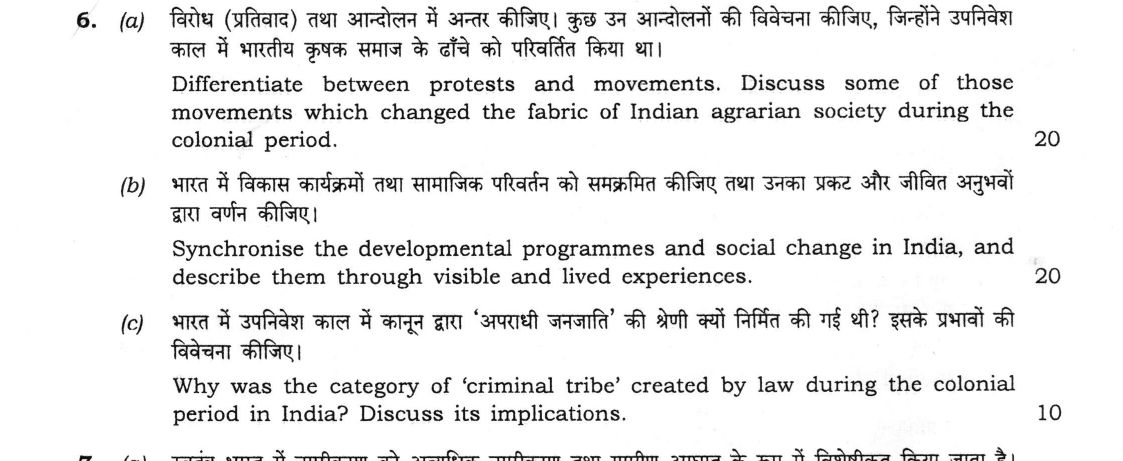
Differentiate between protests and movements. Discuss some of those movements which changed the fabric of Indian agrarian society during the colonial period. 20 marks
Synchronise the developmental programmes and social change in India, and describe them through visible and lived experiences. 20 marks
Why was the category of 'criminal tribe' created by law during the colonial period in India? Discuss its implications. 10 marks
हिंदी में प्रश्न पढ़ें
विरोध (प्रतिवाद) तथा आन्दोलन में अन्तर कीजिए। कुछ उन आन्दोलनों की विवेचना कीजिए, जिन्होंने उपनिवेश काल में भारतीय कृषक समाज के ताने-बाने को परिवर्तित किया था। (20 अंक)
भारत में विकास कार्यक्रमों तथा सामाजिक परिवर्तन को समक्रमित कीजिए तथा उनका प्रकट और जीवित अनुभवों द्वारा वर्णन कीजिए। (20 अंक)
भारत में उपनिवेश काल में कानून द्वारा 'अपराधी जनजाति' की श्रेणी क्यों निर्मित की गई थी? इसके प्रभावों की विवेचना कीजिए। (10 अंक)
Model answer
Drafted with AI by UPSC Answer Check against this question's marking rubric, to the expected length. UPSC does not publish answers for Mains — this is one way to score well, not an official key. How we build rubrics and answers.
(a) Protests, movements and colonial agrarian society
Protests and movements:
| Basis | Protest | Movement |
|---|---|---|
| Duration | Episodic, short-lived | Sustained over time |
| Organisation | Loose or spontaneous | Leadership, organisation and a membership |
| Ideology | A specific grievance | An ideology and a vision of change |
| Goal | Redress of a particular wrong | Structural change (reform, transformation or revolution) |
| Identity | Temporary crowd | Collective identity |
- M.S.A. Rao (Social Movements in India, 1978) defined movements by sustained collective mobilisation and ideology, and classed them as reformist, transformative or revolutionary. Ghanshyam Shah (1990) stressed ideology and organisation. A protest can grow into a movement: an episode becomes a process.
Colonial agrarian movements that changed the agrarian order:
- Santhal Hul (1855–56), led by Sidhu and Kanhu Murmu against moneylenders, zamindars and police. It led to the creation of the Santhal Parganas as a protected tract.
- Indigo Revolt (1859–60), Bengal, against forced indigo cultivation. The Indigo Commission (1860) followed, and forced cultivation ended.
- Pabna agrarian leagues (1873–76), against enhanced rents. They led to the Bengal Tenancy Act, 1885, which secured occupancy rights.
- Deccan Riots (1875), Maharashtra, against moneylenders. The Deccan Agriculturists' Relief Act, 1879 followed.
- Birsa Munda's Ulgulan (1899–1900), Chotanagpur, for khuntkatti rights. It led to the Chotanagpur Tenancy Act, 1908.
- Champaran (1917) and Kheda (1918): Gandhian satyagraha; the Champaran Agrarian Act, 1918 abolished the tinkathia system.
- Awadh Kisan Sabhas (1920–22) under Baba Ramchandra, and the Mappila rebellion (1921) in Malabar.
- Bardoli (1928), Gujarat: revenue enhancement was reversed after the Broomfield inquiry.
- The All India Kisan Sabha (1936), under Swami Sahajanand Saraswati, gave peasants a national organisation and the demand to abolish zamindari.
- Tebhaga (1946–47), Bengal: sharecroppers demanded two-thirds of the crop. The Telangana struggle (1946–51) was against the doras and the Nizam and straddled 1947.
How they changed the agrarian fabric:
- they produced tenancy and debt legislation that redefined landlord–tenant–moneylender relations;
- they turned peasants into a political constituency linked to nationalism, and set the agenda for zamindari abolition after 1947;
- they drew tribal and peasant groups into wider class and national identities.
Interpretations:
- D.N. Dhanagare (Peasant Movements in India 1920–1950, 1983) analysed the class bases of peasant mobilisation, including the role of middle peasants;
- Ranajit Guha (Elementary Aspects of Peasant Insurgency, 1983) recovered peasant consciousness as autonomous;
- Kathleen Gough classified uprisings by type.
(b) Development programmes and social change
Framework:
- Yogendra Singh (Modernization of Indian Tradition, 1973) showed planned change interacting with tradition;
- Amartya Sen's capability approach judges development by the freedoms people actually enjoy, not by outputs;
- "visible" means measurable, official outcomes; "lived" means how people actually experience them.
Phases of development and social change:
- Community Development Programme (1952); the Balwantrai Mehta Committee (1957) and panchayati raj (1959);
- the Green Revolution (1966–67); ICDS (1975); the 20-Point Programme;
- the 73rd and 74th Amendments (1992), with one-third (now about half in many states) of seats for women, producing about 14 lakh elected women representatives;
- rights-based schemes: MGNREGA (2005, now succeeded by the VB-G RAM G Act, 2025), NRHM (2005), NRLM (2011), the National Food Security Act (2013);
- delivery schemes: Swachh Bharat (2014), Ujjwala (2016), PM-KISAN (2019), Jal Jeevan Mission (2019).
Visible and lived experiences, case by case:
| Programme | Visible outcome | Lived experience |
|---|---|---|
| Women's reservation in panchayats | Lakhs of women in office | "Sarpanch-pati" proxies in many places. Yet Chattopadhyay and Duflo (2004) found women leaders shift spending to drinking water, and a new generation of women leaders is emerging |
| Swachh Bharat | ODF declarations (2019), crores of toilets | Uneven use, caste norms about pollution, and manual scavenging persisting despite the 2013 Act |
| MGNREGA | Crores of job cards, a buffer in the COVID year | Wage delays, Aadhaar-linked exclusion (Drèze and Khera); yet higher rural wages and women's earnings |
| Ujjwala | Over 10 crore LPG connections | Many poor households cannot afford refills and go back to firewood |
| ICDS and nutrition | Near-universal anganwadi network | Stunting still at 35.5% (NFHS-5); anganwadi workers are "volunteers" on an honorarium |
The costs of development:
- dams, mines and industrial corridors displaced tens of millions, a large share of them Adivasis (Walter Fernandes), as the Narmada Bachao Andolan showed;
- James Scott's Seeing Like a State (1998) warns that high-modernist schemes destroy local knowledge (metis); Arturo Escobar (1995) criticises "development" as a discourse.
Genuine gains: literacy, life expectancy, electrification, sanitation and women's political presence have all risen measurably.
Conclusion: development and social change are synchronised when outputs become capabilities. That requires participation, accountability (social audits, the right to information) and attention to caste, gender and region.
(c) The colonial 'criminal tribe'
The law:
- the Criminal Tribes Act, 1871 allowed the colonial state to notify whole communities as "criminal by birth";
- it was extended and consolidated in 1924;
- notified groups had to register, report to police, carry passes, and could be confined to settlements.
Why the category was created:
- Colonial criminology: the idea of hereditary caste occupations was extended to crime, so "criminality" was seen as inherited, like a trade.
- Control of mobility: nomads, pastoralists, itinerant traders (such as the Banjaras, displaced by railways) and entertainers resisted revenue and census administration, so the state sought to sedentarise them.
- Forests and land: the forest laws of 1865 and 1878 criminalised traditional forest use by mobile communities.
- Labour: settlements, some run by the Salvation Army, supplied cheap, disciplined labour to mills, plantations and public works.
- Scapegoating after 1857: suspicion of groups seen as unruly.
- Scholars include Meena Radhakrishna (Dishonoured by History, 2001) and Sanjay Nigam (1990).
Implications:
- the Act was repealed in 1952 after the Ayyangar Committee. The communities were "denotified" and became the Vimukta Jatis (DNTs);
- its logic survives in state Habitual Offenders Acts, which the UN Committee on the Elimination of Racial Discrimination (2007) asked India to repeal;
- stigma persists: police routinely suspect, round up and torture members, as in the custodial death of Budhan Sabar (1998), which Mahasweta Devi highlighted;
- there is categorical invisibility: many DNTs are not Scheduled Tribes or Castes, so they miss reservations, and many lack land, documents and a fixed address;
- their deprivation is intergenerational, with very low literacy and much insecure itinerant work.
Responses:
- the Renke Commission (2008) and the Idate Commission (2017) recommended recognition and protection;
- a Development and Welfare Board for DNTs was set up, and the SEED scheme (2022) for their economic empowerment.
Sociological lesson: this is a case of labelling (Becker) and the colonial construction of social categories. A legal label hardened into ascribed stigma that has outlasted the law.
How this answer will be evaluated
Evaluation rubric
Each sub-part is marked on its own, against the marks and word limit printed on the paper.
- (a) Two explicit tasks. First, differentiate protest from social movement on clear criteria (duration, organisation, ideology, goal, collective identity). Second, discuss specific colonial-period movements that changed the fabric of Indian agrarian society - so named movements with dates, leaders, regions and consequences are required, not a general account of peasant discontent. 20 marks
Must cover
- protest as episodic and unorganised vs movement as sustained, organised and ideological
- M. S. A. Rao and/or Ghanshyam Shah on social movements in India
- at least four colonial agrarian movements with correct dates and regions
- Champaran 1917 and/or Bardoli 1928
- All India Kisan Sabha, 1936 (Sahajanand Saraswati)
- Tebhaga 1946-47 and/or Telangana 1946-51
- at least two pieces of resulting legislation (e.g. Bengal Tenancy Act 1885, Deccan Agriculturists' Relief Act 1879, Chotanagpur Tenancy Act 1908, Champaran Agrarian Act 1918)
- Ranajit Guha and/or D. N. Dhanagare
Loses marks
- Skipping the conceptual differentiation and going straight to a list of movements - the first directive carries substantial marks.
- Date and region errors: the Santhal Hul is 1855-56, the Indigo Revolt 1859-60 in Bengal, the Deccan Riots 1875 in Maharashtra, Birsa's Ulgulan 1899-1900 in Chotanagpur, Champaran 1917 in Bihar, Bardoli 1928 in Gujarat, Tebhaga 1946-47 in Bengal, Telangana 1946-51.
- Including post-Independence movements (Naxalbari 1967, the farmers' movements of the 1980s) when the question specifies the colonial period; the Telangana struggle is admissible because it began in 1946 but should be flagged as straddling 1947.
- Listing movements without saying what they changed in the agrarian fabric, which is the operative phrase in the question.
- Naming no sociologist of social movements, so the answer becomes a history essay.
Earns more
- Early tribal and agrarian uprisings named with dates, regions, leaders and consequences: the Santhal Hul of 1855-56 under Sidhu and Kanhu Murmu; the Indigo Revolt of 1859-60 in Nadia, dramatised in Dinabandhu Mitra's 'Nil Darpan' (1860) and followed by the Indigo Commission; the Pabna Agrarian League of 1873 in East Bengal against illegal abwabs, feeding into the Bengal Tenancy Act of 1885; the Deccan Riots of 1875 in Poona and Ahmednagar against moneylenders, answered by the Deccan Agriculturists' Relief Act of 1879; and Birsa Munda's Ulgulan of 1899-1900, followed by the Chotanagpur Tenancy Act of 1908 protecting khuntkatti rights
- The Gandhian satyagraha phase in the countryside: Champaran (1917) against the tinkathia system of forced indigo cultivation, leading to the Champaran Agrarian Act of 1918; Kheda (1918) on revenue remission in a year of crop failure, with Vallabhbhai Patel and Indulal Yagnik; and Bardoli (1928), where Patel led resistance to a revenue enhancement and the Maxwell-Broomfield enquiry scaled it back - the campaign that earned him the title Sardar
- The organised peasant-union and left-led phase: the Awadh Kisan Sabha (1920) under Baba Ramchandra and the Eka movement of 1921-22; the Mappila rebellion of 1921 in Malabar; the founding of the All India Kisan Sabha at Lucknow in 1936 with Swami Sahajanand Saraswati as president and N. G. Ranga prominent; the Tebhaga movement of 1946-47 in Bengal demanding two-thirds of the crop for the sharecropper; the Warli revolt of 1945-47 in Thane led by Godavari Parulekar; Punnapra-Vayalar (1946) in Travancore; and the Telangana armed struggle of 1946-51 against the Nizam's regime, vetti forced labour and the doras
- What changed in the agrarian fabric, with the theoretical literature: tenancy and moneylending legislation wrung from the colonial state, the collapse of forced commercial cropping such as indigo and tinkathia, protection of tribal land rights, the peasantry's transformation into an organised political constituency whose demands the post-Independence land reforms inherited - analysed in A. R. Desai's 'Peasant Struggles in India' (1979), D. N. Dhanagare's 'Peasant Movements in India 1920-1950' (1983), Ranajit Guha's 'Elementary Aspects of Peasant Insurgency in Colonial India' (1983) on the autonomous consciousness of insurgency, and Eric Wolf's middle-peasant thesis
Extra mark
- Dinabandhu Mitra's Nil Darpan (1860) as a record of the Indigo Revolt, or Eric Wolf's middle-peasant thesis tested on a named Indian case
- (b) 'Synchronise' asks the candidate to pair India's development programmes with the social changes they produced, phase by phase, and then to describe those changes through two registers the question names: 'visible' experience (measurable, official, countable outputs) and 'lived' experience (how beneficiaries actually experience them). The gap between the two registers is where the analysis lies. 20 marks
Must cover
- Community Development Programme, 1952; Balwantrai Mehta Committee, 1957; panchayati raj from 1959
- 73rd and 74th Amendments, 1992, with one-third reservation for women
- at least four named programmes with years (MGNREGA 2005, NRHM 2005, ICDS 1975, SBM 2014, Ujjwala 2016, NRLM 2011, PM-KISAN 2019)
- Yogendra Singh and/or Amartya Sen's capability approach
- the visible/lived distinction applied to at least two concrete cases
- sarpanch pati; toilets built vs used; MGNREGA wage delays
- James Scott and/or Escobar; Narmada Bachao Andolan
Loses marks
- Producing a list of government schemes with no sociological analysis and no engagement with the visible/lived distinction the question sets.
- Treating official coverage statistics as equivalent to social change, which is exactly the conflation the question asks the candidate to examine.
- Wrong years: CDP 1952, Balwantrai Mehta 1957, panchayati raj inaugurated 1959, ICDS 1975, 73rd/74th Amendments 1992, MGNREGA 2005, NRLM 2011, Swachh Bharat 2014, Ujjwala 2016.
- Ignoring the costs of development - displacement, ecological loss, exclusion errors - which belong to the lived register.
- Offering only criticism with no acknowledgement of genuine gains in literacy, life expectancy, sanitation and women's political presence.
Earns more
- Theorises the change rather than listing it: Yogendra Singh's 'Modernization of Indian Tradition' (1973) distinguishing structural from cultural change and orthogenetic from heterogenetic sources; Srinivas' Sanskritisation and Westernisation as the idioms in which new resources are converted into status; and Amartya Sen's capability approach ('Development as Freedom', 1999), with Dreze and Sen's 'An Uncertain Glory' (2013), redefining development as the expansion of substantive freedoms rather than of output
- The visible register evidenced: near-universal enrolment in elementary schooling after the RTE Act, rural sanitation coverage and the open-defecation-free declaration of 2019, LPG connections and electrification, bank accounts and direct transfers, all-weather roads, panchayats with roughly 14 lakh elected women representatives, and sharply improved life expectancy and literacy since 1951
- The lived register and the gap between the two: the 'sarpanch pati' or pradhan-husband phenomenon hollowing out women's reservation - against which Chattopadhyay and Duflo's randomised study (2004) showed that women pradhans do shift investment towards the goods women prioritise; toilets built but not used, and manual scavenging persisting despite the Prohibition of Employment as Manual Scavengers and their Rehabilitation Act, 2013 and Bezwada Wilson's Safai Karmachari Andolan; LPG connections without affordable refills; MGNREGA job cards with delayed wages and rationed work; caste practices reappearing in mid-day-meal kitchens; and Aadhaar authentication failures excluding the very poorest from entitlements
- The critical literature on planned development: James C. Scott's 'Seeing Like a State' (1998) on high-modernist schemes that make society legible while destroying local practical knowledge (metis); Arturo Escobar's 'Encountering Development' (1995) treating development as a discourse that constitutes its beneficiaries; Robert Chambers' 'Rural Development: Putting the Last First' (1983) and participatory methods as the corrective; and development-induced displacement - the Narmada Bachao Andolan under Medha Patkar, and Walter Fernandes' estimates of the scale of displacement, disproportionately of Adivasis
Extra mark
- Robert Chambers' participatory approach or Drèze and Sen's An Uncertain Glory (2013) used to frame the visible–lived gap
- (c) Two linked tasks: explain WHY the colonial state created a legal category of hereditary criminality, and then discuss the implications, which must extend past 1952 to the continuing condition of the Denotified and Nomadic Tribes. Naming the statute correctly is the minimum entry condition. 10 marks
Must cover
- Criminal Tribes Act, 1871 (consolidated 1924)
- hereditary criminality / criminality by birth
- control of nomadic and mobile populations; forest laws and sedentarisation
- repealed 1952; Denotified Tribes / Vimukta Jatis
- Habitual Offenders Acts reproducing the logic
- Renke (2008) and/or Idate Commission
- continuing stigma and police targeting
Loses marks
- Getting the statute or its year wrong; it is the Criminal Tribes Act of 1871, consolidated in 1924 and repealed in 1952.
- Stopping the answer at repeal, when the question asks about implications, which are mainly post-1952.
- Confusing 'criminal tribes' with Scheduled Tribes; most DNT communities are not Scheduled Tribes, and their non-placement in any reserved category is itself a major disability.
- Treating the category as a simple administrative error rather than as a device that served revenue, labour and control purposes.
- Offering no sociological concept - labelling, ascription or the colonial construction of categories - so the answer reads as history.
Earns more
- Implication - stigma, first suspicion and custodial violence: DNT communities remain the default suspects in local policing, carried on history sheets and rounded up after unsolved crimes; the custodial death of Budhan Sabar in West Bengal in 1998 became the emblematic case and prompted the Denotified and Nomadic Tribes Rights Action Group founded by Mahasweta Devi and G. N. Devy, alongside the Chharanagar Budhan Theatre
- Implication - administrative invisibility and welfare exclusion: successive enquiries (the Ananthasayanam Ayyangar Committee, 1949; the Renke Commission, 2008; the Idate Commission on Denotified, Nomadic and Semi-Nomadic Tribes, reporting in 2017-18) found these communities scattered unevenly across the Scheduled Caste, Scheduled Tribe and Other Backward Class lists or omitted from all of them, without separate census enumeration, and therefore excluded from targeted entitlements; the Development and Welfare Board for DNTs (2019) and the SEED scheme (2022) are the belated responses
- Sociological reading: a textbook case of labelling (Howard Becker) in which deviance is created by the rule and its enforcement rather than by the act; a state-manufactured ascriptive status resembling caste in its hereditary and endogamous fixity; and an instance of colonial knowledge-making constituting the very groups it claimed merely to describe
Extra mark
- The communities' own response, e.g., the DNT Rights Action Group (Mahasweta Devi and G.N. Devy) or the Chharanagar Budhan Theatre
What "Differentiate" is asking you to do
Fix the criteria on which the two differ and apply each criterion to both, so the pair can no longer be mixed up. Differentiate stems usually carry a further task attached — describe the mechanism, set out the principles, discuss the applications — and that task carries its own marks.
Structure that answers it
Criterion 1 applied to both → criterion 2 → criterion 3 → summary line or table → the attached second demand answered in full
Where marks are lost
Two standalone definitions placed side by side, leaving the reader to extract the difference. The second common loss is running out of space before the attached task, which is often worth as much as the differentiation.
Practice this exact question
Write your answer and it is marked point by point against the model answer above — what you covered, what you missed, what you got wrong.
Evaluate my answer →More from Sociology 2026 Paper II
- Q3 (a) Examine the challenges of applying micro-level village studies to macro-level village…
- Q4 (a) How does the Constitution of India promote education? Do you think that education can…
- Q5 Answer the following questions in about 150 words each : (a) Discuss the challenges faced…
- Q6 (a) Differentiate between protests and movements. Discuss some of those movements which c…
- Q7 (a) Urbanisation in Independent India has been characterized by over-urbanization and rur…
- Q8 (a) How has colonial rule transformed Indian society? If it (Indian society) had not unde…