Paper II — Q5
(a) Discuss the challenges faced by the aged people in receiving ‘elder care’. (10 marks) (b) Examine the transiting social…
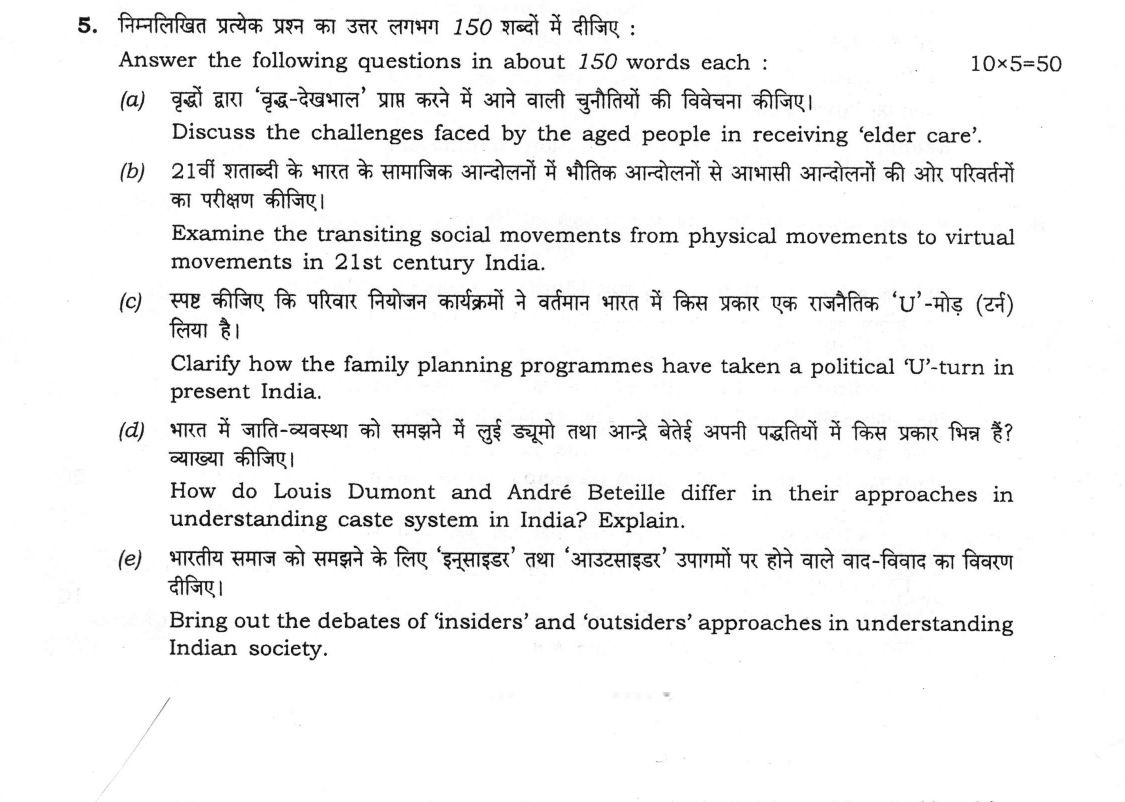
Answer the following questions in about 150 words each :
Discuss the challenges faced by the aged people in receiving ‘elder care’. 10 marks
Examine the transiting social movements from physical movements to virtual movements in 21st century India. 10 marks
Clarify how the family planning programmes have taken a political ‘U’-turn in present India. 10 marks
How do Louis Dumont and André Beteille differ in their approaches in understanding caste system in India? Explain. 10 marks
Bring out the debates of ‘insiders’ and ‘outsiders’ approaches in understanding Indian society. 10 marks
हिंदी में प्रश्न पढ़ें
निम्नलिखित प्रत्येक प्रश्न का उत्तर लगभग 150 शब्दों में दीजिए :
वृद्धों द्वारा ‘वृद्ध-देखभाल’ प्राप्त करने में आने वाली चुनौतियों की विवेचना कीजिए। (10 अंक)
21वीं शताब्दी के भारत के सामाजिक आन्दोलनों में भौतिक आन्दोलनों से आभासी आन्दोलनों की ओर परिवर्तनों का परीक्षण कीजिए। (10 अंक)
स्पष्ट कीजिए कि परिवार नियोजन कार्यक्रमों ने वर्तमान भारत में किस प्रकार एक राजनैतिक ‘U’-मोड़ (टर्न) लिया है। (10 अंक)
भारत में जाति-व्यवस्था को समझने में लुई डूमों तथा आन्द्रे बेतेई अपनी पद्धतियों में किस प्रकार भिन्न हैं? व्याख्या कीजिए। (10 अंक)
भारतीय समाज को समझने के लिए ‘इन्साइडर’ तथा ‘आउटसाइडर’ उपागमों पर होने वाले वाद-विवाद का विवरण दीजिए। (10 अंक)
Model answer
Drafted with AI by UPSC Answer Check against this question's marking rubric, to the 150-word length. UPSC does not publish answers for Mains — this is one way to score well, not an official key. How we build rubrics and answers.
(a) Challenges in receiving elder care
Scale: Census 2011 counted 10.4 crore people aged 60 and above (8.6%); the UNFPA India Ageing Report 2023 projects over 20% by 2050.
Family: nuclearisation and the out-migration of children weaken the joint family's moral economy of care, leaving "left-behind" parents, as in Kerala; care is still expected from daughters-in-law, whose own work makes it uncertain.
Gender: the feminisation of ageing: elderly women are more often widowed and lack property or pension.
Economic: most elderly people worked informally and have no pension; the central NSAP old-age pension is only ₹200 a month.
Health system: LASI (2017–18) found about three-quarters living with a chronic condition, yet geriatric, long-term and palliative care is scarce and paid out of pocket; NPHCE (2010) and Ayushman Bharat for all aged 70 and above (2024) are partial.
Rights: the Maintenance and Welfare of Parents and Senior Citizens Act, 2007 is underused, as parents rarely sue their children; the digital divide blocks access to services.
Conclusion: care must become a shared responsibility of family, state and community.
(b) From physical to virtual movements
Hybrid, not replacement: 21st-century Indian movements combine the street and the screen.
Examples: India Against Corruption (2011) joined missed-call and Facebook campaigns to the Ramlila Maidan fast; the Nirbhaya protests (2012), mobilised online, led to the Criminal Law (Amendment) Act, 2013; #MeToo India (2018) was largely online; the Shaheen Bagh sit-in (2019–20) and the farmers' protest (2020–21) were physical occupations amplified by WhatsApp, YouTube and the diaspora.
Theory: Manuel Castells (Networks of Outrage and Hope, 2012) on movement between cyberspace and urban space; Bennett and Segerberg's "connective action" (2012); Zeynep Tufekci (Twitter and Tear Gas, 2017) on quickly built but fragile movements that lack organisational capacity.
Limits: the digital divide (NFHS-5: about 33% of women against 57% of men had ever used the internet); slacktivism; internet shutdowns, which Anuradha Bhasin (2020) required to be proportionate; the IT Rules, 2021; trolling and misinformation.
Gains: counter-publics for Dalit, feminist and queer voices, and cheap mobilisation beyond geography.
Conclusion: the virtual is now part of every movement's repertoire, but durable change still needs organisation and physical presence.
(c) The political U-turn in family planning
Original paradigm: India launched the world's first national family planning programme (1952); it became target-driven, then coercive in the Emergency sterilisation drive (1975–77). After ICPD Cairo (1994), India adopted a target-free approach (1996) and the National Population Policy, 2000.
The U-turn: national TFR is 2.0 (NFHS-5, 2019–21), below replacement. Southern leaders, including the chief ministers of Andhra Pradesh and Tamil Nadu (2024), now make pro-natalist appeals; Andhra Pradesh (2024) and Telangana (2026) scrapped two-child bars for local-body elections.
Why it is political: the 84th Amendment (2001) froze Lok Sabha seats on the 1971 Census until the first census after 2026, so low-fertility states fear losing seats and Finance Commission share at delimitation; they also face ageing.
Contradictions: two-child norms survive in Assam, and Javed v State of Haryana (2003) upheld them for panchayat candidates; the burden stays on women, with female sterilisation at about 38% of married women against under 1% for men (NFHS-5).
Conclusion: policy has swung from "control" to "population as power"; either way, a sustainable approach is rights-based.
(d) Dumont and Béteille on caste
Dumont (Homo Hierarchicus, 1966; English 1970):
- a structuralist, ideological approach that reads texts and ethnography for underlying values;
- caste is a single value system built on the opposition of purity and impurity, in which hierarchy "encompasses the contrary"; India is homo hierarchicus against Western homo aequalis;
- disjunction of status and power: Brahmin status encompasses Kshatriya power;
- change is surface-level; the ideology persists.
Béteille (Caste, Class and Power, 1965, on Sripuram, Thanjavur):
- empirical fieldwork, Weberian and comparative;
- caste is one of three dimensions: caste, class and power;
- in Sripuram, Brahmins lost land and power to non-Brahmins, so the orders are dissociating, from cumulative to dispersed inequalities (harmonic to disharmonic systems).
Core difference: Dumont explains caste through ideas; Béteille through social relations and practice, faulting Dumont for taking the Brahmanical ideal for reality.
Critiques: Dumont is charged with essentialism and a "book view" (Berreman; Nicholas Dirks, Castes of Mind, 2001); Béteille's single-village study limits generalisation.
(e) Insiders and outsiders in studying Indian society
The framework: Robert K. Merton ("Insiders and Outsiders", 1972) contrasted the Insider doctrine (only members truly understand a group) with the Outsider doctrine (only detached strangers see it objectively). He concluded that everyone is both in some respects.
Insiders: M.N. Srinivas, G.S. Ghurye and T.N. Madan claim the emic view (Kenneth Pike) through language and access; the risk is taking the familiar for granted, hence the maxim to "make the familiar strange".
Outsiders: Louis Dumont, McKim Marriott, F.G. Bailey and Adrian Mayer offer comparative, etic detachment; the risks are imposed categories, Orientalism, or "going native".
Blurred lines: Béteille, a Bengali in a Tamil village, was an insider to India but an outsider to Sripuram; caste, class and gender make most researchers partial insiders.
The standpoint turn: Gopal Guru (2002) attacked the divide between "theoretical Brahmins" and "empirical Shudras"; Dalit and feminist scholars deny that the upper-caste male insider is neutral; the indigenisation debate (Ramkrishna Mukherjee, Yogendra Singh) seeks concepts rooted in Indian experience.
Resolution: identity does not guarantee truth; reflexivity, dialogue and evidence do.
How this answer will be evaluated
Evaluation rubric
Each sub-part is marked on its own, against the marks and word limit printed on the paper.
- (a) 'Discuss the challenges' faced by the aged in RECEIVING elder care - so the focus is on obstacles to access, not on ageing in general. The answer must cover the familial/structural, economic, health-system and rights-realisation dimensions, backed by Indian data, and should show why care is becoming scarcer even as the elderly population grows. 10 marks · 150 words
Must cover
- Census 2011: 60-plus about 8.6 per cent / 10.4 crore
- UNFPA India Ageing Report 2023 - about 20 per cent by 2050
- feminisation of ageing / widowhood
- nuclear family and out-migration of children
- Maintenance and Welfare of Parents and Senior Citizens Act, 2007
- pension inadequacy (IGNOAPS/NSAP)
- absence of geriatric and long-term care capacity
Loses marks
- Writing about the problems of old age in general (loneliness, illness) without addressing the question's specific focus on the challenges of RECEIVING care.
- Romanticising the joint family as an intact caregiving institution, when migration, nuclearisation and women's employment have demonstrably eroded it.
- Naming no law or scheme, when the Maintenance and Welfare of Parents and Senior Citizens Act, 2007, NPHCE and NSAP pensions are the obvious hooks.
- Using no Indian data at all; Census 2011, LASI and the UNFPA India Ageing Report 2023 are the standard sources.
- Ignoring gender, although widowhood and lack of property make elderly women the most care-deprived group.
Earns more
- Health-system challenge: high chronic and multi-morbidity among the elderly documented by the Longitudinal Ageing Study in India (LASI Wave 1, 2017-18, IIPS), against almost no trained geriatricians, negligible long-term, palliative and dementia care, neglect of elderly mental health and loneliness, and thin implementation of the National Programme for Health Care of the Elderly (2010)
- Abuse, neglect and failure to realise existing entitlements: elder abuse and property-related neglect documented in HelpAge India's surveys; under-use of the Maintenance and Welfare of Parents and Senior Citizens Act, 2007 and its maintenance tribunals because the elderly are reluctant to litigate against their own children; low awareness of the Elderline (14567); and digital, Aadhaar-KYC and life-certificate barriers that exclude the frail from pensions and from schemes such as the extension of Ayushman Bharat cover to all citizens aged 70 and above
- Theoretical framing: Cumming and Henry's disengagement theory ('Growing Old', 1961) against activity and continuity theories; Sarah Lamb's 'White Saris and Sweet Mangoes' on ageing, dependency and the moral economy of care in Bengal; S. Irudaya Rajan's work on the elderly left behind by migration, notably in Kerala
Extra mark
- Community or state care models stated accurately, e.g., Kerala's pakalveedu day-care centres or the Elderline national helpline (14567)
- (b) 'Examine' the transition from street-based to online mobilisation in twenty-first-century India. The strong answer resists the premise slightly - the shift is hybridisation rather than replacement - names concrete Indian movements on both sides, and weighs what digital repertoires gain against what they lose. 10 marks · 150 words
Must cover
- hybrid rather than wholly virtual movements
- at least three dated Indian examples (e.g. India Against Corruption 2011, Nirbhaya protests 2012, #MeToo 2018, anti-CAA/Shaheen Bagh 2019-20, farmers' protest 2020-21)
- Castells and/or Bennett and Segerberg's connective action
- Tufekci's critique of organisational fragility
- digital divide (NFHS-5 internet-use gender gap)
- slacktivism / state countermeasures
Loses marks
- Claiming that Indian movements have simply moved online, when the largest recent mobilisations (Shaheen Bagh, the farmers' protest) were physical occupations amplified online.
- Giving no Indian example, or examples with no dates, so the '21st century India' framing is unevidenced.
- Only listing advantages of social media without the critique of organisational fragility and exclusion, so nothing is 'examined'.
- Ignoring the digital divide, which determines who can join a virtual movement at all.
- Attributing 'connective action' or 'networked protest' to the wrong theorists - Castells for networks of outrage, Bennett and Segerberg for connective action, Tufekci for the fragility critique.
Earns more
- What the virtual form subtracts: Zeynep Tufekci's argument in 'Twitter and Tear Gas' (2017) that networked movements scale rapidly but lack the organisational capacity and internal decision-making that slow, offline movement-building produces, so they struggle to negotiate or sustain gains; slacktivism and low-cost participation; ephemeral attention cycles; vulnerability to trolling, doxxing, misinformation and polarisation; and state countermeasures including the Information Technology Rules, 2021 and internet shutdowns, of which India records among the highest numbers globally
- Exclusion and the digital divide: NFHS-5 (2019-21) found that about 57 per cent of men but only about 33 per cent of women had ever used the internet, with sharp rural-urban, caste and language gaps, so virtual movements over-represent the urban, English-speaking, upper-caste middle class - a criticism made pointedly of Indian #MeToo by Dalit feminists
- Theoretical placement: resource mobilisation theory (McCarthy and Zald) recast when the key resource becomes connectivity rather than money and formal organisation; new social movement theory (Touraine, Melucci) on identity-oriented rather than class-oriented mobilisation; and the Indian literature on social movements - M. S. A. Rao and Ghanshyam Shah's 'Social Movements in India'
Extra mark
- A named Indian online counter-public (e.g., #JusticeForRohith, 2016, or Dalit digital media) used to show gains as well as limits
- (c) 'Clarify how' family planning has taken a political U-turn: the candidate must establish the original anti-natalist paradigm, show the demographic ground on which it has been reversed, and identify the specifically POLITICAL drivers of the reversal - above all the federal arithmetic of delimitation - while noting the contradictions that persist. 10 marks · 150 words
Must cover
- India's national family planning programme, 1952 - the world's first
- Emergency sterilisation drive, 1975-77
- ICPD Cairo 1994 and the target-free approach (1996) / NPP 2000
- TFR 2.0 in NFHS-5, below replacement 2.1
- delimitation freeze - 84th Amendment, 2001, until the first census after 2026
- surviving two-child norms (Assam; Javed v. State of Haryana, 2003)
- female sterilisation as the dominant method
Loses marks
- Describing the history of family planning without identifying any U-turn, so the question's central claim is never addressed.
- Missing the delimitation link, which is the specifically political mechanism behind the southern states' pro-natalism.
- Asserting that India's population is still exploding; NFHS-5 puts national fertility at 2.0, below replacement.
- Wrong dates: the programme began in 1952, the Emergency ran 1975-77, ICPD Cairo was 1994, NPP is 2000.
- Presenting the U-turn as complete, when two-child norms and coercive incentives survive in several states.
Earns more
- The political U-turn identified: pro-natalist appeals by state leaders - notably the chief ministers of Andhra Pradesh and Tamil Nadu in 2024 - and Andhra Pradesh (2024) and Telangana (2026) repealing the two-child bar on contesting local body elections; the driver is federal arithmetic, since the allocation of Lok Sabha seats has been frozen on the 1971 census by the 42nd Amendment (1976) and then the 84th Amendment (2001) until the first census taken after 2026, so states that reduced fertility fastest fear losing parliamentary and fiscal weight to high-fertility states
- The contradictions that survive the turn: two-child norms still operating or proposed elsewhere - Assam's bar on government jobs, the lapsed Uttar Pradesh draft Population Bill of 2021 - and upheld for panchayat candidature in Javed v. State of Haryana (2003); together with a communalised framing of 'population growth' that NFHS-5 undercuts, since fertility has been converging across religious communities and has fallen fastest among Muslims
- The sociological constant: in both the anti-natalist and the pro-natalist phase the burden falls on women's bodies - female sterilisation remains by far the dominant modern method in NFHS-5 while male sterilisation is under one per cent - which is the standing feminist critique of Indian population policy as governance through women's fertility
Extra mark
- Cites Telangana's Panchayat Raj (Amendment) Act, 2026 or NFHS-5 evidence that fertility is converging across religious communities
- (d) 'Explain' the difference in APPROACH - not merely in conclusions. Dumont's is a structuralist, text-and-ideology-based account of caste as a single encompassing value system; Beteille's is an empirical, Weberian, field-based account of caste as one of several dissociating dimensions of stratification. The contrast must be drawn on stated criteria. 10 marks · 150 words
Must cover
- Homo Hierarchicus (1966/1970)
- purity and pollution as the single encompassing principle; hierarchy as encompassing of the contrary
- disjunction of status and power
- Caste, Class and Power (1965), Sripuram, Thanjavur
- caste-class-power as distinct dimensions; cumulative to dispersed inequalities
- ideology/book-view versus fieldwork/empirical method
Loses marks
- Mixing up the two works or field sites - 'Homo Hierarchicus' is Dumont's, 'Caste, Class and Power' is Beteille's on Sripuram in Thanjavur, not Srinivas' Rampura.
- Reversing the status-power relation in Dumont: for him ritual status encompasses temporal power, which is precisely the disjunction he claims is peculiar to India.
- Saying Beteille simply rejects hierarchy; his point is that caste, class and power are becoming dissociated, not that caste has disappeared.
- Listing both scholars' views without a single explicit criterion of comparison, so 'how they differ' is never answered.
- Calling Dumont a functionalist; he is a structuralist working on ideology and values.
Earns more
- Beteille's own objections to Dumont: that reducing caste to ideology makes power and material interest invisible, that it cannot account for observed change, and that the ideology Dumont describes is the Brahmanical view rather than the view of all castes; Beteille separately rejected the equation of caste with race
- Where other critics place the debate: Gerald Berreman's 'The Brahmanical View of Caste' (1971) arguing that from below caste is experienced as exploitation and conflict rather than consensual hierarchy; Dipankar Gupta's 'Interrogating Caste' on multiple and contested hierarchies rather than one; and Nicholas Dirks' 'Castes of Mind' (2001) on caste as substantially reconstituted under colonial rule
Extra mark
- Béteille's contrast of harmonic and disharmonic systems, or Dipankar Gupta's multiple, contested hierarchies as a third position
- (e) 'Bring out the debates' means presenting the rival epistemological claims - that only a member can truly understand a society, and that only a non-member has the detachment to analyse it - and locating them concretely in the study of Indian society, including the sharper contemporary version raised by Dalit and feminist standpoint arguments. 10 marks · 150 words
Must cover
- Robert K. Merton, 'Insiders and Outsiders' (1972)
- Insider doctrine and Outsider doctrine
- at least two Indian insider scholars and two outsider scholars named
- making the familiar strange / going native
- emic and etic
- Gopal Guru's standpoint critique and/or the indigenisation debate
Loses marks
- Attributing the insider-outsider formulation to someone other than Merton, or confusing it with Simmel's 'stranger' (Simmel is a useful antecedent, not the source of this debate).
- Turning the answer into a general note on participant observation instead of an epistemological debate.
- Naming no Indian scholars, so the phrase 'in understanding Indian society' is left unevidenced.
- Presenting the Insider doctrine as obviously correct without noting the risk of nativism, or the Outsider doctrine as obviously correct without noting imposed categories.
- Omitting the standpoint turn, which is where the debate now actually lives in Indian sociology.
Earns more
- The sharper contemporary version - standpoint epistemology: Gopal Guru's 'How Egalitarian Are the Social Sciences in India?' (EPW, 2002) charging Indian social science with a division between 'theoretical Brahmins' and 'empirical Shudras' and arguing for Dalit experience as a source of theory; feminist standpoint theory (Sandra Harding, Dorothy Smith) making the same claim for women; and the wider indigenisation argument - Syed Hussein Alatas on the 'captive mind', Ramkrishna Mukherjee on contextualisation, Sujata Patel on the sociology of Indian sociology
- Attempted resolutions: Kenneth Pike's emic/etic distinction; systematic reflexivity and Bourdieu's participant objectivation; collaborative and multi-vocal research; and Andre Beteille's warning that nativism is as disabling as ethnocentrism, since the test of a sociological claim is evidence and argument, not the identity of the claimant
Extra mark
- Srinivas's reflections on studying one's own society (The Remembered Village, 1976) or Béteille's warning that nativism is as disabling as ethnocentrism
What "Discuss" is asking you to do
Lay the issue out from more than one side — how it arose, what is claimed for it, what is held against it, and where it now stands. UPSC attaches discuss to broad topics with several live dimensions, so coverage of the dimensions earns more than the strength of your opinion.
Structure that answers it
Set the issue up → the case as it is made → the case against → the dimension both sides leave out → where the balance now lies
Where marks are lost
Listing facts with no thread between them, or arguing one side throughout and calling it a discussion.
Practice this exact question
Write your answer and it is marked point by point against the model answer above — what you covered, what you missed, what you got wrong.
Evaluate my answer →More from Sociology 2026 Paper II
- Q2 (a) Indological approach, advocated by G. S. Ghurye, focuses on the study of Indian socie…
- Q3 (a) Examine the challenges of applying micro-level village studies to macro-level village…
- Q4 (a) How does the Constitution of India promote education? Do you think that education can…
- Q5 Answer the following questions in about 150 words each : (a) Discuss the challenges faced…
- Q6 (a) Differentiate between protests and movements. Discuss some of those movements which c…
- Q7 (a) Urbanisation in Independent India has been characterized by over-urbanization and rur…
- Q8 (a) How has colonial rule transformed Indian society? If it (Indian society) had not unde…