Paper II — Q7
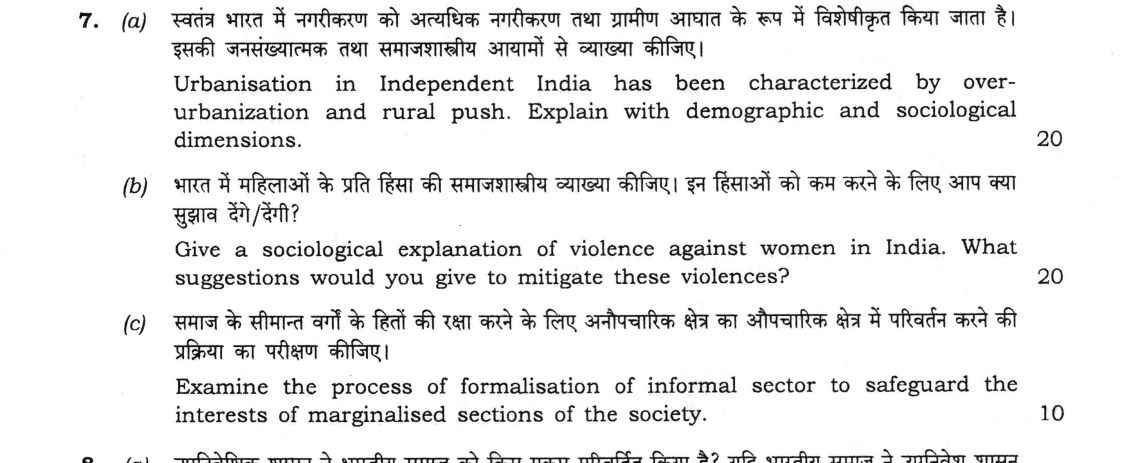
(a) Urbanisation in Independent India has been characterized by over-urbanization and rural push. Explain with demographic and…
Urbanisation in Independent India has been characterized by over-urbanization and rural push. Explain with demographic and sociological dimensions. 20 marks
Give a sociological explanation of violence against women in India. What suggestions would you give to mitigate these violences? 20 marks
Examine the process of formalisation of informal sector to safeguard the interests of marginalised sections of the society. 10 marks
हिंदी में प्रश्न पढ़ें
स्वतंत्र भारत में नगरीकरण को अत्यधिक नगरीकरण तथा ग्रामीण प्रतिकर्ष (पुश) के रूप में विशेषीकृत किया जाता है। इसकी जनसांख्यिकीय तथा समाजशास्त्रीय आयामों से व्याख्या कीजिए। (20 अंक)
भारत में महिलाओं के प्रति हिंसा की समाजशास्त्रीय व्याख्या कीजिए। इन हिंसाओं को कम करने के लिए आप क्या सुझाव देंगे/देंगी? (20 अंक)
समाज के सीमान्त वर्गों के हितों की रक्षा करने के लिए अनौपचारिक क्षेत्र का औपचारिक क्षेत्र में परिवर्तन करने की प्रक्रिया का परीक्षण कीजिए। (10 अंक)
Model answer
Drafted with AI by UPSC Answer Check against this question's marking rubric, to the expected length. UPSC does not publish answers for Mains — this is one way to score well, not an official key. How we build rubrics and answers.
(a) Over-urbanisation and rural push
The concepts:
- Kingsley Davis and Hilda Golden (1954) defined over-urbanisation as urban growth running ahead of industrial employment;
- in India, rural push (landlessness, fragmentation, agrarian distress, caste oppression) has driven migration more than industrial pull;
- Arthur Lewis's surplus-labour model expected factories to absorb rural migrants, but Todaro's model explains why migrants come for expected rather than actual urban wages, and so swell urban unemployment and informality.
Demographic dimensions:
- Census 2011 put the urban share at 31.16% (about 37.7 crore people) in 7,935 towns;
- census towns almost tripled, from 1,362 (2001) to 3,894 (2011);
- the urban share is now estimated at about 35–36%;
- India has 50-odd million-plus cities, and population is concentrating in metropolitan regions;
- growth comes from natural increase, migration and reclassification of rural areas;
- Census 2011 counted about 6.55 crore slum dwellers;
- about 90% of workers are informal, including most urban migrants.
Critique of the concept:
- N.V. Sovani (1964) argued that there is no stable link between urbanisation and industrialisation, so "over-urbanisation" is a weak benchmark;
- by international standards India is under-urbanised relative to its income, with much urbanisation hidden in villages that are urban in character;
- the deficit is in jobs, housing and planning, not in the number of urban dwellers.
Sociological dimensions:
Wirth qualified:
- Louis Wirth's "Urbanism as a Way of Life" (1938) predicted anonymity, secondary ties and individualism;
- in Indian cities, caste, kin and regional networks persist in housing, marriage and labour markets;
- M.S.A. Rao described a rural–urban continuum.
Circular migration: Jan Breman's "footloose labour" moves between village and city without settling. The 2020 COVID-19 reverse migration showed how little protection these migrants have.
Informality and slums: a large share of city life is informal. Partha Chatterjee's "political society" describes how slum dwellers negotiate with the state.
Segregation and polarisation:
- gated enclaves of the new middle class (Leela Fernandes) contrast with Muslim and Dalit ghettoisation (Jaffrelot and Gayer, Muslims in Indian Cities, 2012);
- evictions displace informal settlers for "world-class city" projects.
Subaltern urbanisation: small towns growing without metro links (Denis, Mukhopadhyay and Zérah, 2012).
Gender: migration is mostly male for work and female for marriage; women's access to urban public space is limited.
Policy response: the Smart Cities Mission, AMRUT and PMAY-Urban (all 2015), and the National Urban Livelihoods Mission, which need to be matched by employment generation in manufacturing and services.
Conclusion: Indian urbanisation is best described as push-driven, informal and unevenly planned, rather than simply "excessive". It is a problem of the quality of urban absorption.
(b) Violence against women
Scale:
- NCRB's Crime in India 2022 recorded about 4.45 lakh crimes against women. The largest category is cruelty by husband or relatives;
- NFHS-5 (2019–21) found about 29% of ever-married women aged 18–49 had experienced spousal violence;
- most violence goes unreported.
Sociological explanation:
- Patriarchy as structure: Sylvia Walby (Theorizing Patriarchy, 1990) identified six structures of patriarchy: household production, paid work, the state, male violence, sexuality and culture. Violence is a means of control, not individual deviance.
- Brahmanical patriarchy: Uma Chakravarti ties caste endogamy and purity to the control of women's sexuality. "Honour" killings punish inter-caste and same-gotra marriages (Shakti Vahini, 2018).
- The family as the main site: dowry, son preference and sex-selective abortion (sex ratio at birth about 929 per 1,000 boys, NFHS-5), and violence by in-laws in patrilocal residence.
- Intersectionality: caste-based sexual violence against Dalit and Adivasi women is used to police caste boundaries and punish assertion, as in Khairlanji (2006) and Hathras (2020).
- Backlash and changing roles: women's growing education, work and mobility can provoke violence as male control is threatened.
- Cultural legitimation: norms of family honour, media representations, and victim-blaming, which discourage reporting.
- State and institutions: low conviction rates, police insensitivity and slow courts create impunity.
The legal framework:
- Dowry Prohibition Act, 1961;
- Section 85 BNS (formerly Section 498A IPC, 1983) for cruelty, and Section 80 BNS (formerly Section 304B IPC) for dowry death;
- PCPNDT Act (1994; renamed in 2003);
- PWDVA, 2005;
- Vishaka (1997) and the POSH Act, 2013;
- the Criminal Law (Amendment) Act, 2013, after the Verma Committee.
Suggestions to mitigate violence:
Preventive and structural:
- raise women's employment and land ownership to strengthen their fallback position (Bina Agarwal);
- make girls' secondary education universal;
- work with men and boys on gender norms, and bring comprehensive gender education into schools.
Institutional:
- scale up One Stop Centres (Sakhi) and the 181 helpline;
- build women's help desks in police stations and gender-sensitise the police;
- use fast-track courts and time-bound investigation;
- fund protection officers under the PWDVA.
Public space: safe transport, lighting, and women's right to be in public for its own sake (Why Loiter?, 2011).
Community: support survivors, protect inter-caste couples through safe houses, and keep watch through panchayats and self-help groups.
Data: regular victimisation surveys to capture unreported violence.
Conclusion: violence against women is structural and patterned by caste and family. Law is necessary but not sufficient; changing economic power and norms is the lasting remedy.
(c) Formalising the informal sector
Concept:
- Keith Hart coined "informal sector" (1971; published 1973), and the ILO's 1972 Kenya report popularised it;
- the informal sector (unregistered enterprises) differs from informal employment (workers without contract or social security), which also exists inside formal firms.
Scale: the National Commission for Enterprises in the Unorganised Sector (NCEUS, Arjun Sengupta, 2007) estimated about 92% of the workforce to be informal. PLFS data still show most workers without written contracts or social security.
Instruments of formalisation:
- the Unorganised Workers' Social Security Act, 2008;
- the Street Vendors Act, 2014 and PM SVANidhi (2020);
- the e-Shram portal (2021), with over 30 crore registrations;
- the four Labour Codes (Wages 2019; Social Security, Industrial Relations, and Occupational Safety 2020), in force from 21 November 2025, which define gig and platform workers and provide for aggregator contributions;
- GST, digital payments and EPFO enrolment;
- ILO Recommendation 204 (2015) on the transition to formality.
How far it safeguards marginalised groups:
Gains: identity, access to schemes, portable benefits (One Nation One Ration Card), credit for vendors, and legal recognition.
Limits:
- registration is not protection: a database without funded, portable social security and enforceable minimum wages changes little;
- abrupt formalisation shocks, such as demonetisation (2016) and early GST, hurt small units and informal workers;
- compliance costs push firms to stay small or use contract labour.
Social structuring of informality:
- informality is organised by caste, gender and religion: Dalits in sanitation work, women in home-based and care work, Muslims in self-employment (Sachar Committee, 2006);
- Barbara Harriss-White and Jan Breman show the informal economy regulated by social institutions that law struggles to reach.
Voice: organisations such as SEWA show that collective organisation, not registration alone, secures rights.
Formalisation protects the marginalised only when it brings rights, social security and voice. Otherwise it merely records them.
How this answer will be evaluated
Evaluation rubric
Each sub-part is marked on its own, against the marks and word limit printed on the paper.
- (a) The question supplies two technical characterisations - over-urbanisation and rural push - and asks the candidate to explain post-1947 Indian urbanisation through BOTH a demographic dimension (rates, town counts, migration streams, slum and informal-sector data) and a sociological dimension (urbanism as a way of life, the persistence of caste and kin, labour precarity, urban inequality). Both dimensions are required. 20 marks
Must cover
- over-urbanisation (Davis and Golden, 1954) and Sovani's critique
- push-pull; Lewis and/or Todaro
- Census 2011 urban share 31.16 per cent; 7,935 towns; census towns tripling
- slum population about 6.55 crore (Census 2011)
- informal employment around 90 per cent of workers
- Wirth, 'Urbanism as a Way of Life' (1938) and the Indian qualification (caste and kin persist)
- Jan Breman, footloose labour / circular migration
- COVID-19 reverse migration, 2020
Loses marks
- Answering only the demographic half, or only the sociological half, when the question explicitly asks for both.
- Data errors: the Census 2011 urban share is 31.16 per cent, not above 35 or below 28; the slum population is about 6.55 crore.
- Applying Wirth's anonymity thesis to Indian cities without qualification, when caste, kin and regional networks demonstrably structure urban housing and labour markets.
- Treating over-urbanisation as an established fact rather than a contested concept - Sovani's critique and India's comparatively low urban share both complicate it.
- Ignoring circular migration, which is the dominant Indian form and the one census snapshots most badly under-count.
Earns more
- The specific evidence for over-urbanisation: Census 2011 recorded a slum population of about 6.55 crore in 2,613 towns, roughly 17 per cent of urban households; roughly nine in ten Indian workers are in informal employment; and urban growth has been led by low-productivity services rather than by manufacturing, so cities absorb migrants into informal work, inadequate housing and stressed infrastructure rather than into industrial employment
- The sociological dimension: Louis Wirth's 'Urbanism as a Way of Life' (1938) deriving anonymity, secondary and segmental contacts, heterogeneity and anomie from size, density and heterogeneity; against the Indian finding that this is only partly true - chain migration reproduces caste, kin and regional clusters in the city, jati associations and hometown networks organise housing and jobs, 'urban villages' survive inside metropolitan boundaries, and Srinivas and M. S. A. Rao accordingly describe a rural-urban continuum rather than a dichotomy, extending Redfield's folk-urban continuum
- Labour, precarity and urban inequality: Jan Breman's 'Footloose Labour' (1996) on circular migrants as wage hunters and gatherers moving between countryside and city without ever becoming settled urban workers; Jonathan Parry's studies of Bhilai on the divide between secure company labour and contract labour; the COVID-19 reverse migration of 2020 exposing the absence of urban social protection and residence-based entitlement for migrants; and the simultaneous rise of gated enclaves and a new urban middle class (Leela Fernandes) alongside the slum
- Policy response and a qualified verdict: JNNURM (2005), the Smart Cities Mission and AMRUT (2015), PMAY-Urban, the e-Shram registry (2021) and One Nation One Ration Card portability; the criticism that Indian urban policy is infrastructure-led and largely silent on the migrant worker's housing, mobility and social security; and the counter-argument that at about 31-35 per cent urban India is in fact under-urbanised for its income level, so the deficit is one of planning and employment rather than of excess urban population
Extra mark
- Subaltern urbanisation (Denis, Mukhopadhyay and Zérah, 2012) or the tripling of census towns as evidence of hidden urbanisation
- (b) Two parts. First, a SOCIOLOGICAL explanation of violence against women - locating it in patriarchy as a structure and in its specifically Indian articulation with caste, kinship and the family - rather than a list of crimes. Second, concrete mitigation suggestions, which should be both institutional and structural-preventive. 20 marks
Must cover
- NCRB Crime in India (2022) and NFHS-5 data
- patriarchy as structure - Sylvia Walby
- Uma Chakravarti's Brahmanical patriarchy; caste endogamy and honour
- the family as the primary site; dowry and son preference
- at least four dated statutes or judgments (Dowry Prohibition Act 1961; 498A 1983; PWDVA 2005; POSH Act 2013; Criminal Law (Amendment) Act 2013; PCPNDT 1994)
- intersectionality / caste-based sexual violence
- at least three concrete mitigation suggestions
Loses marks
- Listing crime categories and statutes with no sociological theory, so the question's demand for a 'sociological explanation' is unmet.
- Explaining violence by individual deviance, alcohol or 'mindset' alone rather than by structure.
- Omitting caste, which in the Indian case is not an add-on but the mechanism through which control of female sexuality is organised.
- Statute errors: the Dowry Prohibition Act is 1961, PWDVA 2005, POSH 2013, PCPNDT 1994, Vishaka 1997, the Criminal Law (Amendment) Act following the Verma Committee is 2013.
- Offering only punitive suggestions (harsher sentences) with nothing preventive or structural, when the question asks how to mitigate.
Earns more
- Mechanisms across the life-cycle and the intersections: son preference and sex-selective elimination; dowry and the structural devaluation of daughters; the family as the principal site of violence, which is why most of it is unreported; and the compounding of vulnerability by caste, class, religion, disability and displacement - Kimberle Crenshaw's intersectionality, with the Indian literature on gendered violence in conflict and Partition (Veena Das' 'Life and Words', Ritu Menon and Kamla Bhasin's 'Borders and Boundaries', Urvashi Butalia's 'The Other Side of Silence')
- The legal-institutional record and its gaps, accurately dated: the Dowry Prohibition Act, 1961; Section 498A IPC (1983) and Section 304B on dowry death (1986) won by the anti-dowry agitation; the Mathura custodial rape case (1979) leading to the Criminal Law (Amendment) Act, 1983; the PCPNDT Act, 1994; Vishaka v. State of Rajasthan (1997) leading to the POSH Act, 2013; the Protection of Women from Domestic Violence Act, 2005; POCSO, 2012; the Justice J. S. Verma Committee leading to the Criminal Law (Amendment) Act, 2013; the Prohibition of Child Marriage Act, 2006; and the Bharatiya Nyaya Sanhita, 2023, in force from 1 July 2024 - noting that the exception excluding marital rape has been retained and remains under challenge
- Institutional suggestions: functioning fast-track special courts and time-bound trials to raise a low conviction rate; one-stop Sakhi centres and the 181 helpline scaled and staffed; effective use of the Nirbhaya Fund (2013); gender-sensitisation and far higher representation of women in the police; forensic capacity, victim and witness protection and compensation; mandatory workplace Internal Committees under the POSH Act extended to the informal sector; and removal of the marital rape exception
- Structural and preventive suggestions: girls' secondary education and retention and delayed marriage; women's employment, asset and land ownership to raise intra-household bargaining power (Bina Agarwal); working with men and boys through programmes such as MASVAW and campaigns such as Bell Bajao; gender education in the school curriculum; strict enforcement of the PCPNDT Act against sex selection; community norm change through self-help groups and reserved panchayat seats; and safe, well-lit, well-served public space and transport - the claim to unconditional access to the city made in 'Why Loiter?' (Phadke, Khan and Ranade, 2011)
Extra mark
- Notes that the Bharatiya Nyaya Sanhita, 2023 (in force from 1 July 2024) retained the marital-rape exception, or cites Veena Das or Urvashi Butalia on gendered violence
- (c) 'Examine the process' means assess, not merely describe: set out what formalisation of the informal sector involves in India, identify the specific instruments, and then test whether registration actually safeguards marginalised workers or merely records them. A list of schemes without evaluation does not meet the directive. 10 marks
Must cover
- Keith Hart / ILO 1972 origin of 'informal sector'
- NCEUS (Arjun Sengupta, 2007) - about 92 per cent informal workforce
- informal sector vs informal employment
- e-Shram (2021); Code on Social Security, 2020 defining gig and platform workers
- Street Vendors Act, 2014
- the critique that registration without portable, funded social security is not protection
- caste, gender and religion structuring informality
Loses marks
- Listing government schemes with no assessment, when the directive is 'examine'.
- Treating formalisation as automatically beneficial and ignoring compliance costs and the disemployment effects of abrupt formalisation shocks.
- Confusing the informal sector with the informal workforce - a large share of informal employment exists inside registered formal enterprises.
- Ignoring the social structuring of informality by caste, gender and religion, which is precisely what makes it a question about marginalised sections.
- Attributing the concept of the informal sector to the ILO alone; Keith Hart coined it, and the ILO's 1972 Kenya report popularised it.
Earns more
- The critical examination - registration is not protection: Jan Breman's argument that registering workers without funded, portable entitlements amounts to a formalisation of informality; Barbara Harriss-White's 'India Working' (2003) showing that the informal economy is in practice regulated by caste, community, gender and locality rather than by the state, so a database leaves those structures untouched; compliance costs that push the smallest units further underground; and the job losses that abrupt formalisation shocks such as demonetisation (2016) and the GST transition imposed on informal enterprise
- What would make formalisation protective: universal and portable social security decoupled from identifying a single employer, with statutory aggregator or employer contribution; portability of entitlements on the One Nation One Ration Card model; minimum wage enforcement and inspection capacity; collective bargaining rights for informal and platform workers; and occupation-specific law where none exists - India still has no central statute for domestic workers and has not ratified ILO Convention 189, while sanitation workers depend on the Prohibition of Employment as Manual Scavengers and their Rehabilitation Act, 2013 and the NAMASTE scheme
Extra mark
- ILO Recommendation 204 (2015) on the transition to formality, or the absence of a central domestic workers' law and India's non-ratification of ILO Convention 189
What "Explain" is asking you to do
Make the working of something clear — what sets it off, what follows from what, and what it produces. Explain is the Commission's mechanism word: it dominates the technical papers and the “explain why” stems, where the marks sit in the causal chain and not in the label.
Structure that answers it
State what it is → the initiating condition → the chain of cause, step by step → an instance where it plays out → what the chain produces
Where marks are lost
Describing what something looks like instead of why it works that way. Naming the stages without linking them reads as description too.
Practice this exact question
Write your answer and it is marked point by point against the model answer above — what you covered, what you missed, what you got wrong.
Evaluate my answer →More from Sociology 2026 Paper II
- Q4 (a) How does the Constitution of India promote education? Do you think that education can…
- Q5 Answer the following questions in about 150 words each : (a) Discuss the challenges faced…
- Q6 (a) Differentiate between protests and movements. Discuss some of those movements which c…
- Q7 (a) Urbanisation in Independent India has been characterized by over-urbanization and rur…
- Q8 (a) How has colonial rule transformed Indian society? If it (Indian society) had not unde…