Paper II — Q4
(a) How does the Constitution of India promote education? Do you think that education can be a major instrument of social change?…
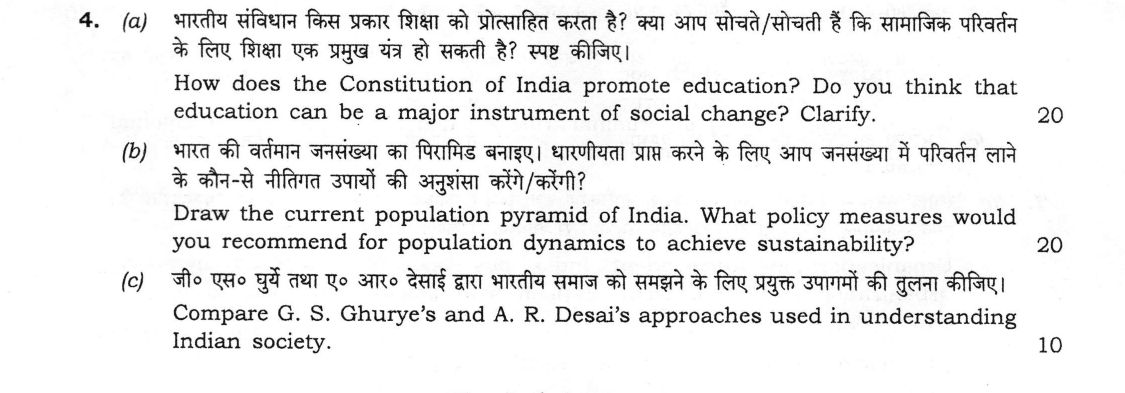
How does the Constitution of India promote education? Do you think that education can be a major instrument of social change? Clarify. 20 marks
Draw the current population pyramid of India. What policy measures would you recommend for population dynamics to achieve sustainability? 20 marks
Compare G. S. Ghurye’s and A. R. Desai’s approaches used in understanding Indian society. 10 marks
हिंदी में प्रश्न पढ़ें
भारतीय संविधान किस प्रकार शिक्षा को प्रोत्साहित करता है? क्या आप सोचते/सोचती हैं कि सामाजिक परिवर्तन के लिए शिक्षा एक प्रमुख यंत्र हो सकती है? स्पष्ट कीजिए। (20 अंक)
भारत की वर्तमान जनसंख्या का पिरामिड बनाइए। धारणीयता प्राप्त करने के लिए आप जनसंख्या में परिवर्तन लाने के कौन-से नीतिगत उपायों की अनुशंसा करेंगे/करेंगी? (20 अंक)
जी० एस० घुर्ये तथा ए० आर० देसाई द्वारा भारतीय समाज को समझने के लिए प्रयुक्त उपागमों की तुलना कीजिए। (10 अंक)
Model answer
Drafted with AI by UPSC Answer Check against this question's marking rubric, to the expected length. UPSC does not publish answers for Mains — this is one way to score well, not an official key. How we build rubrics and answers.
(a) Constitution, education and social change
How the Constitution promotes education:
A right: Article 21A, inserted by the 86th Amendment (2002), makes free and compulsory education a fundamental right for children aged 6–14. The Right to Education Act, 2009 gives it effect, including the 25% quota for disadvantaged children in private schools.
Duties and directives:
- Article 45 (as amended) directs early childhood care and education for children below six;
- Article 51A(k) makes it a parent's duty to provide educational opportunities to children aged 6–14;
- Article 46 directs the state to promote the educational interests of SCs, STs and weaker sections.
Equality and diversity:
- Articles 15(4) and 15(5) (the latter from the 93rd Amendment, 2005) allow reservations in admissions, and 15(6) (103rd Amendment, 2019) extends this to EWS;
- Articles 29–30 protect minority educational institutions;
- Article 350A provides for primary education in the mother tongue.
Federal structure: the 42nd Amendment (1976) moved education to the Concurrent List.
Courts: Mohini Jain (1992) and Unni Krishnan (1993) read education into the right to life. Society for Unaided Private Schools of Rajasthan (2012) upheld the RTE quota; Pramati (2014) exempted minority schools from it.
Is education a major instrument of social change?
Yes, as a channel of change:
- Durkheim saw education as moral socialisation. Parsons saw the school as a sorting agency on achieved rather than ascribed criteria, enabling meritocratic mobility;
- Jyotirao and Savitribai Phule opened schools for girls and lower castes (1848). Ambedkar's call was "educate, agitate, organise";
- literacy rose from 18.33% (1951) to 74.04% (2011);
- a Dalit and OBC middle class grew through reserved seats and jobs;
- women's education is linked to later marriage and lower fertility (NFHS);
- Kerala shows education driving demographic and social change.
But also a means of reproduction:
- Bourdieu's cultural capital and Bowles and Gintis's correspondence principle show schools rewarding the already privileged;
- India has a multi-track system: elite English-medium private schools, weak government schools and coaching industries;
- Satish Deshpande shows the "merit" discourse masking inherited upper-caste advantage;
- ASER surveys repeatedly find that only around half of Class V children can read a Class II text;
- dropout among girls, Dalits and Adivasis remains high.
Verdict:
- education is a necessary but not sufficient instrument of change. It produces individual mobility faster than it dismantles structural inequality;
- its transformative power depends on quality, equity and public investment. The Kothari Commission (1964–66) called for spending 6% of GDP, and NEP 2020 repeated the target, which remains unmet.
(b) India's population pyramid and policy
India's current population pyramid (five-year cohorts; bar lengths are approximate, based on UN World Population Prospects 2024 estimates):

Reading the pyramid:
- the base is narrowing: the youngest cohorts are smaller than those aged 10–24, because fertility has fallen below replacement;
- there is a large working-age bulge: about two-thirds of people are aged 15–59, with about a quarter under 15 and about a tenth over 60;
- the apex is thin but widening. The shape is turning from a pyramid into a barrel.
Supporting data:
- the total fertility rate (TFR) is 2.0 (NFHS-5, 2019–21), below the replacement level of 2.1;
- the population is about 1.46 billion (UN, 2025);
- the 60-plus share is projected to rise from about 10% (2022) to over 20% by 2050 (UNFPA India Ageing Report 2023).
What the national pyramid hides:
- TFR ranges from about 3.0 in Bihar to about 1.8 in Kerala and Tamil Nadu;
- the south and west are ageing while the north-central states still have young, expanding populations;
- the child sex ratio is skewed in several states.
Policy recommendations:
Harvest the demographic dividend:
- foundational learning (NEP 2020);
- skilling tied to jobs;
- raise female labour force participation through childcare, safety and flexible work;
- invest in health and nutrition.
In high-fertility districts, be rights-based and not coercive:
- girls' schooling, delaying marriage, spacing methods and quality contraceptive choice (Mission Parivar Vikas, 2016);
- avoid two-child norms and target-driven sterilisation. In Devika Biswas v Union of India (2016) the Supreme Court condemned sterilisation camps, although Javed v State of Haryana (2003) had upheld a two-child rule for panchayat candidates.
Prepare for ageing:
- universal pensions and health cover (Ayushman Bharat for all aged 70 and above, 2024);
- geriatric care (NPHCE) and support for the care economy;
- enforce the Maintenance and Welfare of Parents and Senior Citizens Act, 2007.
Migration and urbanisation: make welfare portable (One Nation One Ration Card) so that labour can move from young to ageing regions.
Federal balance: the 84th Amendment (2001) froze the delimitation of seats until after the first census taken after 2026. Delimitation must be designed so that states which controlled population growth are not penalised.
Better data: the delayed census (population count due in 2027) is needed to plan all of the above.
Sustainability frame: the aim is no longer population "control" but a stable, healthy, skilled and gender-equal population, living within environmental limits.
(c) Ghurye and Desai compared
| Criterion | G.S. Ghurye | A.R. Desai |
|---|---|---|
| Approach | Indological, textual-cum-empirical, culturological | Marxist, historical-materialist |
| Key work | Caste and Race in India (1932) | Social Background of Indian Nationalism (1948) |
| Unit of analysis | Caste, culture and tradition; Hindu civilisation | Class, mode of production, the state |
| Sources | Sanskrit texts, census and ethnography | Economic history, colonial records, movement data |
| View of change | Cultural continuity and adaptation | Transformation driven by colonial capitalism and class struggle |
| Tribes | Tribes as "backward Hindus" to be assimilated, against Verrier Elwin's isolationism (1943) | Tribal and peasant struggles against exploitation (Peasant Struggles in India, 1979) |
| State and nation | Cultural unity of India | India after independence took a capitalist path; the state is bourgeois (State and Society in India, 1975) |
Convergence:
- both belong to the Bombay School, and Desai wrote his doctorate under Ghurye;
- both were historical in method and saw India as a civilisation in change, though they explained that change differently.
Criticisms:
- Ghurye: a Brahmanical, text-centred and assimilationist bias; little attention to conflict or to lower-caste perspectives.
- Desai: economic determinism; caste, religion and culture reduced to class; thinner fieldwork.
How this answer will be evaluated
Evaluation rubric
Each sub-part is marked on its own, against the marks and word limit printed on the paper.
- (a) Two parts must both be answered. First, a factual account of how the Constitution promotes education - the specific articles, amendments and the statute they generated. Second, an argued position, with 'clarify' requiring a reasoned verdict, on whether education can be a major instrument of social change, tested against both the functionalist and the reproduction traditions and against Indian evidence. 20 marks
Must cover
- Article 21A and the 86th Amendment, 2002
- RTE Act, 2009
- Article 45, Article 51A(k), Article 46
- Articles 29-30; Article 15(5) / 93rd Amendment, 2005
- 42nd Amendment, 1976 - education to the Concurrent List
- Durkheim and/or Parsons; Bourdieu and/or Bowles and Gintis
- Phule, Ambedkar
- Kothari Commission (1964-66) and/or NEP 2020
- literacy 74.04 per cent (Census 2011)
Loses marks
- Getting the amendment numbers wrong: Article 21A comes from the 86th Amendment (2002); Article 15(5) from the 93rd (2005); education moved to the Concurrent List by the 42nd (1976).
- Saying the RTE Act covers all children up to 18; Article 21A and the Act cover ages 6-14.
- Answering only the constitutional half and treating 'education as an instrument of social change' as a one-line afterthought, when it carries roughly half the marks.
- Asserting that education automatically produces equality without engaging the reproduction theorists, so 'clarify' is unmet.
- No Indian thinker or data point, leaving the second half as textbook Western sociology.
Earns more
- Judicial elaboration: Mohini Jain v. State of Karnataka (1992) and Unni Krishnan v. State of Andhra Pradesh (1993) reading a right to education into Article 21, and Society for Un-aided Private Schools of Rajasthan v. Union of India (2012) upholding the RTE Act's 25 per cent reservation for disadvantaged children in private schools
- Indian evidence that education has driven change: Jyotirao and Savitribai Phule's first school for girls (Pune, 1848) and Satyashodhak Samaj (1873); Ambedkar's 'educate, agitate, organise' and education as the route out of caste disability; Gandhi's Nai Talim (Wardha scheme, 1937) and Tagore's Santiniketan; the rise of literacy from 18.33 per cent in 1951 to 74.04 per cent in Census 2011 (female 65.46 per cent); Kerala's schooling-led demographic and health transition; and reservation creating a first-generation Dalit and Adivasi professional class
- Indian evidence that education also reproduces inequality: Krishna Kumar on the political agenda of schooling, Satish Deshpande on 'merit' as inherited upper-caste privilege, Andre Beteille on education and the persistence of inequality; the multi-track system of elite private, English-medium, government and low-fee private schools; ASER's findings on weak foundational learning; dropout at secondary level, especially for girls and Adivasi children; and the digital divide exposed during COVID-19 school closures
- Reasoned verdict, with the policy gap named: education is a necessary but not sufficient instrument of change - it produces mobility for individuals faster than it dismantles structures; the Kothari Commission (1964-66) recommended a common school system and public spending of 6 per cent of GDP, a target reiterated by the National Education Policy 2020 and still unmet
Extra mark
- Sets Article 21A's 6–14 scope against NEP 2020's goal of 100% gross enrolment from preschool to secondary by 2030, or cites Krishna Kumar on the politics of schooling
- (b) An explicit two-part instruction: (i) DRAW India's current population pyramid - a labelled diagram is compulsory, not optional; and (ii) recommend policy measures on population dynamics to achieve sustainability. The drawing must reflect India's actual present age structure (a narrowing base with a working-age bulge), not a textbook expanding pyramid, and the policy half must address the dividend, the remaining high-fertility pockets and ageing together. 20 marks
Must cover
- a labelled population pyramid, males left / females right, five-year cohorts
- narrowing base / barrel shape, working-age bulge
- TFR 2.0 (NFHS-5, 2019-21) below replacement 2.1
- demographic dividend window
- state-level fertility divergence (Bihar vs Kerala/Tamil Nadu)
- rights-based, non-coercive family planning; rejection of two-child norms
- ageing: 60-plus to reach roughly 20 per cent by 2050 (UNFPA India Ageing Report 2023)
Loses marks
- Drawing a textbook expanding pyramid with a very broad base - that is India of the 1970s-80s, not India today, whose base has begun to contract because fertility is already below replacement.
- Not drawing anything at all, when the question begins with the imperative 'Draw'.
- Recommending population control measures such as a two-child norm as the main policy, when national fertility is already below replacement; the live problems are the dividend, ageing and regional divergence.
- Unlabelled axes or omitting the male/female split, which makes the pyramid unreadable.
- Quoting fertility, sex-ratio or elderly-share figures with no source attached (NFHS-5, Census 2011, SRS, UNFPA), so the examiner cannot check them.
Earns more
- Notes the regional divergence the single national pyramid conceals: NFHS-5 total fertility rates ranging from about 3.0 in Bihar and 2.4 in Uttar Pradesh down to about 1.8 in Kerala and Tamil Nadu, 1.6 in West Bengal and the lowest in Sikkim - producing a north-south demographic divide with consequences for migration, labour supply, fiscal transfers and the delimitation of parliamentary seats frozen by the 84th Amendment (2001) until the first census after 2026
- Policy to convert the bulge into a demographic dividend: foundational learning and skilling (NEP 2020, Skill India), health and nutrition to cut stunting and anaemia, and above all employment generation plus raising the female labour force participation rate, which remains low though rising in recent Periodic Labour Force Survey rounds - the dividend is a window, not a guarantee, and closes as the bulge ages
- Policy for the remaining high-fertility districts, explicitly rights-based and non-coercive: Mission Parivar Vikas (2016) in high-fertility districts, the target-free approach and the National Population Policy 2000, girls' secondary education and raising the effective age at marriage, spacing methods and male participation in contraception - with an explicit rejection of coercion, citing the 1975-77 Emergency sterilisation drive, the Supreme Court's directions in Devika Biswas v. Union of India (2016) ending sterilisation camps, and the counter-productive effects of two-child norms
- Policy for ageing and the sustainability frame: pensions and long-term/elder care (National Programme for Health Care of the Elderly, 2010; Maintenance and Welfare of Parents and Senior Citizens Act, 2007; the extension of Ayushman Bharat cover to all citizens aged 70 and above in 2024), investment in the care economy, planned management of internal migration, and the recognition that ecological sustainability depends on per-capita consumption and urban form at least as much as on population size
Extra mark
- Sources the drawn pyramid (UN World Population Prospects 2024 or SRS) and notes that Census 2027 will give the first full count since 2011
- (c) A straight comparison: set out Ghurye's Indological, textual-cum-empirical, culturological approach against Desai's Marxist historical-materialist approach, on explicit and common criteria - unit of analysis, sources of data, view of tradition and change, and stance towards the state - and note where they nonetheless converge. 10 marks
Must cover
- Indological / textual-cum-empirical (Ghurye) vs Marxist historical materialism (Desai)
- Caste and Race in India (1932)
- Social Background of Indian Nationalism (1948)
- Ghurye's 'backward Hindus' thesis vs Verrier Elwin
- culture/tradition as unit vs class/mode of production as unit
- Bombay School; Desai's doctorate under Ghurye
- one criticism of each
Loses marks
- Writing two separate biographies with no comparison, when the directive is 'compare'.
- Wrong attributions: 'Caste and Race in India' is Ghurye's, 'Social Background of Indian Nationalism' is Desai's; neither wrote 'The Remembered Village' (Srinivas) or 'Homo Hierarchicus' (Dumont).
- Calling Ghurye purely an armchair Indologist - he trained under Rivers, founded the Indian Sociological Society in 1951 and supervised extensive empirical work.
- Reversing the tribal debate: it was Ghurye who argued for assimilation of tribes as 'backward Hindus' and Elwin who initially argued for isolation.
- No criticism of either scholar, leaving the comparison uncritical.
Earns more
- Convergences honestly noted: both belong to the Bombay School and Desai completed his doctorate under Ghurye; both are historical rather than ahistorical in method; both study India in its own right rather than as a test case for imported theory; and both combined theory with substantial empirical and documentary work
- Criticisms of each: Ghurye for brahmanical, Hindu-nationalist and elite bias, for the 'backward Hindus' thesis that denies tribal distinctiveness, and for relying on normative texts as evidence of practice; Desai for economic determinism and for subordinating caste, religion and kinship to class in a society where they are not reducible to it
Extra mark
- Places both in the Bombay School lineage alongside another Ghurye student such as M.N. Srinivas or I.P. Desai
What "How" is asking you to do
Set out the route by which the outcome comes about, step by step. Many how stems ask how one thing affects another, and there the channel of transmission is precisely what is being marked.
Structure that answers it
Starting condition → step → step → outcome reached → the conditions the route depends on
Where marks are lost
Answering why it happens instead of how, the commonest single misread in the paper. An answer full of causes and significance that never traces the mechanism has answered a different question.
Practice this exact question
Write your answer and it is marked point by point against the model answer above — what you covered, what you missed, what you got wrong.
Evaluate my answer →More from Sociology 2026 Paper II
- Q1 Answer the following questions in about 150 words each : (a) In what respect is M. N. Sri…
- Q2 (a) Indological approach, advocated by G. S. Ghurye, focuses on the study of Indian socie…
- Q3 (a) Examine the challenges of applying micro-level village studies to macro-level village…
- Q4 (a) How does the Constitution of India promote education? Do you think that education can…
- Q5 Answer the following questions in about 150 words each : (a) Discuss the challenges faced…
- Q6 (a) Differentiate between protests and movements. Discuss some of those movements which c…
- Q7 (a) Urbanisation in Independent India has been characterized by over-urbanization and rur…