Paper II — Q2
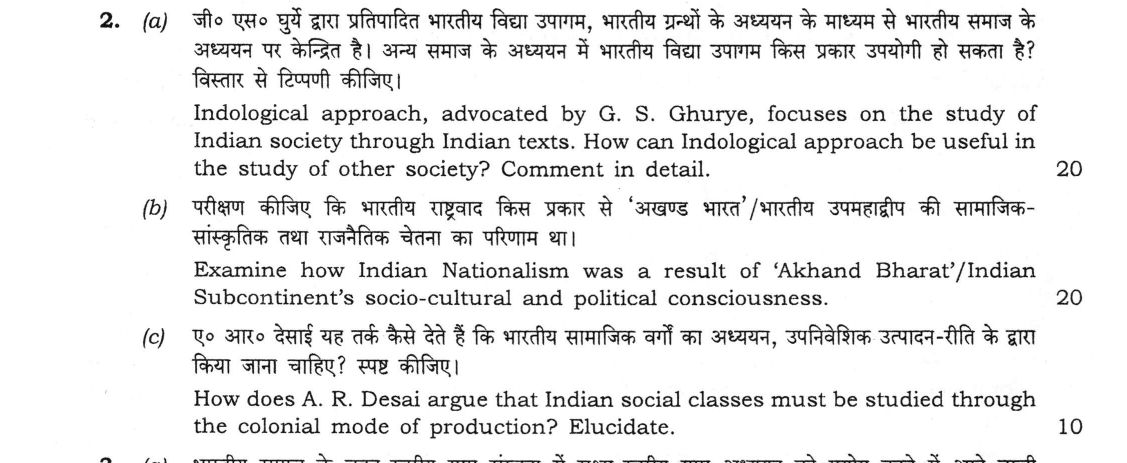
(a) Indological approach, advocated by G. S. Ghurye, focuses on the study of Indian society through Indian texts. How can…
Indological approach, advocated by G. S. Ghurye, focuses on the study of Indian society through Indian texts. How can Indological approach be useful in the study of other society? Comment in detail. 20 marks
Examine how Indian Nationalism was a result of 'Akhand Bharat'/Indian Subcontinent's socio-cultural and political consciousness. 20 marks
How does A. R. Desai argue that Indian social classes must be studied through the colonial mode of production? Elucidate. 10 marks
हिंदी में प्रश्न पढ़ें
जी० एस० घुर्ये द्वारा प्रतिपादित भारतीय विद्या उपागम, भारतीय ग्रन्थों के अध्ययन के माध्यम से भारतीय समाज के अध्ययन पर केन्द्रित है। अन्य समाज के अध्ययन में भारतीय विद्या उपागम किस प्रकार उपयोगी हो सकता है? विस्तार से टिप्पणी कीजिए। (20 अंक)
परीक्षण कीजिए कि भारतीय राष्ट्रवाद किस प्रकार से 'अखण्ड भारत'/भारतीय उपमहाद्वीप की सामाजिक-सांस्कृतिक तथा राजनैतिक चेतना का परिणाम था। (20 अंक)
ए० आर० देसाई यह तर्क कैसे देते हैं कि भारतीय सामाजिक वर्गों का अध्ययन, उपनिवेशिक उत्पादन-रीति के द्वारा किया जाना चाहिए? स्पष्ट कीजिए। (10 अंक)
Model answer
Drafted with AI by UPSC Answer Check against this question's marking rubric, to the expected length. UPSC does not publish answers for Mains — this is one way to score well, not an official key. How we build rubrics and answers.
(a) Ghurye's Indological approach beyond India
Ghurye's approach:
- Ghurye trained under W.H.R. Rivers at Cambridge and founded the Indian Sociological Society (1951). His method was textual-cum-empirical, not armchair Indology;
- Caste and Race in India (1932) set out six features of caste: segmental division, hierarchy, restrictions on feeding and social intercourse, civil and religious disabilities and privileges, restricted choice of occupation, and endogamy;
- his other works include Indian Sadhus (1953) and The Scheduled Tribes (1959), and studies of kinship and costume, all read through Sanskrit texts alongside ethnographic and census data.
A school, not one man:
- K.M. Kapadia (Marriage and Family in India, 1955), P.H. Prabhu (Hindu Social Organization, 1940) and Irawati Karve (Kinship Organisation in India, 1953);
- Dumont and Pocock (1957) held that the sociology of India lies at the confluence of sociology and Indology.
What is transferable:
- hermeneutic reading of a canon that encodes a civilisation's values;
- civilisational-comparative scope;
- insider categories in place of imported ones;
- reading the normative text against lived structure.
Application to other societies:
- China: the Confucian classics on filial piety and ritual order. Weber's The Religion of China (1915) read Chinese society through them;
- Jewish society: the Torah and Talmud, as in Weber's Ancient Judaism;
- Islamic societies: the Qur'an, hadith and fiqh shape family law, inheritance and community;
- Theravada Asia: the Pali canon; Stanley Tambiah (World Conqueror and World Renouncer, 1976) joined text and fieldwork in Thailand;
- The classical world: Fustel de Coulanges's The Ancient City (1864) reconstructed Greek and Roman family and religion from texts;
- Wider theory: Eisenstadt's axial civilisations and multiple modernities (2000) study societies through their own value traditions.
Decolonising sociology: Syed Hussein Alatas's critique of the "captive mind" and Akinsola Akiwowo's Yoruba-based sociology share the aim of building concepts from indigenous traditions.
Limits:
- texts express the view of a literate, male, often priestly elite, not lived practice. This is Srinivas's "book view" versus "field view";
- non-literate and tribal societies have no written canon;
- it can slide into essentialism and Orientalism (Edward Said, 1978; Ronald Inden, Imagining India, 1990) or cultural nationalism.
Verdict: the Indological approach is transferable to any literate civilisation as a way of recovering its own categories. It works best as a supplement to fieldwork and statistics, not a substitute for them.
(b) Sources of Indian nationalism
The claim:
- India had a prior civilisational unity: pilgrimage circuits linking the four dhams and the shakti peethas (Diana Eck, India: A Sacred Geography, 2012), the epics, Sanskrit, and a shared ritual geography;
- Radhakumud Mookerji's The Fundamental Unity of India (1914) made this argument;
- "Akhand Bharat" itself became a political slogan in the 1940s, when partition was being debated (K.M. Munshi's "Akhand Hindustan"). Historians treat it as a contested political construct, not a historical given.
Desai's materialist answer: A.R. Desai (Social Background of Indian Nationalism, 1948) argued that nationalism was a modern product of colonialism. The enabling factors were:
- political and administrative unification under one state;
- the colonial economy, which created new classes with shared grievances, and the "drain" argued by Dadabhai Naoroji;
- railways, the telegraph and the post;
- English education and a pan-Indian intelligentsia;
- the press;
- racial discrimination by the rulers.
The socio-cultural strand:
- reform bodies: the Brahmo Samaj (1828), Prarthana Samaj (1867), Singh Sabha (1873), Arya Samaj (1875), Ramakrishna Mission (1897), Satyashodhak Samaj (1873);
- cultural nationalism: Bankim's Vande Mataram (in Anandamath, 1882) and the image of Bharat Mata;
- Benedict Anderson's print capitalism (1983) explains how an "imagined community" formed through vernacular newspapers.
The political strand: the Indian Association (1876), the Indian National Congress (1885), the Swadeshi movement (1905), and the mass Gandhian phases of 1920, 1930 and 1942.
Rival explanations:
- the Cambridge School (Anil Seal, 1968) saw elites competing for colonial patronage;
- Subaltern Studies (Ranajit Guha, 1982–83) found an autonomous domain of peasant politics;
- Partha Chatterjee (1986; 1993) called nationalism a "derivative discourse" that claimed an inner, spiritual domain as its own;
- Tagore (Nationalism, 1917) criticised the nation-state idea itself.
Counter-evidence:
- the Muslim League's two-nation theory, the Dravidian movement, and Ambedkar's Thoughts on Pakistan (1940);
- Partition in 1947 shows that a single subcontinental consciousness was never assured.
Assessment:
- older cultural connections supplied symbols and a sense of shared space;
- nationalism as a political project came from colonial conditions and the anti-colonial struggle;
- it was a modern synthesis built from pre-modern materials, not the automatic result of an "Akhand Bharat".
(c) Desai: classes and the colonial mode of production
Premise: classes are defined by their relation to the means of production, so the class map follows the mode of production. In India that mode was reshaped by colonialism, so class must be studied through it.
What colonialism did to production (Social Background of Indian Nationalism, 1948):
- it broke the self-sufficient village economy;
- it made land a commodity;
- it caused de-industrialisation of handicrafts;
- it commercialised agriculture for export;
- it drained surplus to Britain.
New agrarian classes created by land settlements:
- the Permanent Settlement (1793), a zamindari system in Bengal, Bihar and Orissa;
- ryotwari in Madras and Bombay, a direct settlement between state and cultivator;
- mahalwari in the north-west, a village or estate-based settlement;
- these produced zamindars and absentee landlords, tenants, peasant proprietors, agricultural labourers and moneylenders.
New urban classes:
- a capitalist class (merchants turned industrialists) dependent on British capital;
- an industrial working class in mills, mines and plantations;
- a professional intelligentsia of English-educated lawyers, teachers and journalists;
- traders.
Why "colonial": capitalist forms coexisted with pre-capitalist relations, giving distorted, arrested development. Hamza Alavi (1975) later formalised this as the "colonial mode of production", which opened the Indian mode of production debate.
Critique:
- Desai was charged with economic determinism: he subordinated caste, religion and kinship to class;
- he read nationalism as largely bourgeois;
- Dumont and Ghurye's followers stressed caste as the primary structure, while later scholars showed caste and class intertwined.
How this answer will be evaluated
Evaluation rubric
Each sub-part is marked on its own, against the marks and word limit printed on the paper.
- (a) Two linked tasks. First, establish what the Indological approach is as Ghurye practised it - the study of Indian society through Indian classical texts. Second, and this is where most marks lie, 'comment in detail' on its transferability: how a textual-civilisational method could illuminate societies other than India, and where it would fail. A pure account of Ghurye without the extension answers only half the question. 20 marks
Must cover
- G. S. Ghurye
- Caste and Race in India (1932) and its six features of caste
- Indian Sadhus (1953) / The Scheduled Tribes (1959)
- at least two of: K. M. Kapadia, P. H. Prabhu, Irawati Karve, Louis Dumont, D. P. Mukerji
- book-view vs field-view
- Weber's comparative sociology of religion
- Said's Orientalism (1978)
- at least two non-Indian textual traditions named
Loses marks
- Answering only the first half - a biography of Ghurye and his works - and never addressing whether the approach can study other societies, which is what the question actually asks.
- Calling Ghurye a pure armchair Indologist; he was trained under W. H. R. Rivers at Cambridge, founded the Indian Sociological Society (1951) and did substantial empirical work, so his practice is textual-cum-empirical.
- Wrong attributions: 'Homo Hierarchicus' is Dumont's, not Ghurye's; 'The Remembered Village' is Srinivas'; 'Hindu Social Organization' is P. H. Prabhu's.
- Listing limitations as a bullet ritual without connecting them to the question of transferability.
- Naming no non-Indian textual tradition at all, which leaves the key demand unevidenced.
Earns more
- Applies it concretely to at least two non-Indian societies - Confucian classics for China, Korea and Japan; sharia, fiqh and Ibn Khaldun's Muqaddimah for Islamic societies; halakhic and Talmudic texts for Jewish society; the Pali canon for Theravada Sri Lanka, Myanmar and Thailand; Greco-Roman legal and philosophical sources for the classical West
- Wider theoretical payoff: Max Weber's comparative sociology of world religions as the nearest Western analogue; S. N. Eisenstadt's axial civilisations and multiple modernities; and the decolonisation/indigenisation agenda - Syed Hussein Alatas on the 'captive mind' and 'The Myth of the Lazy Native', Akinsola Akiwowo's Yoruba-derived sociology, Sujata Patel on doing sociology in India
- Limits stated honestly: texts record the normative claims of a literate, largely brahmanical and male elite, not lived practice - Srinivas' book-view versus field-view; non-literate and tribal societies have no canon to read; the approach tends to be ahistorical and unfalsifiable; and Edward Said's 'Orientalism' (1978) warns that civilisational readings can slide into essentialism or cultural nationalism
- Balanced verdict: Indology travels best as one method within a triangulated design - text plus ethnography plus statistical and comparative data - not as a substitute for either
Extra mark
- A worked example of text-plus-context study outside India, e.g., Fustel de Coulanges's The Ancient City (1864) or Tambiah's World Conqueror and World Renouncer (1976)
- (b) 'Examine' the claim that Indian nationalism issued from the socio-cultural and political consciousness of the subcontinent as a whole. Examination means testing the claim, not asserting it: the candidate must weigh the civilisational-unity thesis against A. R. Desai's materialist account of nationalism as a modern product of colonial conditions, bring in the main rival explanations, and note that the 'Akhand Bharat' framing is itself contested. 20 marks
Must cover
- A. R. Desai, Social Background of Indian Nationalism (1948)
- colonial economy, administrative unification, English education, press, railways
- at least three reform organisations with correct years
- Indian National Congress (1885)
- Benedict Anderson, Imagined Communities (1983)
- at least one rival school (Cambridge School / Subaltern Studies / Partha Chatterjee)
- Partition 1947 as counter-evidence
Loses marks
- Writing a chronological history of the freedom struggle instead of a sociological examination of where nationalism came from.
- Accepting 'Akhand Bharat' as an established historical fact rather than treating it as a contested claim to be examined - the question's own quotation marks invite scrutiny.
- Wrong years on the reform bodies: Brahmo Samaj is 1828, Prarthana Samaj 1867, Arya Samaj 1875, Ramakrishna Mission 1897, Singh Sabha 1873, INC 1885.
- Attributing 'Social Background of Indian Nationalism' to Ghurye or dating it wrongly; it is A. R. Desai, 1948.
- Presenting only one explanation, so nothing is actually 'examined'.
Earns more
- The civilisational-unity or 'Akhand Bharat' claim stated and then evaluated: pan-Indian pilgrimage networks, the Sanskrit and epic tradition, shared ritual geography, argued in Radhakumud Mookerji's 'The Fundamental Unity of India' (1914); but explicitly flagged as a contested political construct that projects a modern nation backwards
- The political consciousness strand: early associations and the Indian National Congress (1885), the Partition of Bengal (1905) and the Swadeshi movement, the Home Rule Leagues (1916), and Gandhi's mass phases (1920-22, 1930-34, 1942); with Benedict Anderson's 'Imagined Communities' (1983) on print-capitalism producing national consciousness
- Rival explanations engaged: the Cambridge School (Anil Seal, 'The Emergence of Indian Nationalism', 1968) reading nationalism as elite competition for colonial patronage; Subaltern Studies (Ranajit Guha, 'Elementary Aspects of Peasant Insurgency in Colonial India', 1983) insisting on an autonomous domain of subaltern politics and 'dominance without hegemony'; Partha Chatterjee's 'Nationalist Thought and the Colonial World: A Derivative Discourse?' (1986) and the inner/spiritual versus outer/material domains in 'The Nation and Its Fragments' (1993); Bipan Chandra's nationalist-Marxist synthesis
- The critical close: Partition in 1947, the two-nation theory, and Ambedkar's 'Pakistan or the Partition of India' demonstrate that a single subcontinental consciousness was contested rather than given; Dravidian and other regional nationalisms make the same point
Extra mark
- Diana Eck's India: A Sacred Geography (2012) on pilgrimage networks, or Tagore's Nationalism (1917) as an Indian critique of the nation-state idea
- (c) 'Elucidate' Desai's reasoning, not merely his conclusion: show HOW he argues that Indian social classes cannot be understood as an indigenous evolution but only as products of the colonial transformation of production - the new land-tenure systems, de-industrialisation and commercialisation that generated a specific and distorted class structure. 10 marks
Must cover
- A. R. Desai
- Social Background of Indian Nationalism (1948)
- relations to the means of production
- Permanent Settlement 1793 / ryotwari / mahalwari
- de-industrialisation and commercialisation of agriculture
- at least three colonial-era classes named
- a critique of Desai
Loses marks
- Describing Marxism in general without showing Desai's specific Indian application.
- Confusing the land-tenure systems: the Permanent Settlement (1793) is zamindari in Bengal/Bihar/Orissa; ryotwari is the cultivator-state settlement in Madras and Bombay; mahalwari is village/estate-based in the north-west.
- Attributing the phrase 'colonial mode of production' to Desai himself - the formulation is Hamza Alavi's; Desai's own emphasis is the colonial social background of class formation.
- Listing classes without explaining the mechanism by which colonial production created them.
- No critical evaluation, so 'elucidate' becomes mere reproduction.
Earns more
- The urban classes colonialism produced: a subordinated Indian industrial bourgeoisie, a modern industrial working class in the mills and mines, and a petty bourgeoisie of English-educated professionals, clerks and the intelligentsia from which nationalist leadership was drawn
- Why the colonial mode is not classical capitalism: capitalist forms coexisting with and preserving pre-capitalist relations, so development is arrested and distorted - the point taken further in the 'mode of production in Indian agriculture' debate of the late 1960s and 1970s in the Economic and Political Weekly, where Hamza Alavi proposed a distinct 'colonial mode of production' and Amit Bhaduri and Pradhan Prasad argued semi-feudalism against Utsa Patnaik's and Ashok Rudra's capitalist reading
- Critical appraisal: Desai is charged with economic determinism, with subordinating caste, religion and kinship to class, and with underestimating how caste and class intersect in India
Extra mark
- Links Desai's class map to his reading of nationalism as led by the bourgeoisie and intelligentsia, or cites his later edited volume Peasant Struggles in India (1979)
What "Comment" is asking you to do
Take a position on the statement and support it. Comment usually attaches to a quoted line in the short slots, so the reasoning must be compressed — an opening view, a few load-bearing reasons, and the limit of the claim.
Structure that answers it
Unpack what the statement asserts → your stance → two or three supporting reasons → the qualification that limits it
Where marks are lost
Neutral summary; a comment without a stance has not answered. Equally costly is accepting the quoted line wholesale and never testing where it fails.
Practice this exact question
Write your answer and it is marked point by point against the model answer above — what you covered, what you missed, what you got wrong.
Evaluate my answer →More from Sociology 2026 Paper II
- Q1 Answer the following questions in about 150 words each : (a) In what respect is M. N. Sri…
- Q2 (a) Indological approach, advocated by G. S. Ghurye, focuses on the study of Indian socie…
- Q3 (a) Examine the challenges of applying micro-level village studies to macro-level village…
- Q4 (a) How does the Constitution of India promote education? Do you think that education can…
- Q5 Answer the following questions in about 150 words each : (a) Discuss the challenges faced…