Paper II — Q8
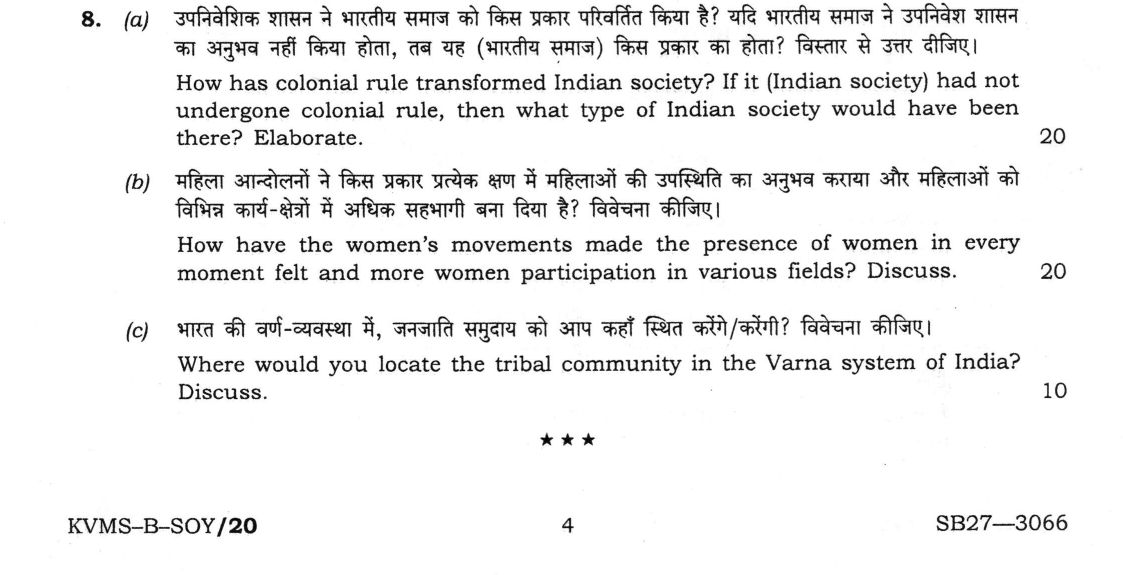
(a) How has colonial rule transformed Indian society? If it (Indian society) had not undergone colonial rule, then what type of…
How has colonial rule transformed Indian society? If it (Indian society) had not undergone colonial rule, then what type of Indian society would have been there? Elaborate. 20 marks
How have the women's movements made the presence of women in every moment felt and more women participation in various fields? Discuss. 20 marks
Where would you locate the tribal community in the Varna system of India? Discuss. 10 marks
हिंदी में प्रश्न पढ़ें
उपनिवेशिक शासन ने भारतीय समाज को किस प्रकार परिवर्तित किया है? यदि भारतीय समाज ने उपनिवेश शासन का अनुभव नहीं किया होता, तब यह (भारतीय समाज) किस प्रकार का होता? विस्तार से उत्तर दीजिए। (20 अंक)
महिला आन्दोलनों ने किस प्रकार प्रत्येक क्षण में महिलाओं की उपस्थिति का अनुभव कराया और महिलाओं को विभिन्न कार्य-क्षेत्रों में अधिक सहभागी बना दिया है? विवेचना कीजिए। (20 अंक)
भारत की वर्ण-व्यवस्था में, जनजाति समुदाय को आप कहाँ स्थित करेंगे/करेंगी? विवेचना कीजिए। (10 अंक)
Model answer
Drafted with AI by UPSC Answer Check against this question's marking rubric, to the expected length. UPSC does not publish answers for Mains — this is one way to score well, not an official key. How we build rubrics and answers.
(a) Colonial rule and a counterfactual India
How colonial rule transformed Indian society:
Agrarian structure:
- the Permanent Settlement (1793), ryotwari and mahalwari systems made land a commodity and created zamindars, tenants, moneylenders and landless labourers;
- agriculture was commercialised for export.
Economy:
- de-industrialisation of handicrafts and the drain of wealth (Dadabhai Naoroji, R.C. Dutt);
- on Angus Maddison's estimates, India's share of world output fell from about a quarter around 1700 to about 4% by 1950;
- railways (1853), ports and plantations served an export economy.
Law and state:
- a uniform criminal law (IPC, 1860), courts and a centralised bureaucracy;
- codified "personal laws" froze plural customs into textual norms.
Caste and the census:
- the first all-India census (1871–72; synchronous from 1881) and Risley's 1901 ranking by "social precedence" objectified caste;
- caste associations formed to petition for higher ranks;
- Bernard Cohn and Nicholas Dirks (Castes of Mind, 2001) see caste as partly a colonial construction, a strong claim that others contest.
Education and new classes:
- Macaulay's Minute (1835), Wood's Despatch (1854) and the universities (1857) created an English-educated middle class (B.B. Misra, 1961);
- this class led social reform and, unintentionally, nationalism.
Reform and control together:
- reform laws: the Sati Regulation (1829), Widow Remarriage (1856), Age of Consent (1891);
- control laws: the Criminal Tribes Act (1871) and the Forest Acts (1865, 1878), which dispossessed forest communities.
Religion and community: separate electorates (1909) and census categories hardened religious identities.
Had India not been colonised (reasoned speculation, not fact):
Argument for an indigenous modern path:
- eighteenth-century India had dynamic commercial regions, bankers and textile exports (C.A. Bayly, Rulers, Townsmen and Bazaars, 1983; Prasannan Parthasarathi, 2011);
- successor states such as Mysore under Tipu Sultan experimented with modernisation;
- a Meiji-style modernisation under Indian elites is conceivable;
- without the drain, capital could have stayed at home.
Argument for continued fragmentation and hierarchy:
- Irfan Habib (1969) doubted that the Mughal economy had strong potential for capitalist development;
- India might have stayed a set of competing polities (Marathas, Sikhs, Mysore, Hyderabad), without a single legal order or national identity;
- caste and gender hierarchies might have faced less challenge from equal law, modern education and print, which reformers from Phule to Ambedkar used.
The balance:
- Marx's "double mission" (1853) of destruction and regeneration captures the ambivalence, though it underplays the costs;
- the most defensible view is that India would have modernised differently, with its own mix of regional states, commerce and reform, and less de-industrialisation, but not necessarily with less hierarchy.
(b) Women's movements and women's participation
Phase 1: reform and nationalist era:
- the social reform of women's status by male reformers;
- the Women's Indian Association (1917) and the All India Women's Conference (1927) campaigned for suffrage, education and legal reform;
- women took part in the Civil Disobedience and Quit India movements;
- women's suffrage and equality were written into the Constitution (1950).
Phase 2: the autonomous women's movement (1970s–80s):
- ***Towards Equality* (1974)** revealed a declining sex ratio and women's marginalisation;
- SEWA (1972) organised informal women workers; women were central to Chipko (1973); the anti-price-rise agitation (1973–74) mobilised women in Maharashtra;
- the Mathura case (Supreme Court acquittal, 1978) led to the open letter by four law professors (1979), campaigns, and the Criminal Law (Amendment) Act, 1983 (custodial rape; reversed burden of proof);
- campaigns against dowry deaths led to Sections 498A (1983) and 304B (1986) of the IPC (now Sections 85–86 and 80 BNS);
- campaigns after Shah Bano (1985) and against Roop Kanwar's sati (1987) followed;
- Manushi (1978) and women's studies centres built a feminist public sphere.
Phase 3: rights, representation and new issues (1990s onwards):
- the 73rd and 74th Amendments (1992) reserved a third of local seats for women, and many states now reserve half, giving about 14 lakh elected women representatives;
- Andhra Pradesh's anti-arrack movement (1992);
- Vishaka (1997) led to the POSH Act (2013); the PWDVA (2005); the Hindu Succession (Amendment) Act, 2005 made daughters coparceners;
- the Nirbhaya protests (2012) led to the Criminal Law (Amendment) Act, 2013;
- #MeToo (2018); Shayara Bano (2017) against triple talaq; Joseph Shine (2018) struck down adultery as a crime;
- the 106th Amendment (2023) reserves a third of Lok Sabha and Assembly seats for women. It will take effect only after delimitation following the next census.
Presence in many fields:
- self-help groups (over nine crore women in NRLM groups) and women's rising turnout, which now matches men's;
- women in the armed forces, sport, science and the judiciary.
Unfinished agenda:
- female labour force participation remains low, though rising (about 42% in PLFS 2023–24);
- women spend about five hours a day on unpaid domestic work, against about 1.5 hours for men (Time Use Survey 2019);
- violence and the skewed sex ratio at birth persist.
Internal critique:
- Sharmila Rege and the National Federation of Dalit Women (1995) argued that the mainstream movement was urban and upper-caste and treated "woman" as uniform, ignoring caste;
- Muslim, tribal and queer women raise similar critiques;
- scholars also warn of NGO-isation and the depoliticising of the movement.
Conclusion: women's movements turned women from objects of reform into subjects of rights. Making participation equal now depends on economic power and care-sharing.
(c) Tribes and the varna system
The conceptual frame:
- varna is a scriptural fourfold scheme (Brahmin, Kshatriya, Vaishya, Shudra), with the "untouchables" as avarna outside it;
- tribes are classically outside varna: they have clan-based, relatively egalitarian societies, their own deities and customary law, and no Brahmanical priesthood.
Positions:
"Backward Hindus": G.S. Ghurye (The Aborigines—So-called—and Their Future, 1943) argued that tribes were imperfectly integrated Hindus and should be assimilated. Verrier Elwin at first argued for protective isolation.
Absorption:
- N.K. Bose's "Hindu method of tribal absorption" (1941) showed tribes entering the Hindu fold, often at the lower, Shudra-like end, through occupation, pilgrimage and the worship of Hindu deities;
- Sanskritisation of tribes, as among Bhils and Gonds.
Entry at the top: Surajit Sinha (1962) showed tribal chiefs claiming Kshatriya or Rajput status through state formation, as the Raj Gonds and the Bhumij did. Tribes did not always enter varna at the bottom.
Continuum: F.G. Bailey saw a tribe–caste continuum, and André Béteille showed the tribe/caste distinction to be relative and historical.
The constitutional category:
- "Scheduled Tribe" (Article 342) is an administrative, non-varna category, based on distinct culture, geographical isolation and backwardness;
- STs were 8.6% of the population in Census 2011;
- the Fifth and Sixth Schedules and PESA (1996) protect autonomy.
Contemporary assertion:
- Adivasi movements (the Jharkhand movement; the demand for a separate Sarna religion code, which the Jharkhand Assembly endorsed in 2020) reject varna placement;
- Virginius Xaxa argues for seeing tribes as indigenous peoples, not as castes in the making;
- "Adivasi" versus "Vanvasi" is itself a contested label.
My position: tribes are best located outside the varna system. Historically some were absorbed at different points, often low and sometimes high, so any "placement" reflects Hinduisation, not an original position. Today, their own assertion and the Constitution treat them as a distinct category.
How this answer will be evaluated
Evaluation rubric
Each sub-part is marked on its own, against the marks and word limit printed on the paper.
- (a) Two tasks of unequal type. First, an evidenced account of how colonial rule transformed Indian society - economic, administrative-legal, educational and, crucially, the transformation of caste and religious identity through colonial knowledge. Second, an explicitly COUNTERFACTUAL speculation about a non-colonised India, which must be flagged and argued as reasoned speculation rather than asserted as fact. 20 marks
Must cover
- Permanent Settlement 1793 and the other land-revenue systems
- de-industrialisation and the drain of wealth (Naoroji, R. C. Dutt)
- IPC 1860; Macaulay's Minute 1835; universities 1857; railways 1853
- the census (1871-72/1881) and Risley 1901; Cohn and Dirks on caste as colonial objectification
- Criminal Tribes Act 1871 and/or the Forest Acts alongside reform legislation
- an explicit flag that the second half is counterfactual speculation
- at least two counterfactual arguments, one on each side
Loses marks
- Presenting the counterfactual as fact - asserting that India would certainly have become an industrial power, or certainly have remained stagnant - instead of arguing it as reasoned speculation.
- Answering only the first half and treating the counterfactual as a one-line afterthought, when it is explicitly asked and carries substantial marks.
- Omitting the census-and-caste argument, which is the most distinctively sociological element of the colonial transformation.
- Date errors: Permanent Settlement 1793, Macaulay's Minute 1835, Wood's Despatch 1854, first railway 1853, IPC 1860, first all-India census 1871-72, Risley's census 1901, Criminal Tribes Act 1871.
- A wholly one-sided verdict - either colonialism as pure modernisation or as pure destruction - when the evidence supports neither.
Earns more
- Social reform and its colonial counterpart: legislation on sati (Bengal Sati Regulation, 1829), widow remarriage (1856), the age of consent (1891) and child marriage (Sharda Act, 1929), alongside indigenous reform movements; but equally the Criminal Tribes Act, 1871 and the Forest Acts, which criminalised mobile and forest-dependent communities - so the colonial state was simultaneously reformist and repressive; Srinivas' Westernisation and Yogendra Singh's 'Modernization of Indian Tradition' (1973) supply the conceptual vocabulary
- Counterfactual, first line of argument, flagged as speculation: India might have modernised on an indigenous path, given pre-colonial commercial dynamism - Irfan Habib on the Mughal agrarian system, C. A. Bayly's 'Rulers, Townsmen and Bazaars' on indigenous merchant and service groups, Prasannan Parthasarathi's 'Why Europe Grew Rich and Asia Did Not' (2011) finding eighteenth-century Indian weavers' living standards comparable to Britain's - with Angus Maddison's estimates that India's share of world output fell from roughly a quarter around 1700 to about 4 per cent by 1950 (figures that are estimates and contested), and with Meiji Japan, Siam and the state-led modernisation of Mysore and Travancore as comparators
- Counterfactual, second line, argued fairly against the first: without colonial rule there might have been no single pan-Indian administrative, legal and link-language framework and no unified territorial nation, but several successor polities - Maratha, Sikh, Mysore, Nizam's dominions; caste and gender hierarchies might have lacked the legal-reformist route and the constitutional, Ambedkarite instrument that eventually challenged them; this is Marx's 'double mission' of destruction and regeneration in his 1853 articles on British rule in India, against the nationalist drain thesis of Naoroji and Dutt
- Methodological caution stated explicitly: counterfactual history is untestable, and the answer must be offered as reasoned speculation rather than as knowledge; the honest position is to identify which trends were already under way before 1757, which were colonial impositions, and which were unintended colonial by-products - the terrain of the long debate between Morris D. Morris and Bipan Chandra on colonialism's economic effects
Extra mark
- The Morris D. Morris–Bipan Chandra debate on colonialism's economic effects, or Parthasarathi's comparison of Indian and British living standards (2011)
- (b) 'Discuss' how women's movements have made women visible and increased their participation across fields. The answer needs a phased account of the movements with named organisations, campaigns and dates; the legal and participatory gains they produced; and, to be a strong answer, the unfinished agenda and the internal Dalit-feminist critique of the movement itself. 20 marks
Must cover
- All India Women's Conference (1927) and/or Women's Indian Association (1917)
- 'Towards Equality' report, 1974
- SEWA (1972); Chipko (1973); anti-price-rise agitation
- Mathura case (Supreme Court judgment 1978; open letter 1979) and the Criminal Law (Amendment) Act, 1983
- Vishaka (1997) and the POSH Act, 2013
- 73rd/74th Amendments (1992) and the 106th Amendment (2023)
- Hindu Succession (Amendment) Act, 2005
- Dalit feminist critique (Sharmila Rege) and/or NGO-isation
Loses marks
- Writing a list of laws with no movement behind them, when the question asks what the MOVEMENTS achieved.
- Stopping at the nationalist period and ignoring the autonomous women's movement from the 1970s, which produced most of the legal gains.
- Date errors: AIWC 1927, Towards Equality 1974, SEWA 1972, Mathura judgment 1978 (open letter 1979) and the amendment 1983, Vishaka 1997, POSH 2013, PWDVA 2005, 106th Amendment 2023.
- Claiming the 106th Amendment reservation is already operational; it takes effect only after delimitation following the next census.
- Presenting an unbroken success story with no unfinished agenda and no internal critique, which is what the best answers supply.
Earns more
- The legal harvest, correctly dated: the Criminal Law (Amendment) Act, 1983 and Section 498A after Mathura and the anti-dowry campaign; the Commission of Sati (Prevention) Act, 1987; the PCPNDT Act, 1994; Vishaka (1997) leading to the POSH Act, 2013; the Protection of Women from Domestic Violence Act, 2005; the Hindu Succession (Amendment) Act, 2005 making daughters coparceners, confirmed in Vineeta Sharma v. Rakesh Sharma (2020), with Mary Roy (1986) for Syrian Christian women; the Criminal Law (Amendment) Act, 2013 after the Justice Verma Committee; and the Muslim Women (Protection of Rights on Marriage) Act, 2019 following Shayara Bano (2017)
- The participation harvest: the 73rd and 74th Amendments (1992) reserving a third of local seats for women, since raised to one-half in many states and producing roughly 14 lakh elected women representatives; the Constitution (One Hundred and Sixth Amendment) Act, 2023 - the Nari Shakti Vandan Adhiniyam - reserving a third of Lok Sabha and state assembly seats, to take effect after delimitation following the next census, against women being only about 14 per cent of the present Lok Sabha; permanent commission and command appointments for women officers after Secretary, Ministry of Defence v. Babita Puniya (2020) and the opening of the National Defence Academy to women (2021); women in the higher judiciary since Justice M. Fathima Beevi (1989); and women's entry into sport, science, aviation and business leadership
- The unfinished agenda measured by data: female labour force participation still low though rising in recent Periodic Labour Force Survey rounds and concentrated in self-employment and unpaid family work; the Time Use Survey 2019 finding that women aged 15-59 spent about 299 minutes a day on unpaid domestic services against about 97 minutes for men; a sex ratio at birth of 929 in NFHS-5; high levels of domestic violence; and the retained exception for marital rape
- The internal critique, which distinguishes a strong answer: the Dalit feminist charge that the mainstream movement was urban, upper-caste and middle-class and treated 'woman' as an undifferentiated category - Sharmila Rege's 'Writing Caste/Writing Gender' and the concept of Dalit patriarchy, and Ruth Manorama's organising of Dalit women; the assertion of Muslim women's own platforms such as the Bharatiya Muslim Mahila Andolan; and the critique of the NGO-isation and professionalisation of the movement, which traded mobilisation for projects
Extra mark
- Babita Puniya (2020) on permanent commission for women officers, or the Muslim Women (Protection of Rights on Marriage) Act, 2019 following Shayara Bano
- (c) 'Where would you locate the tribal community in the Varna system?' requires a reasoned position, not a slot. The expected answer is that tribes stand normatively outside varna, that many have nonetheless been absorbed at the lower end or have claimed Kshatriya status through Sanskritisation, and that contemporary Adivasi assertion rejects varna placement altogether - with the constitutional category deliberately being a non-varna one. 10 marks
Must cover
- varna as fourfold plus avarna; tribes classically outside it
- Ghurye's 'backward Hindus' thesis
- N. K. Bose's Hindu method of tribal absorption and/or Sanskritisation of tribes
- Surajit Sinha on Kshatriya/Rajput claims by tribal chiefs
- tribe-caste continuum (Bailey) and/or Beteille on the relativity of the distinction
- Scheduled Tribe as a constitutional, non-varna category (Article 342; Census 2011: 8.6 per cent)
- contemporary Adivasi assertion (Sarna code / Jharkhand movement)
Loses marks
- Simply asserting that tribes are Shudras, with no argument and no acknowledgement that varna is a scriptural scheme tribes stand outside.
- Equating tribe with Scheduled Caste, or treating untouchability and tribal status as the same disability - they are distinct in origin, law and experience.
- Reversing the tribal debate: Ghurye argued for assimilation of tribes as 'backward Hindus'; Elwin initially argued for protective isolation.
- Ignoring Sanskritisation and the well-documented Kshatriya and Rajput claims of tribal chiefs, which show tribes did not enter varna only at the bottom.
- Ignoring contemporary Adivasi self-assertion, which rejects varna placement outright and is the live political position.
Earns more
- The continuum and distinctiveness positions: F. G. Bailey's tribe-caste continuum ('Tribe, Caste and Nation', 1960) locating groups by access to land and political dependence rather than by a fixed varna slot, and Andre Beteille's argument in 'The Concept of Tribe with Special Reference to India' (1986) that the tribe-caste distinction is relative, not absolute; against which stand Verrier Elwin's isolationist position, Nehru's tribal panchsheel of integration without assimilation, and Virginius Xaxa's case for tribes as indigenous peoples with a distinct social formation (with the Xaxa Committee report of 2014)
- The contemporary assertion and the reasoned verdict: many Adivasi groups explicitly refuse varna placement, asserting a separate identity through the demand for a Sarna religious code, the Jharkhand and Bhil Pradesh movements, and conversion; the Constitution itself deliberately uses a territorial and administrative category, with the Fifth and Sixth Schedules, PESA (1996) and the Forest Rights Act (2006), rather than a varna one - so the defensible answer is that there is no single location: outside varna in principle, variably absorbed or Sanskritised in practice, and increasingly refused politically
Extra mark
- The Xaxa Committee report (2014) or Nehru's tribal panchsheel as the policy frame for a non-varna placement
What "Elaborate" is asking you to do
Give the full detailed account the question has compressed into a line — every dimension of it, with specifics. Elaborate rewards completeness and detail rather than clarification or argument: the examiner is checking whether you can fill out a topic without being told what its parts are.
Structure that answers it
State the proposition → first dimension in detail → second dimension in detail → the part the statement leaves implicit → the consolidated picture
Where marks are lost
Repeating the statement at greater length instead of adding substance. Elaborate also punishes narrowness: omitting a whole dimension costs more here than anywhere else in this family.
Practice this exact question
Write your answer and it is marked point by point against the model answer above — what you covered, what you missed, what you got wrong.
Evaluate my answer →More from Sociology 2026 Paper II
- Q5 Answer the following questions in about 150 words each : (a) Discuss the challenges faced…
- Q6 (a) Differentiate between protests and movements. Discuss some of those movements which c…
- Q7 (a) Urbanisation in Independent India has been characterized by over-urbanization and rur…
- Q8 (a) How has colonial rule transformed Indian society? If it (Indian society) had not unde…