Paper I — Q1
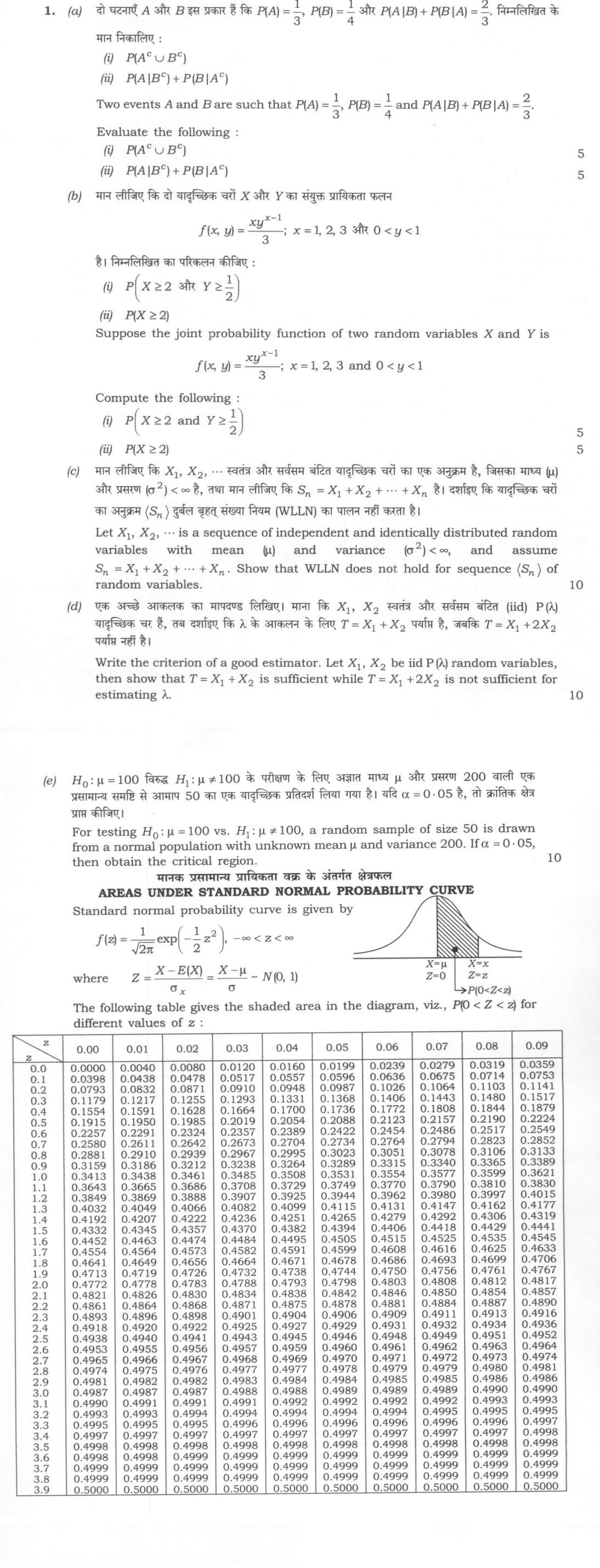
(a) Two events A and B are such that P(A) = 1/3, P(B) = 1/4 and P(A|B) + P(B|A) = 2/3. Evaluate the following: (i) P(A^c ∪ B^c)…
Two events A and B are such that P(A) = 1/3, P(B) = 1/4 and P(A|B) + P(B|A) = 2/3. Evaluate the following: (i) P(A^c ∪ B^c) (5 marks) (ii) P(A|B^c) + P(B|A^c) 5 marks
Suppose the joint probability function of two random variables X and Y is f(x, y) = (xy^(x-1))/3; x = 1, 2, 3 and 0 < y < 1. Compute the following: (i) P(X ≥ 2 and Y ≥ 1/2) (5 marks) (ii) P(X ≥ 2) 5 marks
Let X₁, X₂, ... is a sequence of independent and identically distributed random variables with mean (μ) and variance (σ²) < ∞, and assume Sₙ = X₁ + X₂ + ... + Xₙ. Show that WLLN does not hold for sequence ⟨Sₙ⟩ of random variables. 10 marks
Write the criterion of a good estimator. Let X₁, X₂ be iid P(λ) random variables, then show that T = X₁ + X₂ is sufficient while T = X₁ + 2X₂ is not sufficient for estimating λ. 10 marks
For testing H₀: μ = 100 vs. H₁: μ ≠ 100, a random sample of size 50 is drawn from a normal population with unknown mean μ and variance 200. If α = 0.05, then obtain the critical region. 10 marks
हिंदी में प्रश्न पढ़ें
दो घटनाएँ A और B इस प्रकार हैं कि P(A) = 1/3, P(B) = 1/4 और P(A|B) + P(B|A) = 2/3. निम्नलिखित के मान निकालिए : (i) P(A^c ∪ B^c) (5) (ii) P(A|B^c) + P(B|A^c) 5 marks
मान लीजिए कि दो यादृच्छिक चरों X और Y का संयुक्त प्रायिकता फलन f(x, y) = (xy^(x-1))/3; x = 1, 2, 3 और 0 < y < 1 है। निम्नलिखित का परिकलन कीजिए : (i) P(X ≥ 2 और Y ≥ 1/2) (5) (ii) P(X ≥ 2) 5 marks
मान लीजिए कि X₁, X₂, ... स्वतंत्र और सर्वसम बाँटित यादृच्छिक चरों का एक अनुक्रम है, जिसका माध्य (μ) और प्रसरण (σ²) < ∞ है, तथा मान लीजिए कि Sₙ = X₁ + X₂ + ... + Xₙ है। दर्शाइए कि यादृच्छिक चरों का अनुक्रम ⟨Sₙ⟩ दुर्बल बहुत संख्या नियम (WLLN) का पालन नहीं करता है। 10 marks
एक अच्छे आकलक का मापदंड लिखिए। माना कि X₁, X₂ स्वतंत्र और सर्वसम बाँटित (iid) P(λ) यादृच्छिक चर हैं, तब दर्शाइए कि λ के आकलन के लिए T = X₁ + X₂ पर्याप्त है, जबकि T = X₁ + 2X₂ पर्याप्त नहीं है। 10 marks
H₀: μ = 100 विरुद्ध H₁: μ ≠ 100 के परीक्षण के लिए अज्ञात माध्य μ और प्रसरण 200 वाली एक प्रसामान्य समष्टि से आमाप 50 का एक यादृच्छिक प्रतिदर्श लिया गया है। यदि α = 0.05 है, तो कांतिक क्षेत्र प्राप्त कीजिए। 10 marks
Model answer
Written by UPSC Answer Check against this question's marking rubric, to the expected length. UPSC does not publish answers for Mains — this is one way to score well, not an official key.
(a)(i) Given P(A)=1/3 and P(B)=1/4. Let x = P(A∩B). By definition of conditional probability: P(A|B) = P(A∩B)/P(B) = x/(1/4) = 4x. P(B|A) = P(A∩B)/P(A) = x/(1/3) = 3x. Given P(A|B) + P(B|A) = 2/3, so 4x + 3x = 2/3 ⇒ 7x = 2/3 ⇒ x = 2/21. Thus P(A∩B) = 2/21. Now P(Aᶜ ∪ Bᶜ) = P((A∩B)ᶜ) = 1 − P(A∩B) = 1 − 2/21 = 19/21.
Final answer: 19/21.
(a)(ii) P(A|Bᶜ) + P(B|Aᶜ). P(Bᶜ) = 1 − 1/4 = 3/4. P(A∩Bᶜ) = P(A) − P(A∩B) = 1/3 − 2/21 = 5/21. So P(A|Bᶜ) = (5/21)/(3/4) = 20/63. P(Aᶜ) = 1 − 1/3 = 2/3. P(B∩Aᶜ) = P(B) − P(A∩B) = 1/4 − 2/21 = 13/84. So P(B|Aᶜ) = (13/84)/(2/3) = 13/56. Therefore, P(A|Bᶜ) + P(B|Aᶜ) = 20/63 + 13/56 = 160/504 + 117/504 = 277/504.
Final answer: 277/504.
(b)(i) The joint probability function is f(x,y) = x y^(x−1)/3, x = 1,2,3, 0 < y < 1. We need P(X ≥ 2 and Y ≥ 1/2). Since X is discrete and Y is continuous, P(X ≥ 2, Y ≥ 1/2) = ∑ over x=2,3 of ∫ from y=1/2 to 1 of x y^(x−1)/3 dy. For a fixed x, ∫ from 1/2 to 1 of x y^(x−1)/3 dy = (1/3)[yˣ] from 1/2 to 1 = (1/3)(1 − (1/2)ˣ). For x = 2: (1/3)(1 − 1/4) = 1/4. For x = 3: (1/3)(1 − 1/8) = 7/24. Sum = 1/4 + 7/24 = 6/24 + 7/24 = 13/24.
Final answer: 13/24.
(b)(ii) Marginal probability of X: P(X = x) = ∫ from y=0 to 1 of x y^(x−1)/3 dy = (1/3)[yˣ] from 0 to 1 = 1/3, for x = 1,2,3. Thus X is uniform on {1,2,3}. P(X ≥ 2) = P(X = 2) + P(X = 3) = 1/3 + 1/3 = 2/3.
Final answer: 2/3.
(c) Let Zᵢ = Xᵢ − μ. For the sequence ⟨Sₙ⟩, the average of interest is Cₙ = (1/n)∑ from k=1 to n of (Sₖ − E(Sₖ)) = (1/n)∑ from k=1 to n of (Sₖ − kμ). Now Sₖ = ∑ from i=1 to k of Xᵢ, so Cₙ = (1/n)∑ from k=1 to n of ∑ from i=1 to k of Zᵢ = (1/n)∑ from i=1 to n of (n − i + 1)Zᵢ. Let aₙ,ᵢ = (n − i + 1)/n. Then Cₙ = ∑ from i=1 to n of aₙ,ᵢ Zᵢ. Since the Zᵢ are independent with mean 0 and variance σ², Var(Cₙ) = σ² ∑ from i=1 to n of aₙ,ᵢ² = σ²/n² ∑ from j=1 to n of j² = σ²/n² · n(n+1)(2n+1)/6 = σ²(n+1)(2n+1)/(6n) = σ²(n/3 + 1/2 + 1/(6n)). For σ² > 0, this tends to ∞ as n → ∞. If the weak law held for ⟨Sₙ⟩, we would need Cₙ → 0 in probability. To see this fails, set sₙ² = Var(Cₙ). Since aₙ,ᵢ ≤ 1 and sₙ → ∞, Lindeberg’s condition holds: for any ε > 0, (1/sₙ²)∑ from i=1 to n of E[aₙ,ᵢ² Zᵢ² 1_|aₙ,ᵢ Zᵢ| > ε sₙ] ≤ (1/σ²) E[Z₁² 1_|Z₁| > ε sₙ] → 0. Hence by the Lindeberg–Feller central limit theorem, Cₙ/sₙ → N(0,1) in distribution. But if Cₙ → 0 in probability, then Cₙ/sₙ → 0 in probability, contradicting a non-degenerate normal limit. Therefore Cₙ does not converge to 0 in probability, so the weak law of large numbers does not hold for the sequence ⟨Sₙ⟩. (The statement is for the non-degenerate case σ² > 0; if σ² = 0, the sequence is degenerate.)
Final answer: WLLN fails for ⟨Sₙ⟩ because the centred average Cₙ does not converge to 0 in probability.
(d) Criteria of a good estimator:
- Unbiasedness: E(T) = θ for all θ.
- Consistency: Tₙ → θ in probability as n → ∞.
- Efficiency: among unbiased estimators, it should have minimum variance; in regular cases it should attain the Cramér–Rao lower bound.
- Sufficiency: T should contain all information in the sample about θ; equivalently, the conditional distribution of the sample given T should not depend on θ.
- Completeness: together with sufficiency, it helps obtain a unique minimum-variance unbiased estimator.
- Minimum mean squared error, robustness and invariance are also desirable in practical problems.
Let X₁, X₂ be iid Poisson(λ). Their joint probability mass function is P(X₁=x₁, X₂=x₂) = e^(−λ)λˣ¹/x₁! · e^(−λ)λˣ²/x₂! = e^(−2λ)λ^(x₁+x₂)/(x₁! x₂!).
For T = X₁ + X₂, let t = x₁ + x₂. Then P(X₁=x₁, X₂=x₂) = e^(−2λ)λᵗ/(x₁! x₂!). By the factorization theorem, this is g(t,λ)h(x₁,x₂) with g(t,λ) = e^(−2λ)λᵗ and h(x₁,x₂) = 1/(x₁! x₂!), which does not depend on λ. Hence T = X₁ + X₂ is sufficient for λ.
Now take U = X₁ + 2X₂. Consider two sample points (2,0) and (0,1). For both, U = 2. But P(X₁=2, X₂=0)/P(X₁=0, X₂=1) = [e^(−2λ)λ²/(2! 0!)]/[e^(−2λ)λ¹/(0! 1!)] = λ/2. This ratio depends on λ. If U were sufficient, then for the same value of U, the ratio of joint probabilities would be independent of λ by the factorization theorem. Since it is not, U = X₁ + 2X₂ is not sufficient for λ.
Final answer: T = X₁ + X₂ is sufficient; T = X₁ + 2X₂ is not sufficient.
(e) We test H₀: μ = 100 against H₁: μ ≠ 100. Given n = 50, σ² = 200, so σ = √200 = 10√2. The standard error of X̄ is σ/√n = √200/√50 = √(200/50) = √4 = 2. The test statistic is Z = (X̄ − 100)/2. Under H₀, Z ~ N(0,1). For a two-sided test at α = 0.05, the critical values are ±1.96. Thus the critical region is Z < −1.96 or Z > 1.96. Equivalently, (X̄ − 100)/2 < −1.96 or (X̄ − 100)/2 > 1.96 ⇒ X̄ < 100 − 3.92 or X̄ > 100 + 3.92 ⇒ X̄ < 96.08 or X̄ > 103.92. So reject H₀ if |X̄ − 100| > 3.92.
Final answer: Critical region is X̄ < 96.08 or X̄ > 103.92.
What "Solve" is asking you to do
Choose the method, then carry it through to a final answer. Identifying what kind of problem this is and why that method applies is the first thing marked; a correct figure arrived at invisibly earns almost nothing.
Structure that answers it
Given data and what is required → method chosen, with the reason it applies → set-up (equation, circuit, free body, trial balance) → working, step by step → answer with units and any condition of validity
Where marks are lost
Doing the middle steps mentally and writing only the result. In mathematics papers, a further loss comes from giving a decimal where the exact value in surds or fractions was wanted, or from skipping the justification a part explicitly asks for.
How this answer will be evaluated
Approach
Framework: UPSC Statistics Paper 1. (a(i)) calculate: given > formula > substitution > result with units > interpretation | (a(ii)) calculate: given > formula > substitution > result with units > interpretation | (b(i)) calculate: given > formula > substitution > result with units > interpretation | (b(ii)) calculate: given > formula > substitution > result with units > interpretation | (c) explain: definition/context > points in order > small example > short close | (d) explain: definition/context > points in order > small example > short close | (e) calculate: given > formula > substitution > result with units > interpretation Full marks: All parts with complete derivations, correct notation, and clear interpretation of results.
Key points expected
- Derive P(A∩B) from P(A|B) + P(B|A) = 2/3
- Apply P(A^c ∪ B^c) = 1 - P(A∩B)
- Substitute values to find final probability
- Calculate P(A|B^c) = P(A∩B^c)/P(B^c)
- Calculate P(B|A^c) = P(B∩A^c)/P(A^c)
- Sum the two conditional probabilities
- Set up sum over x=2,3 and integral over y=1/2 to 1
- Evaluate ∫(xy^(x-1)/3)dy for each x
Evaluation rubric
Each sub-part is marked on its own, against the marks and word limit printed on the paper.
- (a(i)) Compute P(A^c ∪ B^c) using the given conditional probabilities. 5 marks
calculate— given → formula → substitution → result with units → interpretation
Must cover
- Derive P(A∩B) from P(A|B) + P(B|A) = 2/3
- Apply P(A^c ∪ B^c) = 1 - P(A∩B)
- Substitute values to find final probability
Loses marks
- Assuming independence without justification
- Arithmetic error in solving for P(A∩B)
Earns more
- Explicitly state P(A∩B) = 1/12
- Show step-by-step algebraic manipulation
Extra mark
- Verify result using P(A^c) + P(B^c) - P(A^c ∩ B^c)
- (a(ii)) Compute P(A|B^c) + P(B|A^c) using derived intersection probability. 5 marks
calculate— given → formula → substitution → result with units → interpretation
Must cover
- Calculate P(A|B^c) = P(A∩B^c)/P(B^c)
- Calculate P(B|A^c) = P(B∩A^c)/P(A^c)
- Sum the two conditional probabilities
Loses marks
- Confusing P(A|B^c) with P(B^c|A)
- Failing to compute P(A^c) or P(B^c) correctly
Earns more
- Use P(A∩B^c) = P(A) - P(A∩B)
- Show clear substitution of P(A^c) and P(B^c)
Extra mark
- Cross-check using law of total probability
- (b(i)) Compute P(X ≥ 2 and Y ≥ 1/2) from the joint pdf. 5 marks
calculate— given → formula → substitution → result with units → interpretation
Must cover
- Set up sum over x=2,3 and integral over y=1/2 to 1
- Evaluate ∫(xy^(x-1)/3)dy for each x
- Sum the resulting probabilities
Loses marks
- Incorrect limits of integration
- Algebraic error in summing x=2 and x=3 terms
Earns more
- Correctly identify limits for x and y
- Show integration steps for y^(x-1)
Extra mark
- Verify total probability sums to 1
- (b(ii)) Compute P(X ≥ 2) by marginalizing over Y. 5 marks
calculate— given → formula → substitution → result with units → interpretation
Must cover
- Sum f(x,y) over x=2,3 and integrate y from 0 to 1
- Calculate P(X=2) and P(X=3) separately
- Sum P(X=2) + P(X=3)
Loses marks
- Forgetting to integrate over full range of Y
- Arithmetic error in summing probabilities
Earns more
- Show marginalization process clearly
- Verify P(X=1) + P(X=2) + P(X=3) = 1
Extra mark
- Compare with P(X ≥ 2 and Y ≥ 1/2) result
- (c) Show WLLN does not hold for the sequence S_n. 10 marks
explain— definition/context → points in order → small example → short close
Must cover
- State WLLN condition: Var(S_n/n) → 0
- Calculate Var(S_n/n) = σ²/n
- Show σ²/n → 0 as n → ∞
- Conclude WLLN holds for S_n/n, not S_n
Loses marks
- Confusing S_n with S_n/n in WLLN statement
- Failing to show variance behavior as n → ∞
Earns more
- Clarify WLLN applies to normalized sequence S_n/n
- State that Var(S_n) = nσ² → ∞
Extra mark
- Reference Chebyshev's inequality in proof
- (d) Show T=X₁+X₂ is sufficient but T=X₁+2X₂ is not. 10 marks
explain— definition/context → points in order → small example → short close
Must cover
- State Fisher-Neyman factorization criterion
- Factor joint pmf for T=X₁+X₂
- Show factorization fails for T=X₁+2X₂
- Conclude sufficiency status for both statistics
Loses marks
- Not applying factorization theorem correctly
- Failing to show non-factorization for T=X₁+2X₂
Earns more
- Write joint pmf: (λ²e^(-2λ))/(x₁!x₂!)
- Show g(T)h(x) form for T=X₁+X₂
Extra mark
- Mention minimal sufficiency of T=X₁+X₂
- (e) Obtain critical region for two-tailed z-test at α=0.05. 10 marks
calculate— given → formula → substitution → result with units → interpretation
Must cover
- State test statistic: Z = (X̄-100)/(√(200/50))
- Find critical z-values: ±1.96 for α=0.05
- Compute standard error: √(200/50) = 2
- State critical region: |Z| > 1.96
Loses marks
- Using one-tailed critical value instead of two-tailed
- Incorrect standard error calculation
Earns more
- Show Z = (X̄-100)/2
- Reference standard normal table for 1.96
Practice this exact question
Write your answer and it is marked point by point against the model answer above — what you covered, what you missed, what you got wrong.
Evaluate my answer →More from Statistics 2024 Paper I
- Q1 (a) Two events A and B are such that P(A) = 1/3, P(B) = 1/4 and P(A|B) + P(B|A) = 2/3. Ev…
- Q2 (a) Let the joint probability density function of two random variables X and Y be f(x, y)…
- Q3 (a) Let moment generating function of random variable X exist in the neighbourhood of zer…
- Q4 (a) Find the most powerful test of size α(= 0·05) for testing H₀: μ = 0 vs. H₁: μ = 1, gi…