Paper I — Q3
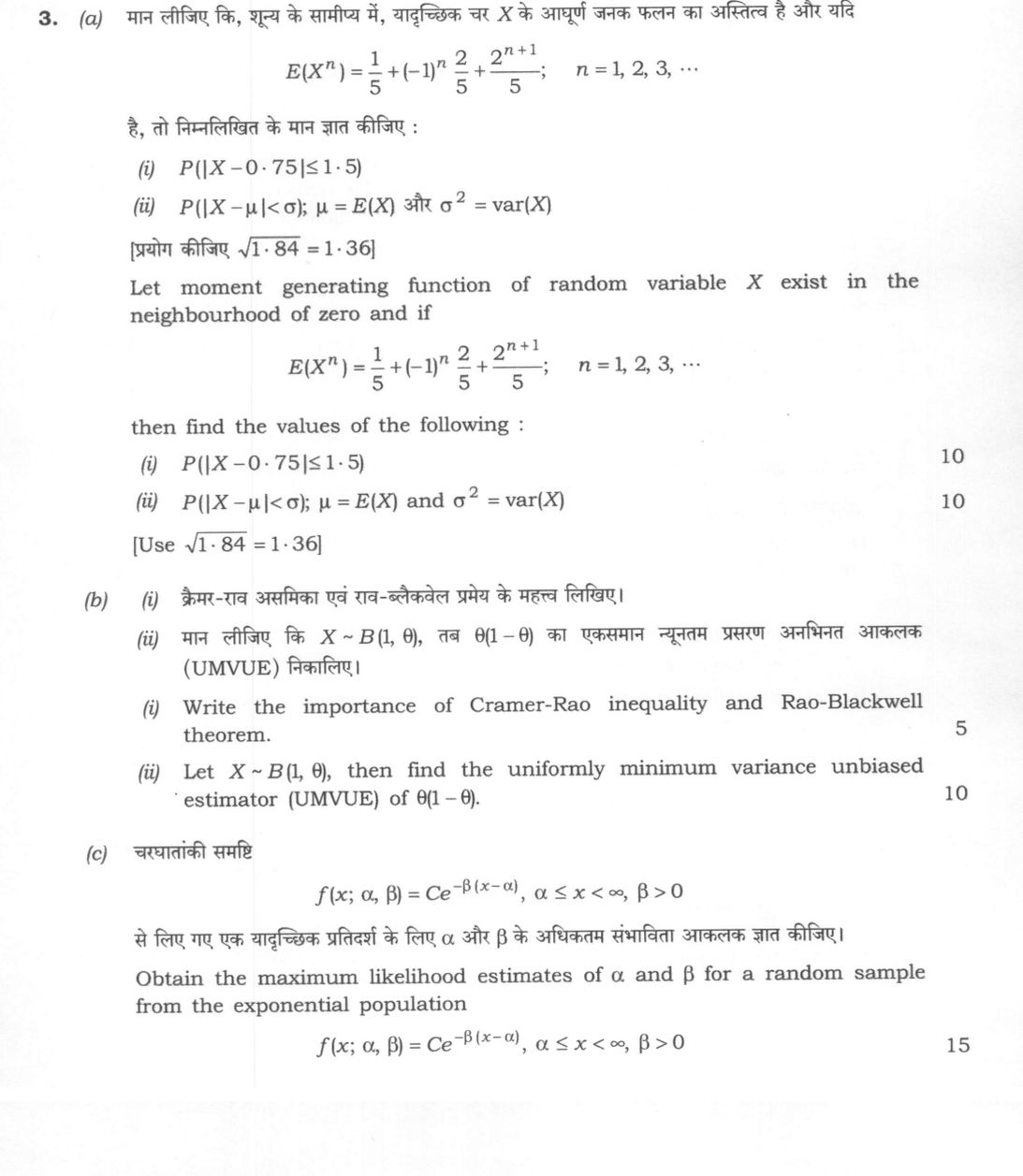
(a) Let moment generating function of random variable X exist in the neighbourhood of zero and if E(Xⁿ) = 1/5 + (-1)ⁿ 2/5 +…
Let moment generating function of random variable X exist in the neighbourhood of zero and if
E(Xⁿ) = 1/5 + (-1)ⁿ 2/5 + (2ⁿ⁺¹)/5; n = 1, 2, 3, …
then find the values of the following:
P(|X - 0.75| ≤ 1.5) 10 marks
P(|X - μ| < σ); μ = E(X) and σ² = var(X) 10 marks
[Use √1.84 = 1.36]
Write the importance of Cramer-Rao inequality and Rao-Blackwell theorem. 5 marks
Let X ∼ B(1, θ), then find the uniformly minimum variance unbiased estimator (UMVUE) of θ(1-θ). 10 marks
Obtain the maximum likelihood estimates of α and β for a random sample from the exponential population
f(x; α, β) = Ce⁻β(x-α), α ≤ x < ∞, β > 0 15 marks
हिंदी में प्रश्न पढ़ें
मान लीजिए कि, शून्य के सामीप्य में, यादृच्छिक चर X के आघूर्ण जनक फलन का अस्तित्व है और यदि
E(Xⁿ) = 1/5 + (-1)ⁿ 2/5 + (2ⁿ⁺¹)/5; n = 1, 2, 3, …
है, तो निम्नलिखित के मान ज्ञात कीजिए :
P(|X - 0.75| ≤ 1.5) (10 अंक)
P(|X - μ| < σ); μ = E(X) और σ² = var(X) (10 अंक)
[प्रयोग कीजिए √1.84 = 1.36]
क्रैमर-राव असमिका एवं राव-ब्लैकवेल प्रमेय के महत्व लिखिए। (5 अंक)
मान लीजिए कि X ∼ B(1, θ), तब θ(1-θ) का एकसमान न्यूनतम प्रसरण अनभिनत आकलक (UMVUE) निकालिए। (10 अंक)
चरघातांकी समिष्टि
f(x; α, β) = Ce⁻β(x-α), α ≤ x < ∞, β > 0
से लिए गए एक यादृच्छिक प्रतिदर्श के लिए α और β के अधिकतम संभाविता आकलक ज्ञात कीजिए। (15 अंक)
Model answer
Written by UPSC Answer Check against this question's marking rubric, to the expected length. UPSC does not publish answers for Mains — this is one way to score well, not an official key.
(a)(i) Let M(t)=E(e^(tX)). Since the moment generating function exists in a neighbourhood of 0, M(t)=1+Σ (n=1 to ∞) E(Xⁿ)tⁿ/n!. Substituting the given moments,
M(t)=1+Σ (n=1 to ∞) [1/5+(−1)ⁿ 2/5+2^(n+1)/5]tⁿ/n!
=1+(1/5)(e^t−1)+(2/5)(e^(−t)−1)+(2/5)(e^(2t)−1)
=(1/5)e^t+(2/5)e^(−t)+(2/5)e^(2t).
Thus X has the distribution P(X=−1)=2/5, P(X=1)=1/5, P(X=2)=2/5.
Now |X−0.75|≤1.5 means −0.75≤X≤2.25. Among the support values, X=1 and X=2 satisfy this, while X=−1 does not.
Therefore P(|X−0.75|≤1.5)=P(X=1)+P(X=2)=1/5+2/5=3/5.
Final answer: 3/5.
(a)(ii) From the distribution, μ=E(X)=(−1)(2/5)+(1)(1/5)+(2)(2/5)=3/5=0.6. Also, E(X²)=(1)(2/5)+(1)(1/5)+(4)(2/5)=11/5. Hence σ²=Var(X)=E(X²)−μ²=11/5−(3/5)²=11/5−9/25=46/25=1.84. So σ=√1.84=1.36, as given.
We need P(|X−μ|<σ)=P(|X−0.6|<1.36). This is equivalent to −1.36<X−0.6<1.36, i.e. −0.76<X<1.96. Among X=−1,1,2, only X=1 lies in this interval.
Therefore P(|X−μ|<σ)=P(X=1)=1/5.
Final answer: 1/5.
(b)(i) The Cramer-Rao inequality states that, under regularity conditions, for an unbiased estimator T of φ(θ), Var(T)≥[φ′(θ)]²/I(θ), where I(θ) is the Fisher information. Its importance is that it gives a lower bound on variance, measures efficiency, helps identify UMVUEs, and guides sample-size determination.
The Rao-Blackwell theorem states that if T is a sufficient statistic and U is an unbiased estimator with finite variance, then E(U|T) is also unbiased and Var(E(U|T))≤Var(U). Its importance is that it improves an estimator by conditioning on a sufficient statistic; combined with completeness and the Lehmann-Scheffé theorem, it yields UMVUEs.
(b)(ii) As written, the question says X∼B(1,θ), i.e. a single Bernoulli observation. Any estimator is T(X) with T(0)=a and T(1)=b. Then E[T(X)]=a(1−θ)+bθ=a+(b−a)θ, which is linear in θ, whereas θ(1−θ)=θ−θ² is quadratic. No choice of a and b makes them equal for all θ. Hence no unbiased estimator of θ(1−θ) exists, and therefore no UMVUE exists.
If the intended statement is a random sample X₁,X₂,…,Xₙ∼B(1,θ) with n≥2, let T=ΣXᵢ. Then T is complete sufficient and T∼Bin(n,θ). The estimator h(T)=T(n−T)/(n(n−1)) is unbiased because E[T(n−T)]=n(n−1)θ(1−θ). By the Lehmann-Scheffé theorem, it is the UMVUE.
Final answer: For one observation, no UMVUE exists. For a sample of size n≥2, the UMVUE is T(n−T)/(n(n−1)), where T=ΣXᵢ.
(c) The density is f(x;α,β)=C e^(−β(x−α)), α≤x<∞, β>0. Normalization gives 1=∫ from α to ∞ C e^(−β(x−α)) dx=C∫ from 0 to ∞ e^(−βu) du=C/β, so C=β. Hence f(x;α,β)=β e^(−β(x−α)), α≤x<∞.
For a random sample X₁,…,Xₙ, the likelihood is L(α,β)=βⁿ e^(−βΣ(Xᵢ−α)), provided α≤min Xᵢ; otherwise L=0.
Let X₍₁₎=min(X₁,…,Xₙ). For fixed β, L=βⁿ e^(−βΣXᵢ+nβα). Since β>0, this increases as α increases. The constraint is α≤X₍₁₎. Therefore the maximum occurs at α̂=X₍₁₎.
Substituting α̂=X₍₁₎, ℓ=ln L=n ln β−βΣ(Xᵢ−X₍₁₎). Differentiate: dℓ/dβ=n/β−Σ(Xᵢ−X₍₁₎). Set equal to zero: β̂=n/Σ(Xᵢ−X₍₁₎). Also, d²ℓ/dβ²=−n/β²<0, so this is a maximum. This requires that not all observations are equal; if all observations are equal, the likelihood is unbounded in β.
Final answer: α̂=min Xᵢ, and β̂=n/Σ(Xᵢ−min Xᵢ)=1/(X̄−min Xᵢ), assuming not all observations are equal.
What "Solve" is asking you to do
Choose the method, then carry it through to a final answer. Identifying what kind of problem this is and why that method applies is the first thing marked; a correct figure arrived at invisibly earns almost nothing.
Structure that answers it
Given data and what is required → method chosen, with the reason it applies → set-up (equation, circuit, free body, trial balance) → working, step by step → answer with units and any condition of validity
Where marks are lost
Doing the middle steps mentally and writing only the result. In mathematics papers, a further loss comes from giving a decimal where the exact value in surds or fractions was wanted, or from skipping the justification a part explicitly asks for.
How this answer will be evaluated
Approach
(a(i)) calculate: given > formula > substitution > result with units > interpretation | (a(ii)) calculate: given > formula > substitution > result with units > interpretation | (b(i)) write short notes: define > 3-4 key features > one example > one-line significance | (b(ii)) calculate: given > formula > substitution > result with units > interpretation | (c) calculate: given > formula > substitution > result with units > interpretation Full marks: All parts solved with correct method, clear steps, and proper interpretation.
Key points expected
- Calculate E(X) and E(X²) from the given formula
- Determine the support of X (values and probabilities)
- Identify the range of X satisfying the inequality
- Sum the probabilities of the relevant values
- Calculate μ = E(X) and σ² = Var(X)
- Use the provided value √1.84 = 1.36 for σ
- Determine the range of X satisfying |X - μ| < σ
- State the Cramer-Rao lower bound for variance
Evaluation rubric
Each sub-part is marked on its own, against the marks and word limit printed on the paper.
- (a(i)) Compute the probability P(|X - 0.75| ≤ 1.5) using the given moments. 10 marks
calculate— given → formula → substitution → result with units → interpretation
Must cover
- Calculate E(X) and E(X²) from the given formula
- Determine the support of X (values and probabilities)
- Identify the range of X satisfying the inequality
- Sum the probabilities of the relevant values
Loses marks
- Assuming a continuous distribution without justification
- Incorrect calculation of the support values
Earns more
- Explicitly listing the probability mass function
- Showing the step-by-step substitution for n=1 and n=2
Extra mark
- Verifying the sum of probabilities equals 1
- (a(ii)) Compute the probability P(|X - μ| < σ) using the calculated mean and variance. 10 marks
calculate— given → formula → substitution → result with units → interpretation
Must cover
- Calculate μ = E(X) and σ² = Var(X)
- Use the provided value √1.84 = 1.36 for σ
- Determine the range of X satisfying |X - μ| < σ
- Sum the probabilities of the relevant values
Loses marks
- Using the wrong value for σ (e.g., 1.84 instead of 1.36)
- Confusing variance with standard deviation
Earns more
- Correctly identifying the strict inequality boundary
- Clear substitution of calculated μ and σ
Extra mark
- Comparing the result with the Chebyshev bound
- (b(i)) Explain the importance of the Cramer-Rao inequality and Rao-Blackwell theorem. 5 marks
write short notes— define → 3-4 key features → one example → one-line significance
Must cover
- State the Cramer-Rao lower bound for variance
- Explain Rao-Blackwellization (conditioning on sufficient statistic)
- Mention the role in finding UMVUE
Loses marks
- Confusing the two theorems
- Failing to mention the reduction in variance
Earns more
- Briefly defining the conditions for Cramer-Rao
- Mentioning the Lehmann-Scheffe theorem connection
Extra mark
- Providing a simple example of Rao-Blackwellization
- (b(ii)) Find the UMVUE of θ(1-θ) for X ~ B(1, θ). 10 marks
calculate— given → formula → substitution → result with units → interpretation
Must cover
- Identify a sufficient statistic (e.g., sum of sample)
- Find an initial unbiased estimator for θ(1-θ)
- Apply Rao-Blackwell theorem to condition on the sufficient statistic
- Derive the final UMVUE formula
Loses marks
- Skipping the Rao-Blackwell step
- Incorrectly identifying the sufficient statistic
Earns more
- Showing the expectation calculation for the initial estimator
- Clearly stating the distribution of the sufficient statistic
Extra mark
- Verifying the final estimator is unbiased
- (c) Obtain the maximum likelihood estimates of α and β for the given exponential population. 15 marks
calculate— given → formula → substitution → result with units → interpretation
Must cover
- Write the likelihood function L(α, β)
- Write the log-likelihood function l(α, β)
- Differentiate with respect to β and solve for β
- Identify the MLE for α (minimum of the sample)
Loses marks
- Ignoring the constraint α ≤ x
- Treating α as a standard parameter for differentiation
Earns more
- Correctly handling the indicator function for the support
- Showing the derivative steps clearly
Extra mark
- Discussing the existence of the MLE for α
Practice this exact question
Write your answer and it is marked point by point against the model answer above — what you covered, what you missed, what you got wrong.
Evaluate my answer →More from Statistics 2024 Paper I
- Q1 (a) Two events A and B are such that P(A) = 1/3, P(B) = 1/4 and P(A|B) + P(B|A) = 2/3. Ev…
- Q2 (a) Let the joint probability density function of two random variables X and Y be f(x, y)…
- Q3 (a) Let moment generating function of random variable X exist in the neighbourhood of zer…
- Q4 (a) Find the most powerful test of size α(= 0·05) for testing H₀: μ = 0 vs. H₁: μ = 1, gi…
- Q5 (a) How will you justify the usage of the principle of least squares in estimating the pa…
- Q6 (a) (X, Y) has bivariate normal distribution BN(μ₁, μ₂, σ₁², σ₂², ρ). (i) Show that X and…