Paper I — Q4
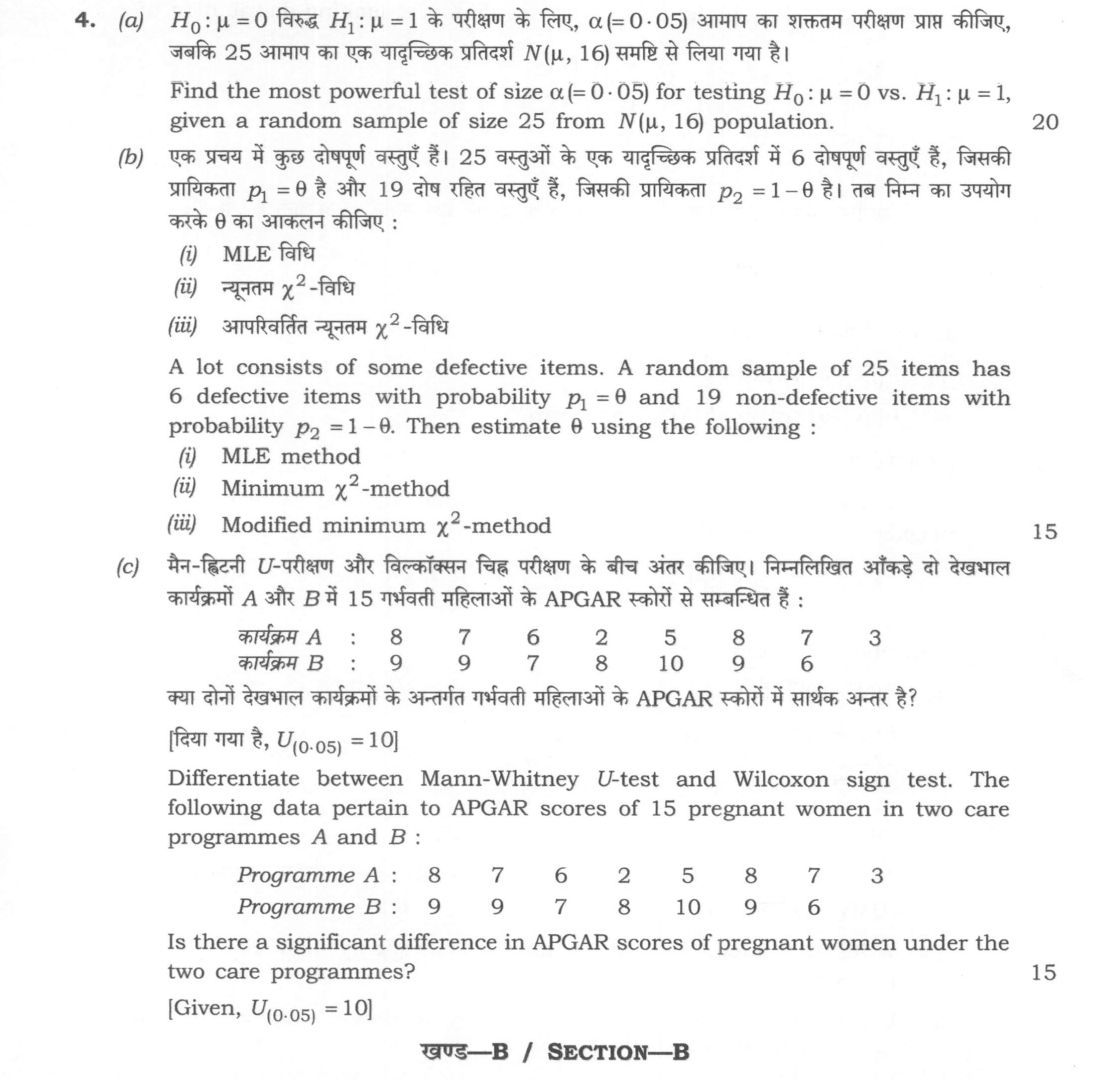
(a) Find the most powerful test of size α(= 0·05) for testing H₀: μ = 0 vs. H₁: μ = 1, given a random sample of size 25 from N(μ…
Find the most powerful test of size α(= 0·05) for testing H₀: μ = 0 vs. H₁: μ = 1, given a random sample of size 25 from N(μ, 16) population. 20 marks
A lot consists of some defective items. A random sample of 25 items has 6 defective items with probability p₁ = θ and 19 non-defective items with probability p₂ = 1 – θ. Then estimate θ using the following:
MLE method
Minimum χ²-method
Modified minimum χ²-method 15 marks
Differentiate between Mann-Whitney U-test and Wilcoxon sign test. The following data pertain to APGAR scores of 15 pregnant women in two care programmes A and B:
Programme A : 8 7 6 2 5 8 7 3
Programme B : 9 9 7 8 10 9 6
Is there a significant difference in APGAR scores of pregnant women under the two care programmes?
[Given, U₍₀.₀₅₎ = 10] 15 marks
हिंदी में प्रश्न पढ़ें
H₀: μ = 0 विरुद्ध H₁: μ = 1 के परीक्षण के लिए, α(= 0·05) आमाप का शक्तम परीक्षण प्राप्त कीजिए, जबकि 25 आमाप का एक यादृच्छिक प्रतिदर्श N(μ, 16) समष्टि से लिया गया है। (20 अंक)
एक प्रचय में कुछ दोषपूर्ण वस्तुएँ हैं। 25 वस्तुओं के एक यादृच्छिक प्रतिदर्श में 6 दोषपूर्ण वस्तुएँ हैं, जिसकी प्रायिकता p₁ = θ है और 19 दोष रहित वस्तुएँ हैं, जिसकी प्रायिकता p₂ = 1 – θ है। तब निम्न का उपयोग करके θ का आकलन कीजिए :
MLE विधि
न्यूनतम χ²-विधि
आपरिवर्तित न्यूनतम χ²-विधि (15 अंक)
मैन-हिटनी U-परीक्षण और विल्कॉक्सन चिह्न परीक्षण के बीच अंतर कीजिए। निम्नलिखित आँकड़े दो देखभाल कार्यक्रमों A और B में 15 गर्भवती महिलाओं के APGAR स्कोरों से सम्बन्धित हैं :
कार्यक्रम A : 8 7 6 2 5 8 7 3
कार्यक्रम B : 9 9 7 8 10 9 6
क्या दोनों देखभाल कार्यक्रमों के अन्तर्गत गर्भवती महिलाओं के APGAR स्कोरों में सार्थक अंतर है?
[दिया गया है, U₍₀.₀₅₎ = 10] (15 अंक)
The figure this question refers to, in words
The question paper is a scan and the diagram did not survive as text. This is the figure as read from the original page — every component, value and label — so the question can be worked from the text below.
(b) The following data is provided for the estimation problem: Sum of A_i (from i=1 to 40) = 200 and Sum of A_i squared (from i=1 to 40) = 1156.
(c) Table of APGAR scores for two care programmes: Programme A: 8, 7, 6, 2, 5, 8, 7, 3 Programme B: 9, 9, 7, 8, 10, 9, 6
Table titled 'AREAS UNDER STANDARD NORMAL PROBABILITY CURVE'. The table provides values for P(0 < Z < z) for different values of z. The first column lists z values from 0.0 to 3.9 in increments of 0.1. The top row lists the second decimal place of z from 0.00 to 0.09. The body of the table contains the corresponding probability values. For example, for z=0.0, the values range from 0.0000 to 0.0359. For z=3.9, the values are all 0.5000. The table is preceded by the formula for the standard normal probability curve f(z) = (1/sqrt(2pi)) exp(-1/2 z^2) and the definition of Z = (X - mu) / sigma.
What "Solve" is asking you to do
Choose the method, then carry it through to a final answer. Identifying what kind of problem this is and why that method applies is the first thing marked; a correct figure arrived at invisibly earns almost nothing.
Structure that answers it
Given data and what is required → method chosen, with the reason it applies → set-up (equation, circuit, free body, trial balance) → working, step by step → answer with units and any condition of validity
Where marks are lost
Doing the middle steps mentally and writing only the result. In mathematics papers, a further loss comes from giving a decimal where the exact value in surds or fractions was wanted, or from skipping the justification a part explicitly asks for.
How this answer will be evaluated
Approach
Framework: UPSC Statistics Paper 1. (a) derive: given > assumptions > stepwise derivation > result > check | (b) calculate: given > formula > substitution > result with units > interpretation | (c) compare: paired headings or table > key differences > significance > conclusion Full marks: Complete derivations with clear interpretation and correct notation throughout
Key points expected
- State Neyman-Pearson lemma application
- Define likelihood ratio for N(μ, 16)
- Determine critical region using α=0.05
- Calculate test statistic value
- Apply MLE method for θ estimation
- Apply minimum χ² method correctly
- Apply modified minimum χ² method
- Show all three calculations clearly
Evaluation rubric
Each sub-part is marked on its own, against the marks and word limit printed on the paper.
- (a) Derive the most powerful test of size 0.05 for H0: μ=0 vs H1: μ=1. 20 marks
derive— given → assumptions → stepwise derivation → result → check
Must cover
- State Neyman-Pearson lemma application
- Define likelihood ratio for N(μ, 16)
- Determine critical region using α=0.05
- Calculate test statistic value
Loses marks
- Missing likelihood ratio derivation
- Incorrect critical region determination
- No interpretation of test result
Earns more
- Explicitly state distributional assumptions
- Show step-by-step derivation of critical value
- Interpret result in context of power
Extra mark
- Mention UMP test property
- Provide power function calculation
- (b) Estimate θ using MLE, minimum χ², and modified minimum χ² methods. 15 marks
calculate— given → formula → substitution → result with units → interpretation
Must cover
- Apply MLE method for θ estimation
- Apply minimum χ² method correctly
- Apply modified minimum χ² method
- Show all three calculations clearly
Loses marks
- Missing any of the three methods
- Incorrect χ² formula application
- No clear distinction between methods
Earns more
- State likelihood function explicitly
- Show χ² formula before substitution
- Compare the three estimates
Extra mark
- Discuss efficiency of each method
- Provide confidence intervals
- (c) Differentiate Mann-Whitney U-test from Wilcoxon sign test and test for significant difference. 15 marks
compare— paired headings or table → key differences → significance → conclusion
Must cover
- Differentiate U-test and sign test clearly
- Apply Mann-Whitney U-test to data
- Calculate U statistic correctly
- Compare with U(0.05)=10 for decision
Loses marks
- Confusing the two tests
- Incorrect ranking or U calculation
- No clear conclusion on significance
Earns more
- State assumptions of each test
- Show ranking procedure clearly
- Interpret result in context of APGAR scores
Extra mark
- Mention when to use each test
- Provide p-value if calculable
Model answer coming soon
Every evaluation on this site is marked against a verified model answer. This question's answer is still being written; evaluation opens the moment it lands.
More from Statistics 2024 Paper I
- Q1 (a) Two events A and B are such that P(A) = 1/3, P(B) = 1/4 and P(A|B) + P(B|A) = 2/3. Ev…
- Q2 (a) Let the joint probability density function of two random variables X and Y be f(x, y)…
- Q3 (a) Let moment generating function of random variable X exist in the neighbourhood of zer…
- Q4 (a) Find the most powerful test of size α(= 0·05) for testing H₀: μ = 0 vs. H₁: μ = 1, gi…
- Q5 (a) How will you justify the usage of the principle of least squares in estimating the pa…
- Q6 (a) (X, Y) has bivariate normal distribution BN(μ₁, μ₂, σ₁², σ₂², ρ). (i) Show that X and…
- Q7 (a) A very big population is divided into two strata. The allocation of units of stratifi…