Paper I — Q6
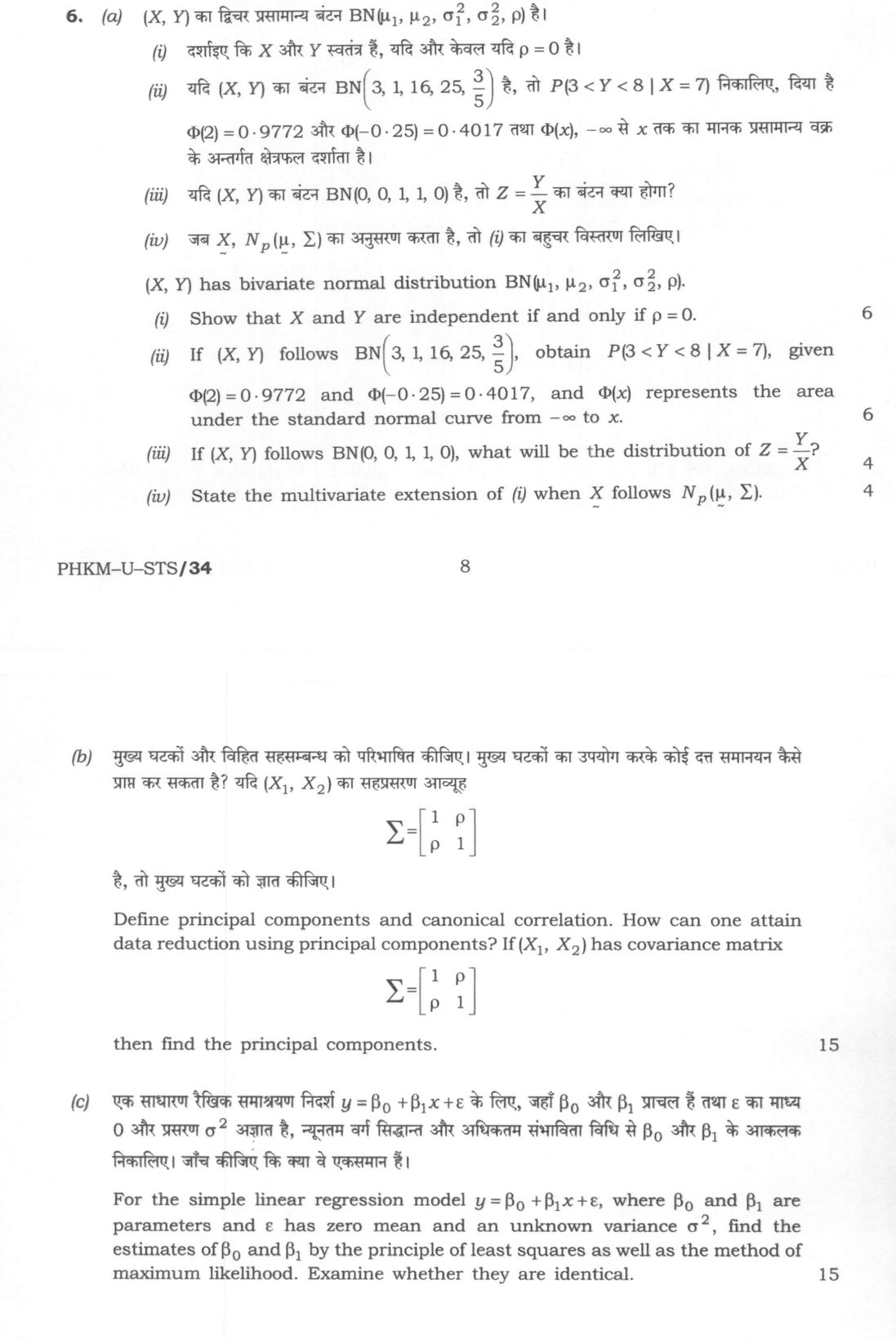
(a) (X, Y) has bivariate normal distribution BN(μ₁, μ₂, σ₁², σ₂², ρ). (i) Show that X and Y are independent if and only if ρ = 0…
(X, Y) has bivariate normal distribution BN(μ₁, μ₂, σ₁², σ₂², ρ). Show that X and Y are independent if and only if ρ = 0. 6 marks
If (X, Y) follows BN(3, 1, 16, 25, 3/5), obtain P(3 < Y < 8 | X = 7), given Φ(2) = 0.9772 and Φ(-0.25) = 0.4017, and Φ(x) represents the area under the standard normal curve from -∞ to x. 6 marks
If (X, Y) follows BN(0, 0, 1, 1, 0), what will be the distribution of Z = Y/X? 4 marks
State the multivariate extension of (i) when X̃ follows Nₚ(μ̃, Σ). 4 marks
Define principal components and canonical correlation. How can one attain data reduction using principal components? If (X₁, X₂) has covariance matrix Σ = [[1, ρ], [ρ, 1]], then find the principal components. 15 marks
For the simple linear regression model y = β₀ + β₁x + ε, where β₀ and β₁ are parameters and ε has zero mean and an unknown variance σ², find the estimates of β₀ and β₁ by the principle of least squares as well as the method of maximum likelihood. Examine whether they are identical. 15 marks
हिंदी में प्रश्न पढ़ें
(X, Y) का द्विवर प्रसामान्य बंटन BN(μ₁, μ₂, σ₁², σ₂², ρ) है। दर्शाइए कि X और Y स्वतंत्र हैं, यदि और केवल यदि ρ = 0 है। (6 अंक)
यदि (X, Y) का बंटन BN(3, 1, 16, 25, 3/5) है, तो P(3 < Y < 8 | X = 7) निकालिए, दिया है Φ(2) = 0.9772 और Φ(-0.25) = 0.4017 तथा Φ(x), -∞ से x तक का मानक प्रसामान्य वक्र के अंतर्गत क्षेत्रफल दर्शाता है। (6 अंक)
यदि (X, Y) का बंटन BN(0, 0, 1, 1, 0) है, तो Z = Y/X का बंटन क्या होगा? (4 अंक)
जब X̃, Nₚ(μ̃, Σ) का अनुसरण करता है, तो (i) का बहुचर विस्तरण लिखिए। (4 अंक)
मुख्य घटकों और विहित सहसंबंध को परिभाषित कीजिए। मुख्य घटकों का उपयोग करके कोई दत्त समान्यन कैसे प्राप्त कर सकता है? यदि (X₁, X₂) का सहप्रसरण आव्यूह Σ = [[1, ρ], [ρ, 1]] है, तो मुख्य घटकों को ज्ञात कीजिए। (15 अंक)
एक साधारण रैखिक समाश्रयन निदर्श y = β₀ + β₁x + ε के लिए, जहाँ β₀ और β₁ प्राचल हैं तथा ε का माध्य 0 और प्रसरण σ² अज्ञात है, न्यूनतम वर्ग सिद्धांत और अधिकतम संभाविता विधि से β₀ और β₁ के आकलक निकालिए। जाँच कीजिए कि क्या वे एकसमान हैं। (15 अंक)
Model answer
Written by UPSC Answer Check against this question's marking rubric, to the expected length. UPSC does not publish answers for Mains — this is one way to score well, not an official key.
(a)(i) For BN(μ₁, μ₂, σ₁², σ₂², ρ), the joint density is f(x,y)=1/(2πσ₁σ₂√(1-ρ²)) exp[-(1/(2(1-ρ²)))(((x-μ₁)/σ₁)² - 2ρ((x-μ₁)/σ₁)((y-μ₂)/σ₂) + ((y-μ₂)/σ₂)²)]. If ρ=0, the exponent separates into a function of x plus a function of y, and the joint density factors into the product of the two marginal normal densities. Hence X and Y are independent. Conversely, if X and Y are independent, then Cov(X,Y)=0. But Cov(X,Y)=ρσ₁σ₂, so ρ=0 because σ₁,σ₂>0. Final: X and Y are independent iff ρ=0.
(a)(ii) For bivariate normal, the conditional distribution is Y|X=x ~ N(μ₂ + ρ(σ₂/σ₁)(x-μ₁), σ₂²(1-ρ²)). Here μ₁=3, μ₂=1, σ₁=4, σ₂=5, ρ=3/5. Thus mean = 1 + (3/5)(5/4)(7-3) = 1+3 = 4, variance = 25(1-9/25)=16, sd=4. So Y|X=7 ~ N(4,16). Therefore P(3<Y<8|X=7)=P((3-4)/4<Z<(8-4)/4)=P(-0.25<Z<1) =Φ(1)-Φ(-0.25)=0.8413-0.4017=0.4396. Final: 0.4396. The supplied Φ(2) would correspond to the upper limit 12; if the intended upper limit was 12, the value would be 0.9772-0.4017=0.5755.
(a)(iii) Since ρ=0 and variances are 1, X and Y are independent standard normal. Let Z=Y/X. Put z=y/x and w=x, so y=zw. The Jacobian is |w|. Hence f_Z(z)=∫ (from -∞ to ∞) (1/(2π)) exp[-(w²+z²w²)/2] |w| dw =1/(2π) ∫ (from -∞ to ∞) |w| exp[-w²(1+z²)/2] dw =1/π ∫ (from 0 to ∞) w exp[-w²(1+z²)/2] dw =1/(π(1+z²)), −∞<z<∞. Final: Z has standard Cauchy distribution with density 1/(π(1+z²)).
(a)(iv) Let X̃ ~ Nₚ(μ̃, Σ). Partition X̃ into X₁ and X₂ with covariance blocks Σ₁₁, Σ₂₂ and cross-covariance Σ₁₂. Then X₁ and X₂ are independent iff Σ₁₂=0. In particular, all components of X̃ are mutually independent iff Σ is diagonal. Final: The multivariate extension is: subvectors are independent iff their cross-covariance block is zero; all components are independent iff Σ is diagonal.
(b) Principal components are uncorrelated linear combinations a'X of maximum variance subject to a'a=1 and zero correlation with earlier components. Their coefficients are eigenvectors of the covariance matrix Σ, and their variances are the corresponding eigenvalues. Canonical correlation between two vectors X and Y is the maximum correlation between linear combinations a'X and b'Y; successive canonical correlations are obtained subject to uncorrelatedness with earlier canonical variates. Data reduction by principal components: sort eigenvalues λ₁≥λ₂≥...≥λₚ, retain the first k components whose cumulative variance proportion (λ₁+...+λₖ)/(λ₁+...+λₚ) is sufficiently large, and replace the original p variables by these k components. If units differ, use the correlation matrix. For Σ=[[1,ρ],[ρ,1]], det(Σ-λI)=(1-λ)²-ρ²=0, so λ=1+ρ, 1-ρ. Assuming ρ≥0, the eigenvector for λ₁=1+ρ is (1,1)/√2, and for λ₂=1-ρ is (1,-1)/√2. Final: PC₁=(X₁+X₂)/√2 with variance 1+ρ, and PC₂=(X₁-X₂)/√2 with variance 1-ρ. If ρ<0, their order is reversed.
(c) For the model yᵢ=β₀+β₁xᵢ+εᵢ, least squares minimizes S(β₀,β₁)=Σ(yᵢ-β₀-β₁xᵢ)². The normal equations are Σyᵢ=nβ₀+β₁Σxᵢ, Σxᵢyᵢ=β₀Σxᵢ+β₁Σxᵢ². Solving, with x̄=Σxᵢ/n, ȳ=Σyᵢ/n, β₁hat=[Σ(xᵢ-x̄)(yᵢ-ȳ)]/[Σ(xᵢ-x̄)²], β₀hat=ȳ-β₁hat x̄. For maximum likelihood, assume εᵢ are independent N(0,σ²). Then L(β₀,β₁,σ²)=(2πσ²)^(-n/2) exp[-Σ(yᵢ-β₀-β₁xᵢ)²/(2σ²)]. Maximizing L over β₀,β₁ is equivalent to minimizing Σ(yᵢ-β₀-β₁xᵢ)². Hence the same normal equations result. Final: β₀hat and β₁hat are identical by least squares and by maximum likelihood under normal errors; the MLE of σ² is Σ(yᵢ-β₀hat-β₁hat xᵢ)²/n. Condition: Σ(xᵢ-x̄)²>0.
What "Prove" is asking you to do
Establish that the statement holds for every case it claims, not for one representative case. The argument must be closed: each line follows from a definition, a hypothesis, or a named theorem you are entitled to use.
Structure that answers it
Given and to prove, restated → theorem or construction to be used, named → the argument line by line → conclusion stated as proved
Where marks are lost
Testing one example, which illustrates but proves nothing. On an if and only if claim, proving one direction and stopping forfeits that half outright, and degenerate cases — zero, the empty set, the equality case — have to be disposed of rather than assumed away.
How this answer will be evaluated
Approach
(a(i)) justify: claim > 3-4 reasons > evidence > conclusion | (a(ii)) calculate: given > formula > substitution > result with units > interpretation | (a(iii)) explain: definition/context > points in order > small example > short close | (a(iv)) explain: definition/context > points in order > small example > short close | (b) explain: definition/context > points in order > small example > short close | (c) compare: paired headings or table > key differences > significance > conclusion Full marks: Rigorous derivations with all steps shown; correct identification of distributions; clear comparison of LS and MLE.
Key points expected
- Write bivariate normal PDF with covariance matrix
- Show PDF factorizes into product of marginals
- Demonstrate factorization occurs if and only if ρ = 0
- State that factorization implies independence
- State conditional distribution Y|X=7 is normal
- Calculate conditional mean μ_{Y|X} = μ₂ + ρ(σ₂/σ₁)(x-μ₁)
- Calculate conditional variance σ²_{Y|X} = σ₂²(1-ρ²)
- Standardize to find P(3 < Z < 8) using Φ values
Evaluation rubric
Each sub-part is marked on its own, against the marks and word limit printed on the paper.
- (a(i)) Prove independence of X and Y is equivalent to ρ = 0. 6 marks
justify— claim → 3-4 reasons → evidence → conclusion
Must cover
- Write bivariate normal PDF with covariance matrix
- Show PDF factorizes into product of marginals
- Demonstrate factorization occurs if and only if ρ = 0
- State that factorization implies independence
Loses marks
- Assuming independence without proving factorization
- Confusing correlation with covariance in the proof
Earns more
- Explicitly write marginal distributions N(μ₁, σ₁²) and N(μ₂, σ₂²)
- Show determinant of covariance matrix is σ₁²σ₂²(1-ρ²)
Extra mark
- Mention that for normal distributions, uncorrelated implies independent
- (a(ii)) Compute P(3 < Y < 8 | X = 7) for given bivariate normal. 6 marks
calculate— given → formula → substitution → result with units → interpretation
Must cover
- State conditional distribution Y|X=7 is normal
- Calculate conditional mean μ_{Y|X} = μ₂ + ρ(σ₂/σ₁)(x-μ₁)
- Calculate conditional variance σ²_{Y|X} = σ₂²(1-ρ²)
- Standardize to find P(3 < Z < 8) using Φ values
Loses marks
- Using marginal distribution of Y instead of conditional
- Arithmetic error in standardization (z-scores)
Earns more
- Show substitution: μ_{Y|X} = 1 + (3/5)(5/4)(7-3) = 4
- Show σ²_{Y|X} = 25(1-9/25) = 16, so σ_{Y|X} = 4
Extra mark
- Explicitly state that conditional distribution is N(4, 16)
- (a(iii)) Identify distribution of Z = Y/X for standard bivariate normal. 4 marks
explain— definition/context → points in order → small example → short close
Must cover
- Note that X and Y are independent standard normals
- Identify Z as ratio of two independent standard normals
- State that Z follows Cauchy distribution
- Specify parameters: Cauchy(0, 1)
Loses marks
- Claiming Z is normal or t-distributed
- Failing to note independence of X and Y
Earns more
- Mention that Cauchy distribution has undefined mean and variance
- Write the PDF of the Cauchy distribution
Extra mark
- Derive the PDF of Z using transformation of variables
- (a(iv)) State multivariate extension of independence condition. 4 marks
explain— definition/context → points in order → small example → short close
Must cover
- State that X̃ ~ Nₚ(μ̃, Σ)
- Define partition of X̃ into sub-vectors
- State that sub-vectors are independent iff covariance is zero
- Specify that off-diagonal blocks of Σ must be zero
Loses marks
- Stating condition without specifying block structure
- Confusing correlation matrix with covariance matrix
Earns more
- Write Σ in block form with zero off-diagonal blocks
- Mention that this generalizes the bivariate case
Extra mark
- Give a specific example with p=3 and partition (1,2)
- (b) Define PC and canonical correlation; find PCs for given Σ. 15 marks
explain— definition/context → points in order → small example → short close
Must cover
- Define principal components as linear combinations maximizing variance
- Define canonical correlation as max correlation between linear combos
- Find eigenvalues of Σ: λ₁ = 1+ρ, λ₂ = 1-ρ
- Find eigenvectors: (1,1)/√2 and (1,-1)/√2
Loses marks
- Confusing principal components with canonical variates
- Incorrect eigenvectors or eigenvalues
Earns more
- Explain data reduction by retaining PCs with large eigenvalues
- Show that PCs are uncorrelated by construction
Extra mark
- Mention that PC1 explains (1+ρ)/2 of total variance
- (c) Derive LS and MLE estimates; examine if identical. 15 marks
compare— paired headings or table → key differences → significance → conclusion
Must cover
- Derive LS estimates by minimizing sum of squared residuals
- Derive MLE estimates by maximizing likelihood function
- Show both methods yield β̂₁ = Σ(xᵢ-x̄)(yᵢ-ȳ)/Σ(xᵢ-x̄)²
- Show both methods yield β̂₀ = ȳ - β̂₁x̄
Loses marks
- Failing to show the derivation steps for either method
- Claiming estimates differ without justification
Earns more
- Write the likelihood function explicitly
- Show that MLE for σ² differs from LS residual variance
Extra mark
- Note MLE σ² is biased while LS is unbiased
Practice this exact question
Write your answer and it is marked point by point against the model answer above — what you covered, what you missed, what you got wrong.
Evaluate my answer →More from Statistics 2024 Paper I
- Q3 (a) Let moment generating function of random variable X exist in the neighbourhood of zer…
- Q4 (a) Find the most powerful test of size α(= 0·05) for testing H₀: μ = 0 vs. H₁: μ = 1, gi…
- Q5 (a) How will you justify the usage of the principle of least squares in estimating the pa…
- Q6 (a) (X, Y) has bivariate normal distribution BN(μ₁, μ₂, σ₁², σ₂², ρ). (i) Show that X and…
- Q7 (a) A very big population is divided into two strata. The allocation of units of stratifi…
- Q8 (a) A 2²-factorial design was used to develop the yield of a crop. Two factors A and B we…