Paper I — Q2
(a) Let the joint probability density function of two random variables X and Y be f(x, y) = x/3, for 0 < 2x < 3y < 6; 0…
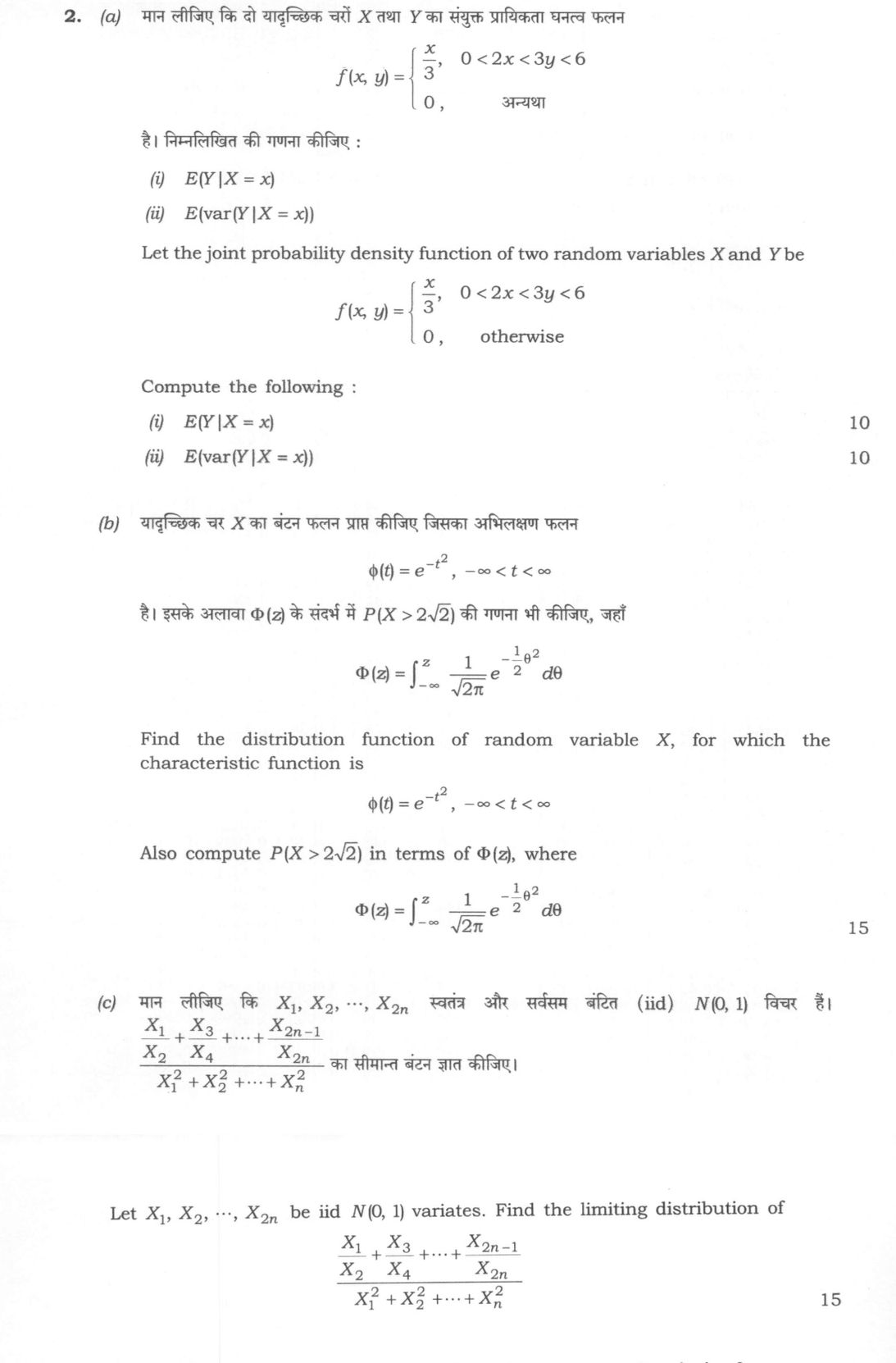
Let the joint probability density function of two random variables X and Y be f(x, y) = x/3, for 0 < 2x < 3y < 6; 0, otherwise. Compute the following: (i) E(Y|X = x) (10 marks) (ii) E(var(Y|X = x)) 10 marks
Find the distribution function of random variable X, for which the characteristic function is φ(t) = e^(-t²), -∞ < t < ∞. Also compute P(X > 2√2) in terms of Φ(z), where Φ(z) = ∫₋∞^z (1/√(2π)) e^(-θ²/2) dθ. 15 marks
Let X₁, X₂, ..., X₂ₙ be iid N(0, 1) variates. Find the limiting distribution of [(X₁/X₂) + (X₃/X₄) + ... + (X₂ₙ₋₁/X₂ₙ)] / [X₁² + X₂² + ... + Xₙ²]. 15 marks
हिंदी में प्रश्न पढ़ें
मान लीजिए कि दो यादृच्छिक चरों X तथा Y का संयुक्त प्रायिकता घनत्व फलन f(x, y) = x/3, 0 < 2x < 3y < 6; 0, अन्यथा है। निम्नलिखित की गणना कीजिए : (i) E(Y|X = x) (10) (ii) E(var(Y|X = x)) 10 marks
यादृच्छिक चर X का बंटन फलन प्राप्त कीजिए जिसका अभिलक्षण फलन φ(t) = e^(-t²), -∞ < t < ∞ है। इसके अलावा Φ(z) के संदर्भ में P(X > 2√2) की गणना भी कीजिए, जहाँ Φ(z) = ∫₋∞^z (1/√(2π)) e^(-θ²/2) dθ. 15 marks
मान लीजिए कि X₁, X₂, ..., X₂ₙ स्वतंत्र और सर्वसम बंति (iid) N(0, 1) विचर हैं। [(X₁/X₂) + (X₃/X₄) + ... + (X₂ₙ₋₁/X₂ₙ)] / [X₁² + X₂² + ... + Xₙ²] का सीमान्त बंटन ज्ञात कीजिए। 15 marks
Model answer
Written by UPSC Answer Check against this question's marking rubric, to the expected length. UPSC does not publish answers for Mains — this is one way to score well, not an official key.
Part (a)
The joint pdf is f(x,y)=x/3 for 0<2x<3y<6. Rewrite the region: 2x<3y<6 gives 2x/3<y<2, and 2x>0 gives x>0; also 3y<6 gives y<2, while 2x<6 gives x<3. Hence the support is 0<x<3, 2x/3<y<2. First find the marginal pdf of X:
f_X(x)=∫_2x/3^2 x/3 dy = (x/3)(2-2x/3) = 2x/3 - 2x²/9 = (2/9)x(3-x), 0<x<3.
(i) The conditional pdf of Y given X=x is
f_Y|X(y|x)= f(x,y)/f_X(x) = (x/3) / [(2/9)x(3-x)] = 3/[2(3-x)], for 2x/3<y<2.
This is uniform on the interval [2x/3, 2]. Therefore
E(Y|X=x)= (2x/3 + 2)/2 = x/3 + 1 = (3+x)/3.
Final answer (i): E(Y|X=x) = (3+x)/3.
(ii) For a uniform distribution on [a,b], variance = (b-a)²/12. Here a=2x/3, b=2, so
Var(Y|X=x)= [2 - 2x/3]² / 12 = [2(3-x)/3]² / 12 = (4(3-x)²/9)/12 = (3-x)²/27.
Now E[Var(Y|X=x)] = (1/27) E[(3-X)²]. Compute this using f_X(x):
E[(3-X)²] = ∫_0^3 (3-x)² · (2/9)x(3-x) dx = (2/9)∫_0^3 x(3-x)³ dx.
Let u=3-x, so x=3-u and dx=-du; limits change from x=0→3 to u=3→0:
∫_0^3 x(3-x)³ dx = ∫_0^3 (3-u)u³ du = 3∫_0^3 u³ du - ∫_0^3 u⁴ du = 3(81/4) - 243/5 = 243/4 - 243/5 = 243/20.
Thus E[(3-X)²] = (2/9)(243/20) = 27/10. Hence
E[Var(Y|X=x)] = (1/27)(27/10) = 1/10.
Final answer (ii): E[Var(Y|X=x)] = 1/10.
Part (b)
The characteristic function of X is φ(t)=e^-t². For a normal distribution N(μ,σ²), the characteristic function is exp(iμt - σ²t²/2). Matching gives μ=0 and σ²/2=1, so σ²=2. Hence X ~ N(0,2).
The distribution function of X is therefore
F_X(x)=P(X≤x)=P(Z≤x/√2)=Φ(x/√2), where Z ~ N(0,1) and Φ is the standard normal CDF.
Now P(X>2√2)=1-P(X≤2√2)=1-Φ(2√2/√2)=1-Φ(2).
Final answer (b): F_X(x)=Φ(x/√2); P(X>2√2)=1-Φ(2).
Part (c)
Let Y_i = X_2i-1/X_2i, i=1,2,...,n. Since the X's are iid N(0,1), each Y_i is the ratio of two independent standard normal variables, so Y_i has the standard Cauchy distribution C(0,1) with characteristic function φ_Y(t)=e^-|t|. The pairs (X_2i-1, X_2i) are disjoint, so the Y_i are independent.
Let S_n = Σ_i=1^n Y_i. Then S_n has characteristic function φ_S_n(t)=e^-n|t|, which is the characteristic function of C(0,n). Therefore S_n/n has characteristic function e^-|t|, so S_n/n ~ C(0,1) exactly for every n. Hence S_n/n converges in distribution to the standard Cauchy distribution.
Let D_n = Σ_j=1^n X_j². Since the X_j² are iid with mean 1, the Weak Law of Large Numbers gives D_n/n → 1 in probability. By Slutsky's theorem,
S_n/D_n = (S_n/n)/(D_n/n) →d C(0,1)/1 = C(0,1).
Thus the limiting distribution is the standard Cauchy distribution with density
f(z)=1/[π(1+z²)], -∞<z<∞.
Final answer (c): standard Cauchy distribution with pdf f(z)=1/[π(1+z²)], -∞<z<∞.
What "Calculate" is asking you to do
Apply the standard formula or schedule to data the question has already supplied — a table of readings, cost records, a balance sheet — and produce the number. The method is rarely in doubt; the marks sit in the named intermediate quantities, each of which has to appear as a labelled line.
Structure that answers it
Data as given → formula or standard treatment, named → substitution → each intermediate, labelled → result with units
Where marks are lost
Omitting an intermediate the marking scheme pays for separately, or rounding at an intermediate line so the final figure drifts. In commerce and accountancy, any figure in a statement that no numbered working note supports is treated as unearned.
How this answer will be evaluated
Approach
Framework: Probability Theory: Conditional Expectation, Characteristic Functions, and Limit Theorems. (a) calculate: given > formula > substitution > result | (b) calculate: given > formula > substitution > result | (c) calculate: given > formula > substitution > result Full marks: Rigorous derivation with correct theorems and clear notation.
Key points expected
- Conditional density derivation
- Characteristic function inversion
- CLT application to Cauchy variables
- Slutsky's theorem application
Evaluation rubric
Each sub-part is marked on its own, against the marks and word limit printed on the paper.
- (a) Compute conditional expectation and variance of Y given X=x. 20 marks
calculate— given → formula → substitution → result
Must cover
- Derive marginal density f_X(x) via integration
- Determine conditional density f(y|x) correctly
- Compute E(Y|X=x) using conditional density
- Compute Var(Y|X=x) and take expectation
Loses marks
- Incorrect limits of integration for y
- Confusing joint and conditional density
Earns more
- Correct integration limits for 0 < 2x < 3y < 6
- Explicit calculation of E(Y^2|X=x)
Extra mark
- Verification of normalization of f_X(x)
- (b) Find distribution function from characteristic function and compute probability. 15 marks
calculate— given → formula → substitution → result
Must cover
- Identify X as Normal(0, 1/2) from phi(t)
- Write CDF F(x) in terms of standard normal
- Standardize variable for P(X > 2√2)
- Express result using given Phi(z) notation
Loses marks
- Incorrect variance extraction from e^(-t^2)
- Failing to standardize before using Phi(z)
Earns more
- Correct identification of variance from CF
- Clear algebraic steps for standardization
Extra mark
- Mentioning inverse Fourier transform property
- (c) Find limiting distribution of the given ratio of sums. 15 marks
calculate— given → formula → substitution → result
Must cover
- Identify numerator terms as Cauchy(0,1)
- Apply CLT to numerator sum
- Identify denominator as Chi-square(n)
- Apply Slutsky's theorem for final limit
Loses marks
- Treating numerator as Normal instead of Cauchy
- Ignoring the denominator's convergence to constant
Earns more
- Explicit statement of independence between numerator and denominator
- Correct scaling of the numerator sum
Extra mark
- Showing convergence in distribution notation
Practice this exact question
Write your answer and it is marked point by point against the model answer above — what you covered, what you missed, what you got wrong.
Evaluate my answer →More from Statistics 2024 Paper I
- Q1 (a) Two events A and B are such that P(A) = 1/3, P(B) = 1/4 and P(A|B) + P(B|A) = 2/3. Ev…
- Q2 (a) Let the joint probability density function of two random variables X and Y be f(x, y)…
- Q3 (a) Let moment generating function of random variable X exist in the neighbourhood of zer…
- Q4 (a) Find the most powerful test of size α(= 0·05) for testing H₀: μ = 0 vs. H₁: μ = 1, gi…
- Q5 (a) How will you justify the usage of the principle of least squares in estimating the pa…