Paper II — Q2
(a) (i) What are control charts by variables and control charts by attributes? 5 marks (ii) Derive the control limits for the…
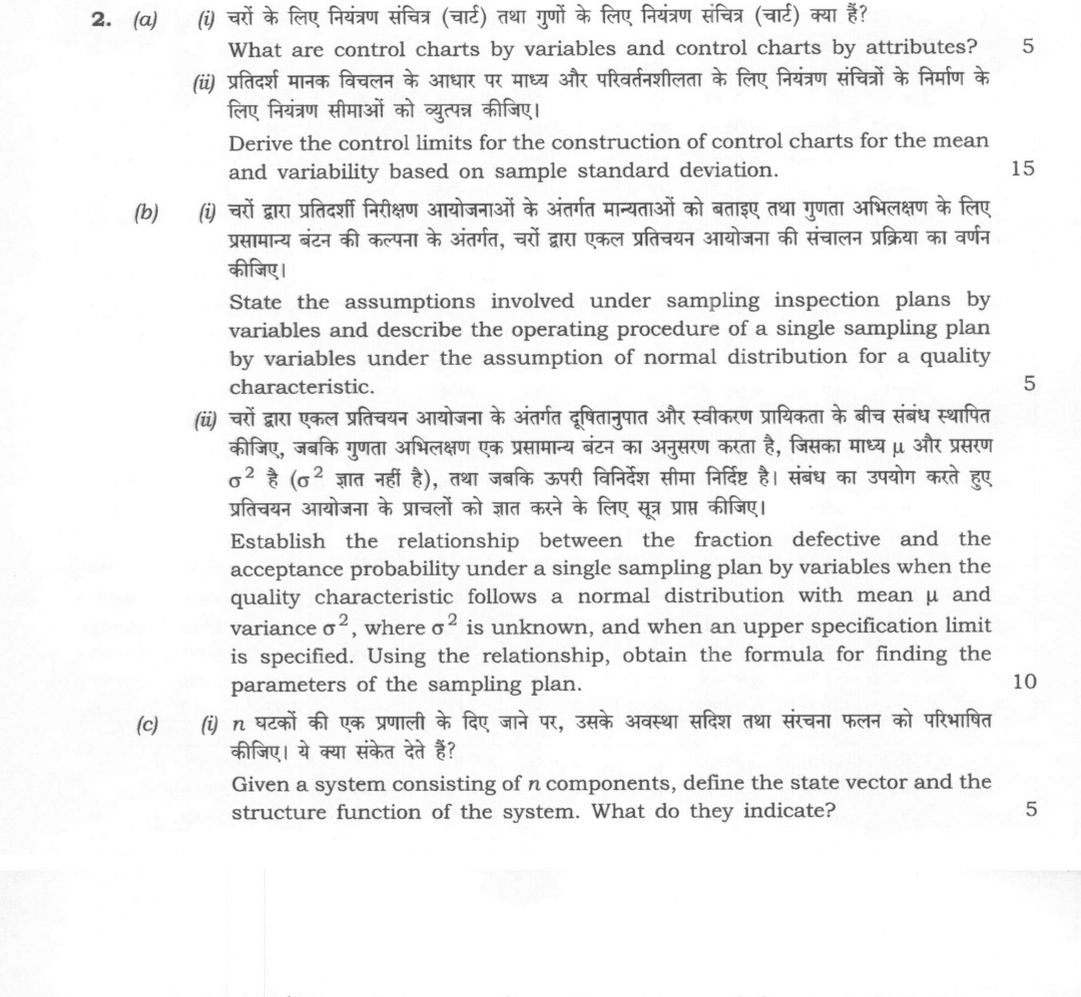
What are control charts by variables and control charts by attributes? 5 marks
Derive the control limits for the construction of control charts for the mean and variability based on sample standard deviation. 15 marks
State the assumptions involved under sampling inspection plans by variables and describe the operating procedure of a single sampling plan by variables under the assumption of normal distribution for a quality characteristic. 5 marks
Establish the relationship between the fraction defective and the acceptance probability under a single sampling plan by variables when the quality characteristic follows a normal distribution with mean μ and variance σ², where σ² is unknown, and when an upper specification limit is specified. Using the relationship, obtain the formula for finding the parameters of the sampling plan. 10 marks
Given a system consisting of n components, define the state vector and the structure function of the system. What do they indicate? 5 marks
Defining (1) a series system, (2) a parallel system and (3) a k-out-of-n system, obtain the associated expressions for the structure functions and the reliability functions. 10 marks
हिंदी में प्रश्न पढ़ें
चरों के लिए नियंत्रण संचित्र (चार्ट) तथा गुणों के लिए नियंत्रण संचित्र (चार्ट) क्या हैं? 5 अंक
प्रतिदर्श मानक विचलन के आधार पर माध्य और परिवर्तनशीलता के लिए नियंत्रण संचित्रों के निर्माण के लिए नियंत्रण सीमाओं को व्युत्पन्न कीजिए। 15 अंक
चरों द्वारा प्रतिदर्शी निरीक्षण आयोजनाओं के अंतर्गत मान्यताओं को बताइए तथा गुणता अभिलक्षण के लिए प्रसामान्य बंटन की कल्पना के अंतर्गत, चरों द्वारा एकल प्रतिचयन आयोजना की संचालन प्रक्रिया का वर्णन कीजिए। 5 अंक
चरों द्वारा एकल प्रतिचयन आयोजना के अंतर्गत दुषितानुपात और स्वीकरण प्रायिकता के बीच संबंध स्थापित कीजिए, जबकि गुणता अभिलक्षण एक प्रसामान्य बंटन का अनुसरण करता है, जिसका माध्य μ और प्रसरण σ² है (σ² ज्ञात नहीं है), तथा जबकि ऊपरी विनिर्देश सीमा निर्दिष्ट है। संबंध का उपयोग करते हुए प्रतिचयन आयोजना के प्राचलों को ज्ञात करने के लिए सूत्र प्राप्त कीजिए। 10 अंक
n घटकों की एक प्रणाली के लिए जाने पर, उसके अवस्था सदिश तथा संरचना फलन को परिभाषित कीजिए। ये क्या संकेत देते हैं? 5 अंक
(1) एक श्रृंखला प्रणाली, (2) एक समांतर प्रणाली तथा (3) एक n-में-से-k प्रणाली को परिभाषित करते हुए संरचना फलनों और विश्वसनीयता फलनों के लिए संबंधित व्यंजकों को प्राप्त कीजिए। 10 अंक
Model answer
Written by UPSC Answer Check against this question's marking rubric, to the expected length. UPSC does not publish answers for Mains — this is one way to score well, not an official key.
(a)(i) A control chart by variables is used when a quality characteristic is measurable on a continuous scale, e.g. length, weight, tensile strength. Samples give numerical values; charts for mean, range or standard deviation are plotted. A control chart by attributes is used when items are classified as conforming/nonconforming or defects are counted; e.g. p, np, c and u charts. Variables charts are more informative but need measurement and often normality; attributes charts are simpler but need larger samples.
(a)(ii) Let X₁,…,Xₙ be a random sample from N(μ,σ²). Define X̄ = (1/n) Σ Xᵢ, S = √[(1/(n−1)) Σ (Xᵢ−X̄)²]. For normal population: X̄ ~ N(μ, σ²/n), E(X̄)=μ, SD(X̄)=σ/√n. Also S is independent of X̄, with E(S)=c₄σ, SD(S)=σ√(1−c₄²), where c₄ = √(2/(n−1)) Γ(n/2)/Γ((n−1)/2).
For 3-sigma limits: limits = mean of statistic ± 3 standard error.
For the mean chart: if σ known, UCL_X̄ = μ + 3σ/√n, LCL_X̄ = μ − 3σ/√n. If unknown, estimate μ by M (grand mean of sample means), and σ by s̄/c₄, where s̄ is average sample standard deviation. Then UCL_X̄ = M + A₃ s̄, LCL_X̄ = M − A₃ s̄, A₃ = 3/(c₄√n).
For the S chart: if σ known, centre line c₄σ, UCL_S = c₄σ + 3σ√(1−c₄²), LCL_S = max(0, c₄σ − 3σ√(1−c₄²)). If unknown, estimate σ by s̄/c₄. Then centre line = s̄, UCL_S = B₄ s̄, LCL_S = max(0, B₃ s̄), B₄ = 1 + (3/c₄)√(1−c₄²), B₃ = 1 − (3/c₄)√(1−c₄²). Validity requires independent normal samples and known sample size n.
(b)(i) Assumptions for variables sampling inspection: the quality characteristic is normally distributed; observations are independent; the lot is homogeneous; measurement error is negligible; σ may be known or unknown; one or two specification limits are prescribed. For a single sampling plan by variables with upper specification U, choose sample size n and acceptance constant k. Draw a random sample of n items. If σ is known, compute X̄ and accept the lot if X̄ ≤ U − k σ/√n, i.e. (U−X̄)/(σ/√n) ≥ k. If σ is unknown, compute X̄ and S and accept if X̄ + kS ≤ U, i.e. (U−X̄)/S ≥ k. For a lower specification L, accept if X̄ ≥ L + k σ/√n (σ known) or X̄ − kS ≥ L (σ unknown). Otherwise reject.
(b)(ii) Let X~N(μ,σ²), upper limit U, σ² unknown. The fraction defective is p = P(X>U) = 1 − Φ((U−μ)/σ). Put z_p = Φ⁻¹(1−p) = (U−μ)/σ.
The plan accepts if X̄ + kS ≤ U, i.e. (U−X̄)/S ≥ k. Define T = √n (U−X̄)/S. Since X̄ ~ N(μ, σ²/n) and (n−1)S²/σ² ~ χ² with n−1 df independently, T follows a noncentral t-distribution with n−1 degrees of freedom and noncentrality parameter δ = √n z_p. Thus P_a(p) = P(T ≥ k√n) = 1 − F(k√n; √n z_p), where F is the noncentral t cdf. This is the required relation.
To determine n and k, specify producer’s risk α at acceptable fraction p₁ and consumer’s risk β at lot tolerance fraction p₂. Solve F(k√n; √n z_p₁) = α, F(k√n; √n z_p₂) = 1 − β, with z_pᵢ = Φ⁻¹(1−pᵢ), i=1,2. The simultaneous solution gives n and k.
(c)(i) For n components, the state vector is x=(x₁,x₂,…,xₙ), where xᵢ=1 if component i works and xᵢ=0 if it fails. The structure function φ(x)=1 if the system works, and φ(x)=0 if it fails. It indicates the system state as a Boolean function of component states. The reliability is R=P(φ(X)=1).
(c)(ii)
- Series system: it works only if all components work. φ(x) = ∏ (i=1 to n) xᵢ = min(x₁,…,xₙ). If components work independently with reliabilities pᵢ, R_s = ∏ (i=1 to n) pᵢ. If identical, R_s = pⁿ.
- Parallel system: it works if at least one component works. φ(x) = 1 − ∏ (i=1 to n) (1−xᵢ) = max(x₁,…,xₙ). Reliability: R_p = 1 − ∏ (i=1 to n) (1−pᵢ). If identical, R_p = 1 − (1−p)ⁿ.
- k-out-of-n system: it works if at least k of n components work. φ(x) = 1 if Σ (i=1 to n) xᵢ ≥ k, else 0. For independent components, R = Σ (j=k to n) Σ over all subsets A of 1,…,n with |A|=j [∏ (i∈A) pᵢ ∏ (i∉A) (1−pᵢ)]. If identical, R = Σ (j=k to n) C(n,j) pʲ (1−p)ⁿ⁻ʲ. Here k=1 gives parallel, k=n gives series.
What "Derive" is asking you to do
Reach the stated expression from a starting relation, justifying every step. The destination is printed in the question, so only the route earns marks, and the assumptions you work under are part of that route.
Structure that answers it
Assumptions and notation defined → starting relation or governing equation → each step with its justification → the required expression → limiting case or boundary check
Where marks are lost
Writing the standard result first and fitting three lines to it, which an examiner reads at a glance. Marks also go on assumptions left unstated — lossless medium, small amplitude, errors independent with zero mean — and on symbols used before they are defined, even when the question says usual notations.
How this answer will be evaluated
Approach
Framework: UPSC Statistics Paper 2. (a(i)) explain: definition/context > points in order > small example > short close | (a(ii)) derive: given > assumptions > stepwise derivation > result > check | (b(i)) describe: define > structure or process in order > labelled diagram > significance | (b(ii)) derive: given > assumptions > stepwise derivation > result > check | (c(i)) define: precise definition > the distinguishing feature > one example | (c(ii)) derive: given > assumptions > stepwise derivation > result > check Full marks: Complete derivations with all steps, correct notation, and clear interpretation.
Key points expected
- Define control charts by variables
- Define control charts by attributes
- Distinguish based on data type (continuous vs discrete)
- State assumptions (normality, independence)
- Derive limits for mean (X-bar chart)
- Derive limits for variability (S chart)
- Show stepwise derivation of constants
- State assumptions (normal distribution)
Evaluation rubric
Each sub-part is marked on its own, against the marks and word limit printed on the paper.
- (a(i)) Define control charts by variables and by attributes. 5 marks
explain— definition/context → points in order → small example → short close
Must cover
- Define control charts by variables
- Define control charts by attributes
- Distinguish based on data type (continuous vs discrete)
Loses marks
- Confusing variables with attributes
- Failing to distinguish the two types
Earns more
- Mention specific chart types (e.g., X-bar, p, c)
Extra mark
- Provide a real-world example for each
- (a(ii)) Derive control limits for mean and variability using sample standard deviation. 15 marks
derive— given → assumptions → stepwise derivation → result → check
Must cover
- State assumptions (normality, independence)
- Derive limits for mean (X-bar chart)
- Derive limits for variability (S chart)
- Show stepwise derivation of constants
Loses marks
- Computation without interpretation
- Unstated assumptions
- Skipping derivation steps
Earns more
- Correct notation for estimator vs parameter
- Clean table of constants
Extra mark
- Mention specific values for A3, B3, B4
- (b(i)) State assumptions and describe operating procedure of single sampling plan by variables. 5 marks
describe— define → structure or process in order → labelled diagram → significance
Must cover
- State assumptions (normal distribution)
- Describe operating procedure in order
- Define quality characteristic
Loses marks
- Unstated assumptions
- Disordered procedure description
Earns more
- Labelled diagram of procedure
Extra mark
- Mention specific sampling plan parameters
- (b(ii)) Establish relationship between fraction defective and acceptance probability; obtain formula for parameters. 10 marks
derive— given → assumptions → stepwise derivation → result → check
Must cover
- Establish relationship for normal distribution
- Handle unknown variance σ²
- Specify upper specification limit
- Derive formula for sampling plan parameters
Loses marks
- Ignoring unknown variance
- Skipping derivation steps
- Computation without interpretation
Earns more
- Correct notation for estimator vs parameter
- Stepwise derivation
Extra mark
- Mention specific parameter values
- (c(i)) Define state vector and structure function; explain what they indicate. 5 marks
define— precise definition → the distinguishing feature → one example
Must cover
- Define state vector
- Define structure function
- Explain what they indicate
Loses marks
- Confusing state vector with structure function
- Failing to explain what they indicate
Earns more
- One example for each
Extra mark
- Mention specific system configuration
- (c(ii)) Define series, parallel, k-out-of-n systems; obtain structure and reliability functions. 10 marks
derive— given → assumptions → stepwise derivation → result → check
Must cover
- Define series system
- Define parallel system
- Define k-out-of-n system
- Derive structure and reliability functions for each
Loses marks
- Skipping derivation steps
- Confusing system types
- Computation without interpretation
Earns more
- Clean table of functions
- Correct notation
Extra mark
- Mention specific reliability values
Practice this exact question
Write your answer and it is marked point by point against the model answer above — what you covered, what you missed, what you got wrong.
Evaluate my answer →More from Statistics 2025 Paper II
- Q1 (a) State the significance of operating characteristic (OC) curves in control chart analy…
- Q2 (a) (i) What are control charts by variables and control charts by attributes? 5 marks (i…
- Q3 (a) A company manufactures 30 items per day. The sale of those items depends upon demand…
- Q4 (a) Solve the game whose payoff matrix is -1 & -2 & 8 7 & 5 & -1 6 & 0 & 12 (15 marks) (b…
- Q5 (a) Explain the multicollinearity problem in a regression model. What are its consequence…