Paper II — Q3
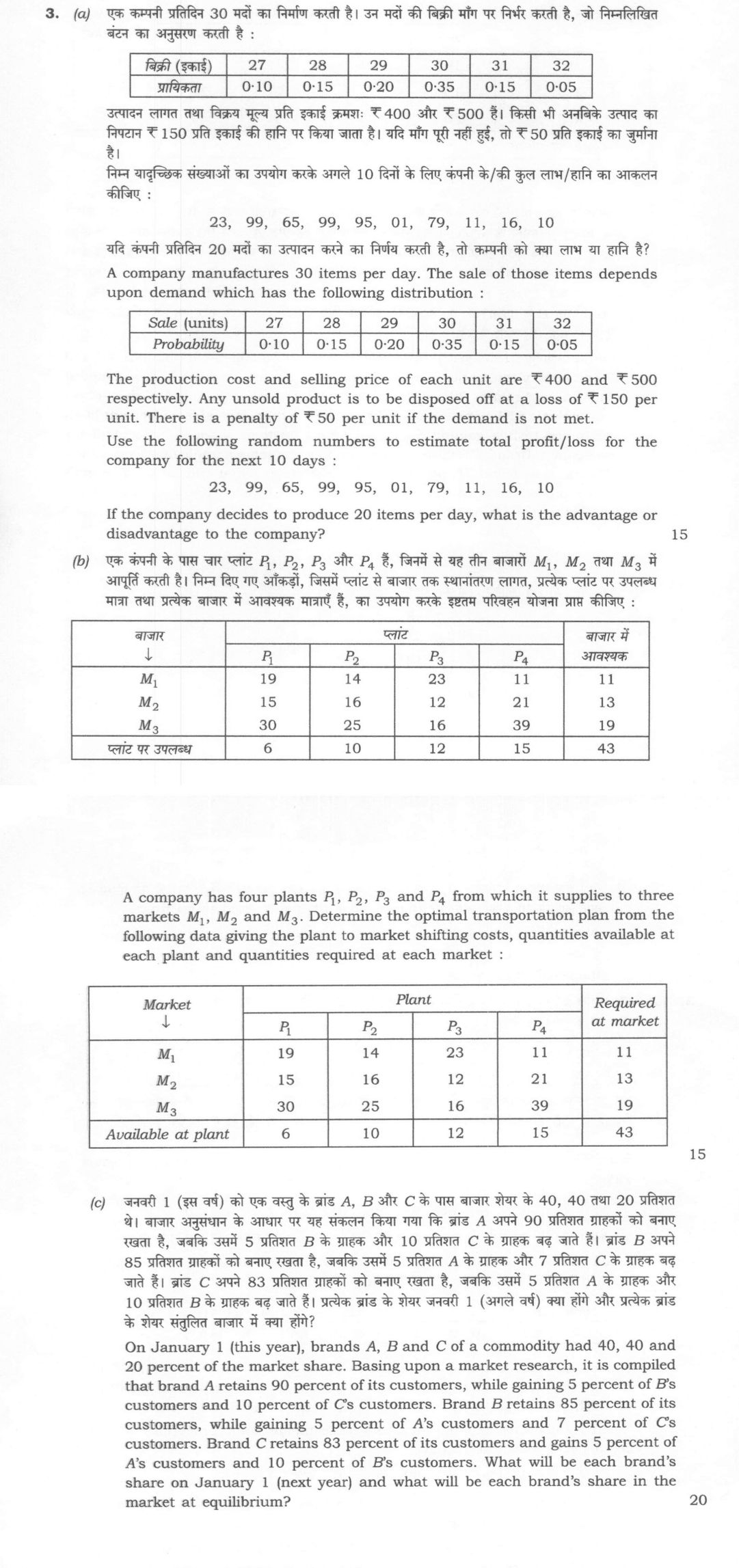
(a) A company manufactures 30 items per day. The sale of those items depends upon demand which has the following distribution…
A company manufactures 30 items per day. The sale of those items depends upon demand which has the following distribution :
| Sale (units) | 27 | 28 | 29 | 30 | 31 | 32 |
|---|---|---|---|---|---|---|
| Probability | 0·10 | 0·15 | 0·20 | 0·35 | 0·15 | 0·05 |
The production cost and selling price of each unit are ₹ 400 and ₹ 500 respectively. Any unsold product is to be disposed off at a loss of ₹ 150 per unit. There is a penalty of ₹ 50 per unit if the demand is not met.
Use the following random numbers to estimate total profit/loss for the company for the next 10 days :
23, 99, 65, 99, 95, 01, 79, 11, 16, 10
If the company decides to produce 20 items per day, what is the advantage or disadvantage to the company? 15 marks
A company has four plants P₁, P₂, P₃ and P₄ from which it supplies to three markets M₁, M₂ and M₃. Determine the optimal transportation plan from the following data giving the plant to market shifting costs, quantities available at each plant and quantities required at each market :
| Market ↓ | P₁ | P₂ | P₃ | P₄ | Required at market |
|---|---|---|---|---|---|
| M₁ | 19 | 14 | 23 | 11 | 11 |
| M₂ | 15 | 16 | 12 | 21 | 13 |
| M₃ | 30 | 25 | 16 | 39 | 19 |
| Available at plant | 6 | 10 | 12 | 15 | 43 |
15 marks
On January 1 (this year), brands A, B and C of a commodity had 40, 40 and 20 percent of the market share. Basing upon a market research, it is compiled that brand A retains 90 percent of its customers, while gaining 5 percent of B's customers and 10 percent of C's customers. Brand B retains 85 percent of its customers, while gaining 5 percent of A's customers and 7 percent of C's customers. Brand C retains 83 percent of its customers and gains 5 percent of A's customers and 10 percent of B's customers. What will be each brand's share on January 1 (next year) and what will be each brand's share in the market at equilibrium? 20 marks
हिंदी में प्रश्न पढ़ें
एक कंपनी प्रतिदिन 30 मदों का निर्माण करती है। उन मदों की बिक्री मांग पर निर्भर करती है, जो निम्नलिखित बंटन का अनुसरण करती है :
| बिक्री (इकाई) | 27 | 28 | 29 | 30 | 31 | 32 |
|---|---|---|---|---|---|---|
| प्रायिकता | 0·10 | 0·15 | 0·20 | 0·35 | 0·15 | 0·05 |
उत्पादन लागत तथा विक्रय मूल्य प्रति इकाई क्रमशः : ₹ 400 और ₹ 500 है। किसी भी अनबिके उत्पाद का निपटान ₹ 150 प्रति इकाई की हानि पर किया जाता है। यदि मांग पूरी नहीं हुई, तो ₹ 50 प्रति इकाई का जुर्माना है।
निम्न यादृच्छिक संख्याओं का उपयोग करके अगले 10 दिनों के लिए कंपनी के/की कुल लाभ/हानि का आकलन कीजिए :
23, 99, 65, 99, 95, 01, 79, 11, 16, 10
यदि कंपनी प्रतिदिन 20 मदों का उत्पादन करने का निर्णय करती है, तो कंपनी को क्या लाभ या हानि है? (15 अंक)
एक कंपनी के पास चार प्लांट P₁, P₂, P₃ और P₄ हैं, जिनमें से यह तीन बाजारों M₁, M₂ तथा M₃ में आपूर्ति करती है। निम्न दिए गए आंकड़ों, जिसमें प्लांट से बाजार तक स्थानांतरण लागत, प्रत्येक प्लांट पर उपलब्ध मात्रा तथा प्रत्येक बाजार में आवश्यक मात्राएं हैं, का उपयोग करके इष्टतम परिवहन योजना प्राप्त कीजिए :
| बाजार ↓ | प्लांट | बाजार में आवश्यक | |||
|---|---|---|---|---|---|
| P₁ | P₂ | P₃ | P₄ | ||
| M₁ | 19 | 14 | 23 | 11 | 11 |
| M₂ | 15 | 16 | 12 | 21 | 13 |
| M₃ | 30 | 25 | 16 | 39 | 19 |
| प्लांट पर उपलब्ध | 6 | 10 | 12 | 15 | 43 |
(15 अंक)
जनवरी 1 (इस वर्ष) को एक वस्तु के ब्रांड A, B और C के पास बाजार शेयर के 40, 40 तथा 20 प्रतिशत थे। बाजार अनुसंधान के आधार पर यह संकलन किया गया कि ब्रांड A अपने 90 प्रतिशत ग्राहकों को बनाए रखता है, जबकि उसमें 5 प्रतिशत B के ग्राहक और 10 प्रतिशत C के ग्राहक बढ़ जाते हैं। ब्रांड B अपने 85 प्रतिशत ग्राहकों को बनाए रखता है, जबकि उसमें 5 प्रतिशत A के ग्राहक और 7 प्रतिशत C के ग्राहक बढ़ जाते हैं। ब्रांड C अपने 83 प्रतिशत ग्राहकों को बनाए रखता है, जबकि उसमें 5 प्रतिशत A के ग्राहक और 10 प्रतिशत B के ग्राहक बढ़ जाते हैं। प्रत्येक ब्रांड के शेयर जनवरी 1 (अगले वर्ष) क्या होंगे और प्रत्येक ब्रांड के शेयर संतुलित बाजार में क्या होंगे? (20 अंक)
Model answer
Written by UPSC Answer Check against this question's marking rubric, to the expected length. UPSC does not publish answers for Mains — this is one way to score well, not an official key.
(a) Using two-digit random numbers from 00 to 99, cumulative intervals are: 27: 00–09, 28: 10–24, 29: 25–44, 30: 45–79, 31: 80–94, 32: 95–99. The given random numbers map to demands: 23→28, 99→32, 65→30, 99→32, 95→32, 01→27, 79→30, 11→28, 16→28, 10→28. Unsold loss ₹150 means salvage value = ₹400−₹150 = ₹250 per unit.
For production Q=30: if D≤30, profit = 500D + 250(30−D) − 400·30 = 250D − 4500. If D>30, profit = 500·30 − 400·30 − 50(D−30) = 4500 − 50D. Daily profits: 28→₹2500, 32→₹2900, 30→₹3000, 32→₹2900, 32→₹2900, 27→₹2250, 30→₹3000, 28→₹2500, 28→₹2500, 28→₹2500. Total profit over 10 days = ₹26,950, average ₹2,695 per day.
For production Q=20, every demand exceeds 20, so profit = 500·20 − 400·20 − 50(D−20) = 3000 − 50D. Daily profits: 28→₹1600, 32→₹1400, 30→₹1500, 32→₹1400, 32→₹1400, 27→₹1650, 30→₹1500, 28→₹1600, 28→₹1600, 28→₹1600. Total = ₹15,250, average ₹1,525 per day.
Advantage of producing 30 instead of 20 = ₹26,950 − ₹15,250 = ₹11,700 over 10 days, i.e. ₹1,170 per day. Hence producing 30 is advantageous.
(b) Let xij be units sent from plant Pi to market Mj. Total supply = 6+10+12+15 = 43, total demand = 11+13+19 = 43, so the problem is balanced. Using VAM followed by MODI, an optimal basic feasible solution is:
P₁→M₂: 6 units; P₂→M₂: 3 units; P₂→M₃: 7 units; P₃→M₃: 12 units; P₄→M₁: 11 units; P₄→M₂: 4 units.
Check supplies: P₁ = 6, P₂ = 3+7 = 10, P₃ = 12, P₄ = 11+4 = 15. Check demands: M₁ = 11, M₂ = 6+3+4 = 13, M₃ = 7+12 = 19.
Minimum cost = 6·15 + 3·16 + 7·25 + 12·16 + 11·11 + 4·21 = 90 + 48 + 175 + 192 + 121 + 84 = ₹710.
MODI check: set u₁=0. From occupied cells, v₂=15, u₄=6, v₁=5, u₂=1, v₃=24, u₃=−8. Reduced costs for non-basic cells: P₁M₁ = 14, P₁M₃ = 6, P₂M₁ = 8, P₃M₁ = 26, P₃M₂ = 5, P₄M₃ = 9, all ≥0. Hence the plan is optimal.
Optimal transportation cost = ₹710.
(c) Let the transition matrix with row order A, B, C be P = [[0·90, 0·05, 0·05]; [0·05, 0·85, 0·10]; [0·10, 0·07, 0·83]]. Initial share π₀ = [0·40, 0·40, 0·20]. Next year’s share π₁ = π₀P:
A = 0·40·0·90 + 0·40·0·05 + 0·20·0·10 = 0·36 + 0·02 + 0·02 = 0·40 = 40%. B = 0·40·0·05 + 0·40·0·85 + 0·20·0·07 = 0·02 + 0·34 + 0·014 = 0·374 = 37·4%. C = 0·40·0·05 + 0·40·0·10 + 0·20·0·83 = 0·02 + 0·04 + 0·166 = 0·226 = 22·6%.
So on January 1 next year: A = 40%, B = 37·4%, C = 22·6%.
For equilibrium, let π = (a, b, c). Solve π = πP and a+b+c = 1. a = 0·90a + 0·05b + 0·10c ⇒ 2a − b − 2c = 0. b = 0·05a + 0·85b + 0·07c ⇒ −5a + 15b − 7c = 0. Solving with a+b+c = 1 gives a = 37/86, b = 24/86, c = 25/86.
Hence equilibrium shares are: A = 37/86 ≈ 43·0233%, B = 24/86 ≈ 27·9070%, C = 25/86 ≈ 29·0698%. This holds if transition probabilities remain constant and no new customers or brands enter.
What "Solve" is asking you to do
Choose the method, then carry it through to a final answer. Identifying what kind of problem this is and why that method applies is the first thing marked; a correct figure arrived at invisibly earns almost nothing.
Structure that answers it
Given data and what is required → method chosen, with the reason it applies → set-up (equation, circuit, free body, trial balance) → working, step by step → answer with units and any condition of validity
Where marks are lost
Doing the middle steps mentally and writing only the result. In mathematics papers, a further loss comes from giving a decimal where the exact value in surds or fractions was wanted, or from skipping the justification a part explicitly asks for.
How this answer will be evaluated
Approach
(a) calculate: given > formula > substitution > result with units > interpretation | (b) calculate: given > formula > substitution > result with units > interpretation | (c) calculate: given > formula > substitution > result with units > interpretation Full marks: Accurate calculations, clear presentation, and correct interpretation of results for all parts.
Key points expected
- Map random numbers to demand using cumulative probabilities
- Calculate profit/loss for each of the 10 days
- Sum total profit/loss for the 10-day period
- Calculate profit/loss for 20 units/day and compare
- Find an initial feasible solution (e.g., Vogel's or NW Corner)
- Perform optimality test (MODI or Stepping Stone method)
- Iterate until optimal solution is reached
- State the final allocation and total transportation cost
Evaluation rubric
Each sub-part is marked on its own, against the marks and word limit printed on the paper.
- (a) Estimate 10-day profit/loss via simulation and compare with 20-unit production. 15 marks
calculate— given → formula → substitution → result with units → interpretation
Must cover
- Map random numbers to demand using cumulative probabilities
- Calculate profit/loss for each of the 10 days
- Sum total profit/loss for the 10-day period
- Calculate profit/loss for 20 units/day and compare
Loses marks
- Incorrect mapping of random numbers to demand levels
- Omission of penalty or disposal cost in calculation
- Failure to compare the 20-unit scenario with the 30-unit scenario
Earns more
- Clean table showing random number to demand mapping
- Explicit calculation of penalty for unmet demand
- Explicit calculation of loss for unsold stock
Extra mark
- Correct identification of the specific demand for each random number
- (b) Determine the optimal transportation plan and total cost. 15 marks
calculate— given → formula → substitution → result with units → interpretation
Must cover
- Find an initial feasible solution (e.g., Vogel's or NW Corner)
- Perform optimality test (MODI or Stepping Stone method)
- Iterate until optimal solution is reached
- State the final allocation and total transportation cost
Loses marks
- Failure to perform the optimality test
- Arithmetic errors in cost calculation
- Incorrect allocation that violates supply/demand constraints
Earns more
- Correct application of the chosen initial solution method
- Clear presentation of the final allocation table
- Accurate calculation of the total cost
Extra mark
- Correct identification of the optimal cells in the final table
- (c) Calculate next year's market share and the equilibrium market share. 20 marks
calculate— given → formula → substitution → result with units → interpretation
Must cover
- Construct the transition probability matrix correctly
- Calculate the market share vector for the next year
- Set up the equilibrium equations (P = P * T)
- Solve for the equilibrium market share vector
Loses marks
- Incorrect transition matrix (e.g., rows/columns transposed)
- Failure to solve for the equilibrium state
- Arithmetic errors in the matrix multiplication
Earns more
- Correct construction of the transition matrix
- Clear step-by-step calculation for the next year's share
- Correct solution of the equilibrium equations
Extra mark
- Verification that the equilibrium shares sum to 1
Practice this exact question
Write your answer and it is marked point by point against the model answer above — what you covered, what you missed, what you got wrong.
Evaluate my answer →More from Statistics 2025 Paper II
- Q1 (a) State the significance of operating characteristic (OC) curves in control chart analy…
- Q2 (a) (i) What are control charts by variables and control charts by attributes? 5 marks (i…
- Q3 (a) A company manufactures 30 items per day. The sale of those items depends upon demand…
- Q4 (a) Solve the game whose payoff matrix is -1 & -2 & 8 7 & 5 & -1 6 & 0 & 12 (15 marks) (b…
- Q5 (a) Explain the multicollinearity problem in a regression model. What are its consequence…
- Q6 (a) On the basis of the figures given below, calculate the age-specific death rates (ASDR…