Paper II — Q4
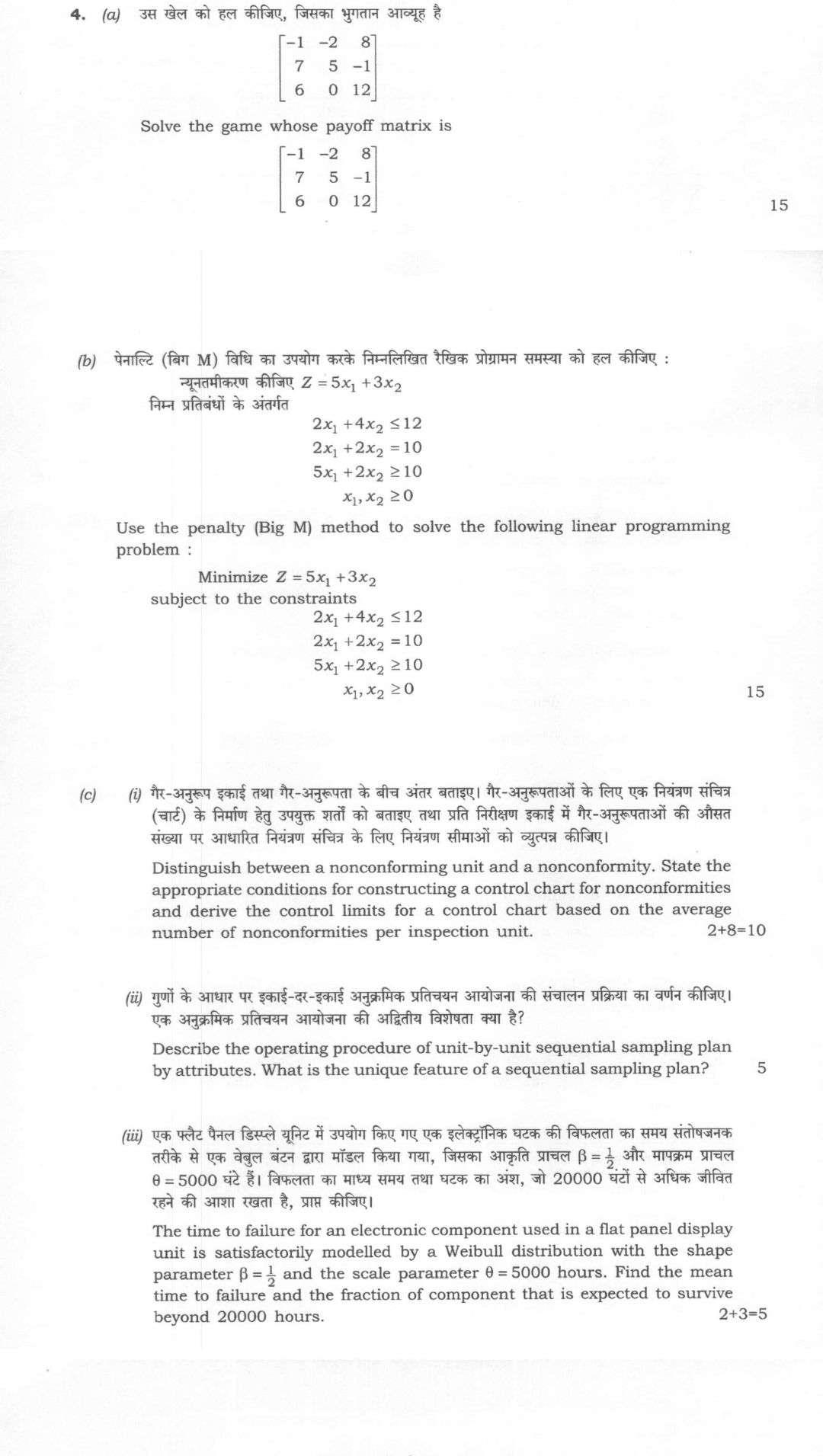
(a) Solve the game whose payoff matrix is -1 & -2 & 8 7 & 5 & -1 6 & 0 & 12 (15 marks) (b) Use the penalty (Big M) method…
Solve the game whose payoff matrix is
-1 & -2 & 8 7 & 5 & -1 6 & 0 & 12
15 marks
Use the penalty (Big M) method to solve the following linear programming problem :
Minimize Z = 5x₁ + 3x₂
subject to the constraints
2x₁ + 4x₂ ≤ 12 2x₁ + 2x₂ = 10 5x₁ + 2x₂ ≥ 10 x₁, x₂ ≥ 0
15 marks
Distinguish between a nonconforming unit and a nonconformity. State the appropriate conditions for constructing a control chart for nonconformities and derive the control limits for a control chart based on the average number of nonconformities per inspection unit. (2+8=10 marks)
Describe the operating procedure of unit-by-unit sequential sampling plan by attributes. What is the unique feature of a sequential sampling plan? 5 marks
The time to failure for an electronic component used in a flat panel display unit is satisfactorily modelled by a Weibull distribution with the shape parameter β = ½ and the scale parameter θ = 5000 hours. Find the mean time to failure and the fraction of component that is expected to survive beyond 20000 hours. (2+3=5 marks)
हिंदी में प्रश्न पढ़ें
उस खेल को हल कीजिए, जिसका भुगतान आव्यूह है
-1 & -2 & 8 7 & 5 & -1 6 & 0 & 12
(15 अंक)
पेनाल्टी (बिग M) विधि का उपयोग करके निम्नलिखित रैखिक प्रोग्रामन समस्या को हल कीजिए :
न्यूनतमीकरण कीजिए, Z = 5x₁ + 3x₂
निम्न प्रतिबंधों के अंतर्गत
2x₁ + 4x₂ ≤ 12 2x₁ + 2x₂ = 10 5x₁ + 2x₂ ≥ 10 x₁, x₂ ≥ 0
(15 अंक)
गैर-अनुकूल इकाई तथा गैर-अनुकूलता के बीच अंतर बताइए। गैर-अनुकूलताओं के लिए एक नियंत्रण संचित्र (चार्ट) के निर्माण हेतु उपयुक्त शर्तों को बताइए तथा प्रति निरीक्षण इकाई में गैर-अनुकूलताओं की औसत संख्या पर आधारित नियंत्रण संचित्र के लिए नियंत्रण सीमाओं को न्यूनतम कीजिए। (2+8=10 अंक)
गुणों के आधार पर इकाई-दर-इकाई अनुक्रमिक प्रतिचयन आयोजना की संचालन प्रक्रिया का वर्णन कीजिए। एक अनुक्रमिक प्रतिचयन आयोजना की अद्वितीय विशेषता क्या है? (5 अंक)
एक फ्लैट पैनल डिस्प्ले यूनिट में उपयोग किए गए एक इलेक्ट्रॉनिक घटक की विफलता का समय संतोषजनक तरीके से एक वेबुल बंटन द्वारा मॉडल किया गया, जिसका आकृति प्राचल β = ½ और मापक्रम प्राचल θ = 5000 घंटे हैं। विफलता का माध्य समय तथा घटक का अंश, जो 20000 घंटों से अधिक जीवित रहने की आशा रखता है, प्राप्त कीजिए। (2+3=5 अंक)
Model answer
Written by UPSC Answer Check against this question's marking rubric, to the expected length. UPSC does not publish answers for Mains — this is one way to score well, not an official key.
(a) Let the row player be the maximizer. Row minima are −2, −1, 0, so maximin = 0. Column maxima are 7, 5, 12, so minimax = 5. No saddle point.
Column 2 dominates column 1 because −2 < −1, 5 < 7, 0 < 6. Row 3 dominates row 1 because 6 > −1, 0 > −2, 12 > 8. The reduced game is
R2: 5, −1 R3: 0, 12
Let row player use R2 with probability p and R3 with probability 1−p. Equating payoffs against column 2 and column 3:
5p = −p + 12(1−p) 5p = 12 − 13p 18p = 12 p = 2/3.
Thus row strategy = (0, 2/3, 1/3), and value v = 5(2/3) = 10/3.
Let column player use column 2 with probability q and column 3 with probability 1−q. Equating payoffs against rows 2 and 3:
5q − 1(1−q) = 0q + 12(1−q) 6q − 1 = 12 − 12q 18q = 13 q = 13/18.
Thus column strategy = (0, 13/18, 5/18). Value v = 10/3.
Final: optimal strategies (0, 2/3, 1/3) and (0, 13/18, 5/18); value = 10/3.
(b) Use Big M method. For minimization, penalise artificial variables by +M. Add slack s₁, surplus s₂ and artificials a₁, a₂:
2x₁ + 4x₂ + s₁ = 12 2x₁ + 2x₂ + a₁ = 10 5x₁ + 2x₂ − s₂ + a₂ = 10
Minimize Z = 5x₁ + 3x₂ + M a₁ + M a₂, M very large.
Initial basis: s₁ = 12, a₁ = 10, a₂ = 10. With M large, x₁ enters; minimum ratio min(12/2, 10/2, 10/5) = 2, so a₂ leaves. After pivot:
(16/5)x₂ + s₁ + (2/5)s₂ − (2/5)a₂ = 8 (6/5)x₂ + (2/5)s₂ + a₁ − (2/5)a₂ = 6 x₁ + (2/5)x₂ − (1/5)s₂ + (1/5)a₂ = 2
Next x₂ enters; minimum ratio is 8/(16/5) = 5/2, so s₁ leaves. After pivot:
x₂ + (5/16)s₁ + (1/8)s₂ − (1/8)a₂ = 5/2 −(3/8)s₁ + (1/4)s₂ + a₁ − (1/4)a₂ = 3 x₁ − (1/8)s₁ − (1/4)s₂ + (1/4)a₂ = 1
Next s₂ enters; minimum ratio is 3/(1/4) = 12, so a₁ leaves. Final tableau:
x₂ + (1/2)s₁ − (1/2)a₁ = 1 s₂ − (3/2)s₁ + 4a₁ − a₂ = 12 x₁ − (1/2)s₁ + a₁ = 4
At optimum, artificials and nonbasic variables are zero: x₁ = 4, x₂ = 1. Check constraints:
2(4) + 4(1) = 12, 2(4) + 2(1) = 10, 5(4) + 2(1) = 22 ≥ 10.
Objective: Z = 5(4) + 3(1) = 23.
Final: x₁ = 4, x₂ = 1, minimum Z = 23.
(c)(i) A nonconforming unit is an entire unit that fails to satisfy one or more specified requirements. A nonconformity is a single departure from a specified requirement; one nonconforming unit may contain several nonconformities.
For a control chart for nonconformities, assume the number of nonconformities in an inspection unit follows a Poisson distribution, nonconformities occur independently, the opportunity for nonconformities is constant, and the inspection unit is fixed or its sample size is known. If c is the number of nonconformities in a sample of n inspection units, then c ~ Poisson(nλ). The average number per unit is u = c/n, with E(u) = λ and Var(u) = λ/n. Estimating λ by ū, the three-sigma limits are:
UCL = ū + 3√(ū/n), CL = ū, LCL = ū − 3√(ū/n), taking LCL = 0 if negative.
If n = 1, this reduces to the c-chart: UCL = c̄ + 3√c̄, CL = c̄, LCL = c̄ − 3√c̄, with LCL = 0 if negative.
(c)(ii) In a unit-by-unit sequential sampling plan by attributes, inspect units one by one and classify each as conforming or nonconforming. Let p₁ be AQL, p₂ be LTPD, with p₂ > p₁; let α and β be producer’s and consumer’s risks. After m units, let D_m be the cumulative number of nonconforming units. Define
den = ln[p₂(1−p₁)/(p₁(1−p₂))], s = ln[(1−p₁)/(1−p₂)] / den, h₁ = ln[(1−α)/β] / den, h₂ = ln[(1−β)/α] / den.
Accept if D_m ≤ s m − h₁. Reject if D_m ≥ s m + h₂. Continue sampling if s m − h₁ < D_m < s m + h₂.
Its unique feature is that the sample size is not fixed in advance; it is a random variable determined by the observations. It often requires fewer units on average than a comparable fixed-sample plan for the same α and β.
(c)(iii) For a Weibull distribution with shape β and scale θ,
Mean = θ Γ(1 + 1/β).
Given β = 1/2, θ = 5000 hours:
Mean = 5000 Γ(1 + 2) = 5000 Γ(3) = 5000 × 2 = 10000 hours.
Survival function:
S(t) = exp[−(t/θ)^β].
For t = 20000 hours:
S(20000) = exp[−(20000/5000)^(1/2)] = exp[−4^(1/2)] = exp(−2) = e⁻² ≈ 0.1353.
Final: mean time to failure = 10000 hours; fraction surviving beyond 20000 hours = e⁻² ≈ 0.1353, i.e. 13.53%.
What "Solve" is asking you to do
Choose the method, then carry it through to a final answer. Identifying what kind of problem this is and why that method applies is the first thing marked; a correct figure arrived at invisibly earns almost nothing.
Structure that answers it
Given data and what is required → method chosen, with the reason it applies → set-up (equation, circuit, free body, trial balance) → working, step by step → answer with units and any condition of validity
Where marks are lost
Doing the middle steps mentally and writing only the result. In mathematics papers, a further loss comes from giving a decimal where the exact value in surds or fractions was wanted, or from skipping the justification a part explicitly asks for.
How this answer will be evaluated
Approach
Framework: Game Theory (Matrix Games) & Linear Programming (Big M Method). (a) explain: Saddle point check > Reduction to LPP > Simplex solution > Strategy & Value | (b) explain: Standardization > Initial Basis > Big M Iterations > Optimal Solution | (c) explain: Definitions & Conditions > Derivation of Limits > Sequential Plan Procedure > Weibull Calculations Full marks: Flawless derivations, correct LPP setups, precise definitions, and accurate Weibull calculations.
Key points expected
- Saddle point check for 3x3 game
- Big M method for mixed constraints
- c-chart control limits derivation
- Weibull mean = θΓ(1+1/β)
Evaluation rubric
Each sub-part is marked on its own, against the marks and word limit printed on the paper.
- (a) Determine optimal strategies and game value via LPP reduction. 15 marks
explain— Saddle point check → Reduction to LPP → Simplex solution → Strategy & Value
Must cover
- Check for saddle point (row min/col max)
- Formulate LPP for Player A (minimize 1/x)
- Solve LPP using Simplex method
- State optimal strategies and game value
Loses marks
- Assuming saddle point exists without checking
- Arithmetic errors in simplex iterations
Earns more
- Correct handling of negative payoff (adding constant)
- Clean simplex tableaus
Extra mark
- Verification of solution via expected payoff calculation
- (b) Solve LPP using Big M method with correct variable setup. 15 marks
explain— Standardization → Initial Basis → Big M Iterations → Optimal Solution
Must cover
- Convert constraints to standard form (slack/surplus/artificial)
- Formulate objective function with Big M penalties
- Perform simplex iterations to remove artificial variables
- State optimal values for x1, x2 and Z
Loses marks
- Forgetting to subtract M for artificial variables in minimization
- Stopping before artificial variables are removed
Earns more
- Correct identification of initial basic feasible solution
- Clear tableau presentation
Extra mark
- Graphical verification of the optimal point
- (c) Define terms, derive c-chart limits, describe sequential plan, solve Weibull.
explain— Definitions & Conditions → Derivation of Limits → Sequential Plan Procedure → Weibull Calculations
Must cover
- Distinguish nonconforming unit vs nonconformity
- Derive c-chart limits (c-bar ± 3√c-bar)
- Describe unit-by-unit sequential sampling procedure
- Calculate Weibull MTTF and survival fraction
Loses marks
- Using p-chart formulas for nonconformities
- Incorrect integration for Weibull mean
Earns more
- Explicit statement of Poisson distribution assumption
- Correct use of Weibull CDF/SF formulas
Extra mark
- Mention of OC curve for sequential plan
Practice this exact question
Write your answer and it is marked point by point against the model answer above — what you covered, what you missed, what you got wrong.
Evaluate my answer →More from Statistics 2025 Paper II
- Q1 (a) State the significance of operating characteristic (OC) curves in control chart analy…
- Q2 (a) (i) What are control charts by variables and control charts by attributes? 5 marks (i…
- Q3 (a) A company manufactures 30 items per day. The sale of those items depends upon demand…
- Q4 (a) Solve the game whose payoff matrix is -1 & -2 & 8 7 & 5 & -1 6 & 0 & 12 (15 marks) (b…
- Q5 (a) Explain the multicollinearity problem in a regression model. What are its consequence…
- Q6 (a) On the basis of the figures given below, calculate the age-specific death rates (ASDR…
- Q7 (a) Explain the concept of index number. Calculate the Fisher's ideal index number from t…