Paper II — Q8
(a) Define time series. For a moving-average process with weights {a₁, a₂, ..., aₘ} of random components {eᵢ, i = 1, 2, ...}…
Define time series. For a moving-average process with weights {a₁, a₂, ..., aₘ} of random components {eᵢ, i = 1, 2, ...}, where eᵢ's are i.i.d. N(0, σ²), obtain the correlogram function. Find its form, when all the weights are equal and their sum is 1. 15 marks
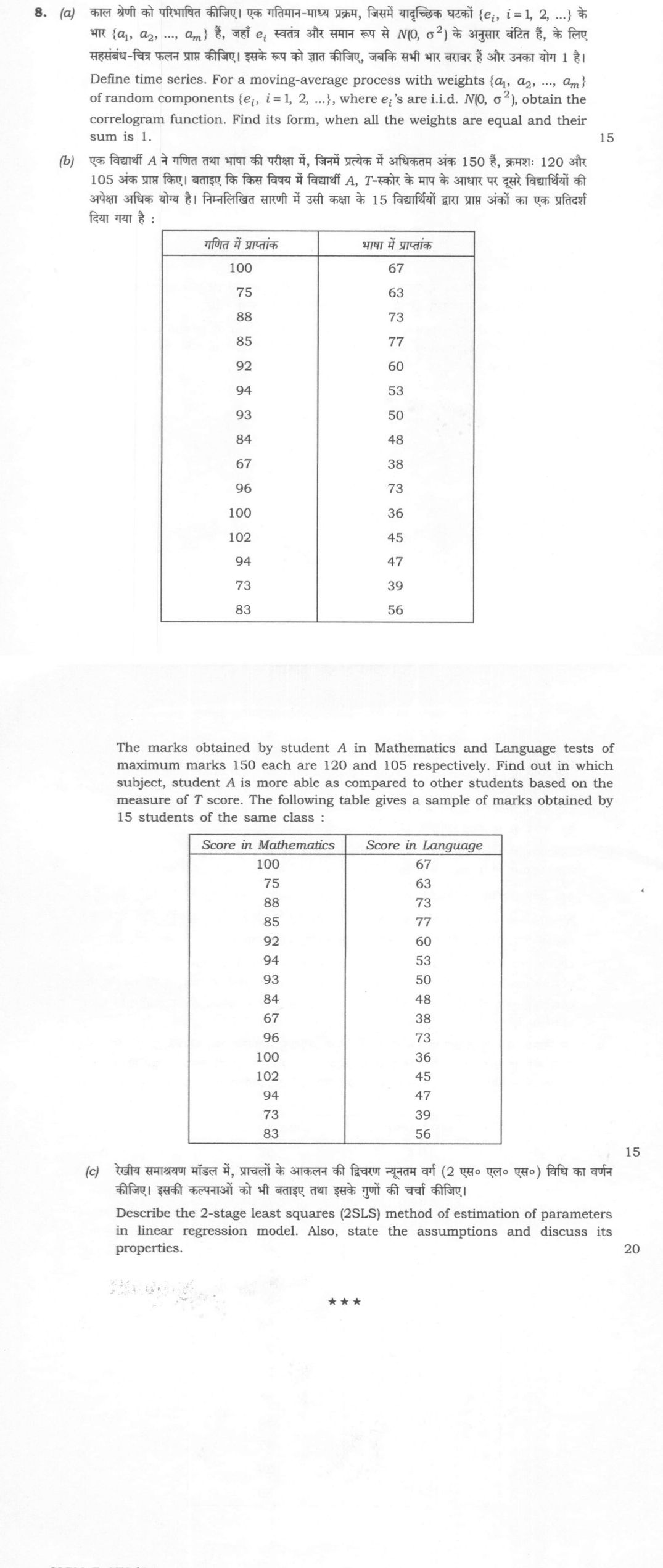
The marks obtained by student A in Mathematics and Language tests of maximum marks 150 each are 120 and 105 respectively. Find out in which subject, student A is more able as compared to other students based on the measure of T score. The following table gives a sample of marks obtained by 15 students of the same class :
Score in Mathematics | Score in Language ---|--- 100 | 67 75 | 63 88 | 73 85 | 77 92 | 60 94 | 53 93 | 50 84 | 48 67 | 38 96 | 73 100 | 36 102 | 45 94 | 47 73 | 39 83 | 56
15 marks
Describe the 2-stage least squares (2SLS) method of estimation of parameters in linear regression model. Also, state the assumptions and discuss its properties. 20 marks
हिंदी में प्रश्न पढ़ें
काल श्रेणी को परिभाषित कीजिए। एक गतिमान-माध्य प्रक्रम, जिसमें यादृच्छिक घटकों {eᵢ, i = 1, 2, ...} के भार {a₁, a₂, ..., aₘ} हैं, जहाँ eᵢ स्वतंत्र और समान रूप से N(0, σ²) के अनुसार बंटित हैं, के लिए सहसंबंध-चित्र फलन प्राप्त कीजिए। इसके रूप को ज्ञात कीजिए, जबकि सभी भार बराबर हैं और उनका योग 1 है। (15 अंक)
एक विद्यार्थी A ने गणित तथा भाषा की परीक्षा में, जिनमें प्रत्येक में अधिकतम अंक 150 हैं, क्रमशः 120 और 105 अंक प्राप्त किए। बताइए कि किस विषय में विद्यार्थी A, T-स्कोर के माप के आधार पर दूसरे विद्यार्थियों की अपेक्षा अधिक योग्य है। निम्नलिखित सारणी में उसी कक्षा के 15 विद्यार्थियों द्वारा प्राप्त अंकों का एक प्रतिदर्श दिया गया है :
| गणित में प्राप्तांक | भाषा में प्राप्तांक |
|---|---|
| 100 | 67 |
| 75 | 63 |
| 88 | 73 |
| 85 | 77 |
| 92 | 60 |
| 94 | 53 |
| 93 | 50 |
| 84 | 48 |
| 67 | 38 |
| 96 | 73 |
| 100 | 36 |
| 102 | 45 |
| 94 | 47 |
| 73 | 39 |
| 83 | 56 |
(15 अंक)
रैखीय समाश्रयण मॉडल में, प्राचलों के आकलन की द्विचरण न्यूनतम वर्ग (2 एस० एल० एस०) विधि का वर्णन कीजिए। इसकी कल्पनाओं को भी बताइए तथा इसके गुणों की चर्चा कीजिए। (20 अंक)
The figure this question refers to, in words
The question paper is a scan and the diagram did not survive as text. This is the figure as read from the original page — every component, value and label — so the question can be worked from the text below.
(b) Table with two columns: 'Score in Mathematics' and 'Score in Language'. Rows: 100, 67 75, 63 88, 73 85, 77 92, 60 94, 53 93, 50 84, 48 67, 38 96, 73 100, 36 102, 45 94, 47 73, 39 83, 56
Model answer
Written by UPSC Answer Check against this question's marking rubric, to the expected length. UPSC does not publish answers for Mains — this is one way to score well, not an official key.
(a) Time series and MA correlogram. A time series is an ordered sequence of random variables Yₜ, t=1,2,... observed over successive time points, whose joint distribution may exhibit dependence, trend and seasonality. It is analysed through its mean function, autocovariance function and correlogram. For an MA(m) process generated by iid N(0,σ²) shocks eₜ, write Yₜ = a₁ eₜ + a₂ eₜ₋₁+...+aₘ eₜ₋ₘ₊₁. Its mean is zero and autocovariance at lag k is γ(k)=Cov(Yₜ,Yₜ₊ₖ)=σ²∑ᵢ₌₁^m-k aᵢ aᵢ₊ₖ, for k=0,...,m-1; by symmetry γ(-k)=γ(k), and γ(k)=0 for |k|≥m because the moving-average window has finite length. The process is weakly stationary because its mean is constant and its autocovariance depends only on the lag. The normality of the shocks gives joint normality of the series, but the correlogram depends only on these second moments. The correlogram is ρ(k)=γ(k)/γ(0), so it has the same truncated triangular shape. If all weights are equal and sum to one, aᵢ=1/m, then γ(k)=σ²(m-k)/m² and γ(0)=σ²/m; hence ρ(k)=(m-|k|)/m for |k|<m and ρ(k)=0 for |k|≥m.
(b) T-score comparison. For the 15 students, the Mathematics scores sum to 1326, giving x̄_M=88.4; the Language scores sum to 825, giving x̄_L=55.0. The squared deviations sum to 1543.6 for Mathematics and 2514 for Language. Using the sample standard deviations, s_M=(1543.6/14)¹/2≈10.50 and s_L=(2514/14)¹/2≈13.40. The T-score is T=50+10(X−x̄)/s, which places the class mean at 50 and one standard deviation at 10. For student A, T_M=50+10(120−88.4)/10.50≈80.1, and T_L=50+10(105−55)/13.40≈87.3. If the class is treated as the population, the corresponding standard deviations are 10.14 and 12.95, giving T_M≈81.2 and T_L≈88.6. In either convention, A’s T-score is higher in Language, so A is relatively more able in Language compared with classmates, even though the absolute Mathematics mark is larger and the maximum marks in both subjects are the same.
(c) 2SLS. In a linear structural equation y=Xβ+u, some regressors in X may be endogenous because they are jointly determined with u. Let Z be a matrix of valid instruments, including all exogenous variables. 2SLS proceeds in two stages. First, each endogenous regressor is regressed on Z to obtain fitted values X̂=P_Z X, where P_Z=Z(Z'Z)⁻¹Z' is the projection matrix on the instrument space. This first stage is the reduced-form projection that replaces endogenous regressors with the part explained by instruments. Second, y is regressed on X̂; the estimator is β̂_2SLS=(X'P_Z X)⁻¹X'P_Z y. It is an IV estimator; when all regressors are exogenous, P_Z X = X and 2SLS reduces to OLS. The key assumptions are linearity in parameters; instrument exogeneity E(Z'u)=0; relevance, meaning E(Z'X) has full column rank so endogenous regressors are predicted with non-zero variation; no perfect multicollinearity among instruments; and finite moments sufficient for the central limit theorem. Under these assumptions, by the law of large numbers, plim β̂_2SLS=β because plim X'P_Z X/n converges to a positive definite matrix and plim X'P_Z u/n=0, so the probability limit of the normal equations is Qβ=0. By the continuous mapping theorem and a central limit theorem, √n(β̂_2SLS−β)→N(0,σ²Q⁻¹), where Q=plim(X'P_Z X/n). If σ² is estimated, it should be computed from the original structural residuals uᵢ=yᵢ−xᵢ'β̂_2SLS, not from the second-stage fitted residuals, to preserve the correct variance estimate. OLS is inconsistent when regressors are endogenous because plim X'u/n≠0; 2SLS removes this bias by replacing endogenous regressors with their instrument-based projections. In simultaneous-equation systems, 2SLS is applied equation by equation using instruments that are correlated with endogenous regressors but uncorrelated with the structural disturbance. In Indian agricultural policy, for example, supply response to output price may be endogenous because price and quantity are jointly determined; rainfall or transport cost can serve as instruments for price, making 2SLS useful for estimating causal supply elasticities.
What "Describe" is asking you to do
Give a full, ordered account of the thing named — its parts, stages or mechanism — in the sequence in which it actually exists or occurs. Most describe questions come from the science optionals, where the marks sit in correct technical detail and, where the stem says so, a labelled diagram.
Structure that answers it
One-line identification of the subject → the parts or stages in their real order, each with its defining detail → labelled diagram where the subject is structural → closing line on function or significance
Where marks are lost
Loose general prose where the examiner is ticking named parts, correct terminology and their sequence; and in the General Studies papers, turning to evaluation before the description is finished.
How this answer will be evaluated
Approach
Framework: UPSC Statistics Paper 2. (a) derive: given > assumptions > stepwise derivation > result > check | (b) calculate: given > formula > substitution > result with units > interpretation | (c) describe: define > structure or process in order > labelled diagram > significance Full marks: Rigorous derivations, accurate computations with interpretation, and comprehensive theoretical discussion.
Key points expected
- Define time series as sequence of observations over time
- State MA(m) model equation with weights and white noise
- Derive autocovariance function γ(k) for lag k
- Show correlogram is zero for lags greater than m
- Calculate mean and standard deviation for Mathematics
- Calculate mean and standard deviation for Language
- Compute T-score for student A in both subjects
- Compare T-scores to determine the subject of higher ability
Evaluation rubric
Each sub-part is marked on its own, against the marks and word limit printed on the paper.
- (a) Definition of time series and derivation of correlogram for MA process. 15 marks
derive— given → assumptions → stepwise derivation → result → check
Must cover
- Define time series as sequence of observations over time
- State MA(m) model equation with weights and white noise
- Derive autocovariance function γ(k) for lag k
- Show correlogram is zero for lags greater than m
Loses marks
- Failing to define time series before derivation
- Incorrect formula for autocovariance at lag k
- Not addressing the specific case of equal weights
Earns more
- Explicitly state i.i.d. N(0, σ²) assumption
- Calculate specific form for equal weights summing to 1
- Show step-by-step substitution in covariance formula
Extra mark
- Mention stationarity condition for MA process
- (b) Compute T-scores for Mathematics and Language to compare student ability. 15 marks
calculate— given → formula → substitution → result with units → interpretation
Must cover
- Calculate mean and standard deviation for Mathematics
- Calculate mean and standard deviation for Language
- Compute T-score for student A in both subjects
- Compare T-scores to determine the subject of higher ability
Loses marks
- Using raw marks for comparison instead of T-scores
- Calculation errors in mean or standard deviation
- Failing to state which subject is better based on the result
Earns more
- Show the T-score formula (50 + 10Z) explicitly
- Present calculations in a clear, organized table
- Interpret the final T-scores in context of class performance
Extra mark
- Mention that T-scores allow comparison across different scales
- (c) Explain the 2SLS method, its assumptions, and properties. 20 marks
describe— define → structure or process in order → labelled diagram → significance
Must cover
- Describe the two stages of the 2SLS estimation process
- State the condition of endogeneity that necessitates 2SLS
- List the key assumptions (exogeneity of instruments, rank condition)
- Discuss properties like consistency and asymptotic normality
Loses marks
- Confusing 2SLS with OLS or GMM
- Failing to mention the exogeneity of instruments
- Vague description of the 'two stages' without technical detail
Earns more
- Explain the role of instrumental variables in the first stage
- Mention the difference between 2SLS and OLS in this context
- Discuss the finite sample bias of 2SLS
Extra mark
- Provide a simple example of an endogenous variable
- Mention the Hausman test for endogeneity
Practice this exact question
Write your answer and it is marked point by point against the model answer above — what you covered, what you missed, what you got wrong.
Evaluate my answer →More from Statistics 2025 Paper II
- Q5 (a) Explain the multicollinearity problem in a regression model. What are its consequence…
- Q6 (a) On the basis of the figures given below, calculate the age-specific death rates (ASDR…
- Q7 (a) Explain the concept of index number. Calculate the Fisher's ideal index number from t…
- Q8 (a) Define time series. For a moving-average process with weights {a₁, a₂, ..., aₘ} of ra…