Paper II — Q7
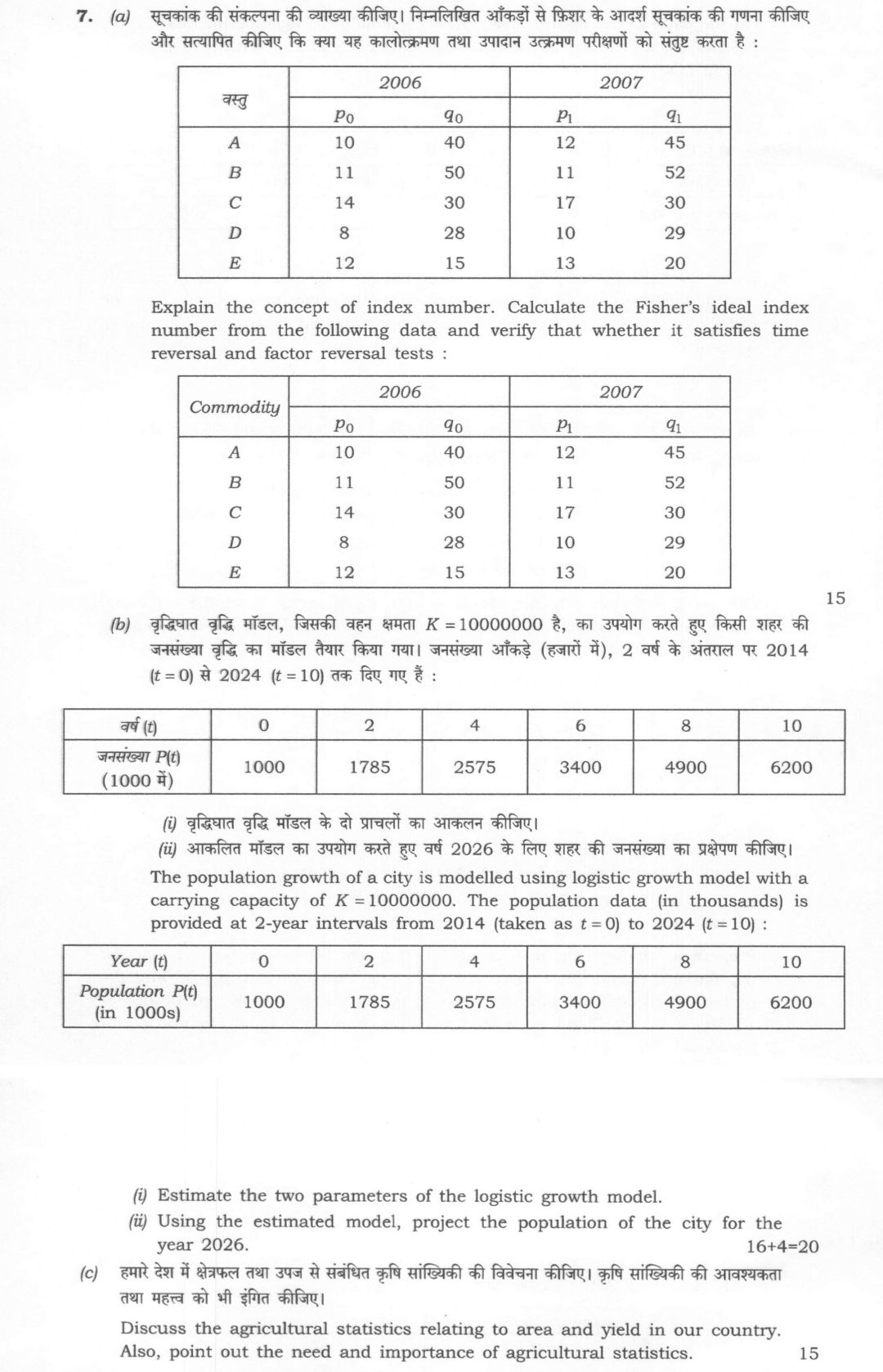
(a) Explain the concept of index number. Calculate the Fisher's ideal index number from the following data and verify that…
Explain the concept of index number. Calculate the Fisher's ideal index number from the following data and verify that whether it satisfies time reversal and factor reversal tests : 10 marks
The population growth of a city is modelled using logistic growth model with a carrying capacity of K = 10000000. The population data (in thousands) is provided at 2-year intervals from 2014 (taken as t = 0) to 2024 (t = 10) : Estimate the two parameters of the logistic growth model. 16 marks
Using the estimated model, predict the population of the city for the year 2026. (4 marks) (16+4=20 marks)
Discuss the agricultural statistics relating to area and yield in our country. Also, point out the need and importance of agricultural statistics. 15 marks
हिंदी में प्रश्न पढ़ें
सूचकांक की संकल्पना की व्याख्या कीजिए। निम्नलिखित आँकड़ों से फिशर के आदर्श सूचकांक की गणना कीजिए और सत्यापित कीजिए कि क्या यह कालोत्क्रमण तथा उपादान उत्क्रमण परीक्षणों को संतुष्ट करता है : (10 अंक)
बृद्धियत बृद्धि मॉडल, जिसकी वहन क्षमता K = 10000000 है, का उपयोग करते हुए किसी शहर की जनसंख्या बृद्धि का मॉडल तैयार किया गया। जनसंख्या आँकड़े (हजारों में), 2 वर्ष के अंतराल पर 2014 (t = 0) से 2024 (t = 10) तक दिए गए हैं : बृद्धियत बृद्धि मॉडल के दो प्राचलों का आकलन कीजिए। (16 अंक)
आकलित मॉडल का उपयोग करते हुए वर्ष 2026 के लिए शहर की जनसंख्या का प्रक्षेपण कीजिए। (4 अंक) (16+4=20 अंक)
हमारे देश में क्षेत्रफल तथा उपज से संबंधित कृषि सांख्यिकी की विवेचना कीजिए। कृषि सांख्यिकी की आवश्यकता तथा महत्व को भी इंगित कीजिए। (15 अंक)
The figure this question refers to, in words
The question paper is a scan and the diagram did not survive as text. This is the figure as read from the original page — every component, value and label — so the question can be worked from the text below.
(a) Table with columns: Commodity, 2006 (sub-columns p0, q0), 2007 (sub-columns p1, q1). Rows: A (10, 40, 12, 45), B (11, 50, 11, 52), C (14, 30, 17, 30), D (8, 28, 10, 29), E (12, 15, 13, 20).
(b) Table with columns: Year (t), 0, 2, 4, 6, 8, 10. Row: Population P(t) (in 1000s), 1000, 1785, 2575, 3400, 4900, 6200.
Model answer
Written by UPSC Answer Check against this question's marking rubric, to the expected length. UPSC does not publish answers for Mains — this is one way to score well, not an official key.
(a) An index number is a statistical device that measures relative change in a variable or group of variables, such as prices, quantities, or production, from a base period to another period, usually expressed as a percentage with base value 100. It is dimensionless, allows comparison over time, and is used to deflate monetary values, compare cost of living, and measure productivity. Index numbers may be simple or aggregate; here an aggregate index is needed because five commodities are combined. The Fisher index is preferred because it uses both base and current quantities and satisfies the two important tests. Here base year is 2006 and current year 2007.
For the data:
- Σp₀q₀ = 400+550+420+224+180 = 1774
- Σp₁q₀ = 480+550+510+280+195 = 2015
- Σp₀q₁ = 450+572+420+232+240 = 1914
- Σp₁q₁ = 540+572+510+290+260 = 2172
Laspeyres price index L₀₁ = (2015/1774)×100 = 113.585. Paasche price index P₀₁ = (2172/1914)×100 = 113.480. Fisher’s ideal index F₀₁ = √(L₀₁P₀₁) = 100√[(2015×2172)/(1774×1914)] = 100√(364715/282953) ≈ 113.53.
Time reversal test: F₀₁F₁₀ = 100². Here F₁₀ = 100√(282953/364715) ≈ 88.08, so 113.53×88.08 ≈ 10000. Hence it satisfies the time reversal test.
Factor reversal test: Fisher quantity index Fq₀₁ = 100√[(1914/1774)(2172/2015)] = 100√(2078604/1787305) ≈ 107.84. Value index V₀₁ = (2172/1774)×100 = 122.435. In percentage form, F₀₁×Fq₀₁ = 100×V₀₁; using unrounded values, 113.532×107.843 ≈ 12243.5. Hence it satisfies the factor reversal test.
(b) (i) Use the logistic model dP/dt = rP(1−P/K), K = 10000000 = 10000 thousand. Its solution is P(t)=K/(1+Ae^(−rt)), where A=(K−P(0))/P(0). Taking logs gives y=ln[(K−P)/P]=ln A−rt, a straight line in t. Estimate a=ln A and b=−r by least squares, minimizing squared residuals in y. This is valid because 0<P<K, so the logarithm is defined. The carrying capacity K is fixed, so only r and A are estimated.
For P in thousands:
- t=0, P=1000, y=ln(9000/1000)=2.197225
- t=2, P=1785, y=ln(8215/1785)=1.526543
- t=4, P=2575, y=ln(7425/2575)=1.059003
- t=6, P=3400, y=ln(6600/3400)=0.663294
- t=8, P=4900, y=ln(5100/4900)=0.040005
- t=10, P=6200, y=ln(3800/6200)=−0.489548
Sums: n=6, Σt=30, Σt²=220, Σy=4.996522, Σty=6.693425. The normal equations come from differentiating Σ(y−a−bt)² with respect to a and b: 6a+30b=4.996522 and 30a+220b=6.693425. Solving, b=(6×6.693425−30×4.996522)/(6×220−30²)=−109.735122/420=−0.261274. Then a=(4.996522−30b)/6=2.139124. The fitted line is y=2.139124−0.261274t. Thus r=0.261274 year⁻¹ and A=e^a=8.4920. The slope is negative, so r is positive, as required for growth toward K. Equivalently, fitted P(0)=10000/(1+8.4920)=1053.5 thousand. The fitted value at t=0 need not equal the observed value because both parameters are estimated from all six observations. At t=10, fitted y=−0.473617, close to observed −0.489548, and P≈6163 thousand, close to 6200 thousand. The estimate is sensitive to the log transformation, but it is the standard hand-calculation method for a fixed K.
(ii) For 2026, t=12. P(12)=10000/[1+8.4920e^(−0.261274×12)] thousand. Since e^(−3.135289)=0.043487, P(12)=10000/[1+8.4920×0.043487]=10000/1.369293=7303.04 thousand. Predicted population ≈ 7,303,000.
(c) Agricultural statistics in India relate to area and yield. Area statistics include net sown area, gross cropped area, area under individual crops, and area under irrigation; gross cropped area equals net sown area multiplied by multiple-cropping intensity, and the multiple-cropping index is gross cropped area divided by net sown area. Yield statistics measure output per unit area, usually quintals per hectare, and are obtained from crop-cutting experiments, sample surveys, administrative records, and remote sensing. In India, crop-wise area and yield for rice, wheat, pulses, oilseeds, cotton, and horticulture are tracked season-wise and region-wise to assess cropping pattern, multiple cropping, and regional balance. Production equals area multiplied by yield, so accuracy of both is essential. Major sources are Agricultural Statistics at a Glance, CSD, NSSO, state agriculture departments, and FCI records.
Agricultural statistics are collected for kharif, rabi, and summer seasons, and for major and minor crops. Area data show how much land is devoted to foodgrains, commercial crops, and plantation crops. Yield data show productivity per hectare and are affected by seed quality, irrigation, fertilizers, pesticides, weather, and extension services. In India, statistics are important because agriculture employs a large share of the labour force and provides raw material to industry. They help estimate rural income, poverty, and food availability. They also help compare states and districts, identify high-yield regions, and plan crop diversification. Satellite-based area assessment improves speed and reduces bias in administrative records. They are used by RBI, NABARD, ICAR, and state planning bodies for credit, research, and extension decisions. Timely statistics are especially important in a monsoon-dependent economy, where drought, excess rain, or pest attack can change area and yield sharply. They also support price policy, export-import decisions, and food processing industry planning.
The need and importance are wide. First, they estimate foodgrain availability and help plan food policy, procurement, buffer stocks, and minimum support prices. Second, they guide allocation of credit, crop insurance, subsidies, and disaster relief. Third, they identify regional and crop-wise deficits, support research on high-yielding varieties, irrigation, and climate adaptation, and inform trade, taxation, and income estimates. They also reveal the contribution of different crops to total output and help distinguish short-term weather shocks from long-term productivity trends. Governments use them for budgeting, procurement planning, and setting target prices. Reliable area-yield statistics are therefore necessary for monitoring agricultural growth, doubling farmers’ income, and ensuring food security. Because of underreporting, crop substitution, and seasonal variation, estimates should combine surveys, administrative data, and satellite-based area assessment.
What "Calculate" is asking you to do
Apply the standard formula or schedule to data the question has already supplied — a table of readings, cost records, a balance sheet — and produce the number. The method is rarely in doubt; the marks sit in the named intermediate quantities, each of which has to appear as a labelled line.
Structure that answers it
Data as given → formula or standard treatment, named → substitution → each intermediate, labelled → result with units
Where marks are lost
Omitting an intermediate the marking scheme pays for separately, or rounding at an intermediate line so the final figure drifts. In commerce and accountancy, any figure in a statement that no numbered working note supports is treated as unearned.
How this answer will be evaluated
Approach
Framework: Index Number Theory & Logistic Regression. (a) explain: definition/context > points in order > small example > short close | (b) derive: given > assumptions > stepwise derivation > result > check | (c) discuss: intro > 3-4 dimensions > example > balanced close Full marks: Clear definitions, accurate calculations, and insightful interpretation.
Key points expected
- Fisher's Ideal Index formula
- Logistic growth model parameters
- Agricultural statistics importance
Evaluation rubric
Each sub-part is marked on its own, against the marks and word limit printed on the paper.
- (a) Define index number, compute Fisher's Ideal Index, and verify Time/Factor Reversal tests. 15 marks
explain— definition/context → points in order → small example → short close
Must cover
- Define index number as relative measure
- Calculate Paasche and Laspeyres indices
- Compute Fisher's Ideal Index (geometric mean)
- Verify Time and Factor Reversal tests
Loses marks
- Computation without interpretation
- Unstated assumptions
Earns more
- Clean table for p0q0, p1q1, p0q1, p1q0
- Correct notation for indices (P01, P10)
Extra mark
- Mention Fisher's Ideal Index as 'Ideal'
- (b) Estimate logistic model parameters (K, r, t0) and project 2026 population. 20 marks
derive— given → assumptions → stepwise derivation → result → check
Must cover
- State logistic growth model equation
- Estimate parameters using given data
- Show stepwise calculation of r and t0
- Project population for t=12 (2026)
Loses marks
- Computation without interpretation
- Unstated assumptions
Earns more
- Clean table for t and P(t)
- Correct notation for parameters
Extra mark
- Mention carrying capacity K=10000000
- (c) Discuss agricultural statistics on area/yield and their importance. 15 marks
discuss— intro → 3-4 dimensions → example → balanced close
Must cover
- Define agricultural statistics
- Discuss area and yield statistics
- Point out need for agricultural statistics
- Highlight importance in policy making
Loses marks
- One-sided discussion
- Listing without depth
Earns more
- Mention specific Indian agricultural data
- Reference to government reports
Extra mark
- Mention specific committee or report
Practice this exact question
Write your answer and it is marked point by point against the model answer above — what you covered, what you missed, what you got wrong.
Evaluate my answer →More from Statistics 2025 Paper II
- Q4 (a) Solve the game whose payoff matrix is -1 & -2 & 8 7 & 5 & -1 6 & 0 & 12 (15 marks) (b…
- Q5 (a) Explain the multicollinearity problem in a regression model. What are its consequence…
- Q6 (a) On the basis of the figures given below, calculate the age-specific death rates (ASDR…
- Q7 (a) Explain the concept of index number. Calculate the Fisher's ideal index number from t…
- Q8 (a) Define time series. For a moving-average process with weights {a₁, a₂, ..., aₘ} of ra…