Paper II — Q6
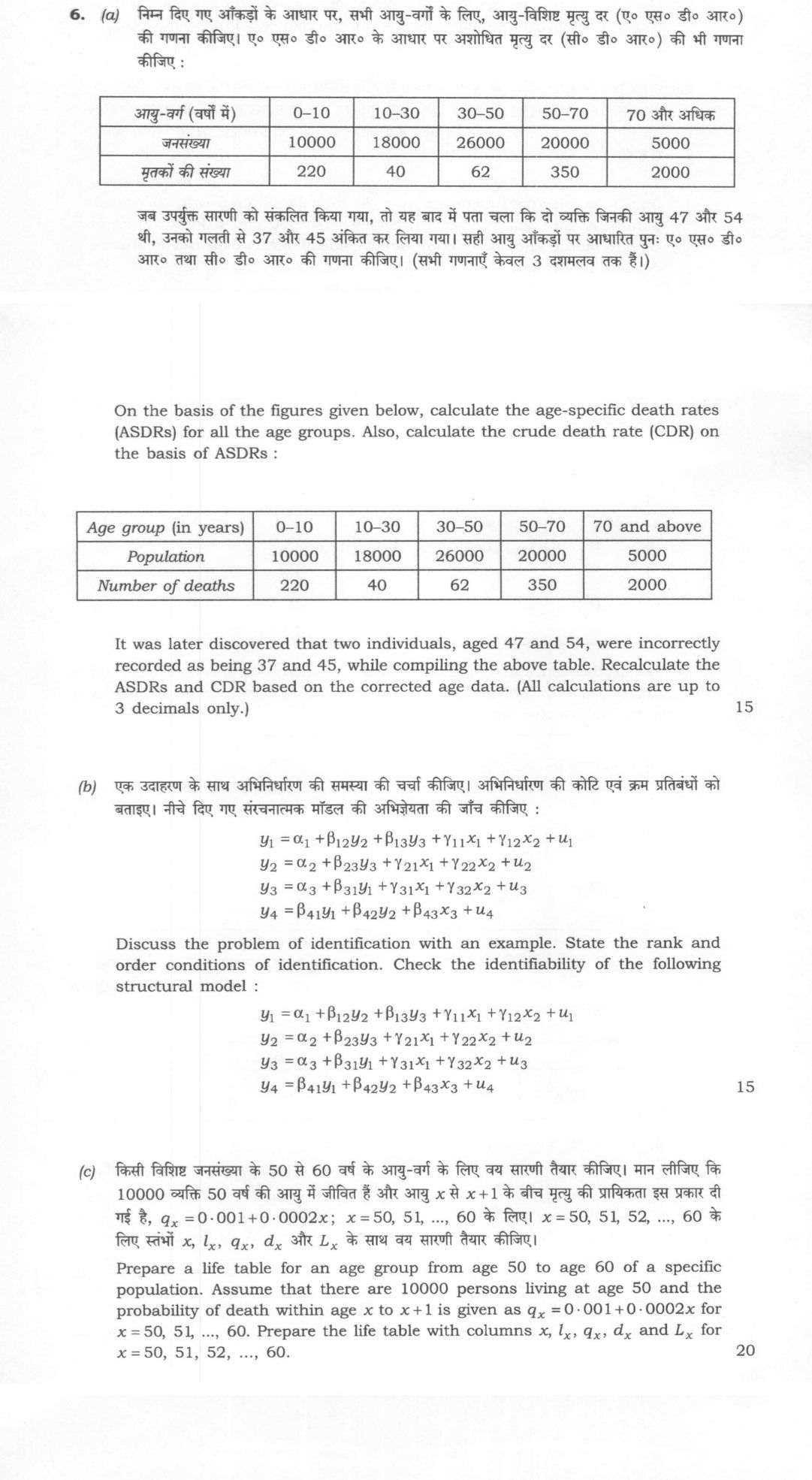
(a) On the basis of the figures given below, calculate the age-specific death rates (ASDRs) for all the age groups. Also…
On the basis of the figures given below, calculate the age-specific death rates (ASDRs) for all the age groups. Also, calculate the crude death rate (CDR) on the basis of ASDRs:
| Age group (in years) | 0-10 | 10-30 | 30-50 | 50-70 | 70 and above |
|---|---|---|---|---|---|
| Population | 10000 | 18000 | 26000 | 20000 | 5000 |
| Number of deaths | 220 | 40 | 62 | 350 | 2000 |
It was later discovered that two individuals, aged 47 and 54, were incorrectly recorded as being 37 and 45, while compiling the above table. Recalculate the ASDRs and CDR based on the corrected age data. (All calculations are up to 3 decimals only.) 15 marks
Discuss the problem of identification with an example. State the rank and order conditions of identification. Check the identifiability of the following structural model:
y₁ = α₁ + β₁₂y₂ + β₁₃y₃ + γ₁₁x₁ + γ₁₂x₂ + u₁
y₂ = α₂ + β₂₃y₃ + γ₂₁x₁ + γ₂₂x₂ + u₂
y₃ = α₃ + β₃₁y₁ + γ₃₁x₁ + γ₃₂x₂ + u₃
y₄ = β₄₁y₁ + β₄₂y₂ + β₄₃x₃ + u₄ 15 marks
Prepare a life table for an age group from age 50 to age 60 of a specific population. Assume that there are 10000 persons living at age 50 and the probability of death within age x to x+1 is given as qₓ = 0·001+0·0002x for x = 50, 51, ..., 60. Prepare the life table with columns x, lₓ, qₓ, dₓ and Lₓ for x = 50, 51, 52, ..., 60. 20 marks
हिंदी में प्रश्न पढ़ें
निम्न दिए गए आँकड़ों के आधार पर, सभी आयु-वर्गों के लिए, आयु-विशिष्ट मृत्यु दर (ए० एस० डी० आर०) की गणना कीजिए। ए० एस० डी० आर० के आधार पर अशोधित मृत्यु दर (सी० डी० आर०) की भी गणना कीजिए:
जब उपर्युक्त सारणी को संकलित किया गया, तो यह बाद में पता चला कि दो व्यक्ति जिनकी आयु 47 और 54 थी, उनको गलती से 37 और 45 अंकित कर लिया गया। सही आयु आँकड़ों पर आधारित पुनः ए० एस० डी० आर० तथा सी० डी० आर० की गणना कीजिए। (सभी गणनाएँ केवल 3 दशमलव तक हैं।) 15 marks
एक उदाहरण के साथ अभिनिश्चयण की समस्या की चर्चा कीजिए। अभिनिश्चयण की कोटि एवं क्रम प्रतिबंधों को बताइए। नीचे दिए गए संरचनात्मक मॉडल की अभिज्ञेयता की जाँच कीजिए:
y₁ = α₁ + β₁₂y₂ + β₁₃y₃ + γ₁₁x₁ + γ₁₂x₂ + u₁
y₂ = α₂ + β₂₃y₃ + γ₂₁x₁ + γ₂₂x₂ + u₂
y₃ = α₃ + β₃₁y₁ + γ₃₁x₁ + γ₃₂x₂ + u₃
y₄ = β₄₁y₁ + β₄₂y₂ + β₄₃x₃ + u₄ 15
किसी विशिष्ट जनसंख्या के 50 से 60 वर्ष के आयु-वर्ग के लिए वय सारणी तैयार कीजिए। मान लीजिए कि 10000 व्यक्ति 50 वर्ष की आयु में जीवित हैं और आयु x से x+1 के बीच मृत्यु की प्रायिकता इस प्रकार दी गई है, qₓ = 0·001+0·0002x; x = 50, 51, ..., 60 के लिए। x = 50, 51, 52, ..., 60 के लिए स्तंभों x, lₓ, qₓ, dₓ और Lₓ के साथ वय सारणी तैयार कीजिए। 20
Model answer
Written by UPSC Answer Check against this question's marking rubric, to the expected length. UPSC does not publish answers for Mains — this is one way to score well, not an official key.
(a) ASDR = (deaths in age group / population in age group) × 1000. Total population = 10000 + 18000 + 26000 + 20000 + 5000 = 79000. Total deaths = 220 + 40 + 62 + 350 + 2000 = 2672.
Original ASDRs (per 1000):
- 0–10: 220/10000 × 1000 = 22.000
- 10–30: 40/18000 × 1000 = 2.222
- 30–50: 62/26000 × 1000 = 2.385
- 50–70: 350/20000 × 1000 = 17.500
- 70+: 2000/5000 × 1000 = 400.000
CDR = Σ(ASDRᵢ × Pᵢ)/ΣPᵢ = (22.000×10000 + 2.222×18000 + 2.385×26000 + 17.500×20000 + 400.000×5000)/79000 = 2672000/79000 = 33.823 per 1000.
Corrected age data: recorded ages 37 and 45 lie in 30–50. True ages are 47 and 54. Since 47 remains in 30–50, but 54 moves to 50–70, one death moves from 30–50 to 50–70. New deaths: 30–50 = 61, 50–70 = 351. Population unchanged.
Corrected ASDRs (per 1000):
- 0–10: 22.000
- 10–30: 2.222
- 30–50: 61/26000 × 1000 = 2.346
- 50–70: 351/20000 × 1000 = 17.550
- 70+: 400.000
Corrected CDR = 2672/79000 × 1000 = 33.823 per 1000 (unchanged, as total deaths and population are unchanged).
(b) Identification means whether the structural parameters can be uniquely recovered from the reduced-form parameters. For example, in the demand-supply model Q_d = α + βP + u, Q_s = γ + δP + v, with equilibrium Q_d = Q_s = Q, only P and Q are observed. Different pairs (α, β, γ, δ) can yield the same reduced-form equations for P and Q, so the structural coefficients are not identified without an exogenous shifter.
Let G be the number of endogenous variables and K the number of predetermined variables (including intercept). For the i-th equation, let gᵢ be the number of endogenous variables appearing in it and kᵢ the number of predetermined variables appearing in it. Order condition: K − kᵢ ≥ gᵢ − 1. Rank condition: delete row i from the structural coefficient matrix; take the columns corresponding to variables excluded from equation i; this submatrix must have rank G − 1.
Here G = 4: y₁, y₂, y₃, y₄. Predetermined variables: intercept, x₁, x₂, x₃, so K = 4.
Equation 1: g₁ = 3, k₁ = 3. Order: 4 − 3 = 1 < 3 − 1 = 2, so it fails. Excluded variables y₄, x₃ give rank 1 < 3. Equation 1 is underidentified.
Equation 2: g₂ = 2, k₂ = 3. Order: 4 − 3 = 1 = 2 − 1. Excluded variables y₁, y₄, x₃ give a submatrix of rank 2 < 3. Equation 2 is underidentified.
Equation 3: g₃ = 2, k₃ = 3. Order: 4 − 3 = 1 = 2 − 1. Excluded variables y₂, y₄, x₃ give rank 2 < 3. Equation 3 is underidentified.
Equation 4: g₄ = 3, k₄ = 1 (only x₃; no intercept). Order: 4 − 1 = 3 ≥ 3 − 1 = 2. Excluded variables y₃, intercept, x₁, x₂ give rank 3 = G − 1. Equation 4 is overidentified and identified.
Thus the first three equations are underidentified, while the fourth equation is identified.
(c) qₓ = 0.001 + 0.0002x. Starting with l₅₀ = 10000. Use dₓ = lₓ qₓ, lₓ₊₁ = lₓ − dₓ, Lₓ = (lₓ + lₓ₊₁)/2.
- x = 50: l₅₀ = 10000.000, q₅₀ = 0.0110, d₅₀ = 110.000, L₅₀ = 9945.000
- x = 51: l₅₁ = 9890.000, q₅₁ = 0.0112, d₅₁ = 110.768, L₅₁ = 9834.616
- x = 52: l₅₂ = 9779.232, q₅₂ = 0.0114, d₅₂ = 111.483, L₅₂ = 9723.490
- x = 53: l₅₃ = 9667.749, q₅₃ = 0.0116, d₅₃ = 112.146, L₅₃ = 9611.676
- x = 54: l₅₄ = 9555.603, q₅₄ = 0.0118, d₅₄ = 112.756, L₅₄ = 9499.225
- x = 55: l₅₅ = 9442.847, q₅₅ = 0.0120, d₅₅ = 113.314, L₅₅ = 9386.190
- x = 56: l₅₆ = 9329.533, q₅₆ = 0.0122, d₅₆ = 113.820, L₅₆ = 9272.622
- x = 57: l₅₇ = 9215.712, q₅₇ = 0.0124, d₅₇ = 114.275, L₅₇ = 9158.575
- x = 58: l₅₈ = 9101.437, q₅₈ = 0.0126, d₅₈ = 114.678, L₅₈ = 9044.098
- x = 59: l₅₉ = 8986.759, q₅₉ = 0.0128, d₅₉ = 115.031, L₅₉ = 8929.244
- x = 60: l₆₀ = 8871.729, q₆₀ = 0.0130, d₆₀ = 115.332, L₆₀ = 8814.063
For x = 60, l₆₁ = 8871.729 − 115.332 = 8756.396, so L₆₀ = (8871.729 + 8756.396)/2 = 8814.063.
What "Calculate" is asking you to do
Apply the standard formula or schedule to data the question has already supplied — a table of readings, cost records, a balance sheet — and produce the number. The method is rarely in doubt; the marks sit in the named intermediate quantities, each of which has to appear as a labelled line.
Structure that answers it
Data as given → formula or standard treatment, named → substitution → each intermediate, labelled → result with units
Where marks are lost
Omitting an intermediate the marking scheme pays for separately, or rounding at an intermediate line so the final figure drifts. In commerce and accountancy, any figure in a statement that no numbered working note supports is treated as unearned.
How this answer will be evaluated
Approach
Framework: UPSC Statistics Paper 2. (a) calculate: given > formula > substitution > result with units > interpretation | (b) discuss: intro > 3-4 dimensions > example > balanced close | (c) calculate: given > formula > substitution > result with units > interpretation Full marks: All calculations correct, clear presentation, proper interpretation
Key points expected
- Calculate ASDR for all 5 age groups
- Compute CDR using weighted average of ASDRs
- Correct population counts for ages 47 and 54
- Recalculate ASDRs and CDR with corrected data
- Define identification problem with example
- State rank and order conditions
- Apply conditions to the given 4-equation model
- Conclude identifiability of each equation
Evaluation rubric
Each sub-part is marked on its own, against the marks and word limit printed on the paper.
- (a) Compute ASDRs and CDR for original and corrected data. 15 marks
calculate— given → formula → substitution → result with units → interpretation
Must cover
- Calculate ASDR for all 5 age groups
- Compute CDR using weighted average of ASDRs
- Correct population counts for ages 47 and 54
- Recalculate ASDRs and CDR with corrected data
Loses marks
- Incorrect correction of age groups
- Failure to recalculate CDR after correction
- Rounding errors beyond 3 decimals
Earns more
- Show formula for ASDR and CDR
- Present results in a clear table
- Round all values to 3 decimals
Extra mark
- Compare original vs corrected CDR
- (b) Explain identification problem and check model identifiability. 15 marks
discuss— intro → 3-4 dimensions → example → balanced close
Must cover
- Define identification problem with example
- State rank and order conditions
- Apply conditions to the given 4-equation model
- Conclude identifiability of each equation
Loses marks
- Confusing order and rank conditions
- Incorrect count of excluded variables
- Failure to check all equations
Earns more
- Use matrix notation for rank condition
- Count excluded variables for order condition
- Clearly label endogenous and exogenous variables
Extra mark
- Mention alternative identification methods
- (c) Construct life table for ages 50-60 using given qx. 20 marks
calculate— given → formula → substitution → result with units → interpretation
Must cover
- Calculate qx for x=50 to 60 using formula
- Compute lx, dx, and Lx for each age
- Start with l50 = 10000
- Present complete table with all columns
Loses marks
- Incorrect application of qx formula
- Arithmetic errors in lx or dx
- Missing ages in the table
Earns more
- Show calculation for at least one age
- Use correct recurrence relations
- Maintain consistent precision throughout
Extra mark
- Add column for survival probability px
Practice this exact question
Write your answer and it is marked point by point against the model answer above — what you covered, what you missed, what you got wrong.
Evaluate my answer →More from Statistics 2025 Paper II
- Q3 (a) A company manufactures 30 items per day. The sale of those items depends upon demand…
- Q4 (a) Solve the game whose payoff matrix is -1 & -2 & 8 7 & 5 & -1 6 & 0 & 12 (15 marks) (b…
- Q5 (a) Explain the multicollinearity problem in a regression model. What are its consequence…
- Q6 (a) On the basis of the figures given below, calculate the age-specific death rates (ASDR…
- Q7 (a) Explain the concept of index number. Calculate the Fisher's ideal index number from t…
- Q8 (a) Define time series. For a moving-average process with weights {a₁, a₂, ..., aₘ} of ra…