Paper I — Q1
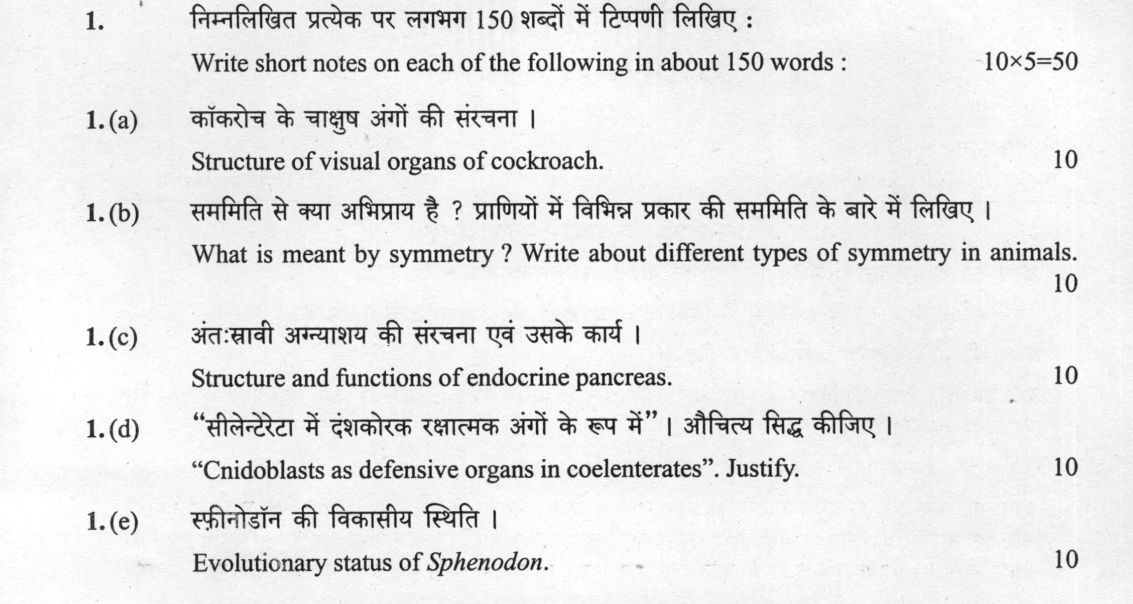
Write short notes on each of the following in about 150 words: (a) Structure of visual organs of cockroach. (10 marks) (b) What…
Write short notes on each of the following in about 150 words: Structure of visual organs of cockroach. 10 marks
What is meant by symmetry? Write about different types of symmetry in animals. 10 marks
Structure and functions of endocrine pancreas. 10 marks
"Cnidoblasts as defensive organs in coelenterates". Justify. 10 marks
Evolutionary status of Sphenodon. 10 marks
हिंदी में प्रश्न पढ़ें
निम्नलिखित प्रत्येक पर लगभग 150 शब्दों में टिप्पणी लिखिए : कॉकरोच के चाक्षुष अंगों की संरचना । (10 अंक)
सममिति से क्या अभिप्राय है ? प्राणियों में विभिन्न प्रकार की सममिति के बारे में लिखिए । (10 अंक)
अंतःस्रावी अग्न्याशय की संरचना एवं उसके कार्य । (10 अंक)
"सीलेंटेरेटा में दंशकोरक रक्षात्मक अंगों के रूप में" । औचित्य सिद्ध कीजिए । (10 अंक)
स्फीनोडॉन की विकासीय स्थिति । (10 अंक)
Model answer
Written by UPSC Answer Check against this question's marking rubric, to the 150-word length. UPSC does not publish answers for Mains — this is one way to score well, not an official key.
(a) Structure of visual organs of cockroach
The visual apparatus of the cockroach (Periplaneta americana) comprises a pair of sessile, kidney-shaped compound eyes positioned dorsolaterally on the head capsule, complemented by a pair of simple eyes or ocellar spots (fenestrae) at the base of the antennae. Each compound eye is an aggregate of approximately 2,000 visual units termed ommatidia. An individual ommatidium consists of an outer dioptric (optical) apparatus and an inner receptive apparatus. The optical region includes a biconvex cuticular lens (cornea) secreted by corneagen cells, and a transparent crystalline cone enveloped by four vitrellae (cone cells) that focus light. The sensory unit beneath comprises seven to eight elongated retinular cells encircling a centrally located, light-sensitive rhabdome, which directly continues into nerve fibres entering the optic ganglion. Surrounding pigment sheaths optically insulate adjacent ommatidia. This structural configuration facilitates mosaic vision via the apposition image mechanism, granting high temporal resolution suited for motion detection in low light. The ocelli function non-visually as simple photoreceptors detecting illumination changes.
(b) What is meant by symmetry? Write about different types of symmetry in animals
Symmetry in animal biology refers to the balanced distribution of duplicate body parts across central axes or reference planes, determining the basic structural body plan.
Asymmetry denotes the absence of any plane of symmetry, characteristic of most Porifera (sponges) and adult gastropods, reflecting a sessile or irregular growth habit.
Radial symmetry occurs when any longitudinal plane passing through the central oral-aboral axis divides the animal into identical halves. It is characteristic of primary radiata like Cnidaria (Hydra, jellyfish) and secondary pentamerous forms like adult Echinodermata, enabling unhindered environmental interaction from all directions.
Biradial symmetry represents a specialized condition where radial arrangement is modified by paired structures, permitting division into equivalent halves through only two vertical planes, as seen in Ctenophora (comb jellies) and sea anemones.
Bilateral symmetry allows body division into mirrored left and right halves through a single median sagittal plane. Found across triploblastic Bilateria, it is evolutionarily linked with cephalization, active directional locomotion, and sophisticated central nervous system organization.
(c) Structure and functions of endocrine pancreas
The endocrine pancreas consists of the Islets of Langerhans, which are micro-endocrine aggregates interspersed throughout the exocrine acinar tissue, contributing approximately one to two percent of the total pancreatic mass. Histologically, each islet comprises four distinct, richly vascularized cell types: alpha (α) cells located predominantly at the periphery, beta (β) cells forming the predominant core (60–70%), delta (δ) cells, and F or pancreatic polypeptide (PP) cells.
Functionally, the endocrine pancreas is the central regulator of carbohydrate, lipid, and protein metabolism via antagonistic hormonal actions. Beta cells secrete insulin, a hypoglycemic hormone that promotes cellular glucose uptake via GLUT-4 translocation, accelerates glycogenesis, and stimulates lipogenesis and protein synthesis. Conversely, alpha cells produce glucagon, which raises blood glucose by stimulating hepatic glycogenolysis and gluconeogenesis during fasting states. Delta cells produce somatostatin, exerting a paracrine inhibitory effect on both insulin and glucagon secretion. Insufficient insulin production or peripheral receptor resistance causes chronic metabolic derangement manifested as diabetes mellitus.
(d) "Cnidoblasts as defensive organs in coelenterates". Justify
Cnidoblasts (cnidocytes) are highly specialized, single-use stinging cells unique to the phylum Cnidaria, serving as a defining synapomorphy vital for organismal survival. Structurally, each cnidoblast houses a fluid-filled collagenous capsule (nematocyst) containing a coiled, invaginated tubular thread, an opercular lid, and a rigid sensory trigger called the cnidocil.
Upon mechanical or chemical stimulation by potential predators, sensory signals trigger an explosive discharge driven by rapid alterations in capsule wall permeability. Under the osmotic hypothesis, a swift influx of water into the hypertonic capsule generates massive hydrostatic pressure (up to 150 atmospheres), causing the operculum to open and violently everting the coiled filament within microseconds. Specialized defensive nematocysts, such as penetrants (stenoteles), inject lethal neurotoxins (hypnotoxin) that paralyze or deter attacking organisms, while glutinants produce sticky threads to entangle adversaries. In soft-bodied, slow-moving polyps and pelagic medusae lacking protective exoskeletons, cnidoblasts concentrated on tentacles form an effective chemical and physical barrier, fully justifying their role as primary defensive organs.
(e) Evolutionary status of Sphenodon
Sphenodon (tuatara), restricted to offshore islands of New Zealand, is the sole surviving genus of the ancient Mesozoic reptilian order Rhynchocephalia (Sphenodontida). Morphologically conservative, it is classified as a classic 'living fossil' that has persisted virtually unchanged for over 200 million years since the Triassic period.
Phylogenetically, Sphenodon occupies a critical position as the sister group to Squamata (lizards and snakes) within the clade Lepidosauromorpha. It preserves numerous primitive diapsid characteristics, including a complete diapsid skull with unreduced upper and lower temporal arcades, amphicoelous (biconcave) vertebrae with persistent intercentra, abdominal ribs (gastralia), and uncinate processes on ribs. It uniquely retains a functional parietal (pineal) third eye equipped with a lens and retina, while lacking a copulatory organ and external auditory meatus. Alongside these ancestral traits, it exhibits derived specializations like acrodont dentition. Consequently, Sphenodon provides an indispensable morphological baseline for reconstructing primitive amniote anatomy and understanding the evolutionary divergence of early diapsids.
What "Write short notes" is asking you to do
Five or six self-contained answers, marked separately, typically 10 marks and about 150 words each. Each note must carry its own definition, its two or three defining features and a line on why it matters; a common introduction or conclusion across the notes earns nothing.
Structure that answers it
Per note: one-line definition or identification → two or three features, mechanisms or named examples → one line of significance or Indian application
Where marks are lost
Writing the first two notes at essay length and rationing the rest. Each note is marked on its own, so marks surrendered on a compressed or unattempted note cannot be won back by the long ones.
How this answer will be evaluated
Approach
Framework: Zoology Paper 1: Define > Structure/Mechanism > Diagram > Example. (a) describe: define > structure or process in order > labelled diagram > significance | (b) explain: definition/context > points in order > small example > short close | (c) describe: define > structure or process in order > labelled diagram > significance | (d) justify: claim > 3-4 reasons > evidence > conclusion | (e) explain: definition/context > points in order > small example > short close Full marks: Precise definitions, detailed structures, labelled diagrams, specific examples, and clear mechanisms.
Key points expected
- Distinguish between compound and simple eyes
- Detail the structure of the compound eye (ommatidia)
- Describe the structure of the ommatidium (cornea, lens, rhabdom)
- Mention the function of the three ocelli
- Define symmetry in biological terms
- Explain radial symmetry with an example (e.g., Cnidaria)
- Explain bilateral symmetry with an example (e.g., Arthropoda)
- Mention asymmetry as a type
Evaluation rubric
Each sub-part is marked on its own, against the marks and word limit printed on the paper.
- (a) Define visual organs and describe the structure of cockroach eyes. 10 marks · 150 words
describe— define → structure or process in order → labelled diagram → significance
Must cover
- Distinguish between compound and simple eyes
- Detail the structure of the compound eye (ommatidia)
- Describe the structure of the ommatidium (cornea, lens, rhabdom)
- Mention the function of the three ocelli
Loses marks
- Confusing compound and simple eye structures
- Omitting the internal structure of the ommatidium
- Using common names without scientific context
Earns more
- Labelled diagram of an ommatidium
- Mention of the tapetum
- Reference to the specific cockroach species (e.g., Periplaneta)
Extra mark
- Mention of the specific number of ommatidia
- Reference to the specific nerve connections
- (b) Define symmetry and explain the different types found in animals. 10 marks · 150 words
explain— definition/context → points in order → small example → short close
Must cover
- Define symmetry in biological terms
- Explain radial symmetry with an example (e.g., Cnidaria)
- Explain bilateral symmetry with an example (e.g., Arthropoda)
- Mention asymmetry as a type
Loses marks
- Confusing radial and bilateral symmetry
- Failing to provide examples for each type
- Vague definitions without biological context
Earns more
- Mention of the plane of symmetry
- Link to cephalization in bilateral animals
- Mention of the evolutionary significance
Extra mark
- Mention of specific phyla for each type
- Reference to the body cavity (coelom) relation
- (c) Describe the structure and functions of the endocrine pancreas. 10 marks · 150 words
describe— define → structure or process in order → labelled diagram → significance
Must cover
- Identify the endocrine part as the Islets of Langerhans
- Describe the different cell types (alpha, beta, delta)
- State the hormone secreted by each cell type
- Explain the function of insulin and glucagon
Loses marks
- Confusing exocrine and endocrine functions
- Omitting the specific cell types
- Failing to link hormones to their functions
Earns more
- Mention of the location within the pancreas
- Reference to the blood glucose regulation mechanism
- Mention of the role of somatostatin
Extra mark
- Mention of the specific percentage of endocrine tissue
- Reference to the clinical significance (diabetes)
- (d) Justify the role of cnidoblasts as defensive organs in coelenterates. 10 marks · 150 words
justify— claim → 3-4 reasons → evidence → conclusion
Must cover
- Define cnidoblasts and their location
- Describe the structure of the nematocyst
- Explain the mechanism of discharge
- State the defensive and offensive functions
Loses marks
- Confusing cnidoblasts with other cell types
- Failing to explain the mechanism of action
- Vague description of the defensive role
Earns more
- Mention of the specific types of nematocysts
- Reference to the role in prey capture
- Mention of the specific coelenterate examples (e.g., Hydra, Obelia)
Extra mark
- Mention of the specific chemical composition of the venom
- Reference to the evolutionary advantage of cnidoblasts
- (e) Explain the evolutionary status of Sphenodon. 10 marks · 150 words
explain— definition/context → points in order → small example → short close
Must cover
- Identify Sphenodon as a living fossil
- Mention its classification (Rhynchocephalia)
- List the primitive features it retains
- Mention its divergence from other reptiles
Loses marks
- Confusing Sphenodon with other reptile groups
- Failing to mention its primitive features
- Vague description of its evolutionary significance
Earns more
- Mention of the specific primitive features (e.g., diapsid skull)
- Reference to its long evolutionary history
- Mention of its current conservation status
Extra mark
- Mention of the specific geological period of divergence
- Reference to its unique physiological adaptations
Practice this exact question
Write your answer and it is marked point by point against the model answer above — what you covered, what you missed, what you got wrong.
Evaluate my answer →More from Zoology 2022 Paper I
- Q1 Write short notes on each of the following in about 150 words: (a) Structure of visual or…
- Q2 (a) Explain asexual and sexual modes of reproduction in Paramecium. (20 marks) (b) Write…
- Q3 (a) Explain habitat, habits, general features and life cycle of Wuchereria. (20 marks) (b…
- Q4 (a) Give an account of the origin as well as adaptive radiation of reptiles. (20 marks) (…