Paper I — Q5
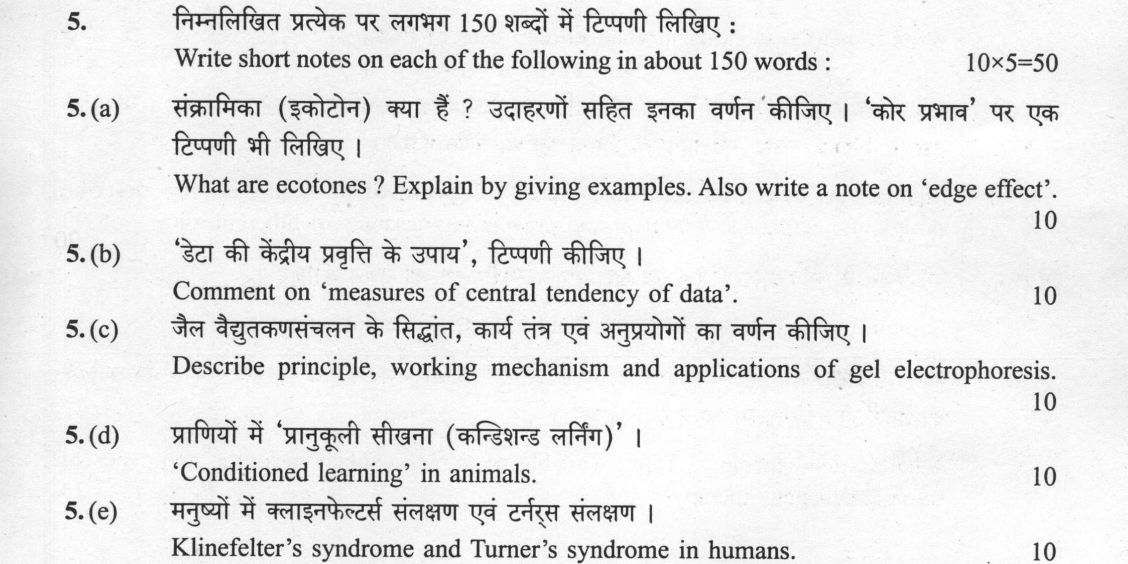
Write short notes on each of the following in about 150 words: (a) What are ecotones? Explain by giving examples. Also write a…
Write short notes on each of the following in about 150 words: What are ecotones? Explain by giving examples. Also write a note on 'edge effect'. 10 marks
Comment on 'measures of central tendency of data'. 10 marks
Describe principle, working mechanism and applications of gel electrophoresis. 10 marks
'Conditioned learning' in animals. 10 marks
Klinefelter's syndrome and Turner's syndrome in humans. 10 marks
हिंदी में प्रश्न पढ़ें
निम्नलिखित प्रत्येक पर लगभग 150 शब्दों में टिप्पणी लिखिए : संक्रामिका (इकोटोन) क्या है ? उदाहरणों सहित इनका वर्णन कीजिए । 'कोर प्रभाव' पर एक टिप्पणी भी लिखिए । (10 अंक)
'डेटा की केंद्रीय प्रवृत्ति के उपाय', टिप्पणी कीजिए । (10 अंक)
जेल वैद्युत्कणसंचलन के सिद्धांत, कार्य तंत्र एवं अनुप्रयोगों का वर्णन कीजिए । (10 अंक)
प्राणियों में 'प्रानुकूली सीखना (कंडीशन्ड लर्निंग)' । (10 अंक)
मनुष्यों में क्लाइनफेल्टर्स सल्लक्षण एवं टर्नर्स सल्लक्षण । (10 अंक)
Model answer
Written by UPSC Answer Check against this question's marking rubric, to the 150-word length. UPSC does not publish answers for Mains — this is one way to score well, not an official key.
(a) Ecotones and edge effect An ecotone is a transitional zone between two adjacent ecosystems, where their biotic and abiotic conditions overlap. It is often called a tension zone because species from both communities meet, compete, and sometimes hybridise, producing a unique assemblage with higher local diversity. For example, the grassland–forest ecotone in the Terai region of Uttar Pradesh and Bihar shows a gradient from open grasses to dense sal and bamboo forest, with distinct bird, mammal and insect communities. The edge effect refers to the intensified biological activity at such boundaries: light, moisture, temperature and wind change abruptly, creating microhabitats that support more species than either interior ecosystem. Thus ecotones are important for conservation, as they maintain connectivity, gene flow and habitat heterogeneity, but they are also vulnerable to fragmentation and invasive species. Such zones are ecologically dynamic and require landscape-level management to preserve their biodiversity.
(b) Measures of central tendency of data Measures of central tendency summarise a data set by a single typical value. The arithmetic mean is common: AM = (x1 + x2 + ... + xn)/n; it is best for normal, symmetrical distributions. The geometric mean, GM = (x1 × x2 × ... × xn)^(1/n), is used for ratios, rates and growth data, such as compound interest, bacterial growth or crop-yield indices. The harmonic mean, HM = n / (1/x1 + 1/x2 + ... + 1/xn), suits rates and reciprocals, for example speed or per-capita consumption. The median is the middle value after arranging data in order; it is preferred for skewed distributions with outliers, such as income or landholding data. The mode is the most frequent value and is useful for discrete, categorical or multimodal data. In Indian agricultural statistics, they analyse rainfall, mandi prices, yields and household consumption; the median suits uneven distributions.
(c) Gel electrophoresis Gel electrophoresis separates charged molecules, mainly DNA, RNA or proteins, according to their charge-to-size ratio in an electric field. The sample is loaded into wells in a gel matrix; agarose is used for nucleic acids, while SDS-PAGE uses polyacrylamide with SDS to make proteins migrate mainly by size. When current is applied, negatively charged DNA moves toward the anode, and the gel acts as a molecular sieve: smaller fragments move faster and farther, while larger fragments remain nearer the wells. Over the resolving range, migration distance or mobility varies approximately linearly with the logarithm of molecular weight, allowing size estimation. A simple gel has wells at one end; smaller fragments form bands farther away. Applications include DNA fingerprinting, paternity testing, forensic identification, and wildlife forensics in tiger and poaching cases, where DNA from hair, faeces or carcass helps identify species and individuals.
(d) Conditioned learning in animals Conditioned learning is the acquisition of new responses through experience, rather than innate reflexes. In classical conditioning, first described by Pavlov, a neutral stimulus is repeatedly paired with an unconditioned stimulus until it alone evokes the response; for example, a dog learns to salivate at the sound of a bell if the bell is followed by food. In operant conditioning, studied by Skinner, an animal learns to connect its own behaviour with consequences: a rat presses a lever to receive food, and the response is strengthened by reinforcement. Key processes include acquisition, when the association is formed; extinction, when the conditioned stimulus is presented without reinforcement and the response weakens; and generalisation, when similar stimuli elicit similar responses. Indian examples include training elephants in Kerala using repeated cues, rewards and correction, where classical and operant principles operate together. Such learning is important in animal husbandry, wildlife management and behavioural research.
(e) Klinefelter’s and Turner’s syndromes Klinefelter’s syndrome is a sex-chromosome disorder in males with karyotype 47,XXY, usually caused by nondisjunction during meiosis. It is the commonest sex-chromosome abnormality in males, with an incidence of about 1 in 500–600 live male births. Affected individuals are phenotypically male but show male hypogonadism, small testes, reduced testosterone, tall stature, gynaecomastia, sparse facial hair and infertility due to impaired spermatogenesis. Turner’s syndrome occurs in females with karyotype 45,X, also due to nondisjunction or structural loss of one X chromosome, with an incidence of about 1 in 2000–2500 live female births. Females are short, have a webbed neck, low posterior hairline, cubitus valgus, lymphoedema, congenital heart defects and primary amenorrhoea because of ovarian dysgenesis. Mosaic forms, such as 46,XY/47,XXY, may show milder features. Turner patients often need growth hormone and oestrogen replacement. Both conditions illustrate how sex-chromosome imbalance affects development, and both require clinical assessment, hormonal management and genetic counselling.
What "Write short notes" is asking you to do
Five or six self-contained answers, marked separately, typically 10 marks and about 150 words each. Each note must carry its own definition, its two or three defining features and a line on why it matters; a common introduction or conclusion across the notes earns nothing.
Structure that answers it
Per note: one-line definition or identification → two or three features, mechanisms or named examples → one line of significance or Indian application
Where marks are lost
Writing the first two notes at essay length and rationing the rest. Each note is marked on its own, so marks surrendered on a compressed or unattempted note cannot be won back by the long ones.
How this answer will be evaluated
Approach
Framework: Zoology Paper 1. (a) explain: definition/context > points in order > small example > short close | (b) comment: context > arguments both sides > judgment > close | (c) describe: define > structure or process in order > labelled diagram > significance | (d) explain: definition/context > points in order > small example > short close | (e) compare: paired headings or table > key differences > significance > conclusion Full marks: Precise definitions, specific examples, and clear mechanisms for all parts.
Key points expected
- Definition of ecotone as a transition zone
- Specific examples (e.g., forest-grassland, marine-terrestrial)
- Explanation of 'edge effect' (increased diversity)
- Mention of higher species richness at boundaries
- Definition of Mean, Median, and Mode
- Explanation of when each is used (e.g., skewed data)
- Comparison of the three measures
- Mention of sensitivity to outliers
Evaluation rubric
Each sub-part is marked on its own, against the marks and word limit printed on the paper.
- (a) Define ecotones, provide examples, and explain the edge effect. 10 marks · 150 words
explain— definition/context → points in order → small example → short close
Must cover
- Definition of ecotone as a transition zone
- Specific examples (e.g., forest-grassland, marine-terrestrial)
- Explanation of 'edge effect' (increased diversity)
- Mention of higher species richness at boundaries
Loses marks
- Confusing ecotone with a single habitat
- Failing to define 'edge effect' specifically
- Vague examples without specific biomes
Earns more
- Reference to 'ecological gradient'
- Mention of 'ecological boundaries'
- Distinction between sharp and gradual ecotones
Extra mark
- Diagram of a transition zone
- Reference to specific biomes (e.g., mangroves)
- (b) Discuss the measures of central tendency (Mean, Median, Mode). 10 marks · 150 words
comment— context → arguments both sides → judgment → close
Must cover
- Definition of Mean, Median, and Mode
- Explanation of when each is used (e.g., skewed data)
- Comparison of the three measures
- Mention of sensitivity to outliers
Loses marks
- Defining only one measure
- Failing to distinguish between median and mode
- Ignoring the context of data distribution
Earns more
- Example of a dataset for calculation
- Mention of 'geometric mean' or 'harmonic mean'
- Reference to 'standard deviation' as a related measure
Extra mark
- Formula for standard deviation
- Graphical representation of distribution
- (c) Explain the principle, mechanism, and applications of gel electrophoresis. 10 marks · 150 words
describe— define → structure or process in order → labelled diagram → significance
Must cover
- Principle: separation by charge and size
- Mechanism: migration through gel matrix under voltage
- Applications: DNA/RNA/protein analysis
- Mention of 'sieve effect' or 'molecular sieving'
Loses marks
- Confusing electrophoresis with chromatography
- Failing to mention the role of electric field
- Vague applications without specific examples
Earns more
- Distinction between agarose and polyacrylamide gels
- Mention of 'staining' (e.g., ethidium bromide)
- Reference to 'SDS-PAGE' for proteins
Extra mark
- Diagram of the electrophoresis setup
- Mention of 'Western blotting' as a follow-up
- (d) Describe conditioned learning in animals with examples. 10 marks · 150 words
explain— definition/context → points in order → small example → short close
Must cover
- Definition of conditioned learning (associative learning)
- Distinction between classical and operant conditioning
- Example of classical conditioning (e.g., Pavlov's dog)
- Example of operant conditioning (e.g., Skinner box)
Loses marks
- Confusing conditioned learning with innate behavior
- Failing to provide specific animal examples
- Ignoring the role of the stimulus-response link
Earns more
- Mention of 'reinforcement' (positive/negative)
- Reference to 'extinction' of the conditioned response
- Mention of 'generalization' or 'discrimination'
Extra mark
- Reference to specific animal studies (e.g., Koko the gorilla)
- Mention of 'instinctive drift'
- (e) Compare Klinefelter's and Turner's syndromes in humans. 10 marks · 150 words
compare— paired headings or table → key differences → significance → conclusion
Must cover
- Karyotype of Klinefelter's (47, XXY)
- Karyotype of Turner's (45, X)
- Phenotypic features of Klinefelter's (male, tall, gynecomastia)
- Phenotypic features of Turner's (female, short, webbed neck)
Loses marks
- Confusing the karyotypes (e.g., XXY vs XX)
- Failing to specify the sex of the patient
- Ignoring the chromosomal basis of the syndromes
Earns more
- Mention of 'gonadal dysgenesis' in both
- Reference to 'infertility' in both conditions
- Mention of 'Streak gonads' in Turner's
Extra mark
- Mention of 'ring X chromosome' in Turner's
- Reference to 'mosaicism' in Turner's
Practice this exact question
Write your answer and it is marked point by point against the model answer above — what you covered, what you missed, what you got wrong.
Evaluate my answer →More from Zoology 2022 Paper I
- Q2 (a) Explain asexual and sexual modes of reproduction in Paramecium. (20 marks) (b) Write…
- Q3 (a) Explain habitat, habits, general features and life cycle of Wuchereria. (20 marks) (b…
- Q4 (a) Give an account of the origin as well as adaptive radiation of reptiles. (20 marks) (…
- Q5 Write short notes on each of the following in about 150 words: (a) What are ecotones? Exp…
- Q6 (a) Describe various types of social groupings in primates. Write a note on importance of…
- Q7 (a) What is meant by biodiversity? Explain various means of in situ conservation of biodi…
- Q8 (a) Mention the causative agent and means of spread of tuberculosis. Also describe sympto…