Paper I — Q4
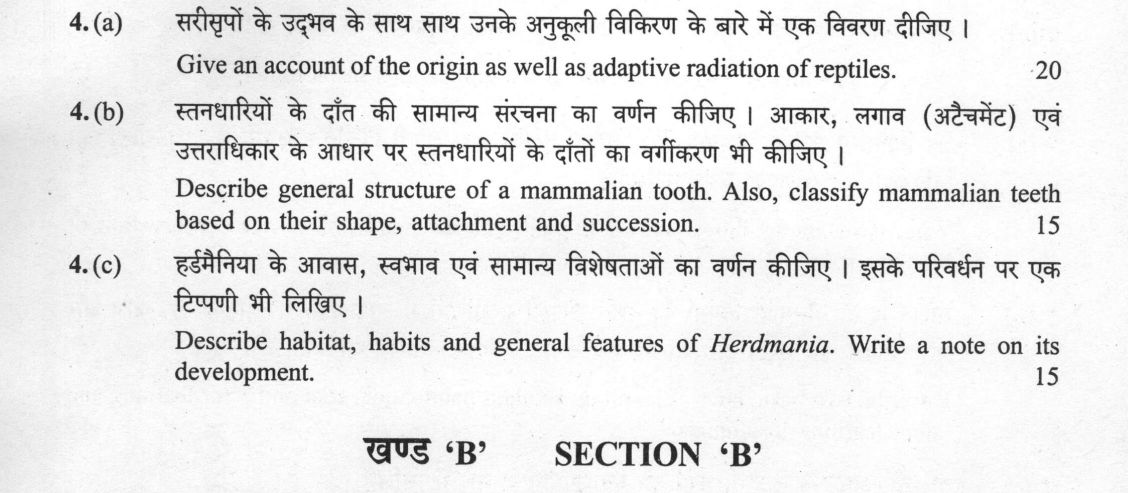
(a) Give an account of the origin as well as adaptive radiation of reptiles. (20 marks) (b) Describe general structure of a…
Give an account of the origin as well as adaptive radiation of reptiles. 20 marks
Describe general structure of a mammalian tooth. Also, classify mammalian teeth based on their shape, attachment and succession. 15 marks
Describe habitat, habits and general features of Herdmania. Write a note on its development. 15 marks
हिंदी में प्रश्न पढ़ें
सरीसृपों के उद्भव के साथ साथ उनके अनुकूली विकिरण के बारे में एक विवरण दीजिए । (20 अंक)
स्तनधारियों के दांत की सामान्य संरचना का वर्णन कीजिए । आकार, लगाव (अटैचमेंट) एवं उत्तराधिकार के आधार पर स्तनधारियों के दांतों का वर्गीकरण भी कीजिए । (15 अंक)
हर्डमेनिया के आवास, स्वभाव एवं सामान्य विशेषताओं का वर्णन कीजिए । इसके परिवर्धन पर एक टिप्पणी भी लिखिए । (15 अंक)
Model answer
Written by UPSC Answer Check against this question's marking rubric, to the expected length. UPSC does not publish answers for Mains — this is one way to score well, not an official key.
Origin and radiation of reptiles. The reptilian stock is traced to early amniotes such as captorhinomorphs and cotylosaurs. The decisive split was between synapsids, with one temporal fenestra, which led to mammals, and diapsids, with two temporal fenestrae, which gave rise to most reptiles. Reptiles became truly terrestrial because of the amniotic egg with extra-embryonic membranes, a water-resistant keratinized skin, and improved jaw articulation with stronger tooth implantation, allowing efficient feeding without cranial kinesis. The diapsid skull, with enlarged temporal openings, lightened the skull and gave space for jaw muscles, facilitating ecological diversification. Early reptiles had a rigid, akinetic skull; cranial kinesis is a later derived feature in some squamates. Their Mesozoic radiation was extensive. Testudines evolved a protective shell and occupied slow-moving aquatic and terrestrial niches, as in the Indian star tortoise and softshell turtles. Squamata radiated into lizards and snakes, exploiting terrestrial, arboreal, fossorial and aquatic habitats; Indian cobra and monitor lizards illustrate venomous and non-venomous adaptations. Crocodilia became semiaquatic ambush predators, represented by the Indian crocodile and gharial. Rhynchocephalia, represented by tuatara, is a relictual, slow-changing lineage. Reptiles dominated Mesozoic ecosystems, but many remained ectothermic; endothermy evolved mainly in the therapsid-mammal transition, giving mammals greater activity and parental care. Mass extinctions, especially the Permian and Cretaceous events, removed many amniote groups, while survivors persisted through aquatic life, small size, burrowing and ecological flexibility. This combination of amniotic reproduction, desiccation resistance and efficient feeding underlies reptile success.
Mammalian tooth structure and classification. A mammalian tooth is a thecodont, heterodont organ. The crown is covered by enamel, the hardest tissue, formed by ameloblasts; beneath it is dentine, formed by odontoblasts of neural-crest ectomesenchymal origin; the central pulp cavity contains nerves, blood vessels and connective tissue. The neck marks the junction of crown and root, while the root is embedded in the jaw and covered by cementum, which anchors the periodontal ligament. Structurally, teeth are divided into crown, neck and root. By shape, mammalian teeth are incisors for cutting, canines for tearing, premolars for grinding and shearing, and molars for crushing; some mammals have reduced or homodont dentitions. By attachment, mammalian teeth are normally thecodont, set in sockets; pleurodont and acrodont attachment are comparative conditions in which teeth are fixed to the inner jaw ridge or fused to the ridge, respectively. By succession, most mammals are diphyodont, having a deciduous and a permanent set, as in humans, cats and dogs. Polyphyodont succession, with continuous replacement, occurs in manatees and some other sirenians. Monophyodonty is rare in mammals; adult edentulism in platypus is not a replacement pattern.
Herdmania: habitat, features and development. Herdmania is a marine tunicate living in subtidal benthic habitats, attached to rocks, mud or seaweed, where it filter-feeds on plankton and organic particles. Its habit is sessile and filter-feeding; tunicates are often colonial, and Herdmania is an attached ascidian with a protective tunic of tunicin and collagen. The body has two siphons: an oral siphon for water entry and an atrial siphon for exit. Water passes through the branchial basket into the branchial chamber, where food is trapped; the gut lies mainly in the branchial chamber, while the heart and gonads lie in the atrial chamber. Herdmania is hermaphroditic, with male and female gonads in one individual. Development is ovoviviparous: fertilized eggs develop inside the female and release a free-swimming tadpole larva. The larva has a notochord, dorsal nerve cord, tail and sensory organs, showing chordate characters. On settlement, it attaches by its oral end, the tail is absorbed, and the notochord and nerve cord regress; this retrogressive metamorphosis produces the sessile adult. Thus Herdmania illustrates a free-living chordate larva and a simplified adult body plan.
What "Describe" is asking you to do
Give a full, ordered account of the thing named — its parts, stages or mechanism — in the sequence in which it actually exists or occurs. Most describe questions come from the science optionals, where the marks sit in correct technical detail and, where the stem says so, a labelled diagram.
Structure that answers it
One-line identification of the subject → the parts or stages in their real order, each with its defining detail → labelled diagram where the subject is structural → closing line on function or significance
Where marks are lost
Loose general prose where the examiner is ticking named parts, correct terminology and their sequence; and in the General Studies papers, turning to evaluation before the description is finished.
How this answer will be evaluated
Approach
Framework: Zoology Paper 1: Define > Structure/Mechanism > Diagram > Example. (a) account for: state the phenomenon > the causes in order of weight > conclusion | (b) describe: define > structure or process in order > labelled diagram > significance | (c) describe: define > structure or process in order > labelled diagram > significance Full marks: Precise taxonomic names, labelled diagrams, and clear mechanistic explanations for all parts.
Key points expected
- Origin from Carboniferous/Permian amphibian ancestors
- Key synapomorphies: amniotic egg, scaly skin
- Adaptive radiation into distinct orders (Squamata, Testudines, etc.)
- Ecological diversification (terrestrial, aquatic, aerial)
- Labelled diagram of tooth structure (crown, root, enamel, dentine)
- Classification by shape: incisors, canines, premolars, molars
- Classification by attachment: thecodont
- Classification by succession: diphyodont
Evaluation rubric
Each sub-part is marked on its own, against the marks and word limit printed on the paper.
- (a) Chronological account of reptile origin and subsequent adaptive radiation. 20 marks
account for— state the phenomenon → the causes in order of weight → conclusion
Must cover
- Origin from Carboniferous/Permian amphibian ancestors
- Key synapomorphies: amniotic egg, scaly skin
- Adaptive radiation into distinct orders (Squamata, Testudines, etc.)
- Ecological diversification (terrestrial, aquatic, aerial)
Loses marks
- Confusing reptiles with mammals or birds
- Omitting the amniotic egg as a key feature
- Listing orders without explaining the radiation
Earns more
- Mention of specific fossil taxa (e.g., Hylonomus)
- Diagram of reptilian phylogeny
- Link to specific environmental changes (e.g., aridification)
Extra mark
- Reference to specific geological periods (Triassic/Jurassic)
- (b) Structural description of a mammalian tooth and classification by shape, attachment, and succession. 15 marks
describe— define → structure or process in order → labelled diagram → significance
Must cover
- Labelled diagram of tooth structure (crown, root, enamel, dentine)
- Classification by shape: incisors, canines, premolars, molars
- Classification by attachment: thecodont
- Classification by succession: diphyodont
Loses marks
- Unlabelled or missing diagram
- Confusing deciduous and permanent teeth
- Omitting the classification by attachment
Earns more
- Mention of pulp cavity and cementum
- Comparison of homodont vs heterodont dentition
Extra mark
- Example of specific dental formula (e.g., human 2113)
- (c) Habitat, habits, and general features of Herdmania, plus a note on its development. 15 marks
describe— define → structure or process in order → labelled diagram → significance
Must cover
- Habitat: marine, attached to rocks/piles
- General features: tunic, siphons, endostyle, pharyngeal basket
- Habits: filter feeding, sessile adult
- Development: larval stage (swimming) to metamorphosis
Loses marks
- Confusing Herdmania with other tunicates
- Omitting the larval stage in development
- Failing to mention the filter-feeding mechanism
Earns more
- Diagram of Herdmania showing siphons and tunic
- Mention of the notochord in the larva
- Description of the pharyngeal basket mechanism
Extra mark
- Mention of asexual reproduction (budding)
Practice this exact question
Write your answer and it is marked point by point against the model answer above — what you covered, what you missed, what you got wrong.
Evaluate my answer →More from Zoology 2022 Paper I
- Q1 Write short notes on each of the following in about 150 words: (a) Structure of visual or…
- Q2 (a) Explain asexual and sexual modes of reproduction in Paramecium. (20 marks) (b) Write…
- Q3 (a) Explain habitat, habits, general features and life cycle of Wuchereria. (20 marks) (b…
- Q4 (a) Give an account of the origin as well as adaptive radiation of reptiles. (20 marks) (…
- Q5 Write short notes on each of the following in about 150 words: (a) What are ecotones? Exp…
- Q6 (a) Describe various types of social groupings in primates. Write a note on importance of…
- Q7 (a) What is meant by biodiversity? Explain various means of in situ conservation of biodi…