Paper I — Q6
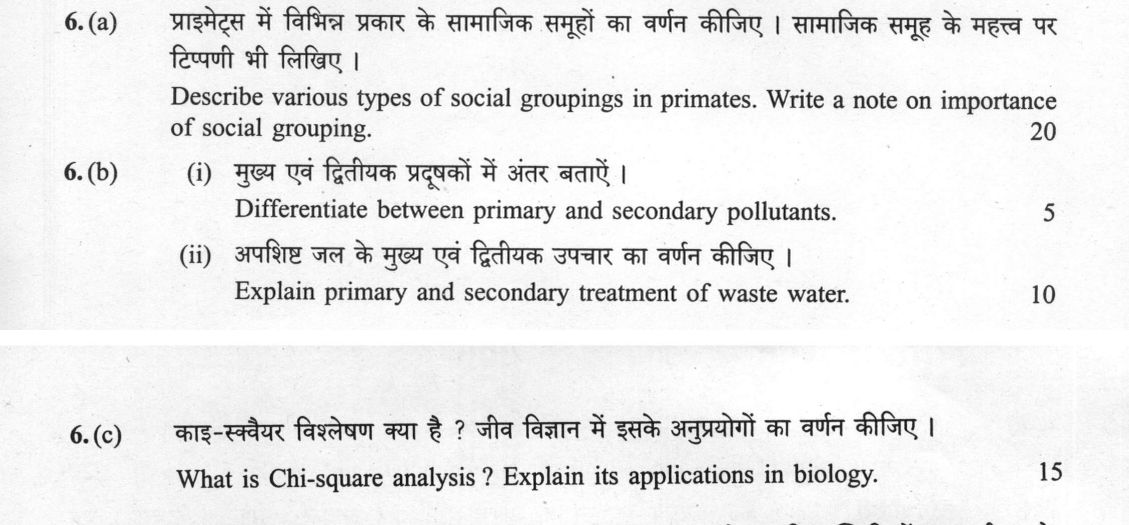
(a) Describe various types of social groupings in primates. Write a note on importance of social grouping. (20 marks) (b) (i)…
Describe various types of social groupings in primates. Write a note on importance of social grouping. 20 marks
Differentiate between primary and secondary pollutants. 5 marks
Explain primary and secondary treatment of waste water. 10 marks
What is Chi-square analysis? Explain its applications in biology. 15 marks
हिंदी में प्रश्न पढ़ें
प्राइमेट्स में विभिन्न प्रकार के सामाजिक समूहों का वर्णन कीजिए । सामाजिक समूह के महत्व पर टिप्पणी भी लिखिए । (20 अंक)
मुख्य एवं द्वितीयक प्रदूषकों में अंतर बताएं । (5 अंक)
अपशिष्ट जल के मुख्य एवं द्वितीयक उपचार का वर्णन कीजिए । (10 अंक)
काइ-स्क्वेयर विश्लेषण क्या है ? जीव विज्ञान में इसके अनुप्रयोगों का वर्णन कीजिए । (15 अंक)
Model answer
Written by UPSC Answer Check against this question's marking rubric, to the expected length. UPSC does not publish answers for Mains — this is one way to score well, not an official key.
(a) Social groupings in primates Primate social organisation varies with habitat, food availability, predation pressure and reproductive strategy. Solitary primates live alone except during mating; their offspring are defended individually. Monogamous pairs consist of one male and one female that remain associated for a season or longer, sharing vigilance and infant care. Polyandrous groups have one female with several males, rare in primates but useful for describing male competition and cooperative male care. Polygynous groups contain one or more females with a dominant male; single-male polygynous groups defend a harem, while multi-male polygynous groups allow several males to mate with several females. Multi-male/multi-female groups are common in many Old World monkeys, where several adult males and females coexist with shifting dominance. Fission-fusion societies are flexible: a large community splits into smaller subgroups and reunites according to food, safety or social tension. These patterns are not fixed; group size and composition change with season, fruit availability and male dispersal. In India, Hanuman langur and Nilgiri langur typically form multi-male/multi-female groups, while lion-tailed macaques form smaller polygynous or multi-male groups depending on locality. Social grouping is important because it improves predator defence through group vigilance and mobbing, helps defend food or territory, supports cooperative breeding and alloparental care, facilitates social learning of foraging and social skills, increases reproductive success through mate access and infant protection, and can favour kin selection when relatives share resources and care. In langurs, troop cohesion reduces infanticide risk and improves infant survival.
(b) Pollutants and waste-water treatment (i) Primary pollutants are substances emitted directly from natural or anthropogenic sources, such as CO, SO₂, NOₓ, particulates and heavy metals. Secondary pollutants are not emitted directly; they form in the atmosphere by chemical or photochemical reactions, such as O₃, PAN, photochemical smog and acid rain containing H₂SO₄ and HNO₃. (ii) Primary treatment of waste water is mainly physical. Screening removes large solids, grit chambers remove sand and grit, and sedimentation settles suspended solids. Secondary treatment is biological and, in conventional systems, primarily aerobic. In the activated sludge process, aerated wastewater is mixed with microbial flocs; heterotrophic bacteria such as Pseudomonas and Zoogloea oxidise organic matter, while nitrifying bacteria convert ammonia: Nitrosomonas oxidises ammonia to nitrite and Nitrobacter oxidises nitrite to nitrate. Trickling filters use aerobic biofilm on media, and oxidation ponds rely on algae and bacteria in shallow basins.
(c) Chi-square analysis Chi-square analysis is a statistical test used to compare observed categorical frequencies with expected frequencies under a null hypothesis. It is calculated as χ² = Σ (O - E)² / E, where O is observed frequency and E is expected frequency. It is a non-parametric test suited to counts, not continuous measurements. The test statistic is compared with a critical value for the chosen significance level and degrees of freedom, usually number of categories minus one for goodness-of-fit tests. If χ² exceeds the critical value, the null hypothesis is rejected. Assumptions include independent observations, categorical data and adequate expected frequencies, often at least five per category. Its limitations are that it is sensitive to small samples, does not show the direction of difference, and can be misleading when expected counts are low. In biology, it is applied in genetics to test whether observed offspring ratios fit Mendelian expectations, such as 3:1 monohybrid or 9:3:3:1 dihybrid ratios. In ecology, it tests habitat preference, species association or community composition. In epidemiology, it examines whether disease occurrence is associated with exposure or risk factors. In India, such tests are used in disease surveillance to check associations between exposure and illness. Thus, primate grouping, waste-water treatment and chi-square analysis are ordered biological, environmental and statistical processes.
What "Describe" is asking you to do
Give a full, ordered account of the thing named — its parts, stages or mechanism — in the sequence in which it actually exists or occurs. Most describe questions come from the science optionals, where the marks sit in correct technical detail and, where the stem says so, a labelled diagram.
Structure that answers it
One-line identification of the subject → the parts or stages in their real order, each with its defining detail → labelled diagram where the subject is structural → closing line on function or significance
Where marks are lost
Loose general prose where the examiner is ticking named parts, correct terminology and their sequence; and in the General Studies papers, turning to evaluation before the description is finished.
How this answer will be evaluated
Approach
Framework: Zoology Paper 1: Define > Structure/Mechanism > Diagram > Example. (a) describe: define > structure or process in order > labelled diagram > significance | (b(i)) compare: paired headings or table > key differences > significance > conclusion | (b(ii)) explain: definition/context > points in order > small example > short close | (c) explain: definition/context > points in order > small example > short close Full marks: Precise definitions, specific examples, clear mechanisms, and accurate applications.
Key points expected
- Define social grouping in primates
- Describe 3-4 types (e.g., one-male, multi-male, multi-female)
- Provide specific primate examples for each type
- Explain importance (protection, foraging, mating)
- Define primary pollutants (direct emission)
- Define secondary pollutants (formed in atmosphere)
- Give examples of each (e.g., SO2 vs Smog)
- Define primary treatment (physical removal)
Evaluation rubric
Each sub-part is marked on its own, against the marks and word limit printed on the paper.
- (a) Define social grouping, list types with examples, and explain their importance. 20 marks
describe— define → structure or process in order → labelled diagram → significance
Must cover
- Define social grouping in primates
- Describe 3-4 types (e.g., one-male, multi-male, multi-female)
- Provide specific primate examples for each type
- Explain importance (protection, foraging, mating)
Loses marks
- Listing types without specific examples
- Confusing social grouping with family structure
- Ignoring the 'importance' aspect of the question
Earns more
- Mention specific species (e.g., Macaca, Papio)
- Discuss sexual dimorphism in group structure
- Link grouping to predation pressure
- Mention grooming and social bonding
Extra mark
- Reference specific study on primate sociality
- Mention conservation status of a social primate
- (b(i)) Differentiate between primary and secondary pollutants. 5 marks
compare— paired headings or table → key differences → significance → conclusion
Must cover
- Define primary pollutants (direct emission)
- Define secondary pollutants (formed in atmosphere)
- Give examples of each (e.g., SO2 vs Smog)
Loses marks
- Confusing primary with secondary sources
- Failing to provide examples
Earns more
- Mention specific chemical reactions for secondary
- Note on persistence or toxicity differences
Extra mark
- Mention specific environmental impact of a secondary pollutant
- (b(ii)) Explain primary and secondary treatment of waste water. 10 marks
explain— definition/context → points in order → small example → short close
Must cover
- Define primary treatment (physical removal)
- Define secondary treatment (biological removal)
- Describe the process of each stage
- Mention the goal of each stage
Loses marks
- Confusing primary with secondary processes
- Failing to explain the mechanism of removal
Earns more
- Mention specific equipment (e.g., sedimentation tank)
- Explain the role of microorganisms in secondary
- Mention BOD reduction
Extra mark
- Mention tertiary treatment briefly
- Reference specific wastewater treatment plant
- (c) Define Chi-square analysis and explain its applications in biology. 15 marks
explain— definition/context → points in order → small example → short close
Must cover
- Define Chi-square analysis (statistical test)
- Explain the formula or concept
- List 2-3 applications in biology
- Give a specific example of an application
Loses marks
- Failing to define the statistical test
- Listing applications without specific examples
- Confusing Chi-square with other statistical tests
Earns more
- Mention degrees of freedom
- Explain null hypothesis in context
- Mention specific biological study using Chi-square
Extra mark
- Reference a specific paper or study
- Mention limitations of Chi-square analysis
Practice this exact question
Write your answer and it is marked point by point against the model answer above — what you covered, what you missed, what you got wrong.
Evaluate my answer →More from Zoology 2022 Paper I
- Q3 (a) Explain habitat, habits, general features and life cycle of Wuchereria. (20 marks) (b…
- Q4 (a) Give an account of the origin as well as adaptive radiation of reptiles. (20 marks) (…
- Q5 Write short notes on each of the following in about 150 words: (a) What are ecotones? Exp…
- Q6 (a) Describe various types of social groupings in primates. Write a note on importance of…
- Q7 (a) What is meant by biodiversity? Explain various means of in situ conservation of biodi…
- Q8 (a) Mention the causative agent and means of spread of tuberculosis. Also describe sympto…