Paper I — Q7
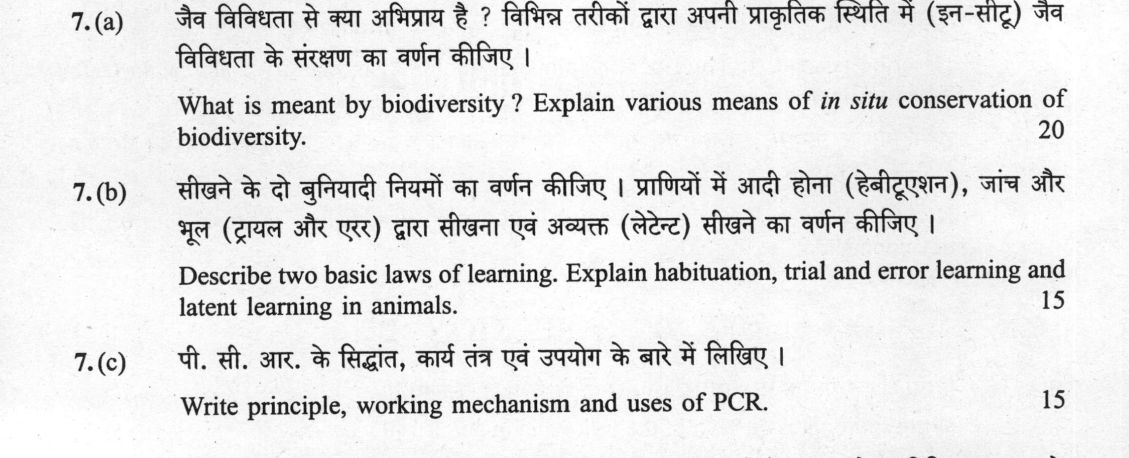
(a) What is meant by biodiversity? Explain various means of in situ conservation of biodiversity. (20 marks) (b) Describe two…
What is meant by biodiversity? Explain various means of in situ conservation of biodiversity. 20 marks
Describe two basic laws of learning. Explain habituation, trial and error learning and latent learning in animals. 15 marks
Write principle, working mechanism and uses of PCR. 15 marks
हिंदी में प्रश्न पढ़ें
जैव विविधता से क्या अभिप्राय है ? विभिन्न तरीकों द्वारा अपनी प्राकृतिक स्थिति में (इन-सीटू) जैव विविधता के संरक्षण का वर्णन कीजिए । (20 अंक)
सीखने के दो बुनियादी नियमों का वर्णन कीजिए । प्राणियों में आदी होना (हैबिटुएशन), जाँच और भूल (ट्रायल एण्ड एरर) द्वारा सीखना एवं अव्यक्त (लेटेन्ट) सीखने का वर्णन कीजिए । (15 अंक)
पी. सी. आर. के सिद्धान्त, कार्य तन्त्र एवं उपयोग के बारे में लिखिए । (15 अंक)
Model answer
Written by UPSC Answer Check against this question's marking rubric, to the expected length. UPSC does not publish answers for Mains — this is one way to score well, not an official key.
(a) Biodiversity and in situ conservation Biodiversity is the variety of life at genetic, species and ecosystem levels. Genetic diversity is variation within a species, species diversity is number and abundance of species, and ecosystem diversity is range of habitats and ecological processes. These are measured as alpha diversity within a site, beta diversity among sites, and gamma diversity across a landscape. In situ conservation means protecting species and ecosystems in their natural habitats, so that natural selection, gene flow, pollination, predation and nutrient cycling continue. It maintains co-evolved interactions and adaptive potential, allowing populations to respond to environmental change. It differs from ex situ conservation, which maintains organisms outside their natural range in zoos, botanical gardens, seed banks or cryopreservation. In India, in situ methods include national parks such as Jim Corbett and Kaziranga, wildlife sanctuaries, biosphere reserves such as Nilgiri in the Western Ghats biodiversity hotspot, sacred groves, and community reserves. Protected areas reduce hunting, logging and conversion, while biosphere reserves combine core protection with buffer zones for sustainable use. Sacred groves and community reserves involve local institutions, reducing illegal extraction. The legal framework includes the Convention on Biological Diversity (CBD), Wildlife Protection Act 1972 and Biological Diversity Act 2002. Yet in situ conservation faces habitat fragmentation, invasive species, climate change and human-wildlife conflict, which can isolate populations and reduce genetic diversity.
(b) Laws and types of learning The two basic laws of learning are Thorndike’s Law of Effect and Law of Exercise. The Law of Effect states that responses followed by satisfying consequences are strengthened, while those followed by discomfort are weakened; this explains instrumental or operant conditioning. The Law of Exercise says that repeated association between stimulus and response strengthens the connection, though reinforcement matters more than repetition. Pavlov’s classical conditioning provides the paradigm in which a neutral stimulus becomes associated with an unconditioned stimulus; it shows acquisition, extinction and generalization. Habituation is non-associative learning in which an animal reduces its response to a repeated, harmless stimulus; Aplysia shows reduced gill withdrawal after repeated touch, and urban birds ignore traffic. Trial and error learning occurs when an animal tests responses until one produces reward, as in Thorndike’s puzzle box, where cats escape faster over trials. Latent learning is learning that occurs without obvious reinforcement and appears later when motivated; Tolman’s rats formed cognitive maps of mazes, showing internal maps guide behaviour. In India, these principles guide wildlife management, such as reducing habituation to humans and using deterrents.
(c) PCR PCR is a molecular technique that amplifies a specific DNA segment using a thermostable DNA polymerase. Its principle is primer-directed, template-dependent DNA synthesis: two short primers bind to flanking sequences, and DNA polymerase extends them, copying the target region. The reaction mixture contains template DNA, forward and reverse primers, dNTPs, buffer, Mg2+ and Taq polymerase. The working mechanism is cyclic. In denaturation at 94-95°C, double-stranded DNA separates into single strands. In annealing at 50-65°C, primers bind to complementary sequences. In extension at 72°C, Taq polymerase adds nucleotides to the 3’ ends of primers, synthesising new strands. Taq polymerase is specific for the primer-template junction and thermostable, so it withstands repeated heating. This makes PCR highly specific. Because each cycle doubles the target, amplification is exponential, approximately 2^n after n cycles. PCR is used in forensics for DNA fingerprinting, disease diagnosis such as COVID-19 RT-PCR, phylogenetics, ancient DNA studies, and genetic testing. Variants include qPCR for quantification, RT-PCR for RNA targets and digital PCR for absolute measurement. In India, PCR supports diagnostics and forensic DNA profiling.
What "Explain" is asking you to do
Make the working of something clear — what sets it off, what follows from what, and what it produces. Explain is the Commission's mechanism word: it dominates the technical papers and the “explain why” stems, where the marks sit in the causal chain and not in the label.
Structure that answers it
State what it is → the initiating condition → the chain of cause, step by step → an instance where it plays out → what the chain produces
Where marks are lost
Describing what something looks like instead of why it works that way. Naming the stages without linking them reads as description too.
How this answer will be evaluated
Approach
Framework: Zoology, Paper 1. (a) explain: definition/context > points in order > small example > short close | (b) describe: define > structure or process in order > labelled diagram > significance | (c) explain: definition/context > points in order > small example > short close Full marks: Precise definitions, clear mechanisms, specific examples, and correct terminology throughout.
Key points expected
- Define biodiversity (genetic, species, ecosystem)
- Define in situ conservation
- Explain National Parks and Sanctuaries
- Explain Biosphere Reserves and Wildlife Sanctuaries
- State two basic laws of learning (e.g., Thorndike)
- Define and explain habituation
- Define and explain trial and error learning
- Define and explain latent learning
Evaluation rubric
Each sub-part is marked on its own, against the marks and word limit printed on the paper.
- (a) Define biodiversity and detail in situ conservation methods. 20 marks
explain— definition/context → points in order → small example → short close
Must cover
- Define biodiversity (genetic, species, ecosystem)
- Define in situ conservation
- Explain National Parks and Sanctuaries
- Explain Biosphere Reserves and Wildlife Sanctuaries
Loses marks
- Confusing in situ with ex situ methods
- Listing methods without explaining their function
Earns more
- Mention specific Indian examples (e.g., Kaziranga)
- Contrast briefly with ex situ conservation
- Mention IUCN Red List status of a species
Extra mark
- Reference to specific conservation acts (e.g., WPA 1972)
- (b) State two learning laws and explain habituation, trial and error, and latent learning. 15 marks
describe— define → structure or process in order → labelled diagram → significance
Must cover
- State two basic laws of learning (e.g., Thorndike)
- Define and explain habituation
- Define and explain trial and error learning
- Define and explain latent learning
Loses marks
- Confusing habituation with extinction
- Failing to distinguish latent from active learning
Earns more
- Use specific animal examples (e.g., rats, pigeons)
- Reference specific psychologists (e.g., Thorndike, Köhler)
Extra mark
- Mention specific experiments (e.g., Tolman's mazes)
- (c) Write the principle, working mechanism, and uses of PCR. 15 marks
explain— definition/context → points in order → small example → short close
Must cover
- State the principle of PCR (DNA amplification)
- Describe the 3 steps: Denaturation, Annealing, Extension
- List specific uses (e.g., forensics, diagnostics)
- Mention Taq polymerase
Loses marks
- Omitting the role of primers
- Incorrect order of the PCR steps
Earns more
- Include a labelled diagram of the cycle
- Mention specific temperatures for each step
Extra mark
- Mention specific applications like Sanger sequencing
Practice this exact question
Write your answer and it is marked point by point against the model answer above — what you covered, what you missed, what you got wrong.
Evaluate my answer →More from Zoology 2022 Paper I
- Q4 (a) Give an account of the origin as well as adaptive radiation of reptiles. (20 marks) (…
- Q5 Write short notes on each of the following in about 150 words: (a) What are ecotones? Exp…
- Q6 (a) Describe various types of social groupings in primates. Write a note on importance of…
- Q7 (a) What is meant by biodiversity? Explain various means of in situ conservation of biodi…
- Q8 (a) Mention the causative agent and means of spread of tuberculosis. Also describe sympto…