Paper I — Q2
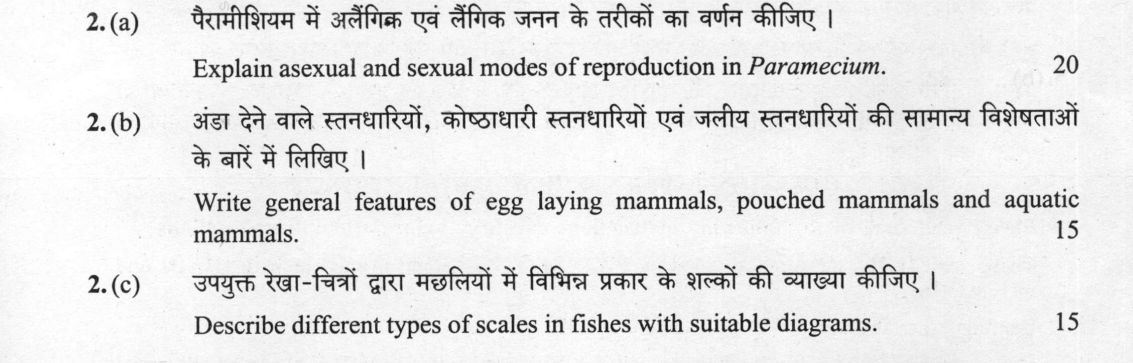
(a) Explain asexual and sexual modes of reproduction in Paramecium. (20 marks) (b) Write general features of egg laying mammals…
Explain asexual and sexual modes of reproduction in Paramecium. 20 marks
Write general features of egg laying mammals, pouched mammals and aquatic mammals. 15 marks
Describe different types of scales in fishes with suitable diagrams. 15 marks
हिंदी में प्रश्न पढ़ें
पैरामीशियम में अलैंगिक एवं लैंगिक जनन के तरीकों का वर्णन कीजिए । (20 अंक)
अंडा देने वाले स्तनधारियों, कोष्ठधारी स्तनधारियों एवं जलीय स्तनधारियों की सामान्य विशेषताओं के बारे में लिखिए । (15 अंक)
उपयुक्त रेखा-चित्रों द्वारा मछलियों में विभिन्न प्रकार के शल्कों की व्याख्या कीजिए । (15 अंक)
Model answer
Written by UPSC Answer Check against this question's marking rubric, to the expected length. UPSC does not publish answers for Mains — this is one way to score well, not an official key.
Reproduction in Paramecium combines vegetative multiplication with a sexual process that restores nuclear function and recombines genes. Asexual mode is transverse binary fission in P. aurelia and P. caudatum. The cell elongates, the micronucleus divides by closed mitosis and the macronucleus divides amitotically; this karyokinesis is followed by transverse cytokinesis, in which the cytoplasm, cilia and oral apparatus divide to give two daughter cells. Because the macronucleus is the vegetative nucleus and the micronucleus the germline nucleus, fission rapidly propagates a clone without genetic recombination. The distinction is important: asexual fission is vegetative and preserves the genotype, while conjugation is sexual because it involves meiosis, nuclear exchange and recombination. Nuclear dimorphism is therefore central: the macronucleus controls somatic metabolism, while the micronucleus supplies the hereditary material for conjugation. Sexual mode is conjugation between two compatible mating types. The cells align and form a cytoplasmic bridge. Each micronucleus undergoes meiosis, producing four haploid pronuclei; three degenerate and the remaining one divides mitotically into a stationary and a migratory pronucleus. The migratory pronucleus of each cell passes to the other, and each fuses with the stationary pronucleus of its partner, so that a diploid synkaryon forms in each exconjugant. The old macronucleus then degenerates; the synkaryon divides to form a new micronucleus and a new macronucleus, after which the exconjugants separate and resume binary fission. Thus conjugation is not merely fertilisation: it replaces the aged macronucleus and introduces recombination. Autogamy and cytogamy are rarer variants of this sexual cycle.
Mammalian groups. Egg-laying mammals (Monotremata/Prototheria) include Ornithorhynchus and Tachyglossus. They lay leathery eggs, have a cloaca, secrete milk onto skin patches without nipples, and the platypus has electroreception. Monotremes thus retain ancestral egg-laying traits while still producing milk. Pouched mammals (Marsupialia/Metatheria) include Macropus and Didelphis. Gestation is short, the young are born altricial, and a chorioallantoic placenta is present but short-lived; the young complete development in a marsupium with teats. Marsupials combine placental pregnancy with pouch nursing. Aquatic mammals include Cetacea, Sirenia and Pinnipedia. Cetaceans have a fusiform body, blubber, forelimbs as flippers, reduced or lost hindlimbs, tail flukes and a dorsal blowhole; Indian examples are Platanista gangetica and Neophocaena phocaenoides. Sirenians are herbivorous, with paddle-like limbs and a tail fluke. Pinnipeds retain hindlimbs modified into flippers, have nostrils on the snout rather than a blowhole, and lack tail flukes; they use blubber and dense fur for insulation. Aquatic mammals show extreme eutherian modification for water. Their aquatic adaptations are therefore group-specific, not a single shared body plan.
Fish scales. Scales are dermal structures arranged in overlapping rows, and their type helps identify the fish group. Cosmoid scales are heavy, layered and fossil, as in coelacanth ancestors. Placoid scales of sharks and rays are dermal denticles with a base, a single backwardly directed tooth-like spine, enamel/enameloid, dentine and a pulp cavity; they protect and reduce drag. Ganoid scales of Polypterus and Lepisosteus are rhomboid, hard and covered by ganoin. Ctenoid and cycloid scales are bony teleost scales: ctenoid have a comb-like posterior margin, cycloid a smooth posterior margin. Diagrammatically, the five types are: placoid as a base with one backward spine, showing enamel, dentine and pulp cavity; ganoid as a rhomboid plate with ganoin; ctenoid as a plate with comb teeth; cycloid as a plate with a smooth edge; cosmoid as a thick layered plate. Placoid scales favour protection and hydrodynamics, while ctenoid/cycloid scales allow flexibility and growth; the evolutionary trend is from heavy ganoid/cosmoid armour to lighter teleost scales. This trend reduces weight while retaining protection. These reproductive and protective adaptations show how organisms balance rapid propagation, genetic renewal, and environmental fit.
What "Explain" is asking you to do
Make the working of something clear — what sets it off, what follows from what, and what it produces. Explain is the Commission's mechanism word: it dominates the technical papers and the “explain why” stems, where the marks sit in the causal chain and not in the label.
Structure that answers it
State what it is → the initiating condition → the chain of cause, step by step → an instance where it plays out → what the chain produces
Where marks are lost
Describing what something looks like instead of why it works that way. Naming the stages without linking them reads as description too.
How this answer will be evaluated
Approach
Framework: Zoology Paper 1: Define > Structure/Mechanism > Diagram > Example. (a) explain: definition/context > points in order > small example > short close | (b) explain: definition/context > points in order > small example > short close | (c) describe: define > structure or process in order > labelled diagram > significance Full marks: Precise mechanisms, labelled diagrams, named species, conservation links.
Key points expected
- Asexual: Binary fission (transverse) mechanism
- Sexual: Conjugation (exchange of micronuclei)
- Labelled diagrams for both processes
- Distinction between macro- and micronuclei
- Egg-laying (Monotremes): Features (e.g., cloaca, no nipples)
- Pouched (Marsupials): Features (e.g., pouch, short gestation)
- Aquatic (Cetaceans): Features (e.g., blubber, flippers)
- One example taxon for each group
Evaluation rubric
Each sub-part is marked on its own, against the marks and word limit printed on the paper.
- (a) Mechanism of asexual (binary fission) and sexual (conjugation) reproduction in Paramecium. 20 marks
explain— definition/context → points in order → small example → short close
Must cover
- Asexual: Binary fission (transverse) mechanism
- Sexual: Conjugation (exchange of micronuclei)
- Labelled diagrams for both processes
- Distinction between macro- and micronuclei
Loses marks
- Diagrams without labels
- Confusing binary fission with multiple fission
Earns more
- Mention of specific species (e.g., P. caudatum)
- Description of exconjugants and autogamy
Extra mark
- Mention of genetic recombination significance
- (b) General features of egg-laying, pouched, and aquatic mammals. 15 marks
explain— definition/context → points in order → small example → short close
Must cover
- Egg-laying (Monotremes): Features (e.g., cloaca, no nipples)
- Pouched (Marsupials): Features (e.g., pouch, short gestation)
- Aquatic (Cetaceans): Features (e.g., blubber, flippers)
- One example taxon for each group
Loses marks
- Using common names without scientific names
- Missing one of the three mammal groups
Earns more
- Mention of specific species (e.g., Platypus, Kangaroo, Dolphin)
Extra mark
- Recent conservation status of a named species
- (c) Different types of scales in fishes with suitable diagrams. 15 marks
describe— define → structure or process in order → labelled diagram → significance
Must cover
- Types: Placoid, Ganoid, Ctenoid, Cycloid
- Structure of each scale type
- Labelled diagrams for each type
- Example taxon for each type
Loses marks
- Diagrams without labels
- Confusing Ctenoid and Cycloid scales
Earns more
- Mention of scale formula or counting method
Extra mark
- Mention of scale use in age determination
Practice this exact question
Write your answer and it is marked point by point against the model answer above — what you covered, what you missed, what you got wrong.
Evaluate my answer →More from Zoology 2022 Paper I
- Q1 Write short notes on each of the following in about 150 words: (a) Structure of visual or…
- Q2 (a) Explain asexual and sexual modes of reproduction in Paramecium. (20 marks) (b) Write…
- Q3 (a) Explain habitat, habits, general features and life cycle of Wuchereria. (20 marks) (b…
- Q4 (a) Give an account of the origin as well as adaptive radiation of reptiles. (20 marks) (…
- Q5 Write short notes on each of the following in about 150 words: (a) What are ecotones? Exp…