Paper I — Q8
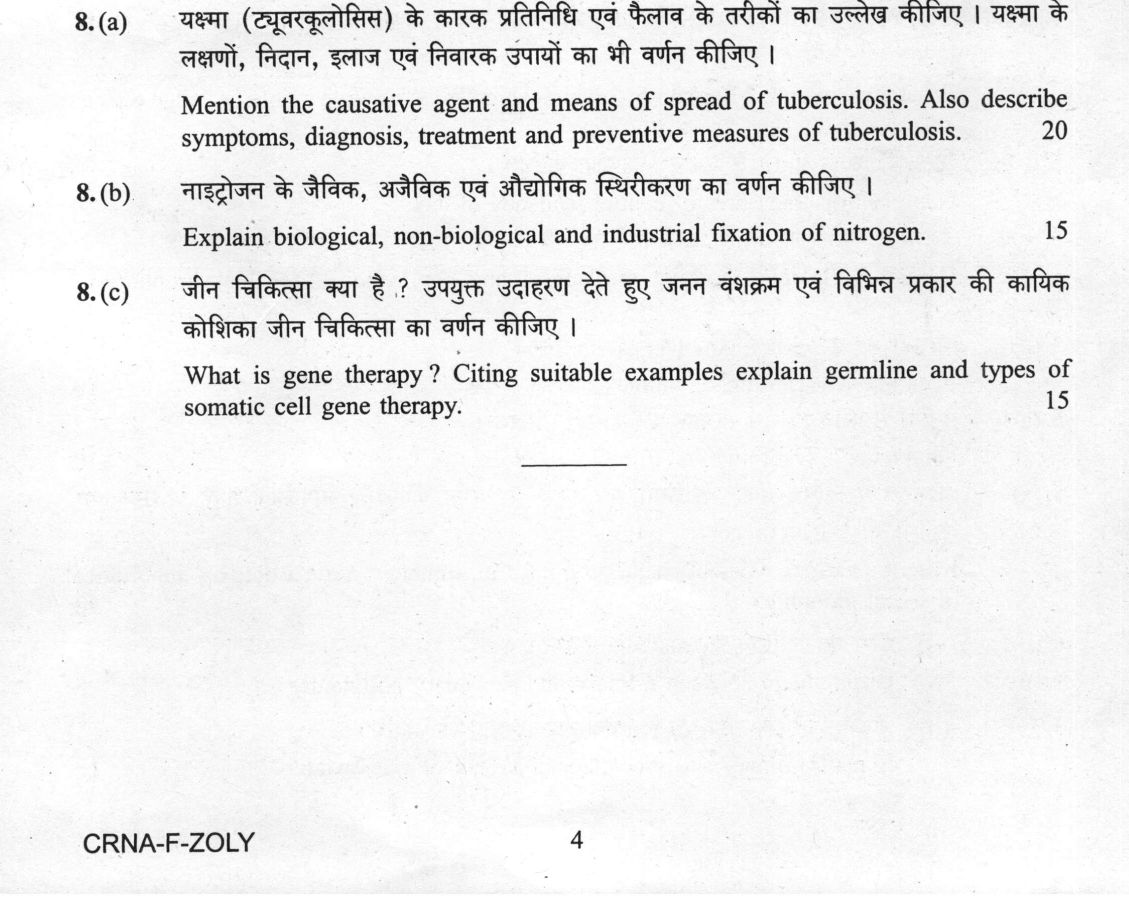
(a) Mention the causative agent and means of spread of tuberculosis. Also describe symptoms, diagnosis, treatment and preventive…
Mention the causative agent and means of spread of tuberculosis. Also describe symptoms, diagnosis, treatment and preventive measures of tuberculosis. 20 marks
Explain biological, non-biological and industrial fixation of nitrogen. 15 marks
What is gene therapy? Citing suitable examples explain germline and types of somatic cell gene therapy. 15 marks
हिंदी में प्रश्न पढ़ें
यक्ष्मा (ट्यूबरक्यूलोसिस) के कारक प्रतिनिधि एवं फैलाव के तरीकों का उल्लेख कीजिए । यक्ष्मा के लक्षणों, निदान, इलाज एवं निवारक उपायों का भी वर्णन कीजिए । (20 अंक)
नाइट्रोजन के जैविक, अजैविक एवं औद्योगिक स्थिरीकरण का वर्णन कीजिए । (15 अंक)
जीन चिकित्सा क्या है ? उपयुक्त उदाहरण देते हुए जनन वंशक्रम एवं विभिन्न प्रकार की कार्यिक कोशिका जीन चिकित्सा का वर्णन कीजिए । (15 अंक)
Model answer
Written by UPSC Answer Check against this question's marking rubric, to the expected length. UPSC does not publish answers for Mains — this is one way to score well, not an official key.
Tuberculosis Tuberculosis (TB) is caused by Mycobacterium tuberculosis, identified by Robert Koch in 1882; M. bovis can also cause zoonotic TB. It spreads mainly by airborne droplet nuclei when a pulmonary TB patient coughs, sneezes or speaks; close household contact is important. Infection may remain latent or progress. Primary TB in children often forms a Ghon focus with draining hilar lymph nodes, together a Ghon complex; reactivation/post-primary TB usually appears in apical/posterior segments and may form Simon foci. Symptoms include chronic cough, fever, night sweats, weight loss, haemoptysis; extrapulmonary TB may affect lymph nodes, spine, pleura, kidneys. Diagnosis combines sputum smear/culture, chest X-ray, Mantoux tuberculin skin test for latent infection, IGRA (QuantiFERON/T-SPOT), and in India CBNAAT/CB-NAAT is central for rapid diagnosis and rifampicin resistance under NTEP/NDTB. Treatment follows DOTS/NDTB: HRZE for 2 months followed by HR for 4 months for drug-susceptible TB; MDR-TB and XDR-TB require longer, more toxic regimens with fluoroquinolones, linezolid and bedaquiline. India bears a high MDR-TB burden. Prevention includes DOTS, contact tracing, BCG vaccination, latent-TB preventive therapy, nutrition, DOTS-Plus, and India’s TB Elimination 2025 target under NTEP.
Nitrogen fixation Biological nitrogen fixation converts atmospheric N₂ to NH₃ by nitrogenase. The standard Mo-dependent nitrogenase has a MoFe protein (dinitrogenase) and an Fe protein (dinitrogenase reductase, Fe-S); some organisms use alternative Fe-Fe or Fe-only nitrogenases. In *Rhizobium*-legume symbiosis, bacteria form root nodules, fix N₂, and supply amino acids; Frankia fixes N₂ in actinorhizal plants; free-living cyanobacteria such as Anabaena and Nostoc fix N₂ in paddy fields and water. Non-biological fixation includes atmospheric lightning, which provides energy to convert N₂ and O₂ to NO/NO₂, eventually nitrates, and the Haber-Bosch process, which synthesises ammonia from N₂ and H₂ at high pressure/temperature with iron catalyst, energy-intensive. Industrial fixation uses Haber-Bosch ammonia; part of ammonia is oxidised by the Ostwald process to nitric acid, used for ammonium nitrate and nitrophosphate fertilisers, while ammonia and CO₂ are converted to urea by the Bosch-Meiser process. India produces about 25 million tonnes of urea a year but still imports a substantial quantity. Overuse of synthetic fertilisers, however, can disrupt nutrient cycles through eutrophication and nitrous-oxide emissions, reducing long-term soil productivity.
Gene therapy Gene therapy delivers functional genes, corrects mutations, or modulates gene expression to treat disease. Germline gene therapy targets gametes, zygotes or early embryos, so the change can be inherited; it is ethically restricted and not clinically approved. Because no approved human germline gene therapy exists, the clearest examples are experimental germline genome-editing attempts, such as CRISPR/Cas9 correction of β-thalassaemia or cystic fibrosis mutations in human embryos, and the controversial 2018 CRISPR-edited embryos for HIV resistance; mitochondrial replacement therapy is a related heritable mitochondrial technique but not classic gene therapy. Somatic cell gene therapy targets non-reproductive cells and is not inherited. Ex vivo therapy removes patient cells, modifies them, and reinfuses them: ADA-SCID, β-thalassaemia/sickle-cell disease ex vivo editing, and CAR-T cell therapy, which is being developed in India for haematological malignancies. In vivo therapy delivers vectors, often AAV or lentiviral, directly to tissues: AAV-mediated RPE65 gene therapy for inherited retinal dystrophy, Zolgensma for spinal muscular atrophy, and ocular gene therapy trials in India. In India, gene therapy is regulated under ICMR guidelines and the Drugs and Cosmetics Act/CDSCO framework, requiring safety, vector control and ethical approval.
Thus TB control, nitrogen fixation and gene therapy intersect in biomedical significance: TB elimination requires rapid diagnostics and DOTS; sustainable agriculture needs efficient nitrogen fixation; gene therapy offers future tools for TB vaccines, mycobacterial gene targeting and nitrogen-fixing crop improvement, while One Health links M. bovis, nutrient cycles and human health.
What "Describe" is asking you to do
Give a full, ordered account of the thing named — its parts, stages or mechanism — in the sequence in which it actually exists or occurs. Most describe questions come from the science optionals, where the marks sit in correct technical detail and, where the stem says so, a labelled diagram.
Structure that answers it
One-line identification of the subject → the parts or stages in their real order, each with its defining detail → labelled diagram where the subject is structural → closing line on function or significance
Where marks are lost
Loose general prose where the examiner is ticking named parts, correct terminology and their sequence; and in the General Studies papers, turning to evaluation before the description is finished.
How this answer will be evaluated
Approach
(a) describe: define > structure or process in order > labelled diagram > significance | (b) explain: definition/context > points in order > small example > short close | (c) explain: definition/context > points in order > small example > short close Full marks: Precise scientific terminology, clear mechanisms, and specific examples for all parts.
Key points expected
- Identify Mycobacterium tuberculosis as causative agent
- Explain airborne spread via respiratory droplets
- List clinical symptoms (cough, fever, weight loss)
- Detail DOTS treatment and BCG vaccination
- Explain biological fixation by Rhizobium or Azotobacter
- Describe non-biological fixation via lightning or heat
- Detail industrial fixation via Haber-Bosch process
- Mention the role of nitrogenase enzyme
Evaluation rubric
Each sub-part is marked on its own, against the marks and word limit printed on the paper.
- (a) Causative agent, spread, symptoms, diagnosis, treatment, and prevention of tuberculosis. 20 marks
describe— define → structure or process in order → labelled diagram → significance
Must cover
- Identify Mycobacterium tuberculosis as causative agent
- Explain airborne spread via respiratory droplets
- List clinical symptoms (cough, fever, weight loss)
- Detail DOTS treatment and BCG vaccination
Loses marks
- Confusing TB with common cold or flu
- Omitting the specific causative bacterium name
- Vague treatment without naming specific drugs
Earns more
- Mention Mantoux test or GeneXpert for diagnosis
- Describe granuloma formation in pathology
- Note MDR-TB and drug resistance issues
- Include specific drugs like Isoniazid or Rifampicin
Extra mark
- Reference WHO Global TB Report statistics
- Mention specific diagnostic flowcharts
- (b) Mechanisms of biological, non-biological, and industrial nitrogen fixation. 15 marks
explain— definition/context → points in order → small example → short close
Must cover
- Explain biological fixation by Rhizobium or Azotobacter
- Describe non-biological fixation via lightning or heat
- Detail industrial fixation via Haber-Bosch process
- Mention the role of nitrogenase enzyme
Loses marks
- Confusing nitrogen fixation with nitrification
- Omitting the industrial process entirely
- Failing to distinguish biological from non-biological
Earns more
- Include chemical equation for Haber-Bosch process
- Describe nodule formation in legumes
- Mention free-living vs symbiotic bacteria
- Note energy requirements for fixation
Extra mark
- Mention specific industrial conditions (temp/pressure)
- Reference specific nitrogen-fixing cyanobacteria
- (c) Definition of gene therapy and explanation of germline and somatic types with examples. 15 marks
explain— definition/context → points in order → small example → short close
Must cover
- Define gene therapy as genetic material transfer
- Explain germline therapy affecting reproductive cells
- Explain somatic cell therapy affecting body cells
- Provide suitable examples for each type
Loses marks
- Confusing gene therapy with genetic engineering
- Failing to distinguish germline from somatic
- Lacking specific examples for the types
Earns more
- Mention specific diseases like SCID or Cystic Fibrosis
- Discuss ethical issues of germline therapy
- Describe viral vectors used in therapy
- Differentiate between in vivo and ex vivo methods
Extra mark
- Reference specific clinical trials or breakthroughs
- Mention CRISPR-Cas9 in gene editing context
Practice this exact question
Write your answer and it is marked point by point against the model answer above — what you covered, what you missed, what you got wrong.
Evaluate my answer →More from Zoology 2022 Paper I
- Q5 Write short notes on each of the following in about 150 words: (a) What are ecotones? Exp…
- Q6 (a) Describe various types of social groupings in primates. Write a note on importance of…
- Q7 (a) What is meant by biodiversity? Explain various means of in situ conservation of biodi…
- Q8 (a) Mention the causative agent and means of spread of tuberculosis. Also describe sympto…