Paper II — Q1
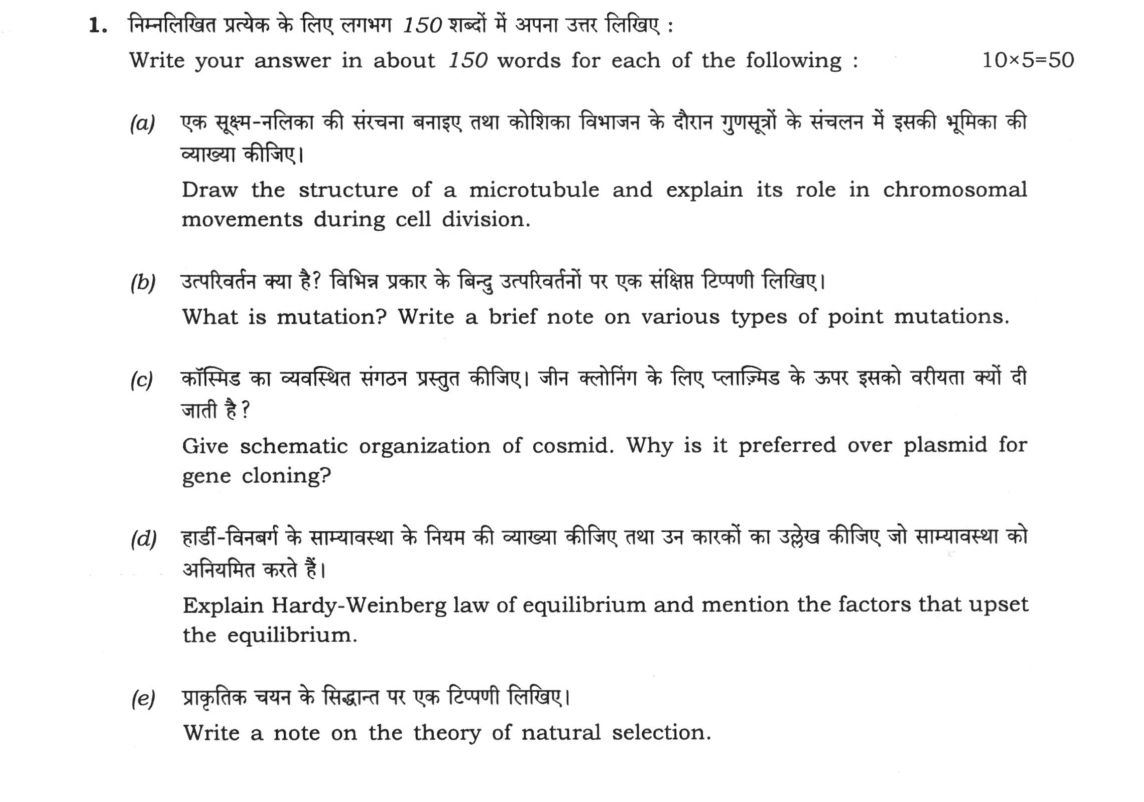
Write your answer in about 150 words for each of the following : 10×5=50 (a) Draw the structure of a microtubule and explain its…
Write your answer in about 150 words for each of the following : 10×5=50
Draw the structure of a microtubule and explain its role in chromosomal movements during cell division.
What is mutation? Write a brief note on various types of point mutations.
Give schematic organization of cosmid. Why is it preferred over plasmid for gene cloning?
Explain Hardy-Weinberg law of equilibrium and mention the factors that upset the equilibrium.
Write a note on the theory of natural selection.
हिंदी में प्रश्न पढ़ें
निम्नलिखित प्रत्येक के लिए लगभग 150 शब्दों में अपना उत्तर लिखिए : 10×5=50
एक सूक्ष्म-नलिका की संरचना बनाइए तथा कोशिका विभाजन के दौरान गुणसूत्रों के संचलन में इसकी भूमिका की व्याख्या कीजिए।
उत्परिवर्तन क्या है? विभिन्न प्रकार के बिंदु उत्परिवर्तनों पर एक संक्षिप्त टिप्पणी लिखिए।
कॉस्मिड का व्यवस्थित संगठन प्रस्तुत कीजिए। जीन क्लोनिंग के लिए प्लाज्मिड के ऊपर इसको वरियता क्यों दी जाती है?
हार्डी-विनबर्ग के साम्यावस्था के नियम की व्याख्या कीजिए तथा उन कारकों का उल्लेख कीजिए जो साम्यावस्था को अनियमित करते हैं।
प्राकृतिक चयन के सिद्धांत पर एक टिप्पणी लिखिए।
Model answer
Written by UPSC Answer Check against this question's marking rubric, to the 150-word length. UPSC does not publish answers for Mains — this is one way to score well, not an official key.
(a) Microtubule structure and role in chromosomal movements
A microtubule is a hollow, unbranched cylindrical organelle of the cytoskeleton, about 25 nm in external diameter, with a central lumen of about 15 nm. Its wall is made of 13 protofilaments arranged side by side. Each protofilament is a linear polymer of α-tubulin and β-tubulin heterodimers. Because the heterodimers are added head-to-tail, the microtubule is polar: the β-tubulin end is the plus (+) end and the α-tubulin end is the minus (−) end. GTP bound to β-tubulin is required for polymerization; hydrolysis of GTP to GDP favours depolymerization. This produces dynamic instability, i.e. rapid switching between growth and shrinkage.
Schematic cross-section and side view:
`` Cross-section: Side view: ○ ○ ○ Plus (+) ○ ○ ↑ ○ lumen ○ αβ αβ αβ ... → protofilament ○ ○ ↓ ○ ○ ○ Minus (−) 13 protofilaments ``
During cell division, microtubules form the spindle apparatus. Centrosomes act as microtubule-organizing centres and nucleate three classes of spindle microtubules: kinetochore microtubules, polar/interpolar microtubules, and astral microtubules. Kinetochore microtubules attach to kinetochores at the centromeres. In prometaphase, chromosomes are captured and congressed to the metaphase plate. In anaphase A, kinetochore microtubules shorten mainly by depolymerization at the plus end, pulling sister chromatids poleward. In anaphase B, polar microtubules slide past one another by motor proteins such as kinesin, and astral microtubules help separate the spindle poles. Dynein and kinesin motors provide force. The spindle assembly checkpoint ensures bipolar attachment before anaphase. Thus, microtubule polymerization, depolymerization, and motor activity are directly responsible for chromosomal movements and faithful chromosome segregation. Validity requires GTP, Mg²⁺, motor proteins, and an intact spindle.
(b) Mutation and types of point mutations
Mutation is a heritable change in the nucleotide sequence of DNA. It may be spontaneous or induced, and it may occur in somatic cells or germ cells. A point mutation is a change involving one or a very small number of base pairs at a specific site. Point mutations are mainly of the following types:
- Substitution: one base pair is replaced by another.
- Transition: a purine is replaced by a purine (A ↔ G) or a pyrimidine by a pyrimidine (C ↔ T).
- Transversion: a purine is replaced by a pyrimidine, or vice versa (A ↔ C, A ↔ T, G ↔ C, G ↔ T).
- Insertion: addition of one or a few nucleotides.
- Deletion: loss of one or a few nucleotides.
According to their effect on protein synthesis, substitutions are further classified as:
- Silent mutation: the new codon codes for the same amino acid because of codon degeneracy. Usually no phenotypic effect.
- Missense mutation: the new codon codes for a different amino acid. It may be conservative, if the amino acid properties are similar, or non-conservative, if they differ greatly. Example: sickle-cell anaemia, where GAG → GTG in the β-globin gene changes glutamic acid to valine.
- Nonsense mutation: a sense codon is changed to a stop codon, producing a truncated and usually non-functional protein.
- Start or stop codon mutation: alters initiation or termination of translation.
Insertions or deletions that are not multiples of three cause frameshift mutations. The reading frame shifts, and all downstream codons are misread, usually producing a severely altered protein. Point mutations may also be classified as forward, reverse, suppressor, or lethal. Their phenotypic effect depends on the gene, position, and whether the mutation is homozygous or heterozygous.
(c) Schematic organization of cosmid and its preference over plasmid
A cosmid is a hybrid cloning vector constructed by combining plasmid DNA with the cos site of bacteriophage λ. It behaves as a plasmid in E. coli but can be packaged into λ phage particles because of the cos sequence.
Schematic organization:
`` cos site ─ MCS ─ selectable marker (ampᴿ) ─ ori ↑ foreign DNA insert (35–45 kb) ``
Main components:
- ori: plasmid origin of replication for autonomous replication in E. coli.
- Selectable marker: usually an antibiotic-resistance gene such as ampᴿ or tetᴿ for selection.
- cos site: recognition sequence for λ packaging; permits in vitro packaging into phage heads.
- Multiple cloning site (MCS): region with unique restriction sites for inserting foreign DNA.
- Sometimes promoters, T3/T7 RNA polymerase sites, and NotI sites for mapping.
A cosmid is usually 5–7 kb in size and can carry inserts of about 35–45 kb. It is preferred over an ordinary plasmid for gene cloning because a plasmid generally accepts only about 10 kb or less, whereas a cosmid accepts much larger DNA fragments. Therefore, fewer clones are needed to construct a complete genomic library. The λ packaging system introduces cosmid DNA into bacterial cells with high efficiency. Inside the host, the cosmid replicates as a plasmid, so the inserted DNA is maintained and amplified. In packaging, recombinant cosmid concatemers, or vectors carrying two cos sites, provide the two cos sites required by λ terminase. Cosmids are therefore useful for cloning large genes, preparing genomic libraries, chromosome walking, and physical mapping. They are less suitable for very large inserts than BACs or YACs, and repeated sequences may sometimes cause instability.
(d) Hardy-Weinberg law of equilibrium and factors upsetting it
The Hardy-Weinberg law states that in an ideal, large, randomly mating population, in the absence of mutation, migration, selection, and genetic drift, both allele frequencies and genotype frequencies remain constant from generation to generation. This equilibrium is described by the Hardy-Weinberg principle.
Working: consider one autosomal locus with two alleles, A and a. Let the frequency of allele A be p and that of allele a be q. Then
p + q = 1.
Gametes carrying A have probability p, and gametes carrying a have probability q. Under random mating, gametes unite at random. Therefore:
- Frequency of AA = p × p = p²
- Frequency of Aa = p × q + q × p = 2pq
- Frequency of aa = q × q = q²
Thus the total genotypic frequency is
p² + 2pq + q² = (p + q)² = 1.
Now calculate the allele frequency in the next generation. The frequency of A in the next generation, p', is the frequency of AA plus half the frequency of heterozygotes:
p' = p² + ½(2pq) = p² + pq = p(p + q) = p.
Similarly, q' = q. Hence allele frequencies do not change, and genotype frequencies remain at p², 2pq, and q². This is Hardy-Weinberg equilibrium.
Conditions of validity: infinite population size, random mating, no mutation, no migration, no selection, equal fertility and viability of all genotypes, and Mendelian segregation.
Factors that upset the equilibrium:
- Mutation: introduces new alleles and changes allele frequencies.
- Gene flow/migration: movement of individuals or gametes between populations changes allele frequencies.
- Genetic drift: random fluctuations in finite populations, especially founder effect and bottleneck effect.
- Non-random mating: inbreeding increases homozygosity; assortative mating changes genotype frequencies.
- Natural selection: differential survival and reproduction changes allele frequencies.
- Meiotic drive: unequal transmission of alleles during meiosis.
- Population subdivision: Wahlund effect produces excess homozygosity when subpopulations are pooled.
Thus, Hardy-Weinberg equilibrium is a null model; departures from it indicate that evolutionary forces are acting.
(e) Theory of natural selection
The theory of natural selection was proposed independently by Charles Darwin and Alfred Russel Wallace. It explains evolutionary change as the result of differential survival and reproduction of individuals that vary in heritable traits. Its main postulates are:
- Overproduction: organisms produce more offspring than can possibly survive.
- Variation: individuals in a population differ in many phenotypic traits.
- Struggle for existence: limited resources lead to competition, predation, disease, and environmental stress.
- Differential survival and reproduction: individuals with traits better suited to the environment survive and reproduce more successfully.
- Inheritance: favourable variations are heritable, so they are passed to the next generation.
Over many generations, favourable alleles increase in frequency, while disadvantageous alleles decrease. The result is adaptation of populations to their environment. Fitness in this theory is not physical strength but relative reproductive success, i.e. contribution to the next generation’s gene pool. Selection acts on phenotypes, but evolutionary change is measured as change in allele frequencies.
Natural selection can be of different types:
- Directional selection: favours one extreme phenotype, shifting the mean. Example: increase in dark-coloured moths during industrial melanism; antibiotic resistance in bacteria.
- Stabilizing selection: favours intermediate phenotypes and reduces extremes. Example: human birth weight.
- Disruptive selection: favours both extremes and may lead to speciation. Example: birds with either large or small beaks in a mixed food environment.
- Sexual selection: favours traits that increase mating success, sometimes at survival cost.
- Kin selection: favours traits that increase inclusive fitness by helping relatives.
Evidence comes from artificial selection, comparative anatomy, fossils, geographical distribution, and modern examples such as Darwin’s finches, peppered moth, and drug resistance. Natural selection is not random: mutation provides random variation, but selection is non-random because it consistently favours alleles that increase fitness in a given environment. It is a major mechanism of evolution and, together with mutation, gene flow, and genetic drift, changes Hardy-Weinberg equilibrium.
What "Draw" is asking you to do
Produce the diagram as the answer, not as an ornament to it. Where the question lists several items — circuit, function table, logic symbol, structure — each is separately marked, and the lines of text must refer to the diagram through its own labels.
Structure that answers it
Diagram drawn large and clean → every part, axis and terminal labelled → caption → two or three lines tying it to what was asked
Where marks are lost
Delivering part of the list and leaving the rest, which forfeits those marks directly. In chemistry, a flat sketch where the geometry or stereochemistry was the point; in engineering, unlabelled terminals, missing polarity, or no sign convention stated.
How this answer will be evaluated
Approach
Framework: Zoology, Paper 2. (a) describe: define > structure or process in order > labelled diagram > significance | (b) write short notes: define > 3-4 key features > one example > one-line significance | (c) describe: define > structure or process in order > labelled diagram > significance | (d) explain: definition/context > points in order > small example > short close | (e) write short notes: define > 3-4 key features > one example > one-line significance Full marks: Precise definitions, labelled diagrams, and specific examples for all parts.
Key points expected
- Labelled diagram of microtubule structure
- Identification of alpha and beta tubulin subunits
- Mechanism of spindle fiber attachment
- Role in chromosome segregation
- Precise definition of mutation
- Definition of point mutation
- Classification into silent, missense, nonsense
- One example for each type
Evaluation rubric
Each sub-part is marked on its own, against the marks and word limit printed on the paper.
- (a) Labelled microtubule structure and mechanism of chromosomal movement. · 150 words
describe— define → structure or process in order → labelled diagram → significance
Must cover
- Labelled diagram of microtubule structure
- Identification of alpha and beta tubulin subunits
- Mechanism of spindle fiber attachment
- Role in chromosome segregation
Loses marks
- Diagram without labels
- Description without structural basis
Earns more
- Mention of centrosome as MTOC
- Distinction between kinetochore and polar fibers
- Reference to dynamic instability
Extra mark
- Mention of specific motor proteins (dynein/kinesin)
- (b) Definition of mutation and classification of point mutations. · 150 words
write short notes— define → 3-4 key features → one example → one-line significance
Must cover
- Precise definition of mutation
- Definition of point mutation
- Classification into silent, missense, nonsense
- One example for each type
Loses marks
- Confusing point mutation with chromosomal
- Listing types without definitions
Earns more
- Mention of frameshift as a contrast
- Reference to specific gene (e.g., sickle cell)
Extra mark
- Mention of transition vs transversion
- (c) Schematic of cosmid and justification for preference over plasmid. · 150 words
describe— define → structure or process in order → labelled diagram → significance
Must cover
- Schematic showing cos, ori, and MCS
- Mention of lambda phage cos site
- Comparison of insert size (40kb vs 10kb)
- Reason for preference (large gene cloning)
Loses marks
- Schematic missing cos site
- No quantitative comparison of size
Earns more
- Mention of packaging requirement (38-52kb)
- Reference to specific vector (e.g., pCos1)
Extra mark
- Mention of cosmid library construction
- (d) Hardy-Weinberg law statement and factors disrupting equilibrium. · 150 words
explain— definition/context → points in order → small example → short close
Must cover
- Statement of the law (p+q=1)
- Mention of the 5 assumptions
- List of factors disrupting equilibrium
- Explanation of one factor (e.g., selection)
Loses marks
- Missing the formula
- Listing factors without explanation
Earns more
- Mention of gene flow/migration
- Reference to genetic drift
Extra mark
- Mention of non-random mating
- (e) Key features of the theory of natural selection. · 150 words
write short notes— define → 3-4 key features → one example → one-line significance
Must cover
- Mention of Darwin and Wallace
- Concept of variation in population
- Struggle for existence/competition
- Survival of the fittest
Loses marks
- Confusing with Lamarckism
- Vague description without mechanism
Earns more
- Mention of adaptation
- Reference to specific example (e.g., peppered moth)
Extra mark
- Mention of 'descent with modification'
Practice this exact question
Write your answer and it is marked point by point against the model answer above — what you covered, what you missed, what you got wrong.
Evaluate my answer →More from Zoology 2022 Paper II
- Q1 Write your answer in about 150 words for each of the following : 10×5=50 (a) Draw the str…
- Q2 (a) What is rough endoplasmic reticulum (RER)? Describe in detail the various modificatio…
- Q3 (a) Sketch out a basic transcription unit and illustrate the RNA polymerase II associated…
- Q4 (a) What is fossil? Describe the origin and evolution of horse based on the fossil record…