Paper II — Q4
(a) What is fossil? Describe the origin and evolution of horse based on the fossil records. 20 (b) Define variation. Describe…
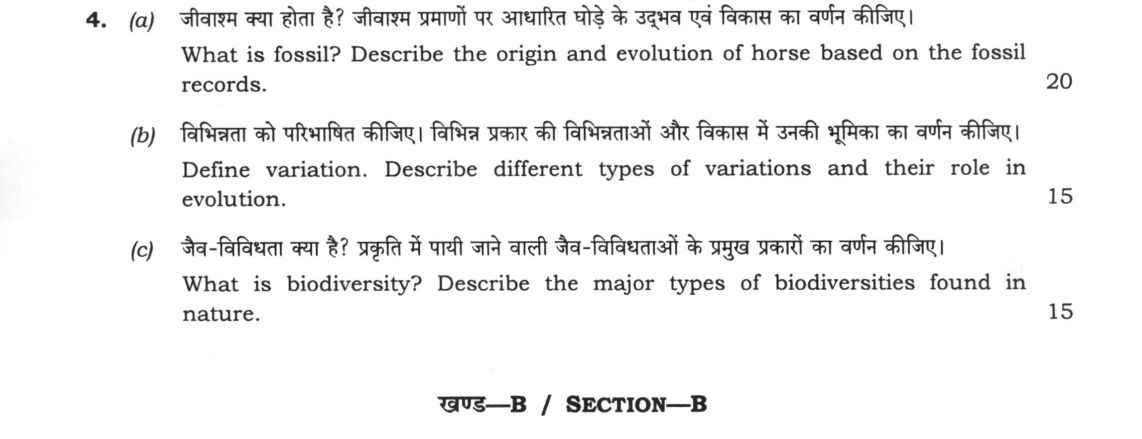
What is fossil? Describe the origin and evolution of horse based on the fossil records. 20 marks
Define variation. Describe different types of variations and their role in evolution. 15 marks
What is biodiversity? Describe the major types of biodiversities found in nature. 15 marks
हिंदी में प्रश्न पढ़ें
जीवाश्म क्या होता है? जीवाश्म प्रमाणों पर आधारित घोड़े के उद्भव एवं विकास का वर्णन कीजिए। 20
विभिन्नता को परिभाषित कीजिए। विभिन्न प्रकार की विभिन्नताओं और विकास में उनकी भूमिका का वर्णन कीजिए। 15
जैव-विविधता क्या है? प्रकृति में पायी जाने वाली जैव-विविधताओं के प्रमुख प्रकारों का वर्णन कीजिए। 15
Model answer
Written by UPSC Answer Check against this question's marking rubric, to the expected length. UPSC does not publish answers for Mains — this is one way to score well, not an official key.
Fossils and horse evolution. A fossil is the remains, impression, cast or trace of a prehistoric organism preserved in sedimentary rock, providing a chronological record of past life. Horse evolution is often presented through a representative sequence—Eohippus (Hyracotherium), Mesohippus, Merychippus, Pliohippus and Equus—but this is a simplified teaching lineage, not a single unbranched line; the fossil record shows a branching bush with many side forms, and the sequence is inferred from stratigraphic succession and comparative anatomy. Eohippus, an Eocene forest browser, was small, had low-crowned brachydont teeth, slender limbs with four toes on the forefeet and three on the hindfeet, and a short gut adapted to soft leaves. Mesohippus, of Oligocene age, was larger, had three toes on each foot, longer limbs, and a more developed middle toe. Merychippus, a Miocene form, retained three functional toes, but the middle toe bore most of the weight while the lateral digits became smaller and less weight-bearing as open woodlands expanded. Pliohippus, from the late Miocene/Pliocene, had a single large central toe and much reduced side toes, longer limbs, and higher-crowned hypsodont teeth adapted to abrasive grasses on plains. Equus, appearing in the Pliocene around 4 million years ago, had a single hoof, long legs, and high-crowned, ridged grazing teeth for hard grasses. The trend—increasing body size, limb elongation, reduction of lateral digits, and hypsodonty—fits Cope’s law and reflects adaptation from browsing to grazing over millions of years. Important fossil sites include the Gobi Desert of Mongolia and the Siwalik Hills of India, where equid fossils in sedimentary strata document these changes.
Variation and evolution. Variation is the difference among individuals of the same species in morphology, physiology, behaviour or genetics. It may be continuous or quantitative, as in height or weight, or discontinuous or qualitative, as in blood groups; it may be somatic, affecting the body, or germinal, affecting gametes; and it may be heritable, passed to offspring, or non-heritable, produced by environment. Somatic changes are usually acquired and not inherited, while germinal changes can be transmitted. Heritable variation is the raw material for natural selection and evolution. Mutation creates new alleles, recombination shuffles them during meiosis, and gene flow transfers alleles between populations; genetic drift does not create new variation but changes allele frequencies and often reduces polymorphism in small populations. Variation allows populations to adapt to changing environments, maintains polymorphism, and enables selection to favour individuals with better survival and reproduction across generations. Without heritable variation, evolution by natural selection would have no material on which to act and adaptive evolution would be limited.
Biodiversity. Biodiversity, as defined by the Convention on Biological Diversity and popularised by E. O. Wilson, is the variety of life at genetic, species and ecosystem levels in all ecosystems. Genetic diversity is the variation within a species, such as the many rice varieties in India, which provides resistance to disease and climate stress and adaptive potential. Species diversity includes species richness and evenness; the Western Ghats, a biodiversity hotspot, contains high numbers of endemic species such as the Nilgiri tahr and lion-tailed macaque. Ecosystem diversity is the variety of habitats and biomes, from the Himalayan forests and alpine meadows to the Western Ghats, Indo-Burma and Sundaland hotspots, and from coral reefs to mangroves, shaping ecological processes. In India, ecosystem diversity supports conservation programmes such as Project Tiger and Project Elephant, which are centrally sponsored schemes operating within the legal framework of the Wildlife (Protection) Act, 1972, for protecting flagship species and their habitats. Biodiversity is the outcome of long-term evolutionary processes: fossils record past changes, variation supplies the heritable differences on which selection acts, and the resulting diversity appears today as genetic, species and ecosystem richness, whose conservation is essential.
What "Describe" is asking you to do
Give a full, ordered account of the thing named — its parts, stages or mechanism — in the sequence in which it actually exists or occurs. Most describe questions come from the science optionals, where the marks sit in correct technical detail and, where the stem says so, a labelled diagram.
Structure that answers it
One-line identification of the subject → the parts or stages in their real order, each with its defining detail → labelled diagram where the subject is structural → closing line on function or significance
Where marks are lost
Loose general prose where the examiner is ticking named parts, correct terminology and their sequence; and in the General Studies papers, turning to evaluation before the description is finished.
How this answer will be evaluated
Approach
Framework: Zoology Paper 2: Define > Structure/Mechanism > Diagram > Example. (a) describe: define > structure or process in order > labelled diagram > significance | (b) describe: define > structure or process in order > labelled diagram > significance | (c) describe: define > structure or process in order > labelled diagram > significance Full marks: Precise definitions, clear evolutionary sequence with morphological details, distinct categorization of variation, and comprehensive coverage of biodiversity levels.
Key points expected
- Precise definition of fossil including preservation types
- Sequence of 4-5 key stages (Eohippus to Equus)
- Changes in limb structure (toes to single hoof)
- Changes in dentition (low to high crowned teeth)
- Definition of variation as deviation from mean
- Distinction between continuous and discontinuous variation
- Distinction between heritable (genetic) and non-heritable (somatic)
- Role of variation in natural selection
Evaluation rubric
Each sub-part is marked on its own, against the marks and word limit printed on the paper.
- (a) Define fossil and trace the evolutionary sequence of the horse from Eohippus to Equus. 20 marks
describe— define → structure or process in order → labelled diagram → significance
Must cover
- Precise definition of fossil including preservation types
- Sequence of 4-5 key stages (Eohippus to Equus)
- Changes in limb structure (toes to single hoof)
- Changes in dentition (low to high crowned teeth)
Loses marks
- Listing stages without explaining morphological changes
- Confusing horse evolution with other ungulates
- Omitting the definition of fossil
Earns more
- Mention of specific genera (Mesohippus, Merychippus, Pliohippus)
- Link to environmental change (forests to grasslands)
- Labelled diagram of limb evolution
Extra mark
- Mention of specific fossil sites (e.g., North America)
- Reference to specific geological epochs (Eocene, Pliocene)
- (b) Define variation and categorize types (continuous/discontinuous, heritable/non-heritable) with evolutionary roles. 15 marks
describe— define → structure or process in order → labelled diagram → significance
Must cover
- Definition of variation as deviation from mean
- Distinction between continuous and discontinuous variation
- Distinction between heritable (genetic) and non-heritable (somatic)
- Role of variation in natural selection
Loses marks
- Failing to distinguish heritable from non-heritable
- Confusing variation with mutation
- No link to the mechanism of evolution
Earns more
- Examples of continuous variation (height, weight)
- Examples of discontinuous variation (blood groups)
- Mention of mutation as source of variation
Extra mark
- Reference to specific genetic mechanisms (recombination)
- Mention of industrial melanism as an example
- (c) Define biodiversity and outline the three major levels: genetic, species, and ecosystem. 15 marks
describe— define → structure or process in order → labelled diagram → significance
Must cover
- Definition of biodiversity (variety of life)
- Explanation of genetic diversity
- Explanation of species diversity
- Explanation of ecosystem diversity
Loses marks
- Confusing biodiversity with population density
- Omitting one of the three major levels
- Vague definitions without examples
Earns more
- Examples for each level (e.g., rice varieties for genetic)
- Mention of alpha, beta, gamma diversity
- Link to conservation importance
Extra mark
- Reference to specific hotspots (e.g., Western Ghats)
- Mention of IUCN red list categories
Practice this exact question
Write your answer and it is marked point by point against the model answer above — what you covered, what you missed, what you got wrong.
Evaluate my answer →More from Zoology 2022 Paper II
- Q1 Write your answer in about 150 words for each of the following : 10×5=50 (a) Draw the str…
- Q2 (a) What is rough endoplasmic reticulum (RER)? Describe in detail the various modificatio…
- Q3 (a) Sketch out a basic transcription unit and illustrate the RNA polymerase II associated…
- Q4 (a) What is fossil? Describe the origin and evolution of horse based on the fossil record…
- Q5 Write your answer in about 150 words for each of the following : 10×5=50 (a) Define immun…
- Q6 (a) Draw the molecular structure of ATP synthase and diagrammatically explain the chemios…
- Q7 (a) What are intestinal glands? Describe the roles of intestinal juices in digestion and…