Paper II — Q8
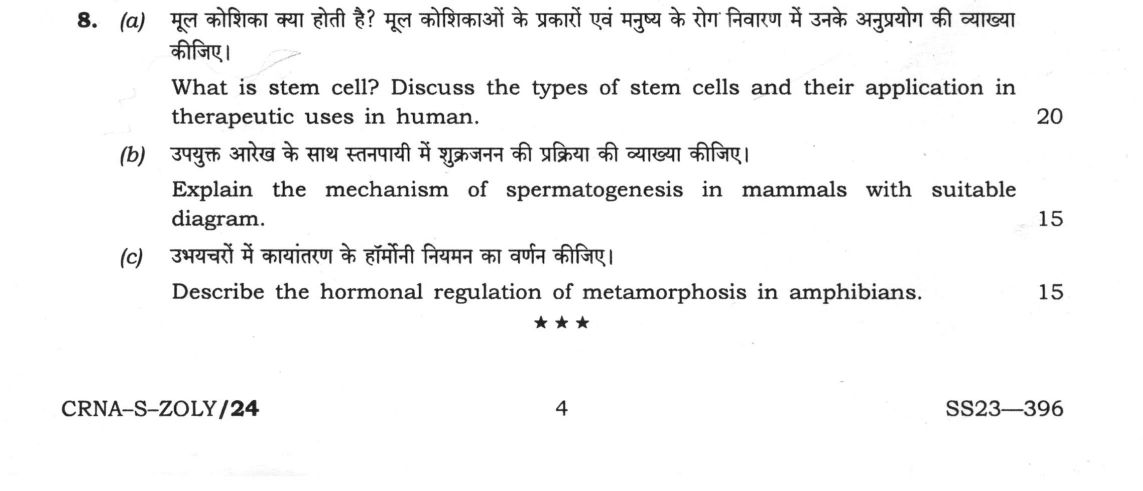
(a) What is stem cell? Discuss the types of stem cells and their application in therapeutic uses in human. 20 (b) Explain the…
What is stem cell? Discuss the types of stem cells and their application in therapeutic uses in human. 20 marks
Explain the mechanism of spermatogenesis in mammals with suitable diagram. 15 marks
Describe the hormonal regulation of metamorphosis in amphibians. 15 marks
हिंदी में प्रश्न पढ़ें
मूल कोशिका क्या होती है? मूल कोशिकाओं के प्रकारों एवं मनुष्य के रोग निवारण में उनके अनुप्रयोग की व्याख्या कीजिए। 20
उपयुक्त आरेख के साथ स्तनपायी में शुक्रजनन की प्रक्रिया की व्याख्या कीजिए। 15
उभयचरों में कायांतरण के हार्मोनी नियमन का वर्णन कीजिए। 15
Model answer
Written by UPSC Answer Check against this question's marking rubric, to the expected length. UPSC does not publish answers for Mains — this is one way to score well, not an official key.
Developmental biology links cell fate, gamete formation and metamorphic change.
Stem cells A stem cell is a self-renewing cell that can give rise to differentiated progeny; its potency ranges from totipotency (zygote/early blastomeres forming embryo and extra-embryonic tissues), pluripotency (embryonic stem cells forming all three germ layers), to multipotency (adult stem cells restricted to a tissue lineage). Embryonic stem cells (ESCs) are isolated from the inner cell mass of the blastocyst and are pluripotent, making them valuable for modelling development and testing drugs, though ethical and tumorigenicity concerns limit routine use. Adult/somatic stem cells (ASCs) reside in tissues such as bone marrow, skin, liver and brain; haematopoietic stem cells are multipotent and already used clinically. Induced pluripotent stem cells (iPSCs) are generated by reprogramming somatic cells with factors such as Oct4, Sox2, Klf4 and c-Myc, providing patient-specific cells and avoiding embryo use. Therapeutic applications include regenerative medicine, where stem cells replace damaged cells or secrete trophic factors. The most established use is haematopoietic stem cell/bone marrow transplantation for thalassaemia and leukaemia, restoring normal blood and immune function. In diabetes, islet or pancreatic progenitor cells are investigated to restore insulin secretion; in Parkinson’s disease, dopaminergic neuron replacement is experimental and under investigation, including iPSC-derived cells, not yet routine. Limitations include ethical issues with ESCs, reprogramming inefficiency and residual oncogenic risk with iPSCs, limited expansion of ASCs, and the need for controlled differentiation, safety and regulatory approval. Indian centres such as the Centre for Cellular and Molecular Biology (CCMB) and NCRM have contributed to stem-cell biology.
Spermatogenesis In mammals, spermatogenesis begins in the seminiferous tubules after puberty with spermatogonial stem cells; primordial germ cells are embryonic precursors that migrate to the gonad and become spermatogonia. These stem cells self-renew and differentiate into type A dark, A pale and B spermatogonia. Mitotic divisions increase cell number. Type B spermatogonia enter meiosis as primary spermatocytes. Meiosis I produces two secondary spermatocytes; meiosis II yields four haploid round spermatids. Spermiogenesis then remodels spermatids: the Golgi forms the acrosome over the anterior nucleus, centrioles organise the flagellum, excess cytoplasm is shed as residual bodies, and the nucleus condenses to form the sperm head. Sertoli cells nurture germ cells, provide nutrients, phagocytose residual bodies, secrete androgen-binding protein (ABP), and form tight junctions creating the blood-testis barrier, which protects meiotic cells from immune attack and maintains a specialised microenvironment. The process is supported by FSH acting on Sertoli cells and testosterone from Leydig cells. A suitable diagram would show a seminiferous tubule in cross-section, with basal spermatogonia, intermediate primary spermatocytes, apical spermatids, Sertoli cells, lumen and the blood-testis barrier.
Amphibian metamorphosis Metamorphosis is controlled by the hypothalamic–pituitary–thyroid axis. Hypothalamic TRH stimulates pituitary thyrotrophs to release TSH, which acts on the thyroid to secrete T3 and T4. These thyroid hormones induce developmental programmes in a tissue-specific manner: tail resorption through apoptosis, limb and gill remodelling, gut shortening and adult digestion, skin changes, eye and ear development, and neural reorganisation. In frogs, rising T3/T4 converts the aquatic larva into a terrestrial adult through coordinated apoptosis and differentiation. Corticosteroids from the adrenal cortex act synergistically, supporting catabolic and stress-related aspects of the transition. In axolotls, neoteny—retention of larval traits—is not mainly due to reduced tissue sensitivity to thyroid hormones; their tissues can respond to exogenous thyroid hormones, but the hypothalamic–pituitary drive, especially TSH secretion, is deficient or reduced, so endogenous thyroid hormone levels remain low and metamorphosis is delayed or absent.
Together, stem cells, gametogenesis and metamorphosis show how regulated cell fate, differentiation and hormonal cues underpin development, reproduction and disease. For therapeutic use, the way forward is to move from experimental cell replacement to safe, regulated regenerative therapies, while comparative developmental mechanisms such as amphibian metamorphosis illuminate evolutionary plasticity and regenerative potential.
What "Discuss" is asking you to do
Lay the issue out from more than one side — how it arose, what is claimed for it, what is held against it, and where it now stands. UPSC attaches discuss to broad topics with several live dimensions, so coverage of the dimensions earns more than the strength of your opinion.
Structure that answers it
Set the issue up → the case as it is made → the case against → the dimension both sides leave out → where the balance now lies
Where marks are lost
Listing facts with no thread between them, or arguing one side throughout and calling it a discussion.
How this answer will be evaluated
Approach
Framework: Zoology Paper 2: Define > Structure/Mechanism > Diagram > Example. (a) discuss: intro > 3-4 dimensions > example > balanced close | (b) explain: definition/context > points in order > small example > short close | (c) describe: define > structure or process in order > labelled diagram > significance Full marks: Precise definitions, labelled diagrams, specific taxon names, and clear mechanistic links.
Key points expected
- Precise definition of stem cell (self-renewal/differentiation)
- Classification: Embryonic (ES) vs Adult (Somatic)
- Potency hierarchy: Totipotent, Pluripotent, Multipotent, Unipotent
- Specific therapeutic applications (e.g., Leukemia, Parkinson's)
- Sequence: Spermatogonia -> Primary -> Secondary -> Spermatids -> Spermatozoa
- Identification of meiotic divisions (Meiosis I & II)
- Description of Spermiogenesis (acrosome, tail formation)
- Suitable labelled diagram of the process
Evaluation rubric
Each sub-part is marked on its own, against the marks and word limit printed on the paper.
- (a) Definition, classification, and therapeutic applications of stem cells. 20 marks
discuss— intro → 3-4 dimensions → example → balanced close
Must cover
- Precise definition of stem cell (self-renewal/differentiation)
- Classification: Embryonic (ES) vs Adult (Somatic)
- Potency hierarchy: Totipotent, Pluripotent, Multipotent, Unipotent
- Specific therapeutic applications (e.g., Leukemia, Parkinson's)
Loses marks
- Confusing stem cells with progenitor cells
- Listing applications without linking to specific cell type
- Vague definitions lacking potency classification
Earns more
- Mention of Induced Pluripotent Stem Cells (iPSCs)
- Distinction between hematopoietic and mesenchymal stem cells
- Reference to ethical constraints in ES cell use
Extra mark
- Mention of specific clinical trial outcomes
- Reference to specific regulatory bodies (e.g., ICMR)
- (b) Mechanism of spermatogenesis in mammals with a suitable diagram. 15 marks
explain— definition/context → points in order → small example → short close
Must cover
- Sequence: Spermatogonia -> Primary -> Secondary -> Spermatids -> Spermatozoa
- Identification of meiotic divisions (Meiosis I & II)
- Description of Spermiogenesis (acrosome, tail formation)
- Suitable labelled diagram of the process
Loses marks
- Diagram without labels (explicitly penalised by method)
- Confusing spermatogenesis with oogenesis
- Omitting the spermiogenesis stage
Earns more
- Mention of Sertoli cell support/nourishment
- Reference to hormonal control (FSH/LH)
- Mention of the blood-testis barrier
Extra mark
- Detailed drawing of the acrosome reaction
- Mention of specific mammalian species (e.g., Rattus norvegicus)
- (c) Hormonal regulation of metamorphosis in amphibians. 15 marks
describe— define → structure or process in order → labelled diagram → significance
Must cover
- Role of Thyroid Hormones (T3/T4) as the primary driver
- Role of Pituitary hormones (TSH) in the axis
- Morphological changes linked to hormone levels (e.g., tail resorption)
- Mention of a specific model organism (e.g., Xenopus laevis)
Loses marks
- Focusing only on physical changes without hormonal link
- Omitting the role of the thyroid gland
- Confusing amphibian metamorphosis with insect metamorphosis
Earns more
- Mention of Cortisol's role in stress-induced metamorphosis
- Description of the Hypothalamic-Pituitary-Thyroid axis
- Mention of the role of IGF-1
Extra mark
- Reference to specific experimental evidence (e.g., thyroidectomy)
- Mention of specific gene markers (e.g., TTR)
Practice this exact question
Write your answer and it is marked point by point against the model answer above — what you covered, what you missed, what you got wrong.
Evaluate my answer →More from Zoology 2022 Paper II
- Q5 Write your answer in about 150 words for each of the following : 10×5=50 (a) Define immun…
- Q6 (a) Draw the molecular structure of ATP synthase and diagrammatically explain the chemios…
- Q7 (a) What are intestinal glands? Describe the roles of intestinal juices in digestion and…
- Q8 (a) What is stem cell? Discuss the types of stem cells and their application in therapeut…