Paper II — Q2
(a) What is rough endoplasmic reticulum (RER)? Describe in detail the various modifications of secretory proteins occurring in…
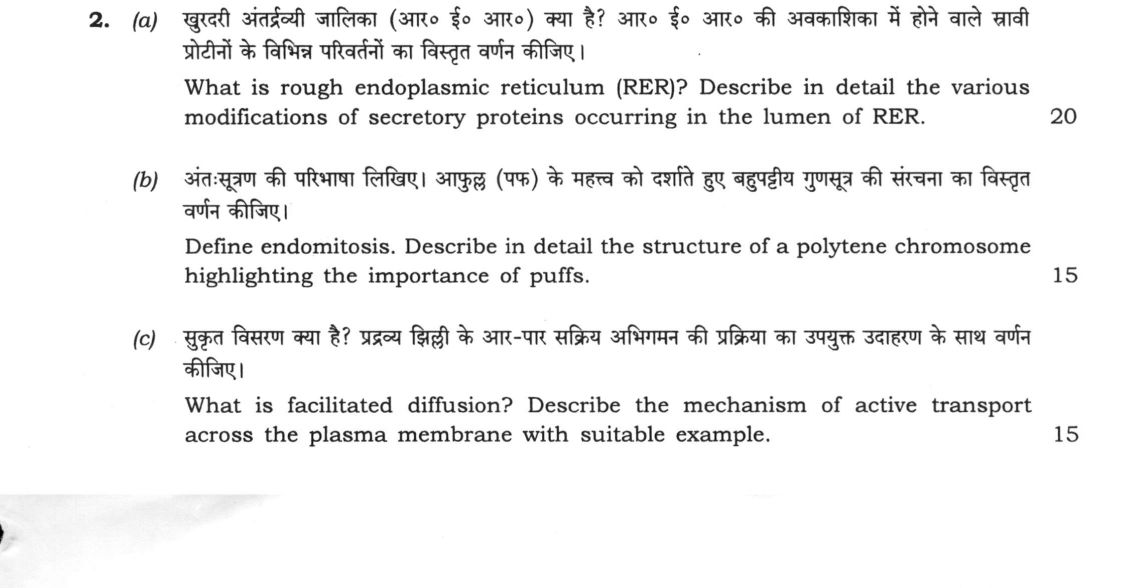
What is rough endoplasmic reticulum (RER)? Describe in detail the various modifications of secretory proteins occurring in the lumen of RER. 20 marks
Define endomitosis. Describe in detail the structure of a polytene chromosome highlighting the importance of puffs. 15 marks
What is facilitated diffusion? Describe the mechanism of active transport across the plasma membrane with suitable example. 15 marks
हिंदी में प्रश्न पढ़ें
खुरदरी अंतर्द्रव्यी जालिका (आर० ई० आर०) क्या है? आर० ई० आर० की अवकाशिका में होने वाले स्रावी प्रोटीनों के विभिन्न परिवर्तनों का विस्तृत वर्णन कीजिए। 20
अंतःसूत्रण की परिभाषा लिखिए। आफुट (पफ) के महत्व को दर्शाते हुए बहुपट्टीय गुणसूत्र की संरचना का विस्तृत वर्णन कीजिए। 15
सुकृत विसरण क्या है? प्रद्रव्य झिल्ली के आर-पार सक्रिय अभिगमन की प्रक्रिया का उपयुक्त उदाहरण के साथ वर्णन कीजिए। 15
Model answer
Written by UPSC Answer Check against this question's marking rubric, to the expected length. UPSC does not publish answers for Mains — this is one way to score well, not an official key.
These processes address cellular logistics at different scales: covalent modification of proteins in the ER, structural amplification of chromosomes, and energetic movement of solutes across membranes.
Rough endoplasmic reticulum and secretory protein modification. Rough ER is a network of flattened cisternae studded on the cytoplasmic face with ribosomes, continuous with the outer nuclear membrane and linked to the Golgi by vesicles. It is the main site for synthesis and early modification of secretory, lysosomal and membrane proteins. A signal sequence at the N-terminus of an emerging polypeptide is recognised by signal recognition particle, which pauses translation and targets the ribosome–nascent chain complex to the SRP receptor on the ER membrane; the chain is threaded co-translationally into the lumen or inserted into the membrane. In the lumen, secretory proteins undergo ordered covalent and conformational modifications. N-linked glycosylation begins when a preassembled oligosaccharide on dolichol phosphate in the ER membrane is transferred en bloc to asparagine in the Asn-X-Ser/Thr motif; trimming and regrowth of sugar chains then refine the glycan. Oxidative folding forms disulfide bonds, catalysed by protein disulfide isomerase, which also corrects non-native pairings. Folding is assisted by the luminal chaperone BiP and by the calnexin/calreticulin cycle: calnexin, a type I membrane protein with a luminal lectin domain, and soluble calreticulin bind glycoproteins through mannose residues, retaining incompletely folded proteins until they are competent. Quality control ensures that only correctly folded proteins leave the ER; in cystic fibrosis, ΔF508-CFTR is correctly recognised as misfolded and degraded, so the disease reflects loss of functional CFTR at the plasma membrane, while chronic ER stress can activate the unfolded protein response.
Endomitosis and polytene chromosomes. Endomitosis is a modified mitotic cycle in which chromosomes replicate and may condense, but division is incomplete or abortive and cytokinesis does not occur, so homologues remain paired and sister chromatids are not separated. Repeated cycles in Dipteran salivary glands produce polytene chromosomes, in which many chromatids lie in register. A polytene chromosome shows a linear array of chromomeres: dark bands and lighter interbands. Bands are dense, DNA-rich regions containing most of the chromosome’s DNA and many active genes; interbands are less condensed. After about ten endomitotic cycles in Drosophila, a polytene chromosome may contain 1024 chromatids. Puffs are decondensed regions, often arising from bands, where chromatin opens for active transcription; large puffs such as Balbiani rings mark intense RNA synthesis. Puffs are important because they reveal gene activity in situ, allow developmental gene mapping, and in salivary glands reflect gene amplification and regulated expression needed for secretion and growth.
Facilitated diffusion and active transport. Facilitated diffusion across the plasma membrane is passive movement of specific solutes down their concentration or electrochemical gradient through integral membrane proteins: channels provide aqueous pores, while carriers undergo conformational change; neither uses ATP directly. Active transport across the plasma membrane moves solutes against a gradient and requires energy, either directly from ATP hydrolysis in primary active transport or indirectly from ion gradients in secondary active transport. The Na⁺-K⁺ ATPase is the classic primary pump: it hydrolyses one ATP to export three Na⁺ and import two K⁺, maintaining low intracellular Na⁺, high K⁺, membrane potential and cell volume; it is inhibited by ouabain. Secondary transport uses the Na⁺ gradient to drive uptake of glucose, amino acids or Cl⁻ in epithelia. These processes are complementary: RER provides covalent protein modification, polytene chromosomes provide structural gene amplification and regulated expression, and membrane transport provides energetic movement of ions and nutrients. Together they coordinate secretion, development, nerve conduction and renal function, showing how cellular logistics at molecular, chromosomal and membrane scales serve organismal homeostasis.
What "Describe" is asking you to do
Give a full, ordered account of the thing named — its parts, stages or mechanism — in the sequence in which it actually exists or occurs. Most describe questions come from the science optionals, where the marks sit in correct technical detail and, where the stem says so, a labelled diagram.
Structure that answers it
One-line identification of the subject → the parts or stages in their real order, each with its defining detail → labelled diagram where the subject is structural → closing line on function or significance
Where marks are lost
Loose general prose where the examiner is ticking named parts, correct terminology and their sequence; and in the General Studies papers, turning to evaluation before the description is finished.
How this answer will be evaluated
Approach
Framework: Zoology Paper 2: Define > Structure/Mechanism > Diagram > Example. (a) describe: define > structure or process in order > labelled diagram > significance | (b) describe: define > structure or process in order > labelled diagram > significance | (c) describe: define > structure or process in order > labelled diagram > significance Full marks: Precise definitions, detailed mechanisms, labelled diagrams, specific examples.
Key points expected
- Definition of RER (ribosome-studded ER)
- Signal peptide recognition and translocation
- N-linked glycosylation (oligosaccharide transfer)
- Disulfide bond formation (oxidizing environment)
- Definition of endomitosis (DNA replication w/o division)
- Structure: polytene bands (heterochromatin)
- Structure: puffs (decondensed euchromatin)
- Function of puffs (active transcription)
Evaluation rubric
Each sub-part is marked on its own, against the marks and word limit printed on the paper.
- (a) Define RER and detail post-translational modifications in the lumen. 20 marks
describe— define → structure or process in order → labelled diagram → significance
Must cover
- Definition of RER (ribosome-studded ER)
- Signal peptide recognition and translocation
- N-linked glycosylation (oligosaccharide transfer)
- Disulfide bond formation (oxidizing environment)
Loses marks
- Confusing RER with SER
- Omitting glycosylation
- Describing Golgi modifications instead
Earns more
- Protein folding via chaperones (BiP)
- Quality control/retrotranslocation
- Labelled diagram of RER lumen
- Mention of proline isomerization
Extra mark
- Specific chaperone names (e.g., calnexin)
- Mention of signal peptidase
- (b) Define endomitosis and detail polytene chromosome structure/puffs. 15 marks
describe— define → structure or process in order → labelled diagram → significance
Must cover
- Definition of endomitosis (DNA replication w/o division)
- Structure: polytene bands (heterochromatin)
- Structure: puffs (decondensed euchromatin)
- Function of puffs (active transcription)
Loses marks
- Confusing with metacentric chromosomes
- Failing to link puffs to transcription
- No mention of banding pattern
Earns more
- Labelled diagram of polytene chromosome
- Mention of salivary gland origin
- Link to gene regulation
- Mention of Balbiani rings
Extra mark
- Specific taxon (e.g., Drosophila)
- Mention of chromomeres
- (c) Define facilitated diffusion and explain active transport mechanism. 15 marks
describe— define → structure or process in order → labelled diagram → significance
Must cover
- Definition of facilitated diffusion (passive, carrier-mediated)
- Mechanism of active transport (ATP hydrolysis)
- Direction: against concentration gradient
- Suitable example (e.g., Na+/K+ pump)
Loses marks
- Confusing facilitated diffusion with active transport
- Omitting ATP requirement
- No example provided
Earns more
- Labelled diagram of pump mechanism
- Distinction between primary/secondary active transport
- Mention of carrier protein conformational change
- Mention of electrochemical gradient
Extra mark
- Specific protein name (e.g., P-type ATPase)
- Mention of proton motive force
Practice this exact question
Write your answer and it is marked point by point against the model answer above — what you covered, what you missed, what you got wrong.
Evaluate my answer →More from Zoology 2022 Paper II
- Q1 Write your answer in about 150 words for each of the following : 10×5=50 (a) Draw the str…
- Q2 (a) What is rough endoplasmic reticulum (RER)? Describe in detail the various modificatio…
- Q3 (a) Sketch out a basic transcription unit and illustrate the RNA polymerase II associated…
- Q4 (a) What is fossil? Describe the origin and evolution of horse based on the fossil record…
- Q5 Write your answer in about 150 words for each of the following : 10×5=50 (a) Define immun…