Paper II — Q5
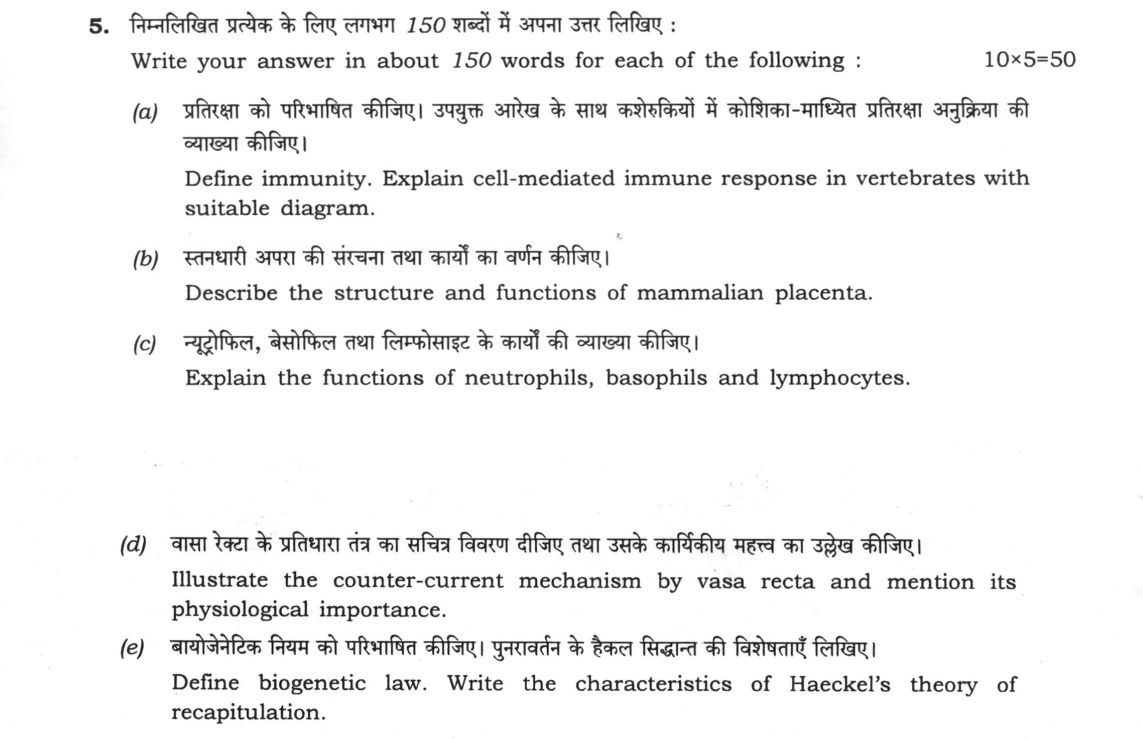
Write your answer in about 150 words for each of the following : 10×5=50 (a) Define immunity. Explain cell-mediated immune…
Write your answer in about 150 words for each of the following : 10×5=50
Define immunity. Explain cell-mediated immune response in vertebrates with suitable diagram.
Describe the structure and functions of mammalian placenta.
Explain the functions of neutrophils, basophils and lymphocytes.
Illustrate the counter-current mechanism by vasa recta and mention its physiological importance.
Define biogenetic law. Write the characteristics of Haeckel's theory of recapitulation.
हिंदी में प्रश्न पढ़ें
निम्नलिखित प्रत्येक के लिए लगभग 150 शब्दों में अपना उत्तर लिखिए : 10×5=50
प्रतिरक्षा को परिभाषित कीजिए। उपयुक्त आरेख के साथ कशेरुकियों में कोशिका-माध्यित प्रतिरक्षा अनुक्रिया की व्याख्या कीजिए।
स्तनधारी अपरा की संरचना तथा कार्यों का वर्णन कीजिए।
न्यूट्रोफिल, बेसोफिल तथा लिम्फोसाइट के कार्यों की व्याख्या कीजिए।
वासा रेक्टा के प्रतिधारा तंत्र का सचित्र विवरण दीजिए, तथा उसके कार्यिकीय महत्व का उल्लेख कीजिए।
बायोजेनेटिक नियम को परिभाषित कीजिए। पुनरावृत्ति के हैकल सिद्धांत की विशेषताएं लिखिए।
Model answer
Written by UPSC Answer Check against this question's marking rubric, to the 150-word length. UPSC does not publish answers for Mains — this is one way to score well, not an official key.
(a) Immunity and Cell-Mediated Immune Response
Immunity is the physiological state of an organism characterized by resistance against pathogenic microorganisms, foreign antigens, or abnormal cells. It comprises non-specific innate defenses and highly specific adaptive immunity, which is subdivided into humoral (antibody-mediated) and cell-mediated branches.
Cell-mediated immune response (CMIR) is orchestrated by T-lymphocytes without the involvement of free circulating antibodies. Antigen-presenting cells (APCs), such as dendritic cells and macrophages, engulf intracellular pathogens, process them, and display peptide fragments bound to Major Histocompatibility Complex (MHC) molecules on their surface.
`` [ Pathogen/Infected Cell ] │ ▼ [ APC processes ] ──(MHC-II:Antigen)──► [ CD4+ Helper T-cell ] [ Antigen ] │ │ (IL-2 / Cytokines) (MHC-I:Antigen) │ │ ▼ └─────────────────────────────► [ CD8+ Cytotoxic T-cell ] │ (Perforin / Granzymes) │ ▼ [ Target Cell Lysis/Apoptosis ] ``
Naïve CD4+ helper T-cells (Th) recognize antigen-MHC Class II complexes via their T-cell receptors (TCR) alongside CD28-B7 co-stimulation, subsequently secreting cytokines like Interleukin-2 (IL-2) and Interferon-gamma (IFN-γ). These cytokines activate CD8+ cytotoxic T-lymphocytes (Tc) and macrophages. Activated Tc cells recognize specific antigens presented by MHC Class I molecules on virus-infected or transformed cells, inducing apoptosis via the secretion of perforins, granzymes, or Fas-Fas ligand interactions. Regulatory T-cells (Treg) concurrently modulate the response to prevent autoimmune pathology.
(b) Structure and Functions of Mammalian Placenta
The mammalian placenta is a composite, temporary feto-maternal organ that develops during gestation to sustain the fetus. Structurally, it consists of a fetal component derived from the chorion (trophoblast layered with extraembryonic mesoderm) and a maternal component formed by the modified uterine endometrium (decidua basalis). Finger-like projections, termed chorionic villi, branch extensively and project into maternal blood sinuses. In the human hemochorial placenta, maternal blood enters the intervillous spaces via maternal spiral arteries, directly bathing the chorionic villi. The placental barrier consists of syncytiotrophoblast, cytotrophoblast, fetal connective tissue, and fetal capillary endothelium, preventing direct mixing of fetal and maternal blood while enabling selective exchange.
`` Maternal Blood Pool (Decidua Basalis) ◄──► [ Placental Barrier ] ◄──► Fetal Capillaries (Chorionic Villi) ``
Functionally, the placenta mediates physiological exchange by facilitating the diffusion of oxygen, glucose, amino acids, and fatty acids to the fetus, and clearing carbon dioxide and urea into maternal circulation. It acts as an active endocrine organ, synthesizing human chorionic gonadotropin (hCG) to maintain the corpus luteum, along with progesterone, estrogens, and human placental lactogen (hPL) to support gestation and mammary gland development. Furthermore, it serves as an immunological barrier by conferring passive immunity via the transcytosis of maternal IgG while suppressing maternal anti-fetal immune responses through non-classical HLA-G expression.
(c) Functions of Neutrophils, Basophils, and Lymphocytes
Neutrophils, basophils, and lymphocytes represent distinct leukocyte lineages that execute innate and adaptive immune defense:
Neutrophils are polymorphonuclear phagocytes that constitute the first cellular line of innate defense. They migrate rapidly to infection sites via chemotaxis, engulfing opsonized bacteria into phagosomes that fuse with lysosomes. Microbial destruction occurs via the respiratory burst, generating reactive oxygen species (ROS) such as superoxide and hypochlorous acid. Neutrophils also release Neutrophil Extracellular Traps (NETs)—web-like chromatin scaffolds studded with antimicrobial peptides—to ensnare and neutralize extracellular pathogens.
Basophils are circulating granulocytes expressing high-affinity IgE receptors (FcεRI). Upon antigen-mediated IgE cross-linking, they degranulate, releasing vasoactive mediators including histamine, heparin, leukotrienes, and platelet-activating factor. These substances induce vasodilation and increase vascular permeability, mediating allergic responses and antiparasitic immunity against helminths.
Lymphocytes direct adaptive and innate surveillance: B-lymphocytes differentiate into antibody-secreting plasma cells, producing immunoglobulins (IgM, IgG, IgA, IgE, IgD) to neutralize antigens and fix complement, while retaining memory B-cells. T-lymphocytes mediate cellular immunity; Th cells coordinate immune cascades via cytokines, while Tc cells directly lyse abnormal and virally infected cells. Natural Killer (NK) cells provide innate cytotoxicity against cells displaying downregulated MHC-I molecules or stress-induced ligands.
(d) Counter-Current Mechanism by Vasa Recta and Physiological Importance
The counter-current mechanism in the vasa recta operates as a counter-current exchanger to preserve the hyperosmotic medullary gradient established by the loops of Henle. The vasa recta are hairpin-shaped peritubular capillaries descending deep into the renal medulla parallel to the loops of Henle.
`` [ Cortex: 300 mOsm/kg ] Descending Limb Ascending Limb (Blood Inflow) (Blood Outflow) │ ▲ │ H2O exits │ H2O enters │ Solutes enter │ Solutes exit ▼ │ [ Deep Medulla: 1200 mOsm/kg ] ``
As blood flows down the descending limb into the hypertonic medullary interstitium, water diffuses out of the capillary into the interstitium, while solutes (NaCl and urea) diffuse into the blood. As blood turns the hairpin loop and flows up the ascending limb toward the cortex, the surrounding interstitium becomes progressively less concentrated; consequently, solutes diffuse out of the capillary back into the interstitium, while water is drawn back into the capillary.
Physiologically, this passive exchange prevents blood flow from washing away the hyperosmotic medullary solute gradient (increasing from 300 mOsm/kg at the corticomedullary junction to 1200 mOsm/kg at the papillary tip). Maintaining this hyperosmolar interstitium enables the collecting ducts, under the regulation of antidiuretic hormone (ADH), to reabsorb water osmotically, thereby producing hypertonic urine and conserving body water.
(e) Biogenetic Law and Characteristics of Haeckel's Theory of Recapitulation
The Biogenetic Law, formulated by Ernst Haeckel in 1866, is summarized by the aphorism "ontogeny recapitulates phylogeny." It posits that the developmental stages of an individual organism (ontogeny) represent a condensed, sequential repetition of the evolutionary adult stages of its ancestors (phylogeny).
Haeckel’s theory of recapitulation is characterized by two fundamental premises: the principle of terminal addition, which assumes that evolutionary novelties are added exclusively to the final adult stage of ancestral ontogeny, and the principle of condensation, which posits that ancestral developmental pathways are accelerated in time to accommodate new features within embryonic life. For example, Haeckel interpreted the transient presence of pharyngeal pouches and a post-anal tail in mammalian embryos as a direct replay of adult ancestral fish stages.
The theory faced severe scientific refutation. Karl Ernst von Baer's laws of embryology demonstrated that embryos share generalized taxonomic characteristics early in ontogeny, diverging into specialized traits later, without passing through adult forms of lower taxa. Modern evolutionary-developmental biology (evo-devo) rejects strict recapitulation, proving that evolution proceeds by modifying developmental timing (heterochrony), gene regulatory networks, and embryonic structures directly, rather than by appending traits onto fixed ancestral adult templates.
What "Explain" is asking you to do
Make the working of something clear — what sets it off, what follows from what, and what it produces. Explain is the Commission's mechanism word: it dominates the technical papers and the “explain why” stems, where the marks sit in the causal chain and not in the label.
Structure that answers it
State what it is → the initiating condition → the chain of cause, step by step → an instance where it plays out → what the chain produces
Where marks are lost
Describing what something looks like instead of why it works that way. Naming the stages without linking them reads as description too.
How this answer will be evaluated
Approach
Framework: Zoology Paper 2: Define > Structure/Mechanism > Diagram > Example. (a) explain: definition/context > points in order > small example > short close | (b) describe: define > structure or process in order > labelled diagram > significance | (c) explain: definition/context > points in order > small example > short close | (d) explain: definition/context > points in order > small example > short close | (e) define: precise definition > the distinguishing feature > one example Full marks: Precise definitions, detailed mechanisms, labelled diagrams, specific examples, clear distinction between concepts.
Key points expected
- Precise definition of immunity
- Steps of cell-mediated response (APC, T-cell activation)
- Suitable labelled diagram of the process
- Identification of effector cells (e.g., cytotoxic T cells)
- Description of structural layers (chorion, allantois, uterine wall)
- Explanation of exchange functions (nutrients, gases, waste)
- Mention of endocrine function (hormone production)
- Reference to specific placental type (e.g., hemochorial)
Evaluation rubric
Each sub-part is marked on its own, against the marks and word limit printed on the paper.
- (a) Definition of immunity and mechanism of cell-mediated response with diagram. · 150 words
explain— definition/context → points in order → small example → short close
Must cover
- Precise definition of immunity
- Steps of cell-mediated response (APC, T-cell activation)
- Suitable labelled diagram of the process
- Identification of effector cells (e.g., cytotoxic T cells)
Loses marks
- Diagram without labels
- Confusing cell-mediated with humoral response
- Vague definition of immunity
Earns more
- Mention of cytokines (e.g., IL-2)
- Distinction from humoral immunity
- Reference to specific vertebrate model
Extra mark
- Mention of specific MHC class I/II molecules
- Reference to specific pathogen (e.g., virus)
- (b) Structural layers and physiological functions of the mammalian placenta. · 150 words
describe— define → structure or process in order → labelled diagram → significance
Must cover
- Description of structural layers (chorion, allantois, uterine wall)
- Explanation of exchange functions (nutrients, gases, waste)
- Mention of endocrine function (hormone production)
- Reference to specific placental type (e.g., hemochorial)
Loses marks
- Omitting endocrine function
- Vague description of structure
- Confusing placenta with other fetal membranes
Earns more
- Mention of specific hormones (e.g., hCG, progesterone)
- Description of barrier function
- Comparison of placental types
Extra mark
- Mention of specific mammal (e.g., human, cow)
- Reference to placental development stages
- (c) Specific roles of neutrophils, basophils, and lymphocytes in immunity. · 150 words
explain— definition/context → points in order → small example → short close
Must cover
- Function of neutrophils (phagocytosis, first responders)
- Function of basophils (histamine release, allergic response)
- Function of lymphocytes (B and T cell roles)
- Distinction between innate and adaptive roles
Loses marks
- Confusing basophils with eosinophils
- Vague description of lymphocyte function
- Omitting one of the three cell types
Earns more
- Mention of specific granule contents
- Reference to specific immune pathways
- Mention of cytokine production
Extra mark
- Mention of specific diseases related to these cells
- Reference to specific markers (e.g., CD4, CD8)
- (d) Mechanism of counter-current exchange in vasa recta and its physiological role. · 150 words
explain— definition/context → points in order → small example → short close
Must cover
- Description of counter-current flow in vasa recta
- Explanation of osmotic gradient maintenance
- Mention of physiological importance (concentrated urine)
- Reference to medullary interstitium
Loses marks
- Confusing counter-current with co-current flow
- Omitting physiological importance
- Vague description of the mechanism
Earns more
- Mention of specific ions (Na+, Cl-)
- Reference to loop of Henle interaction
- Mention of urea recycling
Extra mark
- Mention of specific mammal (e.g., desert rat)
- Reference to specific kidney regions
- (e) Definition of biogenetic law and characteristics of Haeckel's recapitulation theory. · 150 words
define— precise definition → the distinguishing feature → one example
Must cover
- Precise definition of biogenetic law (ontogeny recapitulates phylogeny)
- Mention of Haeckel's theory of recapitulation
- Explanation of key characteristics (embryonic stages reflect ancestry)
- Reference to specific examples (e.g., gill slits in human embryos)
Loses marks
- Vague definition of biogenetic law
- Omitting Haeckel's name
- Confusing ontogeny with phylogeny
Earns more
- Mention of specific taxa (e.g., fish, amphibian, mammal)
- Reference to specific embryonic structures
- Mention of limitations of the theory
Extra mark
- Mention of specific Haeckel drawings
- Reference to modern developmental biology perspective
Practice this exact question
Write your answer and it is marked point by point against the model answer above — what you covered, what you missed, what you got wrong.
Evaluate my answer →More from Zoology 2022 Paper II
- Q2 (a) What is rough endoplasmic reticulum (RER)? Describe in detail the various modificatio…
- Q3 (a) Sketch out a basic transcription unit and illustrate the RNA polymerase II associated…
- Q4 (a) What is fossil? Describe the origin and evolution of horse based on the fossil record…
- Q5 Write your answer in about 150 words for each of the following : 10×5=50 (a) Define immun…
- Q6 (a) Draw the molecular structure of ATP synthase and diagrammatically explain the chemios…
- Q7 (a) What are intestinal glands? Describe the roles of intestinal juices in digestion and…
- Q8 (a) What is stem cell? Discuss the types of stem cells and their application in therapeut…