Paper II — Q3
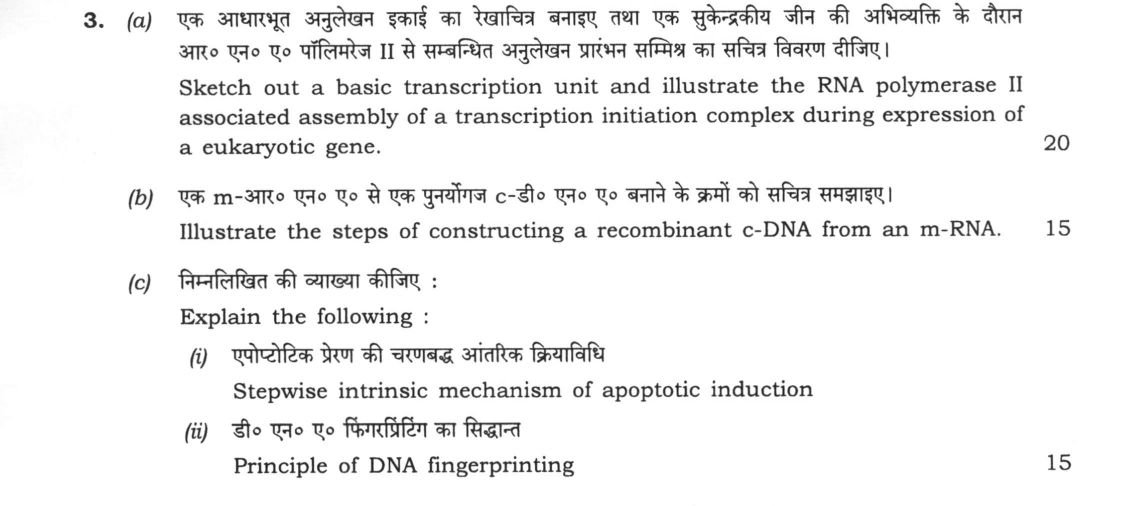
(a) Sketch out a basic transcription unit and illustrate the RNA polymerase II associated assembly of a transcription initiation…
Sketch out a basic transcription unit and illustrate the RNA polymerase II associated assembly of a transcription initiation complex during expression of a eukaryotic gene. 20 marks
Illustrate the steps of constructing a recombinant c-DNA from an m-RNA. 15 marks
Explain the following :
Stepwise intrinsic mechanism of apoptotic induction
Principle of DNA fingerprinting 15
हिंदी में प्रश्न पढ़ें
एक आधारभूत अनुलेखन इकाई का रेखाचित्र बनाइए तथा एक सुकेंद्रकीय जीन की अभिव्यक्ति के दौरान आर० एन० ए० पॉलिमरेज II से संबंधित अनुलेखन प्रारंभ सम्मिश्र का सचित्र विवरण दीजिए। 20
एक m-आर० एन० ए० से एक पुनर्योज्य c-डी० एन० बनाने के क्रमों को सचित्र समझाइए। 15
निम्नलिखित की व्याख्या कीजिए :
एपोप्टोटिक प्रेरण की चरणबद्ध आंतरिक क्रियाविधि
डी० एन० ए० फिंगरप्रिंटिंग का सिद्धांत 15
Model answer
Written by UPSC Answer Check against this question's marking rubric, to the expected length. UPSC does not publish answers for Mains — this is one way to score well, not an official key.
Eukaryotic Transcription Unit and RNA Polymerase II Assembly
A standard eukaryotic transcription unit comprises regulatory and coding elements arranged in a 5' to 3' polarity: upstream distal enhancers or silencers, a core and proximal promoter harboring the CAAT box (-75 to -80 bp) and TATA box (-25 to -30 bp), the transcription start site (+1), structural gene segments containing alternating coding exons and non-coding introns, and a downstream polyadenylation/termination signal.
`` [Enhancer]----[CAAT Box]--[TATA Box]----[+1 TSS]---[Exon 1]-[Intron]-[Exon 2]----[Poly-A Site] ``
Initiation by RNA Polymerase II involves the sequential assembly of the Pre-Initiation Complex (PIC). First, the TATA-binding protein (TBP), a subunit of Transcription Factor II D (TFIID), binds the minor groove of the TATA box, bending the DNA helix. Transcription factors TFIIA and TFIIB then join, stabilizing TFIID and recruiting RNA Polymerase II complexed with TFIIF to the promoter. Subsequently, TFIIE and TFIIH are recruited to complete the PIC. TFIIH acts as an ATP-dependent helicase to melt the DNA duplex at the start site, forming the open promoter complex. Its cyclin-dependent kinase subunit phosphorylates the Ser-5 residues within the heptapeptide repeats (Tyr-Ser-Pro-Thr-Ser-Pro-Ser) of the Carboxy-Terminal Domain (CTD) of RNA Polymerase II, releasing the enzyme from the promoter to commence productive elongation.
Construction of Recombinant c-DNA from m-RNA
Unlike genomic DNA libraries that retain non-coding introns, complementary DNA (cDNA) libraries represent exclusively processed, mature mRNA transcripts, making them indispensable for recombinant protein expression in prokaryotic systems.
`` mRNA: 5'-Cap====================AAAAA-3' Oligo(dT) Priming: <---TTTTT-5' Reverse Transcr.: 5'-Cap====================AAAAA-3' 3'------------------------TTTTT-5' (cDNA 1st strand) RNase H & Pol I: 3'------------------------TTTTT-5' 5'========================AAAAA-3' (cDNA 2nd strand) Linker Ligation: [Linker]-=================[Linker] -> Restriction -> Vector Cloning ``
The construction follows definite biochemical steps:
- Isolation and Priming: Polyadenylated eukaryotic mRNA is isolated and hybridized with a synthetic oligo-dT primer complementary to its 3' poly(A) tail.
- First-Strand Synthesis: Avian myeloblastosis virus (AMV) or Moloney murine leukemia virus (M-MuLV) reverse transcriptase synthesizes a complementary DNA strand using dNTPs, generating an mRNA-cDNA hybrid.
- Second-Strand Synthesis: RNase H introduces single-strand nicks into the RNA template. DNA Polymerase I utilizes these fragments as primers to synthesize the second DNA strand via nick translation. Residual hairpin loops or single-stranded overhangs are trimmed by S1 nuclease.
- Adapter Ligation and Cloning: Chemically synthesized linkers or adapters containing specific restriction endonuclease recognition sequences are ligated to the blunt-ended double-stranded cDNA using T4 DNA ligase. Following restriction endonuclease cleavage to expose cohesive ends, the recombinant cDNA is ligated into an expression vector (e.g., pUC19) and transformed into competent bacterial hosts.
Mechanisms of Apoptotic Induction and DNA Fingerprinting
Intrinsic Mechanism of Apoptotic Induction: The intrinsic (mitochondrial) apoptotic pathway is triggered by intracellular stressors like DNA damage and oxidative stress, contrasting with the extrinsic pathway activated by transmembrane death receptors (FasL/TNF-α). The pathway is governed by the Bcl-2 protein family. Pro-survival proteins (Bcl-2, Bcl-xL) are inhibited by BH3-only proteins (Puma, Bim, Noxa), leading to the homooligomerization of pro-apoptotic effectors Bax and Bak at the outer mitochondrial membrane. This causes Mitochondrial Outer Membrane Permeabilization (MOMP), releasing Cytochrome c and Smac/DIABLO into the cytosol.
Cytochrome c binds the adaptor protein Apaf-1 (Apoptotic Protease Activating Factor-1) in the presence of dATP, polymerizing into a heptameric wheel-like structure called the apoptosome. The apoptosome recruits and cleaves procaspase-9 into active caspase-9. Activated caspase-9 then cleaves and activates downstream executioner caspases (caspase-3, caspase-6, and caspase-7), initiating structural protein degradation and CAD-mediated internucleosomal DNA fragmentation. Fundamental insights into these caspase regulatory networks have been extensively investigated at institutions such as the Centre for Cellular and Molecular Biology (CCMB), Hyderabad.
Principle of DNA Fingerprinting: DNA fingerprinting relies on the vast inter-individual sequence polymorphism present in non-coding regions of the eukaryotic genome, specifically Variable Number Tandem Repeats (VNTRs/minisatellites), Short Tandem Repeats (STRs/microsatellites), and Single Nucleotide Polymorphisms (SNPs).
High-molecular-weight genomic DNA is extracted and cleaved with restriction endonucleases (or specific loci are amplified using multiplex PCR). The resulting fragments are fractionated by size using agarose gel electrophoresis and denatured. The single-stranded DNA fragments are transferred onto a nylon or nitrocellulose membrane via Southern blotting. The membrane is then incubated with radioactively or fluorescently labelled DNA probes complementary to hypervariable minisatellite sequences (such as BKm probes pioneered in India by Lalji Singh). Following unhybridized probe wash-off, autoradiography produces an individual-specific banding profile.
The match probability between samples is determined by statistical population genetics based on Hardy-Weinberg equilibrium. In the Indian applied context, this methodology provides definitive forensic identification in criminal investigations and disputed parentage cases conducted by the Central Forensic Science Laboratories (CFSL) at Hyderabad and Kolkata, and serves as an evidentiary tool in citizenship and lineage verification within the National Register of Citizens (NRC) framework in Assam.
What "Illustrate" is asking you to do
Carry the point with concrete cases rather than assert it, so the examples do the work of proving it. In the technical papers illustrate is often literal — a labelled diagram, a map, a graph — and an answer without the figure has not complied with the instruction.
Structure that answers it
The point stated → example 1 with the feature it demonstrates → example 2 → example 3 or the required diagram → what the set of examples establishes
Where marks are lost
Examples named and then abandoned. A case listed without the sentence showing what it demonstrates is marked as recall of information, not as illustration.
How this answer will be evaluated
Approach
Framework: Molecular Biology: Transcription & Recombinant DNA Technology. (a) explain: definition/context > points in order > small example > short close | (b) explain: definition/context > points in order > small example > short close | (c) explain: definition/context > points in order > small example > short close Full marks: Accurate diagrams, precise molecular names, clear stepwise logic.
Key points expected
- TATA box
- RNA Polymerase II
- Pre-Initiation Complex
- Reverse Transcriptase
- cDNA
- Cytochrome c
- Apoptosome
- Caspase cascade
- RFLP
- Southern Blotting
Evaluation rubric
Each sub-part is marked on its own, against the marks and word limit printed on the paper.
- (a) Diagram of transcription unit and stepwise assembly of RNA Pol II initiation complex. 20 marks
explain— definition/context → points in order → small example → short close
Must cover
- Labelled diagram of transcription unit (promoter, terminator, coding region)
- Identify TATA box and TFIID (TBP) binding
- Sequential binding of TFIIB, TFIIF, RNA Pol II
- Formation of Pre-Initiation Complex (PIC) and promoter clearance
Loses marks
- Unlabelled or missing diagrams
- Confusing prokaryotic sigma factor with eukaryotic TFIID
Earns more
- Mention of TFIIE and TFIIH roles
- Distinction between template and coding strand
- Reference to +1 transcription start site
Extra mark
- Mention of CTD phosphorylation of RNA Pol II
- (b) Stepwise process of cDNA synthesis from mRNA using reverse transcriptase. 15 marks
explain— definition/context → points in order → small example → short close
Must cover
- Isolation of mRNA and reverse transcription to first cDNA strand
- Removal of RNA strand (RNase H) and second strand synthesis
- Cloning into vector (plasmid) with appropriate linkers/adapters
- Transformation and screening for recombinant clones
Loses marks
- Skipping the second strand synthesis step
- Confusing cDNA with genomic DNA cloning
Earns more
- Mention of poly-A tail as primer site
- Use of DNA polymerase I for gap filling
- Reference to cDNA library construction
Extra mark
- Mention of specific enzymes like Klenow fragment
- (c) Mechanism of intrinsic apoptosis and the principle of DNA fingerprinting. 15 marks
explain— definition/context → points in order → small example → short close
Must cover
- Intrinsic pathway: mitochondrial damage, cytochrome c release
- Apoptosome formation (Apaf-1, procaspase-9) and caspase activation
- DNA fingerprinting: restriction digestion of DNA
- Gel electrophoresis and Southern blotting for RFLP analysis
Loses marks
- Confusing intrinsic with extrinsic (death receptor) pathway
- Describing PCR instead of Southern blotting for fingerprinting
Earns more
- Mention of Bcl-2 family proteins (Bax/Bak)
- Reference to VNTRs or STRs in fingerprinting
- Application in paternity testing or forensics
Extra mark
- Mention of specific probes used in Southern blotting
Practice this exact question
Write your answer and it is marked point by point against the model answer above — what you covered, what you missed, what you got wrong.
Evaluate my answer →More from Zoology 2022 Paper II
- Q1 Write your answer in about 150 words for each of the following : 10×5=50 (a) Draw the str…
- Q2 (a) What is rough endoplasmic reticulum (RER)? Describe in detail the various modificatio…
- Q3 (a) Sketch out a basic transcription unit and illustrate the RNA polymerase II associated…
- Q4 (a) What is fossil? Describe the origin and evolution of horse based on the fossil record…
- Q5 Write your answer in about 150 words for each of the following : 10×5=50 (a) Define immun…
- Q6 (a) Draw the molecular structure of ATP synthase and diagrammatically explain the chemios…