Paper II — Q7
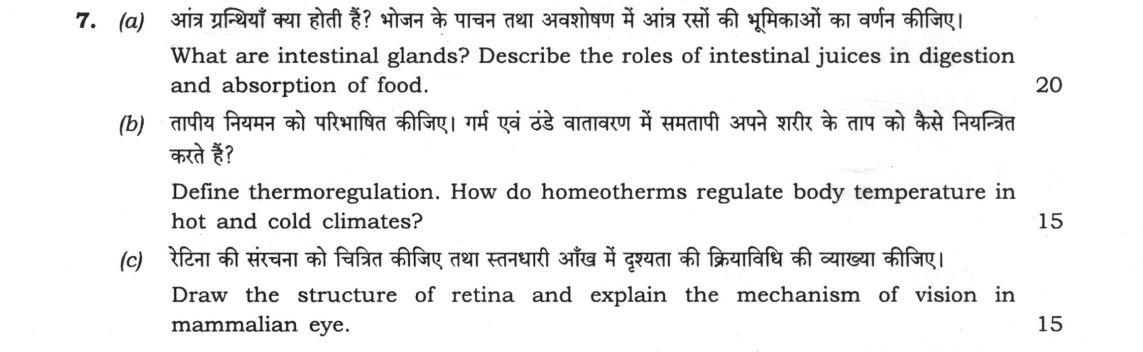
(a) What are intestinal glands? Describe the roles of intestinal juices in digestion and absorption of food. 20 (b) Define…
What are intestinal glands? Describe the roles of intestinal juices in digestion and absorption of food. 20 marks
Define thermoregulation. How do homeotherms regulate body temperature in hot and cold climates? 15 marks
Draw the structure of retina and explain the mechanism of vision in mammalian eye. 15 marks
हिंदी में प्रश्न पढ़ें
आंत्र प्रथियां क्या होती हैं? भोजन के पाचन तथा अवशोषण में आंत्र रसों की भूमिकाओं का वर्णन कीजिए। 20
तापीय नियमन को परिभाषित कीजिए। गर्म एवं ठंडे वातावरण में समतापी अपने शरीर के ताप को कैसे नियंत्रित करते हैं? 15 marks
रेटिना की संरचना को चित्रित कीजिए तथा स्तनधारी आंख में दृश्यता की क्रियाविधि की व्याख्या कीजिए। 15
Model answer
Written by UPSC Answer Check against this question's marking rubric, to the expected length. UPSC does not publish answers for Mains — this is one way to score well, not an official key.
(a) Intestinal glands and intestinal juices. Intestinal glands are the simple tubular crypts of Lieberkühn lying in the mucosa of the small intestine, between villi. They are mucosal glands, distinct from the submucosal Brunner’s glands of the duodenum, which secrete alkaline mucus to protect the duodenal wall. The crypts contain enterocytes and goblet cells, and secrete succus entericus. The secreted juice is watery and contains mucus, electrolytes, bicarbonate and some lipase and nucleosidases; the peptidases and saccharases that complete digestion are largely integral brush-border enzymes of enterocytes, not free soluble juice. Enterokinase, a duodenal brush-border enzyme, activates trypsinogen. Brush-border disaccharidases such as maltase, sucrase, lactase and isomaltase hydrolyse maltose, sucrose, lactose and α-limit dextrins to monosaccharides, while peptidases convert di- and tripeptides to amino acids. Intestinal lipase acts mainly on monoglycerides, complementing pancreatic lipase, which has already hydrolysed triglycerides to fatty acids and monoglycerides. Absorption depends on villi and microvilli, which enlarge surface area. Glucose and galactose enter enterocytes apically by Na+-coupled SGLT1; fructose enters by facilitated diffusion through GLUT5. All monosaccharides leave basolaterally by GLUT2 into blood. Amino acids use separate Na+-dependent and Na+-independent amino-acid transporters, not SGLT1/GLUT2. Fatty acids and monoglycerides are reassembled into chylomicrons and enter lacteals, while water, electrolytes and small molecules move through paracellular and transcellular routes.
(b) Thermoregulation. Thermoregulation is the maintenance of thermal homeostasis by balancing heat production and heat loss around a hypothalamic set point, using negative feedback. Poikilotherms largely allow body temperature to vary with environment; homeotherms maintain a narrow internal range; heterotherms alternate between homeothermic and poikilothermic states, as in some hibernators. In cold climates, homeotherms conserve heat by cutaneous vasoconstriction, piloerection to trap air, reduced surface-area exposure, shivering thermogenesis and non-shivering thermogenesis in brown adipose tissue, where uncoupling protein 1 dissipates the proton gradient as heat; Himalayan tahr and other high-altitude mammals use thick coats, dense fur and metabolic heat production. In hot climates, they lose heat by cutaneous vasodilation, sweating, panting, radiation from large ears and nasal passages, and postural or behavioural adjustments. Indian examples include desert foxes of the Thar using burrows and nocturnal activity, and blackbucks reducing midday activity and seeking shade. The hypothalamus integrates cutaneous and core temperature signals, activating sympathetic, endocrine and behavioural responses to restore the set point.
(c) Retina and vision. In a drawn transverse section, the mammalian retina is inverted and lies between the choroid and vitreous humour. From choroid outward, the layers are retinal pigment epithelium, photoreceptor layer of rods and cones, external limiting membrane, outer nuclear layer, outer plexiform layer, inner nuclear layer, inner plexiform layer, ganglion cell layer, nerve fibre layer, and internal limiting membrane. The fovea centralis is a thin, cone-rich pit for sharp vision; the optic disc is the blind spot where ganglion axons leave. Light passes through cornea, pupil, aqueous humour, lens and vitreous humour and is focused on the retina. In rods, a photon is absorbed by 11-cis retinal in rhodopsin, converting it to all-trans retinal and activating metarhodopsin II. This activates transducin, which activates phosphodiesterase; cGMP falls, cGMP-gated sodium channels close, and the photoreceptor hyperpolarises. It releases less glutamate onto bipolar cells, changing their sign and driving ganglion cells to fire action potentials. Cones use iodopsins for colour and high-acuity vision. Signals pass through bipolar cells, amacrine cells and ganglion cells, whose axons form the optic nerve to the brain. Dark adaptation is slow because rhodopsin must be regenerated; light adaptation is rapid because excess light bleaches rhodopsin, reduces sensitivity and shifts vision toward cones. Thus, intestinal digestion, hypothalamic thermoregulation and retinal vision show how epithelial, endocrine and neural control maintain internal order.
What "Describe" is asking you to do
Give a full, ordered account of the thing named — its parts, stages or mechanism — in the sequence in which it actually exists or occurs. Most describe questions come from the science optionals, where the marks sit in correct technical detail and, where the stem says so, a labelled diagram.
Structure that answers it
One-line identification of the subject → the parts or stages in their real order, each with its defining detail → labelled diagram where the subject is structural → closing line on function or significance
Where marks are lost
Loose general prose where the examiner is ticking named parts, correct terminology and their sequence; and in the General Studies papers, turning to evaluation before the description is finished.
How this answer will be evaluated
Approach
Framework: UPSC Zoology Paper 2. (a) describe: define > structure or process in order > labelled diagram > significance | (b) explain: definition/context > points in order > small example > short close | (c) explain: definition/context > points in order > small example > short close Full marks: Precise definitions, detailed mechanisms, and accurate labelled diagrams.
Key points expected
- Define intestinal glands (Crypts of Lieberkühn)
- Identify specific enzymes (e.g., maltase, sucrase, peptidases)
- Explain the mechanism of absorption (e.g., active transport)
- Mention the role of mucus in protection
- Define thermoregulation
- Explain heat loss mechanisms in hot climates (e.g., sweating)
- Explain heat conservation in cold climates (e.g., shivering)
- Mention the role of the hypothalamus
Evaluation rubric
Each sub-part is marked on its own, against the marks and word limit printed on the paper.
- (a) Define intestinal glands and detail the roles of intestinal juices in digestion and absorption. 20 marks
describe— define → structure or process in order → labelled diagram → significance
Must cover
- Define intestinal glands (Crypts of Lieberkühn)
- Identify specific enzymes (e.g., maltase, sucrase, peptidases)
- Explain the mechanism of absorption (e.g., active transport)
- Mention the role of mucus in protection
Loses marks
- Confusing intestinal juice with pancreatic juice
- Failing to distinguish digestion from absorption
- Vague description of 'enzymes' without naming them
Earns more
- Mention specific transport mechanisms (e.g., Na+/glucose co-transport)
- Reference specific cell types (enterocytes, goblet cells)
- Mention the role of brush border enzymes
Extra mark
- Mention specific hormones regulating secretion (e.g., secretin)
- Reference specific transporters (e.g., SGLT1)
- (b) Define thermoregulation and explain homeothermic regulation in hot and cold climates. 15 marks
explain— definition/context → points in order → small example → short close
Must cover
- Define thermoregulation
- Explain heat loss mechanisms in hot climates (e.g., sweating)
- Explain heat conservation in cold climates (e.g., shivering)
- Mention the role of the hypothalamus
Loses marks
- Confusing homeotherms with poikilotherms
- Failing to distinguish hot vs. cold regulation
- Omitting the role of the hypothalamus
Earns more
- Mention vasodilation and vasoconstriction
- Reference specific examples (e.g., humans, birds)
- Mention behavioral adaptations (e.g., huddling)
Extra mark
- Mention specific physiological pathways (e.g., sympathetic nervous system)
- Reference specific hormones (e.g., thyroxine)
- (c) Draw the structure of the retina and explain the mechanism of vision in the mammalian eye. 15 marks
explain— definition/context → points in order → small example → short close
Must cover
- Draw a labelled diagram of the retina
- Identify photoreceptors (rods and cones)
- Explain the phototransduction mechanism
- Describe the pathway to the optic nerve
Loses marks
- Diagram without labels
- Failing to explain the mechanism of vision
- Confusing rods and cones functions
Earns more
- Mention the role of the fovea centralis
- Reference specific neurotransmitters (e.g., glutamate)
- Mention the role of the optic chiasma
Extra mark
- Mention specific visual pigments (e.g., rhodopsin)
- Reference specific retinal layers (e.g., ganglion cell layer)
Practice this exact question
Write your answer and it is marked point by point against the model answer above — what you covered, what you missed, what you got wrong.
Evaluate my answer →More from Zoology 2022 Paper II
- Q4 (a) What is fossil? Describe the origin and evolution of horse based on the fossil record…
- Q5 Write your answer in about 150 words for each of the following : 10×5=50 (a) Define immun…
- Q6 (a) Draw the molecular structure of ATP synthase and diagrammatically explain the chemios…
- Q7 (a) What are intestinal glands? Describe the roles of intestinal juices in digestion and…
- Q8 (a) What is stem cell? Discuss the types of stem cells and their application in therapeut…