Paper I — Q1
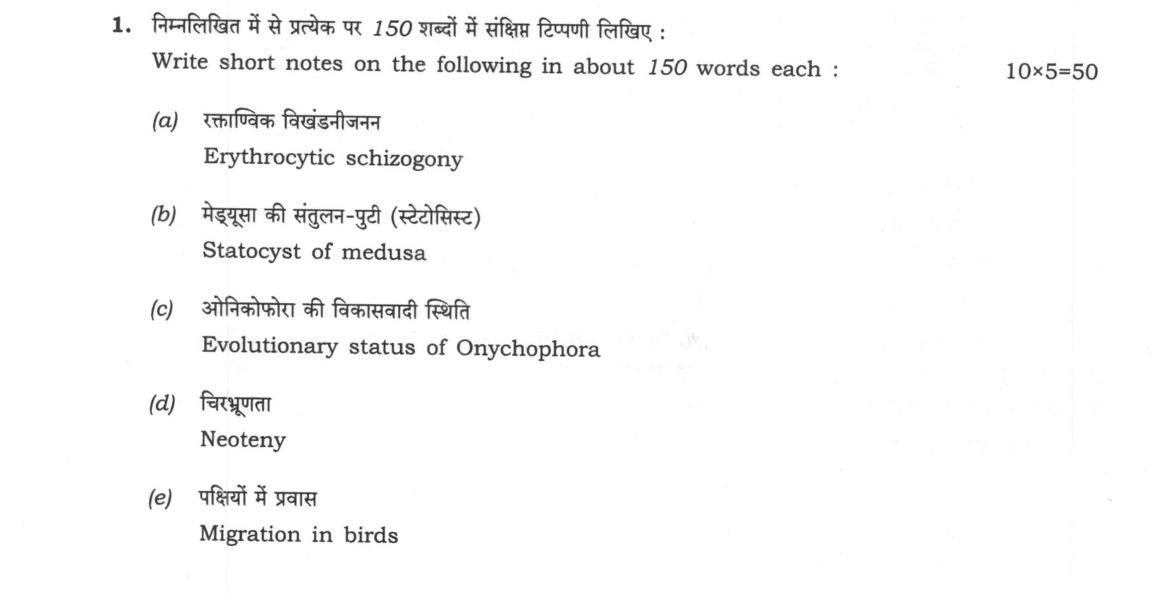
Write short notes on the following in about 150 words each: (a) Erythrocytic schizogony (10 marks) (b) Statocyst of medusa (10…
Write short notes on the following in about 150 words each: Erythrocytic schizogony 10 marks
Statocyst of medusa 10 marks
Evolutionary status of Onychophora 10 marks
Neoteny 10 marks
Migration in birds 10 marks
हिंदी में प्रश्न पढ़ें
निम्नलिखित में से प्रत्येक पर 150 शब्दों में संक्षिप्त टिप्पणी लिखिए : रक्ताण्विक विखण्डनिजन (10 अंक)
मेड्यूसा की संतुलन-पुटी (स्टैटोसिस्ट) (10 अंक)
ओनिकोफोरा की विकासवादी स्थिति (10 अंक)
चिरभूणता (10 अंक)
पक्षियों में प्रवास (10 अंक)
Model answer
Written by UPSC Answer Check against this question's marking rubric, to the 150-word length. UPSC does not publish answers for Mains — this is one way to score well, not an official key.
(a) Erythrocytic Schizogony
Erythrocytic schizogony is the recurring asexual reproductive cycle of Plasmodium occurring inside host erythrocytes. Following the initial asymptomatic exo-erythrocytic (hepatic) schizogony where cryptomerozoites are produced in liver parenchymal cells, the released merozoites invade red blood cells (RBCs). Inside the RBC, the parasite develops through the ring (young trophozoite) and amoeboid trophozoite stages, actively ingesting hemoglobin. Digestion of hemoglobin produces the characteristic toxic, crystalline pigment called hemozoin. The trophozoite undergoes multiple nuclear divisions to form a multinucleate schizont, which eventually cleaves into 12 to 24 erythrocytic merozoites arranged in a typical rosette pattern.
Lysis of the host erythrocyte releases these merozoites alongside metabolic wastes and hemozoin into the bloodstream. This synchronous rupture underpins the clinical pathogenesis of malaria, provoking the hallmark paroxysms of shaking chills and high fever at characteristic species-specific intervals (e.g., 48 hours in Plasmodium vivax, 72 hours in Plasmodium malariae). The released merozoites reinvade fresh RBCs to sustain the erythrocytic cycle or differentiate into micro- and macrogametocytes for sexual development inside the female Anopheles mosquito.
(b) Statocyst of Medusa
The statocyst is a specialized mechanoreceptive sense organ responsible for balance, equilibrium, and geotactic orientation in Cnidarian medusae. Structurally, it consists of a fluid-filled ectodermal vesicle lined internally with sensory epithelial cells equipped with tactile hair-like projections (stereocilia). Suspended within this cavity is a dense, movable calcareous concretion known as a statolith or statocone, composed predominantly of calcium carbonate or calcium sulphate secreted by a specialized lithocyte cell.
In Hydromedusae, statocysts occur along the circular umbrella margin at the bases of perradial or interradial tentacles. In Scyphomedusae such as Aurelia, the statocyst is modified into a sensory club-like rhopalium positioned within marginal notches flanked by marginal lapels. When the medusa tilts or changes swimming trajectory during locomotion, gravity causes the dense statolith to roll against the sensory hairs. Mechanical deformation of these stereocilia initiates action potentials across the marginal nerve ring, coordinating asymmetric contractions of subumbrellar coronal musculature to restore proper vertical orientation during swimming.
(c) Evolutionary Status of Onychophora
Onychophora (e.g., Peripatus) represents a classic "living fossil" exhibiting mosaic evolution, historically interpreted as an evolutionary connecting link between Annelida and Arthropoda. Annelid affinities include a thin, flexible, non-calcified cuticle, a continuous dermo-muscular body wall with circular and longitudinal muscle layers, paired segmental metanephridia, and unjointed, non-articulated lobopodous appendages. Arthropod characteristics comprise a chitinous cuticle requiring ecdysis, a tracheal respiratory system opening via spiracles, a reduced coelom modified into a hemocoel with an open circulatory system, a tubular dorsal heart, modified head appendages functioning as jaws, and a pair of salivary glands.
Onychophora also possesses unique autapomorphies, most notably oral slime glands capable of ejecting defensive proteinaceous adhesive jets, and unjointed stumpy legs (lobopodia) terminating in paired terminal claws. Modern molecular phylogenetics places Onychophora in the clade Panarthropoda (along with Tardigrada and Arthropoda). Phylogenomic analyses resolve Onychophora either as the immediate sister group to Arthropoda or sister to a clade containing Tardigrada and Euarthropoda, providing critical insights into the early evolutionary transition from soft-bodied vermiform ancestors to segmented, hard-exoskeleton arthropods.
(d) Neoteny
Neoteny is a heterochronic evolutionary and developmental phenomenon characterized by the retention of ancestral larval or juvenile morphological traits in a sexually mature adult organism. It occurs due to the retardation or deceleration of somatic tissue differentiation and growth relative to normal germline maturation. Neoteny is a specific mechanism of paedomorphosis; it contrasts with progenesis, wherein somatic development proceeds at a standard rate while sexual maturation is abnormally accelerated.
The classic zoological example of neoteny occurs in the Mexican axolotl (Ambystoma mexicanum), an amphibian that remains permanently aquatic, retaining external gills, four pairs of gill clefts, and a larval caudal fin throughout its adult reproductive life due to a deficiency in thyroid-stimulating hormone (TSH) release, which prevents endogenous thyroxine synthesis. In human evolution, cranial neoteny represents an evolutionary milestone: adult humans retain juvenile hominid cranial features, including a large brain-to-body ratio, a globular cranium, a non-prognathic orthognathous facial profile, and delayed cranial suture closure, facilitating extended post-natal neuroplasticity and prolonged learning capacities.
(e) Migration in Birds
Avian migration refers to the regular, cyclical, two-way seasonal displacement of bird populations between breeding grounds and non-breeding wintering areas. In India, notable migratory phenomena include the winter migration of the Siberian Crane (Leucogeranus leucogeranus) along the Central Asian Flyway to Keoladeo National Park (Bharatpur), and the massive autumnal congregation of the Amur Falcon (Falco amurensis) in the Doyang reservoir region of Nagaland while en route from eastern Asia to southern Africa.
Migration is governed by proximate and ultimate factors. Proximate triggers include changing photoperiods acting upon the pineal-hypothalamic-hypophyseal axis, which elevates prolactin and corticosterone levels, inducing pre-migratory restlessness (Zugunruhe), hyperphagia, and subcutaneous lipid deposition. Ultimate factors center on maximizing reproductive fitness by tracking seasonal food abundance and avoiding winter weather extremes. Navigation involves multi-sensory mechanisms, including solar compass orientation, celestial star patterns, olfactory maps, landscape topography, and geomagnetic sensing mediated by cryptochrome proteins in retinal cells combined with upper-beak magnetite mineral receptors.
What "Write short notes" is asking you to do
Five or six self-contained answers, marked separately, typically 10 marks and about 150 words each. Each note must carry its own definition, its two or three defining features and a line on why it matters; a common introduction or conclusion across the notes earns nothing.
Structure that answers it
Per note: one-line definition or identification → two or three features, mechanisms or named examples → one line of significance or Indian application
Where marks are lost
Writing the first two notes at essay length and rationing the rest. Each note is marked on its own, so marks surrendered on a compressed or unattempted note cannot be won back by the long ones.
How this answer will be evaluated
Approach
Framework: Zoology Paper 1: Define > Structure/Mechanism > Diagram > Example. (a) write short notes: define > 3-4 key features > one example > one-line significance | (b) write short notes: define > 3-4 key features > one example > one-line significance | (c) write short notes: define > 3-4 key features > one example > one-line significance | (d) write short notes: define > 3-4 key features > one example > one-line significance | (e) write short notes: define > 3-4 key features > one example > one-line significance Full marks: Precise definitions, correct mechanisms, named species, labelled diagrams, clear evolutionary/functional links.
Key points expected
- Define erythrocytic schizogony (blood stage)
- Sequence: merozoite -> trophozoite -> schizont
- Mention pigment (hemozoin) formation
- Link to clinical symptoms (fever/chills)
- Define statocyst as a balance organ
- Identify statoliths (statoliths) and statocyst membrane
- Explain mechanism of gravity detection
- Mention location (subumbrellar margin)
Evaluation rubric
Each sub-part is marked on its own, against the marks and word limit printed on the paper.
- (a) Define erythrocytic schizogony and describe the asexual cycle in RBCs. · 150 words
write short notes— define → 3-4 key features → one example → one-line significance
Must cover
- Define erythrocytic schizogony (blood stage)
- Sequence: merozoite -> trophozoite -> schizont
- Mention pigment (hemozoin) formation
- Link to clinical symptoms (fever/chills)
Loses marks
- Confusing with sporogony
- Omitting pigment formation
- No mention of RBC rupture
Earns more
- Distinguish from sporogony (vector stage)
- Mention specific species (e.g., P. vivax)
- Labelled diagram of schizont
Extra mark
- Mention specific vector (Anopheles)
- (b) Describe the structure and function of the statocyst in medusae. · 150 words
write short notes— define → 3-4 key features → one example → one-line significance
Must cover
- Define statocyst as a balance organ
- Identify statoliths (statoliths) and statocyst membrane
- Explain mechanism of gravity detection
- Mention location (subumbrellar margin)
Loses marks
- Confusing with ocellus (light sense)
- Omitting statoliths
- No mention of gravity detection
Earns more
- Mention specific medusa (e.g., Aurelia)
- Labelled diagram of statocyst
- Link to orientation in water
Extra mark
- Mention specific species (e.g., Aurelia aurita)
- (c) Discuss the evolutionary position of Onychophora between arthropods and annelids. · 150 words
write short notes— define → 3-4 key features → one example → one-line significance
Must cover
- Define Onychophora (velvet worms)
- List annelid-like features (e.g., nephridia)
- List arthropod-like features (e.g., tracheae)
- State evolutionary significance (linking group)
Loses marks
- Treating as pure arthropod
- Omitting annelid features
- No mention of evolutionary link
Earns more
- Mention specific genus (e.g., Peripatus)
- Mention haemocoel vs coelom
- Mention book lungs
Extra mark
- Mention specific genus (e.g., Peripatus)
- (d) Define neoteny and explain its mechanism and examples. · 150 words
write short notes— define → 3-4 key features → one example → one-line significance
Must cover
- Define neoteny (retention of juvenile traits)
- Explain mechanism (delayed metamorphosis)
- Give example (e.g., Axolotl)
- Distinguish from paedomorphosis
Loses marks
- Confusing with paedomorphosis
- No mention of mechanism
- No example given
Earns more
- Mention specific species (e.g., Ambystoma mexicanum)
- Mention thyroid hormone role
- Mention reproductive maturity in juvenile form
Extra mark
- Mention specific species (e.g., Ambystoma mexicanum)
- (e) Describe bird migration, its causes, and navigation mechanisms. · 150 words
write short notes— define → 3-4 key features → one example → one-line significance
Must cover
- Define migration (seasonal movement)
- List causes (food, breeding, climate)
- Explain navigation (magnetic, stellar)
- Give example (e.g., Arctic tern)
Loses marks
- Confusing with dispersal
- No mention of navigation
- No example given
Earns more
- Mention specific species (e.g., Grus grus)
- Mention magnetic compass
- Mention stellar navigation
Extra mark
- Mention specific species (e.g., Grus grus)
Practice this exact question
Write your answer and it is marked point by point against the model answer above — what you covered, what you missed, what you got wrong.
Evaluate my answer →More from Zoology 2023 Paper I
- Q1 Write short notes on the following in about 150 words each: (a) Erythrocytic schizogony (…
- Q2 (a) Define conjugation. Explain the mechanism of conjugation in Paramecium. Also give its…
- Q3 (a) Explain the general features, life cycle and pathogenicity of Taenia. (20 marks) (b)…
- Q4 (a) Draw a well-labelled diagram of adrenal gland and discuss the functions of its hormon…