Paper I — Q5
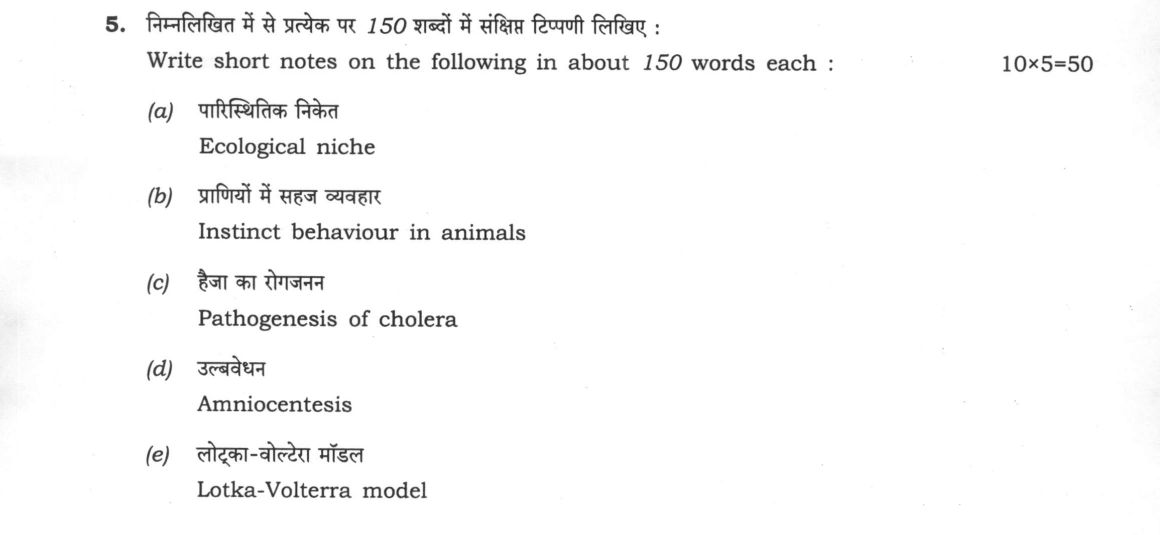
Write short notes on the following in about 150 words each: (a) Ecological niche (10 marks) (b) Instinct behaviour in animals (10…
Write short notes on the following in about 150 words each: Ecological niche 10 marks
Instinct behaviour in animals 10 marks
Pathogenesis of cholera 10 marks
Amniocentesis 10 marks
Lotka-Volterra model 10 marks
हिंदी में प्रश्न पढ़ें
निम्नलिखित में से प्रत्येक पर 150 शब्दों में संक्षिप्त टिप्पणी लिखिए : पारिस्थितिक निकेत (10 अंक)
प्राणियों में सहज व्यवहार (10 अंक)
हैजा का रोगजनन (10 अंक)
उल्बवेधन (10 अंक)
लोटका-वोल्टेरा मॉडल (10 अंक)
Model answer
Written by UPSC Answer Check against this question's marking rubric, to the 150-word length. UPSC does not publish answers for Mains — this is one way to score well, not an official key.
(a) Ecological Niche
The ecological niche represents the functional role, physical space, and environmental tolerances of a species within an ecosystem. G.E. Hutchinson formalized this as an "n-dimensional hypervolume," defined by the multi-dimensional envelope of abiotic and biotic gradients (such as temperature, moisture, and food size) within which a population can persist indefinitely.
A critical distinction exists between the fundamental niche—the full theoretical range of environmental conditions a species can physiologically inhabit in the absence of interspecific competition—and the realized niche, which is the narrower spectrum of resources and habitats actually occupied due to biological constraints like predation, parasitism, and competitive exclusion (Gause's principle).
For example, in the tropical wet evergreen forests of the Western Ghats, the endemic Lion-tailed macaque (Macaca silenus) occupies a specialized realized niche confined predominantly to the upper canopy layer, feeding selectively on specific rainforest fruits and seeds, thereby partitioning resources with sympatric arboreal primates.
(b) Instinct Behaviour in Animals
Instinct or innate behaviour encompasses genetically hardwired, unlearned, and stereotyped behavioural responses that are performed completely upon first exposure to the appropriate stimulus. Formulated by ethologists Konrad Lorenz and Niko Tinbergen, instinctive acts are structured around Fixed Action Patterns (FAPs)—invariant motor sequences that, once triggered, run to completion regardless of sensory feedback.
The trigger for a FAP is a specific external cue known as a sign stimulus or releaser, which activates an internal neural network termed the Innate Releasing Mechanism (IRM). Classic demonstrations include Tinbergen’s experiments on the male three-spined stickleback (Gasterosteus aculeatus), where the sight of a red underbelly (the sign stimulus) reliably elicits aggressive territorial attacks, even against crude non-fish models bearing red undersides. Instinctive behaviours confer critical evolutionary fitness by ensuring error-free execution of vital survival and reproductive actions without the metabolic or temporal costs associated with trial-and-error learning.
(c) Pathogenesis of Cholera
Cholera is a severe, acute diarrhoeal illness caused by the Gram-negative bacterium Vibrio cholerae (primarily serogroups O1 and O139). Following oral ingestion and survival through the gastric acid barrier, the bacteria colonize the microvilli of the small intestinal epithelium via toxin-coregulated pili (TCP).
Colonized bacteria secrete cholera enterotoxin (CT), an AB₅ subunit complex encoded by the ctxAB genes. The B pentamer binds ganglioside GM1 receptors on enterocyte surfaces, facilitating endocytosis and retrograde transport of the active A1 subunit. Within the cytosol, the A1 fragment catalyzes the ADP-ribosylation of the α-subunit of the heterotrimeric stimulatory G protein (Gₛα). This locks Gₛα in an active, GTP-bound state, causing constitutive activation of adenylate cyclase and an exponential rise in intracellular cyclic adenosine monophosphate (cAMP). Hyper-cAMP levels phosphorylate the Cystic Fibrosis Transmembrane Conductance Regulator (CFTR), driving massive active efflux of chloride (Cl⁻) and bicarbonate (HCO₃⁻) ions into the intestinal lumen, while inhibiting sodium (Na⁺) reabsorption. The resulting osmotic gradient draws massive volumes of water across the enterocytes, precipitating rapid, profuse "rice-water" stools, life-threatening hypovolemic shock, and severe metabolic acidosis.
(d) Amniocentesis
Amniocentesis is an invasive prenatal diagnostic procedure typically performed between the 15th and 20th weeks of gestation. Under real-time transabdominal ultrasonographic guidance, a sterile needle is inserted through the maternal abdominal and uterine walls into the amniotic cavity to aspirate approximately 15–20 mL of amniotic fluid containing desquamated fetal cells (amniocytes).
The harvested amniocytes are cultured for cytogenetic karyotyping and chromosomal microarray analysis, permitting the definitive prenatal detection of chromosomal aneuploidies such as Down syndrome (Trisomy 21), Edwards syndrome (Trisomy 18), and Patau syndrome (Trisomy 13). The supernatant fluid is concurrently analyzed for biochemical markers like alpha-fetoprotein (AFP) and acetylcholinesterase to diagnose open neural tube defects (e.g., spina bifida, anencephaly), as well as specific single-gene inborn errors of metabolism. In India, owing to historical misuse for sex-selective abortion, the clinical application of amniocentesis is strictly regulated under the Pre-Conception and Pre-Natal Diagnostic Techniques (PCPNDT) Act, 1994, which legally prohibits prenatal sex determination while preserving its legitimate medical role in detecting severe fetal abnormalities.
(e) Lotka-Volterra Model
The Lotka-Volterra model represents a foundational mathematical framework describing the coupled population dynamics of predator-prey interactions through a pair of first-order non-linear differential equations:
Prey equation: dN/dt = rN - aNP Predator equation: dP/dt = baNP - mP
Where N is prey density, P is predator density, r is the intrinsic growth rate of prey, a is predation efficiency, b is the efficiency of converting consumed prey into predator offspring, and m is the per capita predator mortality rate.
Plotting the zero-growth isoclines for both populations on a phase-plane generates closed, neutrally stable periodic trajectories. These represent continuous, coupled oscillations where peaks in prey abundance are followed by lagged peaks in predator numbers. Despite its foundational utility in theoretical ecology, the classical model incorporates simplifying assumptions—such as exponential prey growth in the absence of predators, linear functional responses (Type I), a homogeneous environment without spatial refugia, and the absence of carrying capacities or biological time lags—which limit its direct predictive power without density-dependent modifications.
What "Write short notes" is asking you to do
Five or six self-contained answers, marked separately, typically 10 marks and about 150 words each. Each note must carry its own definition, its two or three defining features and a line on why it matters; a common introduction or conclusion across the notes earns nothing.
Structure that answers it
Per note: one-line definition or identification → two or three features, mechanisms or named examples → one line of significance or Indian application
Where marks are lost
Writing the first two notes at essay length and rationing the rest. Each note is marked on its own, so marks surrendered on a compressed or unattempted note cannot be won back by the long ones.
How this answer will be evaluated
Approach
Framework: Zoology Paper 1: Define > Structure/Mechanism > Diagram > Example. (a) write short notes: define > 3-4 key features > one example > one-line significance | (b) write short notes: define > 3-4 key features > one example > one-line significance | (c) write short notes: define > 3-4 key features > one example > one-line significance | (d) write short notes: define > 3-4 key features > one example > one-line significance | (e) write short notes: define > 3-4 key features > one example > one-line significance Full marks: Precise definitions, specific mechanisms, named taxa, and clear examples for all parts.
Key points expected
- Precise definition of ecological niche
- Distinction between fundamental and realized niche
- Mention of G. Evelyn Hutchinson's concept
- One specific example of niche differentiation
- Definition of instinct as innate/unlearned behavior
- Description of a specific behavior (e.g., web spinning, migration)
- Mention of fixed action pattern or trigger
- One specific taxon example
Evaluation rubric
Each sub-part is marked on its own, against the marks and word limit printed on the paper.
- (a) Define ecological niche and distinguish fundamental from realized niche. · 150 words
write short notes— define → 3-4 key features → one example → one-line significance
Must cover
- Precise definition of ecological niche
- Distinction between fundamental and realized niche
- Mention of G. Evelyn Hutchinson's concept
- One specific example of niche differentiation
Loses marks
- Confusing niche with habitat
- Vague description without specific ecological terms
Earns more
- Reference to competitive exclusion principle
- Mention of niche breadth or width
Extra mark
- Reference to specific species (e.g., Darwin's finches)
- (b) Define instinct and describe a specific innate behavior with its mechanism. · 150 words
write short notes— define → 3-4 key features → one example → one-line significance
Must cover
- Definition of instinct as innate/unlearned behavior
- Description of a specific behavior (e.g., web spinning, migration)
- Mention of fixed action pattern or trigger
- One specific taxon example
Loses marks
- Describing learned behavior as instinct
- Lack of specific taxonomic example
Earns more
- Reference to ethology or specific researcher (e.g., Tinbergen)
- Distinction between instinct and learned behavior
Extra mark
- Reference to specific species (e.g., Arachnida, Hymenoptera)
- (c) Explain the pathogenesis of cholera from infection to symptom onset. · 150 words
write short notes— define → 3-4 key features → one example → one-line significance
Must cover
- Identification of Vibrio cholerae as the pathogen
- Mechanism of cholera toxin action (adenylate cyclase)
- Resulting electrolyte and water loss
- Mention of the specific clinical symptom (rice-water stool)
Loses marks
- Confusing cholera with other diarrheal diseases
- Omitting the mechanism of toxin action
Earns more
- Mention of O1 or O139 serogroups
- Reference to the specific receptor (GM1 ganglioside)
Extra mark
- Reference to specific historical context or outbreak
- (d) Define amniocentesis and describe its procedure and diagnostic utility. · 150 words
write short notes— define → 3-4 key features → one example → one-line significance
Must cover
- Definition of amniocentesis as a prenatal diagnostic technique
- Description of the procedure (needle insertion)
- Mention of the specific diagnostic purpose (e.g., Down syndrome)
- Reference to the specific sample analyzed (amniotic fluid)
Loses marks
- Confusing amniocentesis with chorionic villus sampling
- Lack of specific diagnostic purpose
Earns more
- Mention of the specific gestational age (e.g., 15-20 weeks)
- Reference to the specific genetic test (karyotyping)
Extra mark
- Reference to specific genetic disorder (e.g., trisomy 21)
- (e) Explain the Lotka-Volterra model and its application to predator-prey dynamics. · 150 words
write short notes— define → 3-4 key features → one example → one-line significance
Must cover
- Identification of Lotka-Volterra as a mathematical model
- Description of the model's application to predator-prey dynamics
- Mention of the specific variables (prey population, predator population)
- Reference to the specific ecological concept (population cycles)
Loses marks
- Confusing Lotka-Volterra with other population models
- Lack of specific ecological application
Earns more
- Mention of the specific equations (differential equations)
- Reference to the specific ecological concept (limit cycles)
Extra mark
- Reference to specific species (e.g., lynx and hare)
Practice this exact question
Write your answer and it is marked point by point against the model answer above — what you covered, what you missed, what you got wrong.
Evaluate my answer →More from Zoology 2023 Paper I
- Q2 (a) Define conjugation. Explain the mechanism of conjugation in Paramecium. Also give its…
- Q3 (a) Explain the general features, life cycle and pathogenicity of Taenia. (20 marks) (b)…
- Q4 (a) Draw a well-labelled diagram of adrenal gland and discuss the functions of its hormon…
- Q5 Write short notes on the following in about 150 words each: (a) Ecological niche (10 mark…
- Q6 (a) Define regression. Explain different methods and applications of regression analysis.…
- Q7 (a) What is lac culture? Explain the life cycle of lac insect and describe cultivation an…
- Q8 (a) What is ELISA? Explain the principle, types, procedure and applications of ELISA. (20…