Paper I — Q7
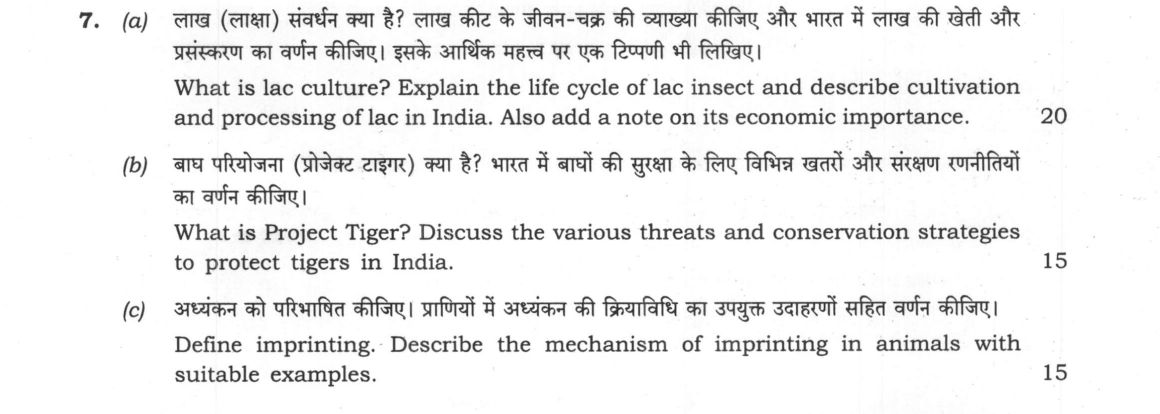
(a) What is lac culture? Explain the life cycle of lac insect and describe cultivation and processing of lac in India. Also add a…
What is lac culture? Explain the life cycle of lac insect and describe cultivation and processing of lac in India. Also add a note on its economic importance. 20 marks
What is Project Tiger? Discuss the various threats and conservation strategies to protect tigers in India. 15 marks
Define imprinting. Describe the mechanism of imprinting in animals with suitable examples. 15 marks
हिंदी में प्रश्न पढ़ें
लाख (लाक्षा) संवर्धन क्या है? लाख कीट के जीवन-चक्र की व्याख्या कीजिए और भारत में लाख की खेती और प्रसंस्करण का वर्णन कीजिए। इसके आर्थिक महत्व पर एक टिप्पणी भी लिखिए। (20 अंक)
बाघ परियोजना (प्रोजेक्ट टाइगर) क्या है? भारत में बाघों की सुरक्षा के लिए विभिन्न खतरों और संरक्षण रणनीतियों का वर्णन कीजिए। (15 अंक)
अध्यंकन को परिभाषित कीजिए। प्राणियों में अध्यंकन की क्रियाविधि का उपयुक्त उदाहरणों सहित वर्णन कीजिए। (15 अंक)
Model answer
Written by UPSC Answer Check against this question's marking rubric, to the expected length. UPSC does not publish answers for Mains — this is one way to score well, not an official key.
(a) Lac Culture
Lac culture is the scientific management and commercial exploitation of the lac insect, Kerria lacca (formerly Laccifer lacca), for the production of resin, dye, and wax.
The life cycle begins when fertilized females lay 200–500 eggs inside the lac cell. The eggs hatch into boat-shaped, red-coloured nymphs called crawlers. These nymphs emerge, walk along twigs, and settle in dense aggregations on tender shoots of host plants. Inserting their piercing-sucking mouthparts into the bark, they feed on phloem sap and secrete a semi-fluid resinous substance from dermal glands across their body. This resin hardens on contact with air, encasing each insect in an individual test or cell.
Following three nymphal instars, sexual dimorphism becomes pronounced. Male nymphs metamorphose into winged or wingless, mouthless adults that emerge from their cells, fertilize the sedentary females, and die soon after. The female nymph never develops wings or distinct body segmentation; after fertilization, she grows rapidly and secretes the bulk of commercial lac. She produces a large resinous chamber, lays eggs, and dies, leaving her body encrusted within the lac matrix.
Cultivation in India relies on specific deciduous host plants, predominantly Palas (Butea monosperma), Ber (Ziziphus mauritiana), and Kusum (Schleichera oleosa). Host trees are systematically pruned to induce succulent shoots. Inoculation is performed by tying mature, brood-lac-bearing twigs onto the fresh branches. After crawler emergence, used brood twigs are removed.
Harvested twigs coated with resin are known as sticklac. Processing begins with scraping the encrustations off the wood, followed by crushing and washing in vats to eliminate insect remains, body pigments, and debris. The dried, washed granular product is seedlac. Seedlac is winnowed to remove fine dust, loaded into long cotton bags, and melted over a charcoal furnace. The molten resin is squeezed through the cloth, mixed, and stretched into thin sheets that break into flakes known as shellac, or molded into button lac.
Economically, lac is a major non-timber forest product providing secondary livelihood and employment to forest-dwelling tribal communities across Jharkhand, Chhattisgarh, Madhya Pradesh, West Bengal, and Odisha. India is a leading global producer and exporter of refined lac. Shellac possesses superior dielectric, adhesive, and film-forming properties, making it indispensable in electrical insulation, varnishes, wood polishing, pharmaceuticals (enteric tablet coating), cosmetics, fruit glazing, and the munitions industry.
(b) Project Tiger
Project Tiger was launched on April 1, 1973, at Corbett National Park as a Centrally Sponsored Scheme to conserve viable populations of the Bengal tiger (Panthera tigris tigris) and its ecological habitats. Functioning on an umbrella species approach, protecting the apex predator ensures the integrity of entire trophic webs and ecosystem services. The management paradigm maintains breeding populations in high-density source habitats that naturally disperse into sink areas and adjoining corridors.
Tigers face severe anthropogenic threats, including habitat loss and fragmentation caused by linear infrastructure projects (highways, railway lines, canals), mining, and human settlements. These factors elevate human-wildlife conflict and retaliatory poisonings. Poaching driven by the illicit international trade in tiger body parts for Traditional Chinese Medicine (TCM) remains an acute pressure. Ecologically, tiger populations are threatened by prey base depletion due to poaching of ungulates, degradation of grasslands by invasive alien plants (such as Lantana camara), and climate change-induced disruptions in fragile ecosystems like the Sundarbans.
India’s conservation strategy is governed statutorily by the National Tiger Conservation Authority (NTCA) under the amended Wildlife (Protection) Act, 1972. Tiger reserves are structured on a core-buffer model, where the inviolate core is kept free of human disturbance through incentivized, voluntary village relocations, while buffer zones accommodate co-managed eco-development. Enforcement is strengthened via the Special Tiger Protection Force (STPF) and real-time electronic patrolling using M-STrIPES (Monitoring System for Tigers: Intensive Protection and Ecological Status). The tiger population has risen to 3,682 (2022 census). Regionally and internationally, transboundary landscape management and anti-poaching operations are coordinated through the Global Tiger Forum.
(c) Imprinting
Imprinting is a specialized, rapid, and developmentally programmed form of learning wherein an animal develops a specific attachment or behavioral response to an object or organism during a brief, genetically constrained "critical period" (or sensitive period) in early ontogeny. Unlike associative conditioning, it occurs without explicit physiological reinforcement and exhibits marked resistance to subsequent modification or forgetting.
Filial imprinting is observed primarily in precocial birds. Konrad Lorenz demonstrated this phenomenon in greylag geese (Anser anser): goslings exposed to Lorenz during a critical window (13–16 hours post-hatching) imprinted on him, following him persistently in preference to their biological mother.
Sexual imprinting operates during early life to direct adult mate choice toward conspecifics possessing traits similar to the rearing parent, as demonstrated in cross-fostered mallard ducks (Anas platyrhynchos).
Habitat (olfactory) imprinting occurs in aquatic species such as sockeye salmon (Oncorhynchus nerka), where juveniles imprint on the unique chemical bouquet of their natal stream, allowing accurate upstream homing years later for spawning.
Neurobiologically, filial imprinting triggers rapid synaptic plasticity and protein synthesis within designated avian telencephalic regions, predominantly the Intermediate Medial Mesopallium (IMHV) and the Lateral Paraolfactory Lobe (LPO).
Evolutionarily, imprinting is an adaptive mechanism ensuring immediate maternal protection, social cohesion, and the prevention of interspecific hybridization. In applied conservation and captive breeding programmes, understanding imprinting is vital; rearing endangered chicks (such as the California Condor or Whooping Crane) requires lifelike hand puppets and isolation from human caretakers to prevent maladaptive human-directed imprinting prior to wild reintroduction.
What "Describe" is asking you to do
Give a full, ordered account of the thing named — its parts, stages or mechanism — in the sequence in which it actually exists or occurs. Most describe questions come from the science optionals, where the marks sit in correct technical detail and, where the stem says so, a labelled diagram.
Structure that answers it
One-line identification of the subject → the parts or stages in their real order, each with its defining detail → labelled diagram where the subject is structural → closing line on function or significance
Where marks are lost
Loose general prose where the examiner is ticking named parts, correct terminology and their sequence; and in the General Studies papers, turning to evaluation before the description is finished.
How this answer will be evaluated
Approach
Framework: UPSC Zoology Paper 1. (a) explain: definition/context > points in order > small example > short close | (b) discuss: intro > 3-4 dimensions > example > balanced close | (c) define: precise definition > the distinguishing feature > one example Full marks: Precise definitions, detailed mechanisms, specific examples, and clear structure.
Key points expected
- Define lac culture and identify host trees (Shorea, Terminalia)
- Explain life cycle: egg, nymph, adult, and lac secretion
- Describe cultivation: stick preparation, inoculation, and harvesting
- Detail processing: boiling, filtering, and separation of shellac/lac dye
- Define Project Tiger and its objective (in-situ conservation)
- List threats: poaching, habitat loss, human-wildlife conflict
- Describe strategies: Tiger Reserves, corridors, anti-poaching squads
- Mention specific conservation tools: camera traps, GPS collaring
Evaluation rubric
Each sub-part is marked on its own, against the marks and word limit printed on the paper.
- (a) Define lac culture, detail life cycle, and describe Indian cultivation/processing with economic context. 20 marks
explain— definition/context → points in order → small example → short close
Must cover
- Define lac culture and identify host trees (Shorea, Terminalia)
- Explain life cycle: egg, nymph, adult, and lac secretion
- Describe cultivation: stick preparation, inoculation, and harvesting
- Detail processing: boiling, filtering, and separation of shellac/lac dye
Loses marks
- Confusing lac insect with honeybee or other resin producers
- Omitting the distinction between resin and dye in processing
- Vague description of life cycle without stages
Earns more
- Mention specific species: Kerria lacca or Tachardia lacca
- Distinguish between shellac (resin) and lac dye (colorant)
- Note on economic importance: export value and rural employment
- Mention specific Indian states: Jharkhand, West Bengal, Odisha
Extra mark
- Mention specific commercial varieties: Seedlac, Sticklac, Buttonlac
- Reference to specific processing units or government schemes
- (b) Define Project Tiger, analyze threats to tigers, and outline conservation strategies in India. 15 marks
discuss— intro → 3-4 dimensions → example → balanced close
Must cover
- Define Project Tiger and its objective (in-situ conservation)
- List threats: poaching, habitat loss, human-wildlife conflict
- Describe strategies: Tiger Reserves, corridors, anti-poaching squads
- Mention specific conservation tools: camera traps, GPS collaring
Loses marks
- Focusing only on threats without conservation strategies
- Confusing Project Tiger with Project Elephant or other initiatives
- Generic conservation advice not specific to tigers
Earns more
- Mention specific Tiger Reserves: Corbett, Ranthambore, Kanha
- Reference to National Tiger Conservation Authority (NTCA)
- Mention of 'One Nation One Tiger' or similar policy initiatives
- Discussion of community-based conservation (Village Tiger Guards)
Extra mark
- Citing specific tiger population statistics from recent census
- Mentioning specific legal acts: Wildlife Protection Act 1972
- (c) Define imprinting, explain the mechanism, and provide suitable animal examples. 15 marks
define— precise definition → the distinguishing feature → one example
Must cover
- Define imprinting: rapid, irreversible learning in critical period
- Explain mechanism: critical/sensitive period, visual/auditory cues
- Provide suitable example: Konrad Lorenz's geese experiment
- Distinguish from general learning or habituation
Loses marks
- Confusing imprinting with general conditioning or habituation
- Failing to mention the 'critical period' aspect
- Vague examples without specific animal taxa
Earns more
- Mention 'critical period' or 'sensitive period' specifically
- Reference to Konrad Lorenz or Nikolaas Tinbergen
- Example of filial imprinting in birds (ducks, geese)
- Mention of 'imprinting' in other contexts (e.g., sexual imprinting)
Extra mark
- Mentioning specific species: Greylag goose (Anser anser)
- Reference to specific experiments or studies
Practice this exact question
Write your answer and it is marked point by point against the model answer above — what you covered, what you missed, what you got wrong.
Evaluate my answer →More from Zoology 2023 Paper I
- Q4 (a) Draw a well-labelled diagram of adrenal gland and discuss the functions of its hormon…
- Q5 Write short notes on the following in about 150 words each: (a) Ecological niche (10 mark…
- Q6 (a) Define regression. Explain different methods and applications of regression analysis.…
- Q7 (a) What is lac culture? Explain the life cycle of lac insect and describe cultivation an…
- Q8 (a) What is ELISA? Explain the principle, types, procedure and applications of ELISA. (20…