Paper I — Q8
(a) What is ELISA? Explain the principle, types, procedure and applications of ELISA. (20 marks) (b) Describe the symptoms…
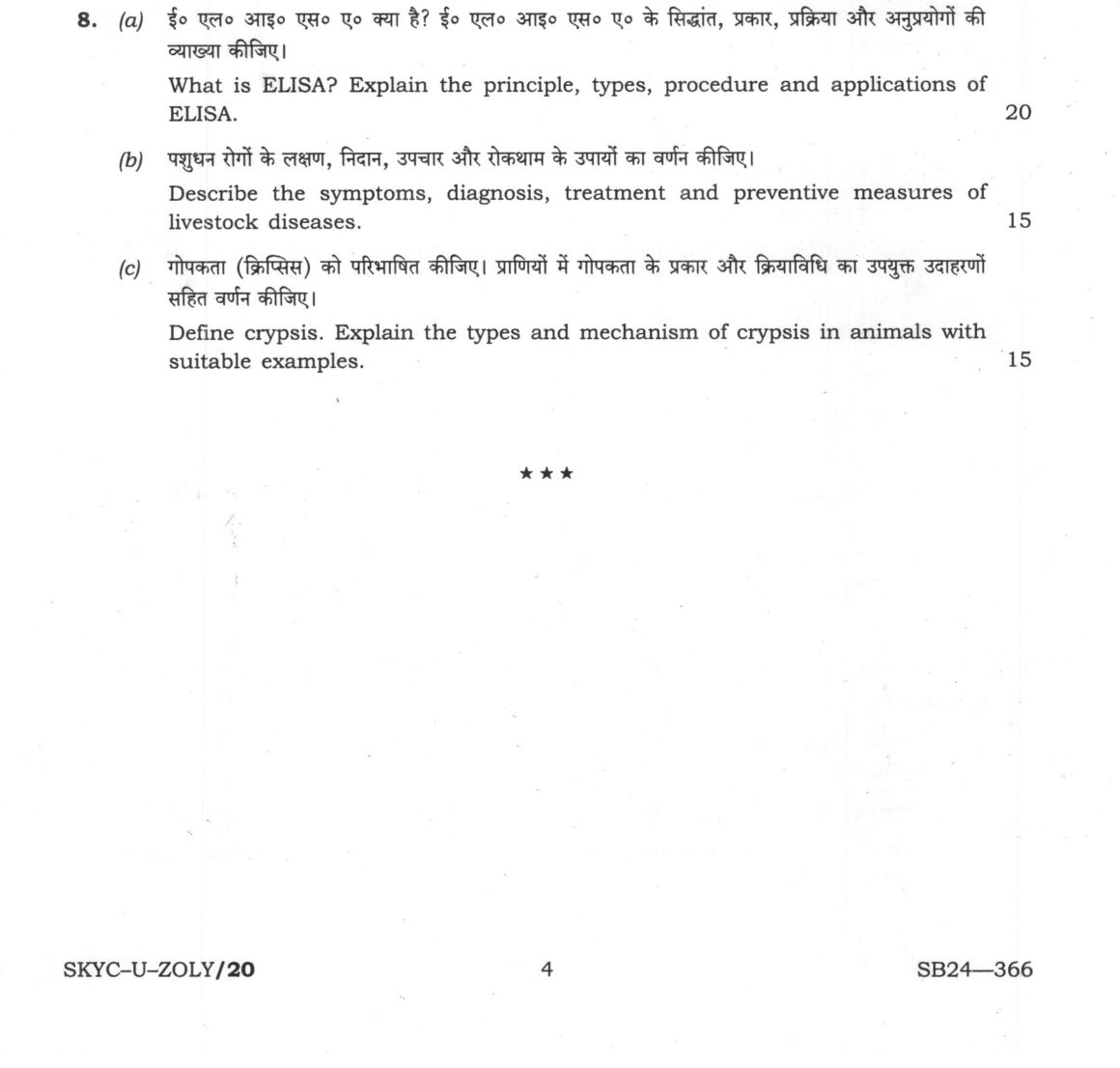
What is ELISA? Explain the principle, types, procedure and applications of ELISA. 20 marks
Describe the symptoms, diagnosis, treatment and preventive measures of livestock diseases. 15 marks
Define crypsis. Explain the types and mechanism of crypsis in animals with suitable examples. 15 marks
हिंदी में प्रश्न पढ़ें
ई० एल० आई० एस० ए० क्या है? ई० एल० आई० एस० ए० के सिद्धांत, प्रकार, प्रक्रिया और अनुप्रयोगों की व्याख्या कीजिए। (20 अंक)
पशुधन रोगों के लक्षण, निदान, उपचार और रोकथाम के उपायों का वर्णन कीजिए। (15 अंक)
गोपकता (क्रिप्सिस) को परिभाषित कीजिए। प्राणियों में गोपकता के प्रकार और क्रियाविधि का उपयुक्त उदाहरणों सहित वर्णन कीजिए। (15 अंक)
Model answer
Written by UPSC Answer Check against this question's marking rubric, to the expected length. UPSC does not publish answers for Mains — this is one way to score well, not an official key.
ELISA. ELISA is an enzyme-linked immunosorbent assay that detects antigen or antibody by immobilising one on a solid phase and using an enzyme-conjugated reagent to convert substrate into measurable colour. The principle is specific antigen–antibody binding: if target is present, enzyme is retained after washing and substrate produces a chromogenic signal proportional to analyte. In direct ELISA, antigen is coated and enzyme-labelled primary antibody detects it; it is simple but less sensitive. In indirect ELISA, antigen is coated, unlabelled primary antibody binds, then enzyme-labelled anti-immunoglobulin amplifies signal; it detects antibodies to pathogens. In sandwich ELISA, capture antibody coats the well, antigen is bound, then detection antibody and enzyme conjugate are added; it is highly specific for antigens with two epitopes. In competitive ELISA, limited labelled antigen competes with sample antigen for antibody, so colour inversely indicates concentration; it suits small molecules and hormones. Procedure: coat plate with antigen/antibody, block with BSA or casein, incubate sample, wash, add labelled reagent, wash, add substrate such as TMB, stop and read absorbance. Applications include HIV, hepatitis B/C, COVID-19 antibody/antigen testing, and veterinary serology for FMD and brucellosis.
Livestock diseases. FMD causes fever, vesicles on tongue, teats and interdigital skin, lameness and reduced milk yield in cattle, buffalo, sheep and goats; diagnosis combines clinical signs, RT-PCR, virus isolation and serology. Treatment is supportive, with antivirals only where available, analgesics, wound care and antibiotics for secondary infection; scheduled FMD vaccination, e.g. FMD-Raksha, under NADCP is central. Anthrax, caused by Bacillus anthracis, causes sudden death, bloating, dark blood from orifices and terminal haemorrhage; diagnosis uses post-mortem blood smear, PCR and culture, but carcasses must not be opened carelessly. Early cases receive antibiotics such as penicillin or tetracycline; prevention relies on live attenuated spore vaccines, e.g. Sterne strain, plus burial of carcasses and pasture management. Black quarter, a Clostridial myonecrosis, causes painful swelling, crepitus and rapid death in cattle; diagnosis is clinical plus post-mortem gas-filled muscle and culture. Treatment is penicillin, supportive care and surgical drainage where possible; prevention uses alum-precipitated toxoid vaccine and wound care. Mastitis in cattle and buffalo presents swollen, hot udder, clotted or watery milk, fever and reduced yield; diagnosis uses CMT, somatic cell count, culture and sensitivity. Treatment is intramammary/systemic antibiotics, anti-inflammatories and dry-cow therapy; prevention uses milking hygiene, footbaths, dry-cow protocols and herd health monitoring. Differential diagnosis therefore integrates clinical signs, laboratory tests and post-mortem findings. In India, NADCP covers FMD and brucellosis, while anthrax and black quarter are managed through state vaccination, IVRI support, quarantine, biosecurity and herd health programmes.
Crypsis. Crypsis is concealment that reduces detection by matching an animal’s appearance to its visual environment. It works because predators and prey detect objects by contrast: edges, colour, brightness and motion are processed against background noise, so lowering signal-to-noise ratio makes an animal harder to find. Background matching, as in leaf insects (Phyllium), uses shape, colour and texture to resemble leaves or twigs; masquerade mimics a harmless object, reducing recognition even when seen. Disruptive coloration breaks the body outline with stripes or blotches, as in tiger stripes in Ranthambore grasslands, where bands interrupt the silhouette against dappled vegetation. Countershading, darker above and lighter below, compensates for overhead light, making a body appear flatter, as in many fish. Chameleons alter skin pigment cells and posture to match substrates, though change is not instantaneous camouflage. These mechanisms are maintained by an evolutionary arms race: predators improve visual acuity, motion detection and pattern recognition, while prey refine concealment. Frequency-dependent selection maintains cryptic polymorphisms because rare morphs are less learned by predators, as in cryptic insects and moths. Thus crypsis is a sensory-ecological strategy shaped by detection thresholds, habitat structure and coevolution.
What "Explain" is asking you to do
Make the working of something clear — what sets it off, what follows from what, and what it produces. Explain is the Commission's mechanism word: it dominates the technical papers and the “explain why” stems, where the marks sit in the causal chain and not in the label.
Structure that answers it
State what it is → the initiating condition → the chain of cause, step by step → an instance where it plays out → what the chain produces
Where marks are lost
Describing what something looks like instead of why it works that way. Naming the stages without linking them reads as description too.
How this answer will be evaluated
Approach
Framework: UPSC Zoology Paper 1. (a) explain: definition/context > points in order > small example > short close | (b) describe: define > structure or process in order > labelled diagram > significance | (c) explain: definition/context > points in order > small example > short close Full marks: Comprehensive, accurate, with specific examples and clear mechanisms.
Key points expected
- Definition of Enzyme-Linked Immunosorbent Assay
- Principle: Antigen-antibody binding and enzyme-substrate reaction
- Types: Direct, Indirect, Sandwich, Competitive
- Stepwise procedure: Coating, blocking, incubation, detection
- Symptoms: Fever, anorexia, respiratory distress, skin lesions
- Diagnosis: Clinical signs, serology, PCR, necropsy
- Treatment: Antibiotics, antiparasitics, supportive care
- Prevention: Vaccination, quarantine, biosecurity, hygiene
Evaluation rubric
Each sub-part is marked on its own, against the marks and word limit printed on the paper.
- (a) Define ELISA and detail its principle, types, procedure, and applications. 20 marks
explain— definition/context → points in order → small example → short close
Must cover
- Definition of Enzyme-Linked Immunosorbent Assay
- Principle: Antigen-antibody binding and enzyme-substrate reaction
- Types: Direct, Indirect, Sandwich, Competitive
- Stepwise procedure: Coating, blocking, incubation, detection
Loses marks
- Confusing ELISA with RIA or Western Blot
- Omitting the 'Enzyme' component in the mechanism
- Listing types without explaining the difference
Earns more
- Labelled diagram of the assay plate
- Specific applications (e.g., HIV, pregnancy, food safety)
- Mention of HRP or Alkaline Phosphatase as enzymes
- Comparison of sensitivity/specificity with other methods
Extra mark
- Mention of specific commercial kits or protocols
- Reference to recent advancements (e.g., digital ELISA)
- (b) Outline symptoms, diagnosis, treatment, and prevention for livestock diseases. 15 marks
describe— define → structure or process in order → labelled diagram → significance
Must cover
- Symptoms: Fever, anorexia, respiratory distress, skin lesions
- Diagnosis: Clinical signs, serology, PCR, necropsy
- Treatment: Antibiotics, antiparasitics, supportive care
- Prevention: Vaccination, quarantine, biosecurity, hygiene
Loses marks
- Vague generalities without specific disease examples
- Confusing treatment with prevention
- Ignoring the diagnostic aspect
Earns more
- Specific examples (e.g., FMD, Brucellosis, Anthrax)
- Mention of zoonotic potential and public health link
- Role of veterinary surveillance and reporting
- Specific vaccine types (live vs. killed)
Extra mark
- Reference to specific national disease control programs
- Mention of One Health approach
- (c) Define crypsis and explain its types and mechanisms with examples. 15 marks
explain— definition/context → points in order → small example → short close
Must cover
- Definition: Concealment from predators/prey
- Types: Background matching, disruptive coloration, camouflage
- Mechanism: Pigmentation, structural color, behavioral adaptation
- Suitable examples: Stick insect, chameleon, cuttlefish
Loses marks
- Confusing crypsis with mimicry or aposematism
- Listing types without explaining the mechanism
- Lack of specific animal examples
Earns more
- Distinction between crypsis and mimicry
- Physiological basis (chromatophores, melanophores)
- Behavioral components (posture, movement)
- Evolutionary advantage and natural selection
Extra mark
- Mention of specific species (e.g., Anolis carolinensis)
- Reference to recent studies on dynamic camouflage
Practice this exact question
Write your answer and it is marked point by point against the model answer above — what you covered, what you missed, what you got wrong.
Evaluate my answer →More from Zoology 2023 Paper I
- Q5 Write short notes on the following in about 150 words each: (a) Ecological niche (10 mark…
- Q6 (a) Define regression. Explain different methods and applications of regression analysis.…
- Q7 (a) What is lac culture? Explain the life cycle of lac insect and describe cultivation an…
- Q8 (a) What is ELISA? Explain the principle, types, procedure and applications of ELISA. (20…